
Physician assistants evaluating an employment or independent contractor agreement in Oregon must consider the contract alongside requirements administered by the Oregon Medical Board and, when dispensing activities are involved, the Oregon Board of Pharmacy. Oregon law uses the term physician associate and requires an active Oregon Medical Board license and a written collaboration agreement signed by a physician, podiatric physician, or employer. The required collaboration structure, prescribing authority, dispensing responsibilities, credentialing process, and permitted practice locations can affect how an agreement defines clinical duties and compliance obligations. These issues may arise in healthcare markets such as Portland, Eugene, and Salem, particularly when a position covers multiple facilities or allows responsibilities to change. Contract review can identify whether the proposed terms align with the intended Oregon practice arrangement while clarifying compensation, malpractice coverage, repayment exposure, restrictive covenants, and termination rights.
A PA contract often incorporates compensation exhibits, benefit plans, policies, handbooks, or clinical protocols that are not summarized in the offer letter. Reviewing the complete set of documents can reveal discretionary bonus language, draw reconciliation, tail insurance obligations, schedule changes, and post-employment restrictions that may materially alter the value and risk of the position.
Agreement Structure and Contracting Parties
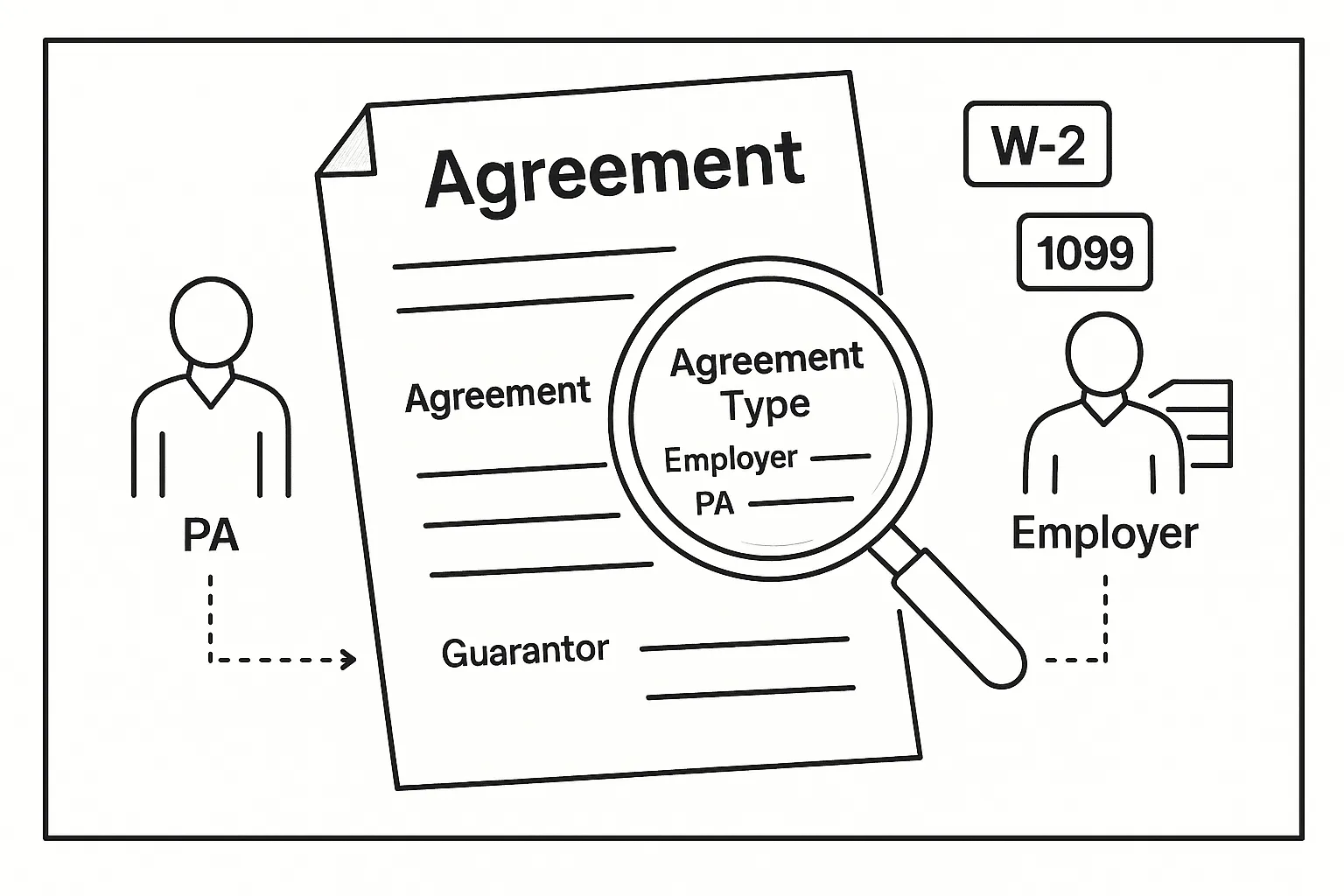
W-2 Employment and 1099 Contractor Status
The agreement’s title does not determine the actual working relationship. Review can evaluate whether the document describes W-2 employment or an independent contractor engagement and how the arrangement allocates taxes, benefits, insurance, business expenses, administrative duties, and control over the work. A contractor label may warrant closer examination when the organization retains substantial authority over schedules, locations, clinical operations, or required procedures.
An Oregon PA considering a nonemployee arrangement can use a focused physician assistant independent contractor agreement review to evaluate classification language, expense allocation, insurance duties, and termination provisions. The analysis can also compare the written terms with the practical structure described during recruitment.
Hiring Entities, Affiliates, and Incorporated Documents
The contract may involve a medical practice, hospital, staffing company, professional medical entity, management organization, or affiliated health system. Identifying the party responsible for salary, benefits, malpractice coverage, credentialing, and post-employment obligations is particularly important when multiple entities appear in the documents. Definitions such as Employee, Provider, Contractor, Practice, and Company can determine which provisions apply and which organizations may attempt to enforce them.
Policies, handbooks, bonus plans, compensation exhibits, clinical protocols, and addenda may be incorporated by reference. Those materials can contain productivity formulas, disciplinary standards, repayment obligations, or employer amendment rights that materially change the arrangement. Review can flag missing documents and conflicts between the agreement, offer letter, and incorporated policies.
Compensation, Benefits, and Repayment Exposure

Salary, Productivity, Collections, and Bonuses
Compensation analysis extends beyond the stated salary or hourly rate. It can determine how pay frequency, guaranteed compensation, productivity thresholds, reconciliation periods, and employer discretion affect expected earnings. When compensation depends on work relative value units, the document may need to define the conversion factor, threshold, measurement period, credited services, reporting process, and treatment of work performed across multiple locations.
Collections-based arrangements require similarly precise definitions. Review can identify whether the applicable percentage is calculated from gross charges, net collections, or another amount and how payer adjustments, refunds, chargebacks, patient balances, and delayed receipts are handled. Quality, productivity, and event-based bonuses are easier to evaluate when the agreement provides objective criteria, accessible data, calculation methods, and payment deadlines. Chelle Law’s PA compensation and productivity review examines these provisions together rather than treating the base rate as the entire deal.
Benefits, Draws, and Clawback Terms
Benefits may include health coverage, retirement contributions, disability insurance, paid leave, continuing medical education funds, professional dues, and reimbursement for licensing or prescribing-related expenses. The contract and applicable plan documents can be compared to determine eligibility dates, employer contribution levels, amendment rights, and whether benefits continue during a notice period or leave of absence.
Signing bonuses, relocation assistance, student loan payments, compensation advances, and draws may create repayment obligations. Analysis can calculate whether repayment is prorated, identify the events that trigger a clawback, and determine whether the debt survives termination without cause. Negative accrual language also warrants attention because a production shortfall may carry forward, accelerate at departure, or include interest and collection expenses. Additional guidance on physician assistant bonus repayment terms can help frame these financial issues.
Oregon Collaboration, Scope, and Credentialing Requirements
Written Collaboration Agreement and Clinical Scope
Oregon requires a physician associate to practice under a written collaboration agreement signed by a physician, podiatric physician, or employer. The collaboration agreement must identify the PA, license number, primary practice location, and collaboration process. A specified collaboration plan is required for a PA with fewer than 2,000 post-graduate clinical hours. The agreement must be maintained at the primary practice location and produced to the Oregon Medical Board upon request.
The employment contract and collaboration agreement serve different functions, but inconsistent terms can create practical risk. Review can compare the proposed clinical duties, reporting structure, primary location, collaboration process, and employer amendment rights. Oregon permits a physician associate to provide medical services within the PA’s scope of practice, including prescribing and administering Schedule II through V controlled substances, subject to applicable legal requirements. Contract language that is broader than the intended role or that permits unilateral scope changes may affect workload, professional judgment, compensation, and licensing exposure.
Prescribing, Dispensing, Credentialing, and Worksites
Prescribing and dispensing provisions may allocate responsibility for registrations, renewals, compliance procedures, and related costs. Oregon allows a physician associate to prescribe Schedule II through V controlled substances and to register with the Oregon Medical Board for dispensing authority. A dispensing facility may separately require registration with the Oregon Board of Pharmacy. Contract review can determine whether the role actually involves dispensing and whether the agreement clearly allocates facility-level and individual responsibilities.
Credentialing and privileging clauses can affect the start date and early compensation. The contract may address who initiates the process, who pays expenses, whether compensation begins before approval, and what happens if credentialing is delayed or denied. For multi-site positions, analysis can identify permitted locations, travel expectations, mileage or expense reimbursement, scheduling consequences, and whether a location change affects productivity targets. These concerns are especially relevant when the employer retains broad authority to add facilities after signing.
Malpractice Insurance and Post-Employment Coverage
Occurrence and Claims-Made Policies
Malpractice provisions can be evaluated for the policy type, insurer, coverage limits, named insureds, exclusions, and defense or indemnity protections. Occurrence coverage generally responds to covered professional acts occurring during the policy period regardless of when the claim is asserted. Claims-made coverage generally depends on the policy being active when the claim is made, subject to the policy’s terms, which can create a need for post-employment coverage.
A benefits summary stating that malpractice insurance is provided may not answer whether the PA is individually covered, whether defense costs reduce policy limits, or whether coverage applies at every assigned location. Review can compare the contract with available insurance documentation and identify provisions that shift uninsured or excluded liabilities to the PA.
Tail Insurance and Prior-Acts Coverage
When the employer uses a claims-made policy, the agreement may allocate responsibility for an extended reporting endorsement, commonly called tail insurance, or for replacement coverage with an appropriate prior-acts date. The cost allocation may depend on whether the PA resigns, is terminated for cause, completes a service period, or moves to another qualifying policy. Some contracts also require reimbursement of employer-paid premiums after an early departure.
Because financial exposure varies by policy, specialty, and coverage history, the actual language matters more than a general promise of malpractice benefits. The physician assistant tail insurance resource explains common coverage concepts that can be considered during review.
Oregon Noncompete Rules and Practice-Entity Control
Restrictions on Medical-Licensee Noncompetition Agreements
Oregon treats a physician associate as a medical licensee for its profession-specific noncompetition provisions. Noncompetition agreements restricting the practice of medicine are generally void when imposed by a person, management services organization, hospital, or hospital-affiliated clinic. Statutory exceptions may apply to qualifying ownership arrangements, professional medical entities, recruitment investment, shortage-area practice, or nonclinical work. These provisions apply to covered agreements entered before, on, or after June 9, 2025.
The medical-licensee rules materially qualify Oregon’s general employment noncompetition framework, so a clause should not be assessed solely under the general 12-month limitation or compensation and notice requirements. Review can identify the entity imposing the restriction, the activity being restricted, and whether a statutory exception may be implicated. It can also distinguish a noncompete from confidentiality, patient nonsolicitation, employee nonsolicitation, and repayment provisions, which may raise separate issues. A focused Oregon PA noncompete review can clarify the practical reach of the contract language without assuming every post-employment restriction receives identical treatment.
Nonsolicitation, Professional Judgment, and Management Structures
Nonsolicitation clauses may address patients, referral sources, employees, contractors, or business relationships. Oregon treats customer and employee nonsolicitation provisions separately from general employment noncompetition agreements. Analysis can identify the protected relationships, restricted conduct, duration, geographic implications, and whether ordinary professional communication could be characterized as solicitation.
Oregon also regulates professional medical entities and management-services organizations. Subject to statutory exemptions and delayed application provisions, a management-services organization generally may not own or control a majority of a professional medical entity, and professional-entity arrangements may not interfere with a licensee’s professional judgment. A professional corporation may employ a physician associate, but nonlicensees may not direct or control professional judgment within the PA’s licensed scope. Contract terms concerning clinical protocols, discipline, productivity, referrals, or management authority can be reviewed with those distinctions in mind.
Scheduling, Call, Billing, and Performance Standards
Schedule Control and Call Coverage
Operational terms can materially affect workload and compensation even when the salary appears straightforward. The agreement may define full-time status, shift duration, weekend and holiday coverage, administrative time, call frequency, response expectations, and the organization’s authority to change schedules. Review can distinguish nonbinding expectations from enforceable requirements that may support discipline, reduced compensation, or termination.
Call provisions are clearer when they address frequency, coverage area, response time, backup support, compensation, and whether call duties count toward productivity targets or scheduled hours. Broad language requiring call “as needed” may leave the workload uncertain. The same concern applies when a multi-site assignment permits the employer to change the primary location without defining travel time or reimbursement.
Billing, Documentation, and Performance Metrics
Billing and documentation clauses can allocate significant compliance responsibility to the PA. Analysis can clarify who controls coding and billing, how audit adjustments or payer recoupments affect compensation, and whether the PA remains responsible for records after departure. The contract may also address chart-completion deadlines, electronic medical record access, quality measures, patient satisfaction scores, and productivity reporting.
Performance standards based on subjective conduct, undefined benchmarks, or policies that the employer can change unilaterally may create uncertainty. Review can determine whether the PA receives the relevant metrics, an opportunity to respond to alleged deficiencies, and a cure period before discipline or termination when appropriate under the contract.
Termination Rights and Pre-Signing Review
Notice, Cause, Cure, and Final Compensation
Termination provisions determine how either party may end the relationship and what financial consequences follow. Review can distinguish without-cause termination, termination for cause, immediate termination events, and breaches that allow an opportunity to cure. The notice period may affect continued scheduling, compensation, benefits, credentialing, and the timing of a new position.
The classification of a departure may also control bonus eligibility, tail insurance, restrictive covenants, and repayment obligations. Final compensation language can be evaluated for accrued leave, unpaid productivity compensation, delayed collections, completed shifts, and bonuses earned before termination. PAs considering departure can obtain a physician assistant contract termination review before relying on a verbal explanation or giving notice.
Documents and Red Flags to Review Before Signing
A complete review ordinarily includes the proposed agreement, offer letter, compensation exhibits, bonus plans, benefit summaries, applicable policies, and any available collaboration or clinical-duty documents. Material terms to confirm include:
- The correct contracting entity, employment classification, defined terms, and incorporated documents.
- Written salary, productivity, collections, bonus, draw, and reconciliation formulas.
- Repayment triggers for signing bonuses, relocation funds, advances, or other benefits.
- The malpractice policy type, coverage limits, exclusions, and responsibility for tail coverage.
- Clinical duties, collaboration terms, prescribing or dispensing responsibilities, and permitted Oregon worksites.
- Schedule, call, travel, billing, documentation, and performance requirements.
- Termination notice, cure rights, final compensation, and surviving repayment obligations.
- Noncompetition, nonsolicitation, confidentiality, and other post-employment restrictions.
Common warning signs include undefined productivity metrics, unilateral compensation changes, broad repayment language, claims-made coverage without clear tail responsibility, unrestricted location changes, and inconsistent collaboration or clinical-duty provisions. A physician assistant employment agreement checklist can help organize the documents and questions, but it does not replace analysis of the actual Oregon agreement and practice arrangement.
Speak With an Oregon Physician Assistant Contract Lawyer Before You Sign
Chelle Law can review your proposed agreement, explain its practical consequences, identify financial and professional risks, and flag provisions that may warrant clarification or revision.
Request a Contract Review