
Physician assistants considering an employment or independent contractor agreement in Oregon must evaluate the contract alongside practice requirements administered by the Oregon Medical Board. Oregon rules affecting collaboration, delegation, prescribing, and other aspects of PA practice can shape how an employer defines clinical duties, oversight, credentialing, and compliance obligations. Those concerns may differ among healthcare systems and practices in Portland, Eugene, and Salem, particularly when an agreement permits multiple work locations or changes to assigned responsibilities. Chelle Law reviews Oregon PA contracts to clarify how state-specific practice expectations interact with compensation formulas, malpractice coverage, restrictive covenants, termination rights, and repayment provisions. A detailed review can identify employer-favorable language, explain the practical consequences of incorporated policies and exhibits, and help a PA understand the financial, professional, and licensing risks before signing.
Agreement Type, Contracting Parties, and Incorporated Documents
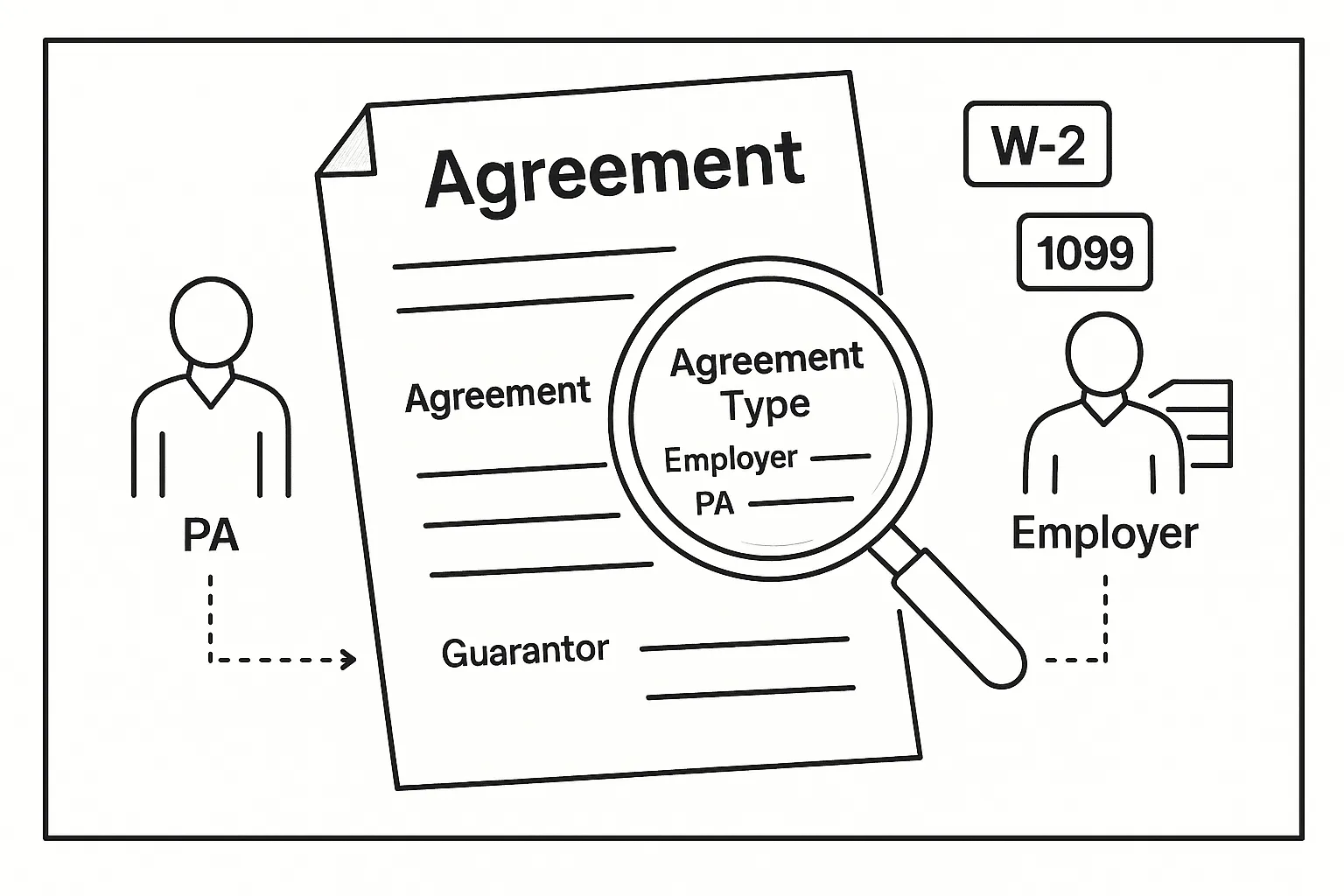
Not every document titled an “agreement” creates the same legal relationship. The first task is to determine whether the arrangement is W-2 employment or a 1099 engagement. That distinction affects taxes, benefits, workers’ compensation, control over the work, and potential classification concerns. PAs considering contractor status should also understand how independent contractor agreement terms allocate expenses, insurance obligations, and administrative responsibilities.
The agreement should clearly identify the hiring entity, the individual PA, and any guarantor, affiliate, staffing company, management organization, or parent health system that may later assert rights involving compensation or restrictive covenants. Layered arrangements can make it harder to determine which entity is responsible for pay, benefits, malpractice coverage, and tail insurance.
We also verify the defined term used for the PA—such as Employee, Provider, or Contractor—and whether the contract incorporates policies, handbooks, addenda, or compensation exhibits. Those documents frequently contain productivity formulas, bonus metrics, disciplinary standards, and repayment obligations that materially change the deal. Oregon PAs can also consult the Oregon Society of Physician Associates for professional information concerning evolving practice and regulatory issues.
Compensation, Productivity Bonuses, and Financial Obligations

Compensation provisions are often the most consequential and complex part of a PA agreement. A thorough PA compensation and productivity review should examine not only the stated salary or rate but also the formulas, measurement periods, employer discretion, and reconciliation terms that determine what the PA will actually earn.
Salary, RVU, Collections, and Bonus Terms
- Base salary guarantee: Confirm the amount, pay frequency, and whether base pay may be reduced because of collections shortfalls or productivity reconciliations. A contract may label part of the compensation as an advance or draw that becomes a debt if production does not meet the stated target.
- Productivity and RVU models: If compensation depends on work relative value units, the agreement should state the conversion factor, measurement period, threshold, and activities that receive credit. For example, a rate of $45 per wRVU applied to 4,000 annual wRVUs equals $180,000 before guarantees or adjustments. The review should determine whether the formula deducts expenses, treats indirect RVUs differently, or caps credit for certain services.
- Collections-based compensation: The contract should identify whether the percentage applies to gross charges, net collections after payer adjustments, or another defined amount. It should also explain payment delays, patient balances, chargebacks, and payer recoupments.
- Bonus structures: Quality, production, and event-based bonuses require objective triggers, measurable standards, and clear payment dates. Broad discretionary language can make an expected bonus difficult to enforce.
- Negative accrual and reconciliation: Draw provisions may require repayment when production falls short during a measurement period. The agreement should state whether a deficit carries forward, accelerates at termination, or includes interest and collection costs.
Benefits, Paid Leave, and Repayment Exposure
Benefits can offset a lower base salary, but the contract or incorporated plan documents should identify health coverage, retirement contributions, disability insurance, paid time off, CME allowances, and licensing or DEA reimbursements. Signing bonuses, relocation payments, and student loan assistance require particular attention to vesting schedules, tax treatment, prorated repayment, and the events that trigger a clawback. Vague benefit descriptions or repayment provisions create financial uncertainty, especially when obligations survive termination.
Malpractice Insurance and Tail Coverage
Malpractice provisions should identify the policy type, insurer, coverage limits, named insureds, and responsibility for post-employment coverage. Occurrence policies generally cover professional acts occurring during the policy period regardless of when a claim is filed. Claims-made policies generally require the policy to remain active when the claim is made, which may create a need for tail coverage after the employment relationship ends.
The contract should state whether the employer’s policy covers the PA, whether the PA receives defense and indemnity protection, and who pays for an extended reporting endorsement or prior-acts coverage. Employer-favorable agreements may shift the full tail cost to the departing PA or require reimbursement of employer-paid premiums following an early departure. Because the financial exposure varies by policy and specialty, PAs should review the agreement’s malpractice insurance requirements rather than relying on a general benefits summary.
Oregon Scope of Practice, Credentialing, and Work Locations
Contract language can expand or restrict clinical duties and define the operational structure under which a PA practices. The agreement should accurately address collaboration, delegation, prescribing responsibilities, required registrations, protocols, and employer compliance expectations without imposing vague or conflicting duties. Overly broad language may expose a PA to discipline, reduce clinical autonomy, or permit the employer to change responsibilities without a corresponding compensation adjustment.
Credentialing and privileging provisions should explain who starts the process, who pays related expenses, and whether compensation begins before or after approval. The contract should also address delays, loss of privileges, and the consequences of failing to receive approval by a stated date. If the employer may assign the PA to multiple facilities, the agreement should define the permitted locations, travel obligations, scheduling impact, and whether a location change affects productivity expectations or reimbursement.
Non-Competes, Repayment Terms, and Contract Termination
Restrictive covenants can materially affect a PA’s ability to continue practicing after leaving an employer. Oregon has statutory limits affecting non-compete agreements in many employment settings, but the practical effect of a clause still depends on its language, duration, geographic reach, restricted activities, and the circumstances surrounding the agreement. A focused non-compete review can identify whether a restriction extends beyond the PA’s actual practice location, specialty, or patient relationships. Non-solicitation and confidentiality provisions should also be examined because they may independently restrict contact with patients, referral sources, or staff.
Termination rights determine how and when either party may end the relationship. The contract should distinguish without-cause termination, termination for cause, immediate termination events, and any opportunity to cure an alleged breach. Notice periods affect income and the timing of a new position, while termination classifications may control bonus eligibility, tail responsibility, restrictive covenants, and repayment obligations. PAs should understand the full process for ending a physician assistant contract before giving notice or relying on an employer’s verbal explanation.
Signing bonuses, relocation assistance, CME payments, and other advances may be subject to repayment after resignation or termination. The agreement should define whether repayment is prorated, whether termination without cause excuses the debt, and whether interest or collection expenses may be added. Final compensation provisions should also establish when the PA receives accrued leave, unpaid productivity bonuses, and collections-based compensation earned before departure.
Scheduling, Call Coverage, Billing, and Performance Standards
Operational terms can have a significant effect on workload, compliance exposure, and compensation. Contracts commonly address full-time status, shift lengths, weekend responsibilities, call coverage, administrative time, productivity targets, and the employer’s authority to change schedules or locations. The review should determine whether “expected” metrics are merely goals or enforceable standards that may support discipline, reduced compensation, or termination.
Billing and documentation clauses can shift substantial compliance responsibility to the PA. The agreement should clarify who controls coding and billing, how chargebacks or audit adjustments are allocated, and whether the PA remains responsible for records after employment ends. EMR access, chart-completion deadlines, performance monitoring, and subjective conduct standards should be specific enough for the PA to understand the expected performance and the consequences of an alleged deficiency.
Attorney Review and a Pre-Signing Checklist for Oregon PAs
Attorney review is particularly important when an agreement materially affects compensation, liability, licensing obligations, or future mobility. Chelle Law’s review process includes secure document submission, attorney analysis, a consultation explaining the practical risks, and written comments or proposed revisions when appropriate. The goal is to clarify the contract’s financial and professional consequences before the PA becomes bound by its terms.
Contract Red Flags Requiring Closer Review
- Broad draw, negative accrual, or repayment obligations that survive termination
- Claims-made malpractice coverage without clear responsibility for tail insurance
- Productivity or bonus terms controlled by undefined metrics or employer discretion
- Restrictive covenants with vague activities, lengthy durations, or broad geographic limits
- Clinical duty, collaboration, delegation, or prescribing language that does not clearly reflect the intended Oregon practice arrangement
- An independent contractor label that does not match the employer’s stated control over day-to-day work
Documents and Terms to Confirm Before Signing
- Confirm the contracting entity, employment classification, and all incorporated policies or exhibits.
- Obtain written compensation formulas, thresholds, bonus metrics, and reconciliation procedures.
- Verify the malpractice policy type, coverage limits, and responsibility for tail coverage.
- Calculate potential exposure from signing bonuses, relocation payments, draws, and other repayment provisions.
- Compare the clinical duties and practice structure with the intended Oregon role.
- Confirm termination notice, final compensation, post-employment restrictions, and the treatment of unpaid bonuses.
A broader physician assistant employment agreement checklist can help organize the documents and questions needed for review. It does not replace legal analysis of the actual agreement, incorporated policies, and Oregon-specific practice arrangement.
Have an Oregon PA Contract Reviewed Before You Sign
Chelle Law can review the compensation, malpractice, practice obligations, termination terms, repayment provisions, and post-employment restrictions in your proposed agreement.
Contact Chelle Law