
Rhode Island physician assistants evaluating employment contracts or independent contractor agreements must consider the licensing and practice framework administered by the Rhode Island Department of Health, Division of Professional Regulation and the Rhode Island Board of Licensure of Physician Assistants. Rhode Island requires PAs to be licensed and permits them to provide medical and surgical services within their education, training, and competence while collaborating with physicians. A physician must remain accessible for consultation, while the degree of collaboration may depend on the practice, employer, group, and applicable credentialing systems. In Providence, Warwick, and other Rhode Island healthcare markets, these requirements can affect how an agreement describes clinical duties, prescribing authority, site coverage, credentialing, schedules, and available physician support. Contract review can determine whether the written terms reflect the proposed role and identify provisions that may create regulatory, financial, or career risk.
Compensation formulas, malpractice coverage, restrictive covenants, termination rights, and repayment obligations also require close analysis. A favorable salary can be offset by uncertain productivity calculations, extensive call, tail insurance costs, or a signing-bonus clawback. Chelle Law provides attorney-led contract review that identifies these issues, explains how the provisions work together, and helps physician assistants understand terms that may warrant clarification or revision before signing.
Why Review a Rhode Island PA Contract Before Signing?

The Offer Letter May Not Contain the Entire Deal
An offer letter may summarize salary, benefits, start date, and schedule without addressing the detailed conditions found in the employment agreement, compensation plan, handbook, or incorporated policies. Review of the complete document package can identify inconsistencies involving bonus eligibility, work locations, call expectations, termination notice, or repayment obligations.
Verbal statements about patient volume, scheduling, remote work, partnership opportunities, or future compensation may not be enforceable when the agreement contains an integration clause. Providing all exhibits, policies, job descriptions, and written offer materials allows the reviewer to compare the documents and flag unresolved differences.
Small Drafting Choices Can Shift Significant Risk
Employment agreements allocate financial and professional risk between the PA and the employer. An undefined productivity formula may reduce realized compensation, a malpractice clause may place tail costs on the PA, and an expansive work-location provision may permit assignments far beyond the expected site. An attorney-led physician assistant contract review evaluates these provisions together rather than treating salary as the only measure of the offer.
Rhode Island Scope of Practice and Credentialing Terms
Collaboration, Consultation, and Clinical Duties
Rhode Island PAs practice in collaboration with physicians and may perform medical and surgical services within their education, training, and competence. A physician must be accessible for consultation at all times, although the degree of collaboration may be determined by the practice, employer, group, and relevant credentialing systems. Contract analysis can determine whether the stated duties, consultation structure, and available physician support are consistent with the role described during recruitment.
Broad language allowing unilateral changes to duties, specialties, or clinical settings deserves attention. If responsibilities may expand, the agreement can be evaluated for how additional services, training, support, schedules, locations, and compensation will be documented.
Prescribing Authority and Medical Orders
Rhode Island permits physician assistants to prescribe legend medications, including Schedule II through V controlled substances, as well as medical therapies, devices, and diagnostics, subject to state law, collaboration, employer or facility guidelines, and credentialing. Controlled-substance prescribing also requires applicable Rhode Island and federal registrations. Review can clarify whether the employer or PA bears responsibility for registration costs, renewals, credentialing tasks, and delays outside the PA’s control.
Facility Privileges, Locations, and Credentialing Delays
Rhode Island hospitals and licensed healthcare facilities may grant or deny PA privileges and define permitted services and inpatient medical orders through their bylaws and credentialing processes. The employment agreement may address whether the start date depends on licensure, payer enrollment, hospital privileges, or other employer-controlled approvals. Analysis can identify whether a delay permits termination, postpones compensation, or triggers repayment despite the PA’s timely cooperation.
Multi-site and telehealth provisions also merit review. The document may need to clarify approved locations, travel expectations, expense reimbursement, licensure responsibilities, scheduling control, and whether future assignments require written agreement.
Compensation, Benefits, and Workload
Base Salary and Productivity Formulas
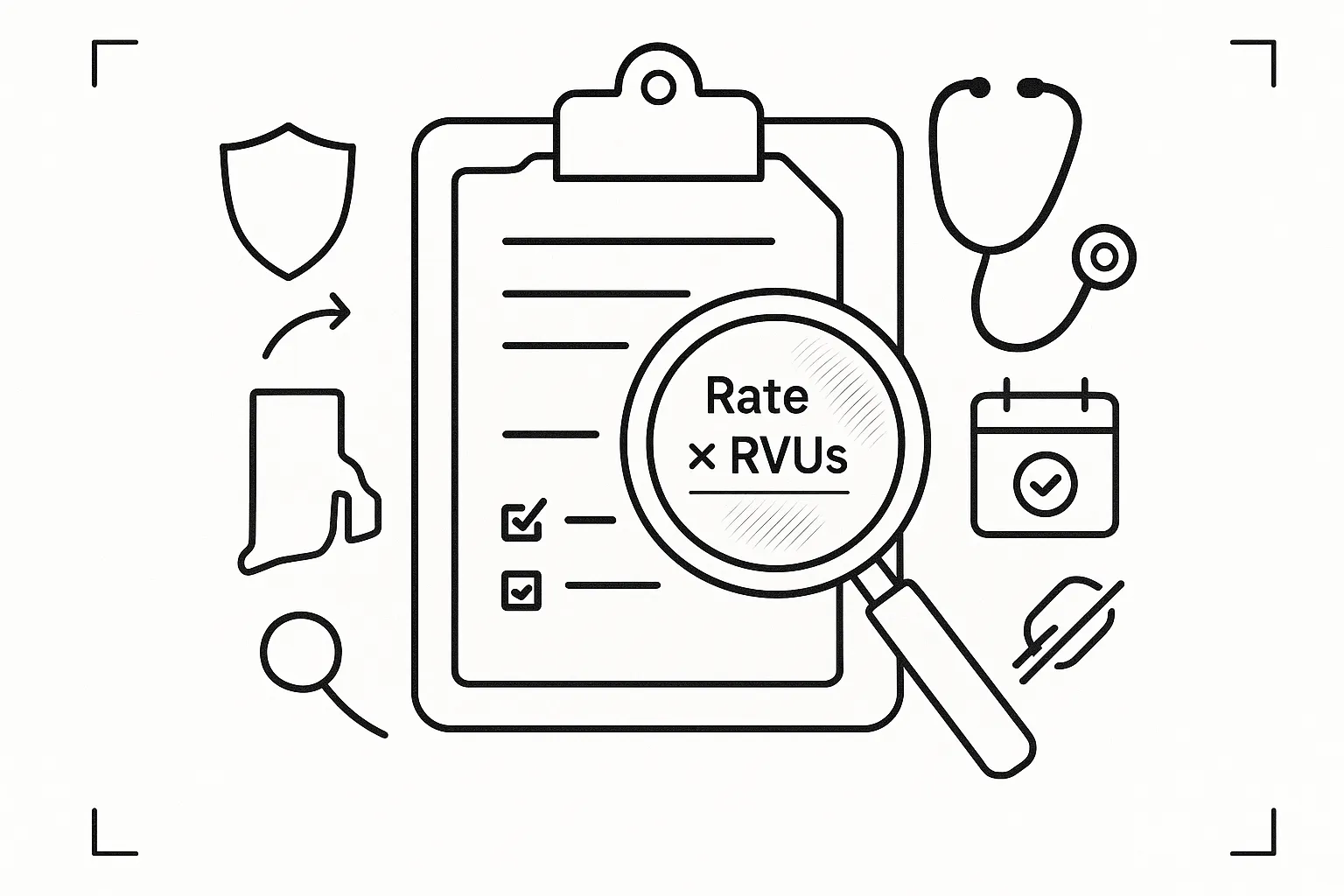
PA compensation may consist of guaranteed salary, base pay plus productivity, collections-based compensation, RVU compensation, or quality and panel-based bonuses. Each model creates different payment timing and financial risk. A compensation and productivity review can examine thresholds, conversion factors, reconciliation periods, payment dates, credited services, reporting access, and the treatment of refunds or adjustments.
- A salary guarantee provides predictability, but it may be paired with demanding productivity or patient-volume expectations.
- A collections formula ties pay to money received by the employer rather than billed charges, potentially exposing the PA to payer delays, denials, and collection practices.
- An RVU formula may depend on the conversion factor, threshold, credited services, reporting methodology, and timing of reconciliation.
- Draw and negative-accrual language may create future offsets or repayment exposure when production falls below an advance.
Benefits and Incentive Eligibility
Benefit provisions may address health insurance contributions, retirement matching and vesting, paid leave, continuing medical education, professional dues, licensing expenses, and reimbursement for required registrations. Waiting periods and eligibility conditions can materially affect the value of the package, particularly when the PA must remain employed through a specific payment or vesting date.
Signing bonuses, relocation assistance, student-loan support, and retention incentives often include separate repayment terms. Review can identify whether repayment is prorated, which termination events trigger it, whether repayment is accelerated, and whether the employer claims a right to deduct the amount from final compensation.
Scheduling, Call, and Multi-Site Coverage
Workload language may define regular hours, weekend coverage, call frequency, response times, patient volume, administrative duties, and assignments at additional locations. Vague descriptions can create scheduling and compensation disputes, especially when productivity assumptions rely on a particular clinical schedule or level of support.
Review of PA call and coverage requirements can determine whether call is included in salary, separately compensated, subject to unilateral change, or shared according to an undefined rotation. Related provisions may also address travel time, remote coverage, backup support, and post-call scheduling.
Malpractice Insurance and Liability Allocation
Claims-Made Coverage, Occurrence Coverage, and Tail
Medical malpractice and negligent or incompetent practice may result in professional discipline in Rhode Island, and malpractice claims and adverse dispositions are reported to and maintained by the Board. No profession-specific Rhode Island rule identified in the research requires an employer to provide malpractice insurance or tail coverage, making the contract language particularly important.
The agreement may specify claims-made or occurrence coverage, policy limits, carrier requirements, and responsibility for post-termination protection. Claims-made coverage generally requires continuing coverage or a tail policy for later claims arising from services performed during the policy period. A review of tail insurance terms for physician assistants can identify who pays, which termination events change that obligation, and whether prior-acts coverage may satisfy it.
Indemnification and Cooperation Duties
Indemnification language may create obligations beyond ordinary malpractice exposure. Analysis can identify whether the PA must reimburse the employer for claims, regulatory matters, billing disputes, or losses caused by other parties. Cooperation clauses, consent-to-settle language, and responsibility for legal expenses must be considered alongside the insurance provision because coverage may not extend to every contractual obligation.
Restrictive Covenants, Termination, and Repayment Risk
Rhode Island Non-Compete and Non-Solicitation Provisions
No physician-assistant-specific Rhode Island statute expressly invalidating PA employment non-competes was identified. Rhode Island’s general Noncompetition Agreement Act makes non-competes unenforceable against certain categories, including nonexempt employees, interns or short-term student employees, employees age eighteen or younger, and low-wage employees. Whether those protections apply depends on the worker’s status and the agreement’s facts.
The Act excludes independent contractors from its definition of employee and does not treat confidentiality, trade-secret, or certain customer, client, and vendor non-solicitation provisions as statutory non-competes. A physician assistant non-compete review can evaluate classification, duration, geographic scope, restricted activities, protected relationships, triggering events, and practical effects on future employment without assuming every restrictive clause is governed by the same rule.
Notice, Immediate Termination, and Clawbacks
Termination provisions establish without-cause notice periods, for-cause standards, cure rights, immediate termination events, and any severance obligations. Review can determine whether the notice period is mutual, whether the employer can remove the PA from the schedule without pay, and how termination affects accrued leave, unpaid productivity compensation, benefits, and malpractice coverage.
Repayment provisions may apply to signing bonuses, relocation expenses, training costs, continuing education, or credentialing expenses. The interaction between termination and clawback language can be especially important when repayment applies even after an employer-initiated termination. A detailed PA contract termination review can flag acceleration, setoff, forfeiture, and final-reconciliation terms.
Contract Priorities by Career Stage and Practice Setting
New graduates often encounter training periods, probationary terms, competency standards, delayed benefit eligibility, and signing-bonus obligations. Review can assess whether early performance expectations are measurable, whether support and physician access are described, and whether credentialing delays or an early departure could trigger forfeiture or repayment. Chelle Law’s new graduate PA contract review service focuses on the risks that commonly arise at the start of practice.
Experienced PAs may place greater emphasis on specialty duties, compensation formulas, leadership responsibilities, established referral relationships, and career mobility. Hospital and procedure-based roles may also involve privileges, payer enrollment, call, billing rules, and allocation of RVUs for procedures. Independent contractor agreements require separate attention to classification, taxes, expenses, insurance, scheduling control, payment timing, and termination because Rhode Island’s Noncompetition Agreement Act expressly excludes independent contractors from its employee definition.
What Contract Counsel Reviews in a Rhode Island PA Agreement
An attorney-led review translates contract language into practical financial, regulatory, and professional consequences. The analysis may cover compensation calculations, repayment exposure, malpractice and tail obligations, restrictive covenants, termination standards, workload expectations, credentialing conditions, and whether the stated practice structure aligns with Rhode Island’s collaboration and scope framework. Common warning signs include undefined productivity terms, unilateral reconciliation rights, vague for-cause standards, broad indemnification, employer-favorable clawbacks, and unclear independent contractor responsibilities.
For a complete review, provide the agreement and all referenced exhibits, compensation plans, policies, offer materials, and job descriptions. Proposed schedules, productivity examples, and written summaries of recruitment statements may help clarify how the arrangement is expected to work. Preparing questions about patient volume, call, locations, payment timing, credentialing, and physician availability allows the consultation to focus on provisions most likely to affect the signing decision.
Request a Rhode Island Physician Assistant Contract Review
Chelle Law can review your proposed agreement, identify compensation, malpractice, restrictive covenant, termination, repayment, and regulatory concerns, and explain provisions that may warrant clarification or revision.
Contact Chelle Law Before You SignExplore Physician Assistant Contract Guidance
Review Chelle Law’s physician assistant services, educational resources, and state-specific contract guidance.