
Rhode Island physician assistants evaluating an employment contract or independent contractor agreement must consider how the document fits the licensing, supervision, collaboration, delegation, and prescribing requirements overseen by the Rhode Island Board of Medical Licensure and Discipline. In Providence, Warwick, and other healthcare markets across the state, an employer’s expectations for scope of practice, site coverage, scheduling, and supervisory support can directly affect whether the written terms match the role being offered. Chelle Law reviews Rhode Island PA agreements to connect those state-specific practice requirements with compensation, productivity formulas, malpractice coverage, restrictive covenants, termination rights, and repayment obligations. A careful review can identify unclear or employer-favorable language before signing and help the PA understand the financial, regulatory, and career consequences of the proposed relationship.
Why Rhode Island PAs Should Review a Contract Before Signing

Employment agreements are legal and financial instruments that allocate risk and reward between a PA and an employer. Salary, benefits, and call expectations may appear routine, but small drafting choices can have significant consequences. An ambiguous productivity formula can reduce realized pay, a malpractice provision can shift post-termination tail costs to the PA, and a broadly worded restrictive covenant can limit where the clinician may work next.
Our physician assistant contract review focuses on how each provision affects cash flow, regulatory compliance, professional responsibilities, and career mobility. We identify contractual mechanics that create measurable exposure and explain their practical implications so new graduates and experienced clinicians can understand the trade-offs before committing. Rhode Island PAs may also find advocacy and regulatory information through the Rhode Island Society of Physician Assistants.
Compensation, Benefits, and Workload Terms
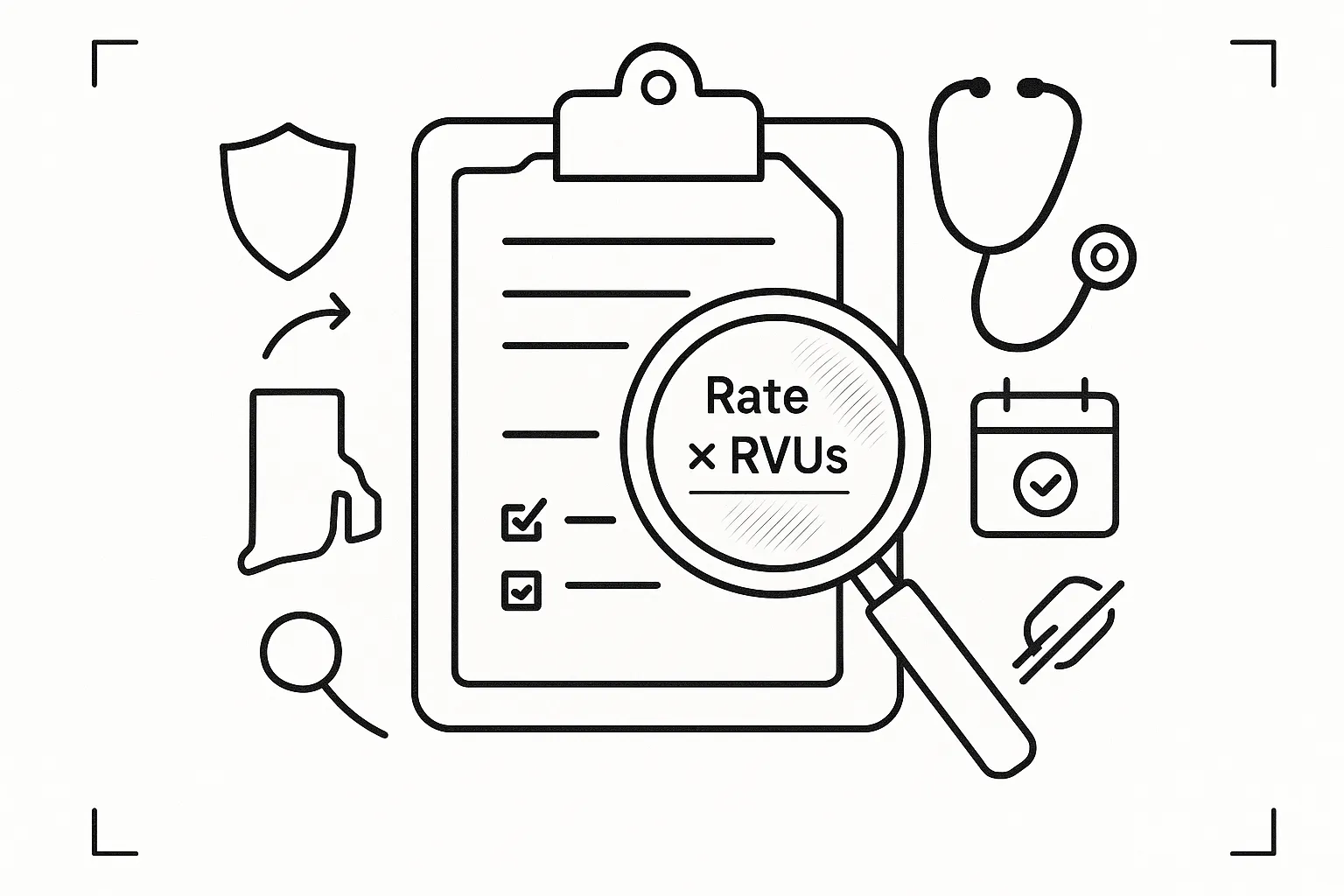
Salary and Productivity Formulas
PA compensation may include a guaranteed base salary, base pay plus productivity, collections-based compensation, relative value unit formulas, or quality and panel-based bonuses. Each model creates different payment timing and risk. A detailed compensation and productivity review should examine the formula, reconciliation periods, thresholds, payment dates, and the employer’s definition of billable or credited activity.
- Base salary guarantees offer predictability but may be paired with demanding productivity expectations.
- Collections models tie compensation to cash received by the employer rather than billed charges, exposing the PA to payer delays, denials, and collection practices.
- RVU formulas should define the conversion factor, credited services, thresholds, reporting rights, and treatment of adjustments. For example, a formula of $45 per RVU applied to 5,000 RVUs produces $225,000 before any contractual thresholds or offsets.
- Draws and negative accrual provisions may create repayment obligations when production falls below an advance or guarantee.
Benefits, Scheduling, and Call Coverage
Benefit language should identify employer contributions to health insurance, retirement matching and vesting rules, paid leave, continuing medical education allowances, and reimbursement for licensing or professional expenses. Eligibility delays, probationary periods, and requirements to remain employed through a payment date can materially change the value of the package.
The agreement should also clearly address expected hours, call frequency, mandatory overtime, multi-site assignments, patient volume, and coverage obligations. Vague workload descriptions create compensation and scheduling risk, especially when productivity assumptions depend on a particular patient volume or clinical schedule.
Malpractice Insurance and Liability Allocation
Malpractice provisions should state whether the employer provides claims-made or occurrence coverage, the applicable limits, and who is responsible for post-termination protection. Claims-made coverage generally requires an active policy or tail coverage when a later claim arises from services performed during the employment period. Because tail obligations can create a substantial expense, the agreement should explain whether the employer or PA pays under different termination scenarios.
A review of PA malpractice insurance terms should also address indemnification, reimbursement duties, cooperation with claims, and any language that shifts liability beyond the PA’s own conduct. These clauses must be read together rather than evaluated in isolation.
Rhode Island Scope of Practice and Regulatory Terms
The Rhode Island Board of Medical Licensure and Discipline oversees the state licensing framework applicable to physician assistants. A contract should accurately describe the PA’s clinical duties, supervision or collaboration structure, delegation expectations, prescribing responsibilities, and required documentation. Language that conflicts with governing requirements or the employer’s actual policies can create uncertainty about who is responsible for maintaining compliant practice arrangements.
Telehealth responsibilities, clinical locations, credentialing, and hospital privileges also deserve attention. The agreement should not leave the PA responsible for services, sites, or performance standards that depend on employer-controlled credentialing or supervisory support. If duties may expand, the contract should clarify how new responsibilities, locations, schedules, and compensation will be documented.
Restrictive Covenants, Termination, and Repayment Risk
Non-Compete and Non-Solicitation Restrictions
Restrictive covenants can affect a PA’s ability to accept another position, maintain patient or referral relationships, or continue working within a preferred community. A non-compete review should examine duration, geographic reach, restricted activities, protected relationships, triggering events, and available exceptions. Enforceability depends on the governing law and specific facts, but an overbroad clause can create practical barriers even before a court considers it.
Notice, Final Compensation, and Clawbacks
Termination provisions establish notice periods, without-cause rights, for-cause standards, immediate termination events, and any severance obligations. They should also explain what happens to accrued leave, unpaid bonuses, productivity compensation, credentialing expenses, and malpractice coverage. Our contract termination review evaluates whether the employer can withhold compensation, accelerate repayment, or change the final reconciliation after the relationship ends.
Signing bonuses, relocation assistance, continuing education funds, and other incentives may carry repayment obligations if the PA resigns or employment ends before a stated date. The agreement should specify whether repayment is prorated, which termination events trigger it, and whether the employer may deduct the amount from final compensation.
Contract Priorities by Career Stage and Practice Setting
New graduates commonly encounter training periods, probationary language, competency standards, student loan support, and signing bonus obligations. A new graduate PA contract review can identify whether early performance expectations are defined, whether benefits begin immediately, and whether an early departure could trigger repayment or forfeiture.
Experienced PAs may place greater emphasis on compensation formulas, mobility, specialty duties, and protection of established professional relationships. Hospital and procedure-based positions may also involve privileging, credentialing, billing rules, call coverage, and RVU treatment for procedures. Independent contractor arrangements require separate attention to payment timing, expenses, insurance, tax responsibility, scheduling control, and termination rights because the written allocation of responsibilities may differ substantially from a traditional employment agreement.
What an Attorney Reviews in a Rhode Island PA Agreement
An attorney-led review translates legal language into financial, regulatory, and professional consequences. We examine compensation calculations, repayment exposure, malpractice and tail obligations, restrictive covenant mechanics, termination standards, workload expectations, and whether the stated practice structure aligns with Rhode Island requirements. Common warning signs include undefined productivity terms, unilateral reconciliation rights, vague for-cause standards, broad indemnification, employer-favorable clawbacks, and unclear independent contractor responsibilities.
For the review, provide the complete agreement and all referenced exhibits, policies, offer materials, and job descriptions. Production reports, proposed schedules, and written summaries of verbal promises may also help clarify how the arrangement is expected to work. Preparing questions about anticipated volume, call, work locations, compensation timing, and supervisory support allows the consultation to focus on the provisions most likely to affect the decision.
Review Your Rhode Island PA Contract Before Signing
Chelle Law can identify compensation, malpractice, restrictive covenant, termination, repayment, and regulatory concerns in your proposed physician assistant agreement.
Contact Chelle LawExplore Physician Assistant Contract Guidance
Review Chelle Law’s services, educational resources, and state-specific contract guidance for physician assistants.