
Physician assistant contracts in South Carolina must account for both employment terms and the clinical practice requirements administered by the South Carolina Board of Medical Examiners, with advisory functions performed by the Physician Assistant Committee of the South Carolina Board of Medical Examiners. A PA must practice with an approved supervising physician and under written scope-of-practice guidelines signed by the PA and supervising physicians. Those guidelines may affect delegated duties, prescribing authority, practice locations, telehealth services, and the supervision structure described in an employment or independent contractor agreement. In healthcare markets such as Charleston and Columbia, offers may also involve hospital credentialing, multiple worksites, call obligations, productivity compensation, or specialty-specific duties. Contract review can determine whether the proposed role, written scope, supervisory responsibilities, and business terms fit together without creating avoidable compliance, compensation, or professional-liability concerns.
The financial value of an offer depends on more than its stated salary. Productivity formulas, malpractice coverage, tail obligations, bonus repayment, restrictive covenants, termination rights, and credentialing contingencies can materially change the arrangement. Chelle Law reviews these provisions together, explains how they interact, identifies contract language that may warrant clarification or revision, and helps physician assistants make informed decisions before signing.
South Carolina PA Practice Requirements and Contract Terms
Supervision, Written Scope of Practice, and Agency
South Carolina requires a physician assistant to practice with an approved supervising physician and under written scope-of-practice guidelines signed by the PA and supervising physicians. Supervision is continuous, although it generally does not require the physician’s physical presence. An employment agreement does not replace those required guidelines, so the documents should be reviewed together for inconsistent descriptions of duties, authority, oversight, and reporting relationships.
A South Carolina PA is also an agent of the supervising physician for practice-related activities, including ordering diagnostic, therapeutic, and other medical services. Contract analysis can identify whether the agreement clearly assigns supervisory responsibilities, permits unilateral expansion of clinical duties, or expects the PA to perform services beyond the approved written scope. Vague language is particularly important when the employer may change specialties, locations, schedules, or supervising physicians during the contract term.
Prescribing, Practice Locations, Telehealth, and Credentialing
Only permanently licensed South Carolina PAs may prescribe drug therapy, and prescribing authority must be authorized by the supervising physician and documented in the written scope-of-practice guidelines. The contract’s description of prescribing duties should therefore be compared with the anticipated authorization, specialty, and applicable state and federal requirements. A broad promise to perform all assigned duties may create concern if the agreement does not recognize limits imposed by licensure, supervision, credentialing, or written scope.
PAs may practice at public or private locations and may perform hospital duties, house calls, telemedicine, and telehealth services when permitted by their scope-of-practice guidelines and supervision arrangement. Additional off-site requirements apply to PAs with less than two years of continuous practice or those changing specialties. Multi-site and remote-care provisions deserve careful review because they may affect travel, scheduling, support, call coverage, malpractice exposure, and compensation.
Credentialing language should identify prerequisites to the start date, responsibility for submitting information, and the consequences of delayed or denied privileges or payer enrollment. Review of PA credentialing delay risks can reveal whether salary and benefits begin as expected, whether either party may terminate, and whether a signing or relocation payment becomes repayable before clinical work starts.
Employee and Independent Contractor Agreements
W-2 and 1099 Classification Issues
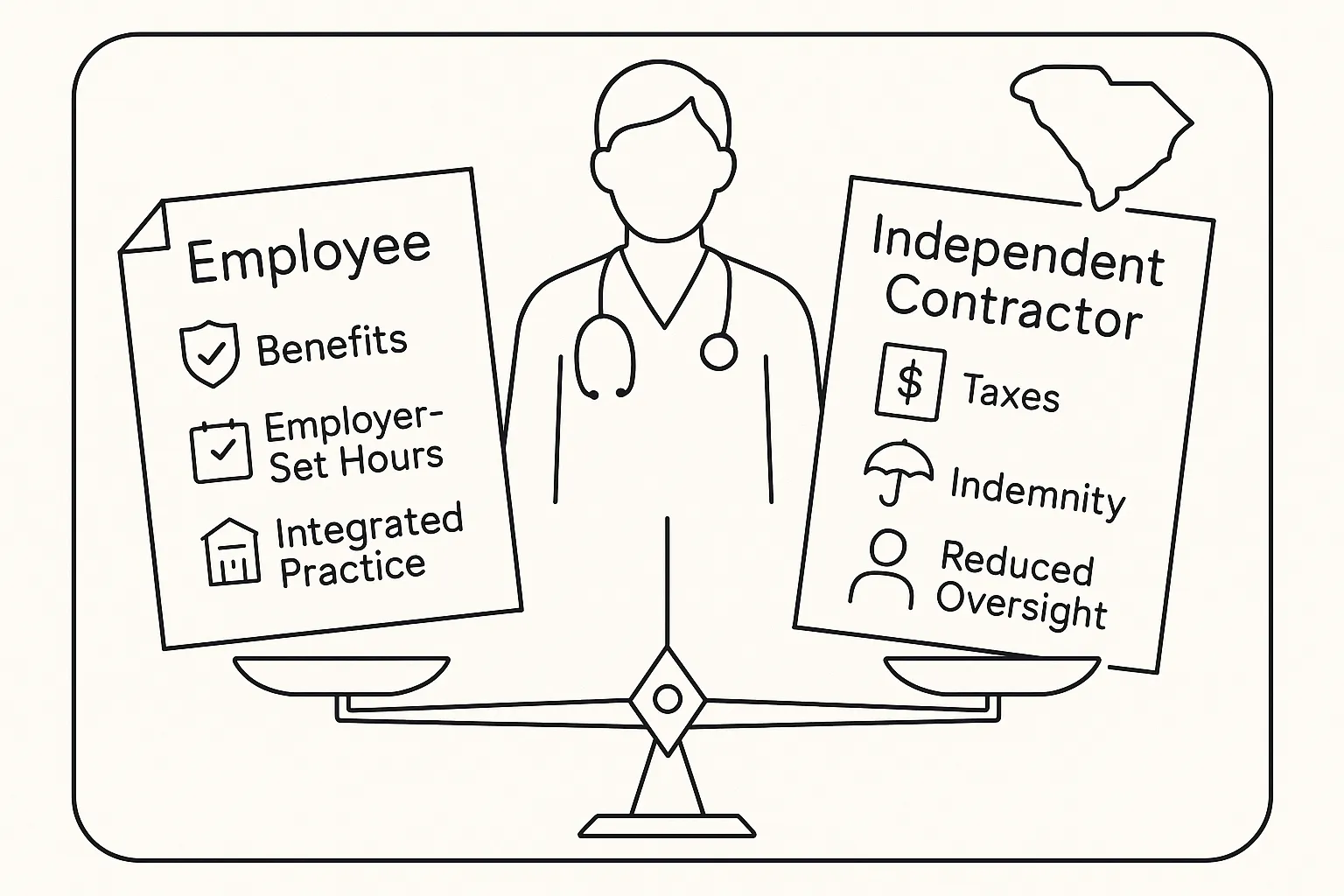
Worker classification affects tax treatment, benefits, scheduling control, insurance, and responsibility for business expenses. Calling a PA an independent contractor does not, by itself, resolve the classification question; the practical relationship may also matter. Relevant contract terms include control over work hours and methods, integration into the practice, supervision, exclusivity, equipment, billing, expense reimbursement, and the ability to provide services elsewhere.
Independent contractor agreements often shift taxes, professional expenses, malpractice coverage, and indemnification obligations to the PA. Employee agreements are more likely to include health insurance, retirement contributions, paid leave, and employer-paid payroll taxes, but may impose greater scheduling control or post-employment restrictions. A comparison of W-2 and 1099 arrangements for physician assistants can help assess the offer’s actual economic value rather than relying on the stated compensation rate alone.
Review can also flag broad indemnities, uncompensated administrative duties, unreimbursed travel, insurance requirements, or extensive employer control within a purported contractor relationship. These provisions should be evaluated together because a higher 1099 rate may not offset taxes, lost benefits, coverage costs, and other expenses assigned to the PA.
Compensation, Productivity, and Benefits

Base Salary, Collections, RVUs, and Bonuses
A predictable base salary may coexist with minimum productivity requirements, a recoverable draw, or a reconciliation formula. Review can determine whether missed targets create negative accrual, reduce future compensation, or permit the employer to recover previously paid amounts. Pay frequency, partial-period calculations, deductions, data access, reconciliation timing, and compensation due after termination also affect the reliability of the stated rate.
- Collections-based compensation: Payment is based on money received rather than amounts billed. If the formula pays 30% of collections and the practice collects $70,000 on $100,000 billed, compensation is calculated from the $70,000 collected. Payer mix, billing delays, refunds, chargebacks, and allocation methods can therefore affect earnings.
- RVU compensation: A formula may combine guaranteed pay with work RVUs multiplied by a conversion factor. At $40 per wRVU, 800 wRVUs would produce a $32,000 productivity amount. The agreement may need to define the RVU schedule, modifiers, conversion rate, threshold, measurement period, attribution method, and reconciliation process.
- Quality or performance bonuses: Payment may depend on patient satisfaction, panel management, documentation, clinical protocols, or other metrics. The practical value depends on objective standards, access to performance data, payment dates, employer discretion, audit rights, and forfeiture triggers.
A focused physician assistant compensation and productivity review can identify ambiguous formulas, unattainable thresholds, negative accrual, and provisions allowing the employer to change a compensation plan during the contract term.
Benefits, Signing Bonuses, and Relocation Assistance
Health coverage, retirement contributions, paid leave, continuing education, licensing expenses, professional dues, and reimbursement policies form part of the overall compensation package. The agreement or incorporated policies may determine when benefits begin, whether unused leave is paid at departure, and whether the employer can modify benefits without amending the contract. Call pay, weekend coverage, administrative work, and travel between locations should also be examined for separate compensation or inclusion in the base rate.
Signing bonuses, relocation payments, loan assistance, and training funds frequently include repayment conditions. Analysis of sign-on bonus repayment terms can clarify whether repayment is triggered by resignation, termination for cause, termination without cause, credentialing failure, or an employer-initiated change in duties. Prorated repayment generally presents a different financial risk from an all-or-nothing obligation that remains in effect until the final day of a commitment period.
Malpractice Insurance, Tail Coverage, and Indemnification
Policy Type, Limits, and Post-Termination Coverage
No profession-specific South Carolina rule identified in the state research requires an employer to provide a PA’s malpractice insurance or tail coverage. The contract must therefore be examined for the actual allocation of coverage obligations. Important terms include the carrier, policy limits, whether coverage is individual or shared, covered services and locations, consent-to-settle provisions, exclusions, and the treatment of claims arising after employment ends.
Claims-made policies generally respond when a claim is reported while coverage remains active, while occurrence policies generally cover incidents occurring during the policy period even if the claim is reported later. A claim made after departure may require extended reporting, commonly called tail coverage, unless another form of continuing protection applies. Review of tail insurance for physician assistants can identify who purchases it, required limits and duration, applicable deadlines, and whether responsibility changes based on the reason for termination.
Indemnification and Defense Obligations
Indemnification language may require one party to defend or reimburse the other for specified claims, losses, or expenses. A provision extending beyond the PA’s own acts or omissions may create exposure not covered by professional liability insurance. Review can determine whether the obligation is limited by fault, insurance coverage, policy limits, or the employer’s own conduct.
The agreement may also address who selects counsel, controls the defense, approves a settlement, pays legal costs, and reports a claim to the carrier. Survival language matters because indemnity, cooperation, record access, and malpractice-reporting duties may continue after the employment relationship ends.
South Carolina Non-Competes and Post-Employment Restrictions
Enforceability and Drafting Under South Carolina Law
South Carolina generally evaluates a non-compete based on whether it protects a legitimate employer interest, is reasonably limited in time and place, is not unduly harsh, is reasonable as a matter of public policy, and is supported by valuable consideration. The practical impact depends on the restricted services, duration, geographic area, covered employer locations, and termination events that activate the covenant. Even before enforceability is decided, broad language may affect a PA’s ability to remain in Charleston, Columbia, Greenville, or another preferred market.
South Carolina courts generally do not rewrite or blue-pencil an overbroad restriction to make it reasonable. A covenant without an adequate geographic limitation may be vulnerable, and a court may decline to insert or materially revise missing terms. A restrictive covenant added later during an existing at-will relationship also requires valuable consideration; continued employment alone may be insufficient when the PA’s duties and position remain unchanged.
Non-Solicitation, Confidentiality, and Other Restrictions
Post-employment provisions may extend beyond a conventional non-compete. Patient, referral-source, and employee non-solicitation clauses can limit communications or relationships, while confidentiality provisions may govern records, business information, compensation data, and proprietary materials. The agreement may also contain liquidated damages, injunctive-relief provisions, or fee-shifting terms that increase the consequences of an alleged violation.
A physician assistant non-compete review can compare the restricted territory and services with the PA’s actual worksite, specialty, patient contact, and future career plans. It can also flag language that may interfere with lawful reporting, professional obligations, general clinical knowledge, or employment that does not compete with the former employer.
Termination, Repayment, and Dispute Provisions
For-Cause and Without-Cause Termination
Termination provisions control how quickly salary and benefits can end and whether the PA has time to transition to another position. The agreement may distinguish for-cause termination from termination without cause, define events constituting cause, and provide notice or an opportunity to cure certain defaults. Immediate termination triggers often address serious matters such as loss of licensure or fraud, while broad discretionary standards can create greater income-interruption risk.
Notice periods should be read together with scheduling requirements, employer authority to remove the PA from duty, accrued leave, final productivity compensation, malpractice coverage, and restrictive covenants. A PA contract termination review can identify whether compensation continues if the employer waives active work during notice and whether failure to complete the period may trigger damages, repayment, or a claim of breach.
Repayment, Arbitration, Venue, and Governing Law
Repayment and forfeiture provisions may apply to signing bonuses, relocation assistance, loan payments, training expenses, continuing education, or incentive compensation. The triggering event, repayment amount, proration schedule, payment deadline, interest, and offset rights determine the practical exposure. Review can also identify whether repayment applies when the employer terminates without cause, materially changes the position, or cannot complete credentialing.
Arbitration, governing-law, venue, attorney-fee, and dispute-notice provisions determine where and how a disagreement may proceed. These clauses warrant review alongside repayment and restrictive covenants because mandatory arbitration, fee shifting, or a distant forum can increase the cost of addressing a dispute. Contract analysis can explain the procedure and identify terms that may warrant clarification before acceptance.
South Carolina Physician Assistant Contract Review Checklist
A focused review connects the legal, clinical, and financial provisions rather than evaluating each clause in isolation. Before signing, consider whether the agreement clearly addresses:
- The approved supervising physician, supervisory responsibilities, written scope-of-practice guidelines, delegated duties, and the PA’s agency relationship.
- Prescribing authority, practice locations, off-site work, telehealth, specialty changes, credentialing, and payer enrollment.
- Whether W-2 or 1099 classification is consistent with the allocation of control, taxes, benefits, insurance, and business expenses.
- How salary, collections, RVUs, bonuses, call pay, reconciliation, negative accrual, deductions, and post-termination compensation are calculated.
- Whether signing, relocation, loan, or training payments are repayable and which termination or credentialing events trigger the obligation.
- Who provides malpractice insurance, pays for tail coverage, controls the defense of claims, and bears indemnification obligations.
- How non-compete, non-solicitation, confidentiality, notice, cure, arbitration, venue, and governing-law clauses affect future options.
Attorney-led review is particularly useful when an offer includes productivity pay, substantial incentives, ambiguous malpractice language, a 1099 classification, multiple worksites, restrictive covenants, or repayment obligations. Chelle Law’s physician assistant contract review service is designed to explain the agreement, identify material risks, and provide practical written comments or proposed revisions when appropriate.
Speak With a Physician Assistant Contract Lawyer Before You Sign
Chelle Law can review your proposed South Carolina PA agreement, identify compensation and liability risks, explain restrictive and termination provisions, and flag language that may warrant clarification or revision.
Request a Contract ReviewExplore Physician Assistant Contract Guidance
Review attorney-led services, practical contract resources, and state-specific guidance for physician assistants.