
Physician assistant contracts in South Carolina must account for employment terms and the practice requirements overseen by the South Carolina Board of Medical Examiners. Scope of practice, supervision, delegation, prescribing authority, and related compliance obligations can affect how a PA’s duties are defined and whether the employer’s expectations align with the permitted clinical arrangement. Those concerns may differ across hospital systems, specialty practices, and other employers in healthcare markets such as Charleston and Columbia. A South Carolina PA contract review should therefore examine more than salary: it should connect the proposed clinical role to supervision language, credentialing conditions, malpractice coverage, productivity formulas, restrictive covenants, and termination rights. Chelle Law reviews these provisions together so physician assistants can understand how the agreement may affect compensation, professional liability, regulatory compliance, and career mobility before signing.
Employee and Independent Contractor Classification
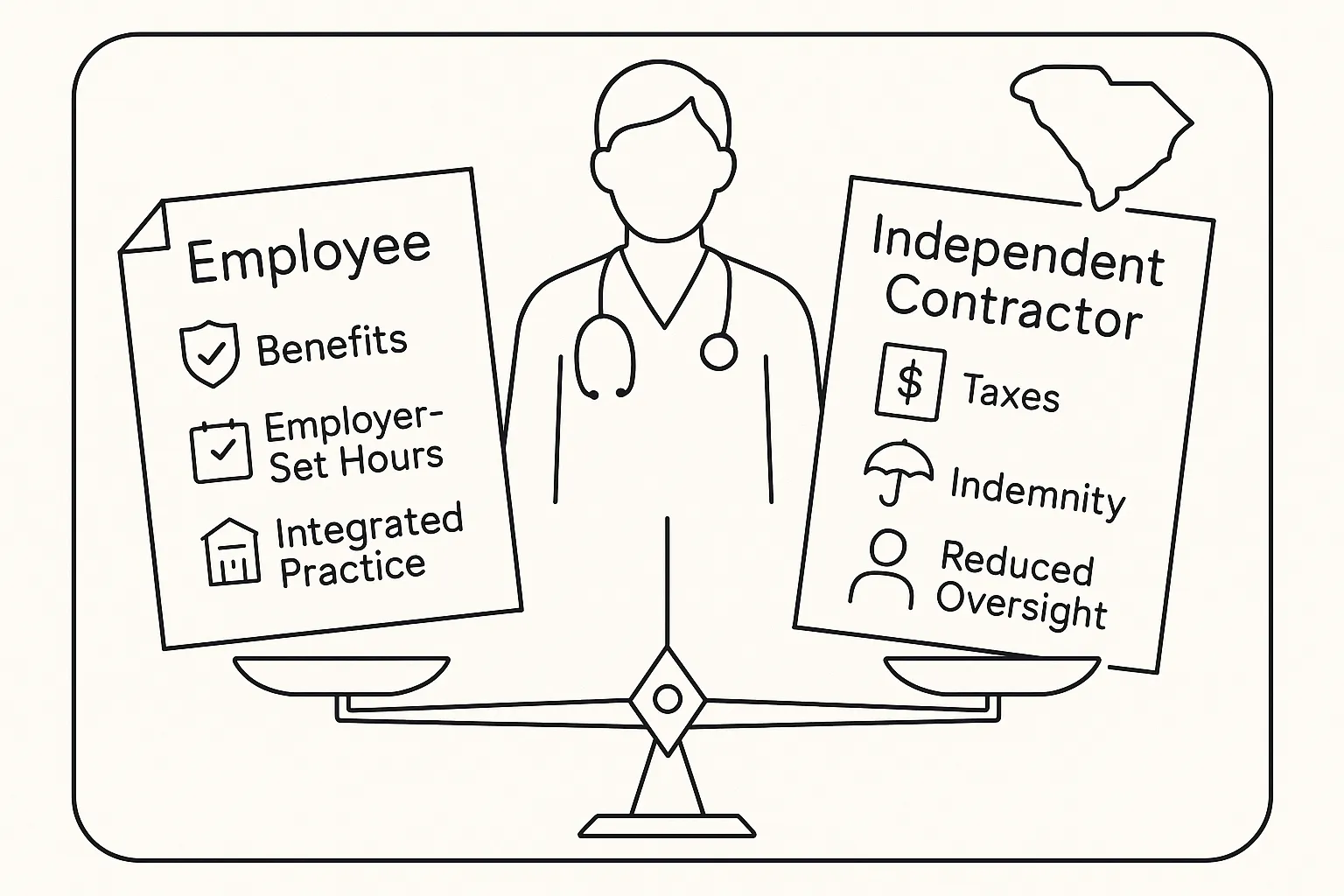
Employment status is foundational because it affects tax treatment, benefits eligibility, control over scheduling, and the allocation of business expenses. The label “independent contractor” is not necessarily controlling; the substance of the relationship—including supervision, work hours, integration into the practice, and control over clinical methods—also matters. PAs comparing proposed classifications should examine the practical differences between W-2 and 1099 arrangements before evaluating the financial value of an offer.
Misclassification can lead to unexpected tax liabilities, lost benefits, and compliance concerns. Independent contractor agreements also commonly contain indemnification, insurance, and expense obligations that may not appear in W-2 employment agreements. Employee contracts are more likely to include health coverage, retirement contributions, and paid leave, but they may give the employer broader control over supervision, scheduling, and post-employment restrictions.
A contract review should identify provisions that shift costs or liability to the PA, such as broad indemnities, responsibility for taxes or insurance, and extensive employer control despite 1099 classification. Physician assistants can also consult the South Carolina Academy of Physician Assistants for professional information concerning legislative and practice developments that may affect PA employment.
Compensation, Productivity, and Benefits

PA compensation structures vary widely, and the underlying contract mechanics can materially affect take-home pay, cash flow, and attainable upside. A thorough compensation and productivity review should address pay frequency, partial-period calculations, deductions, productivity thresholds, reconciliation timing, and whether guaranteed compensation can later be recouped.
Base Salary, Collections, RVUs, and Bonuses
A base salary provides predictable income, but it may coexist with productivity requirements or a draw that is reconciled later. The agreement should state whether missed targets can create negative accrual, reduce future compensation, or trigger a clawback. Collections-based and RVU-based models require especially clear definitions:
- Collections-based compensation: Pay is tied to money received rather than the amount billed. If the contract pays 30% of collections and the practice bills $100,000 but collects $70,000, the applicable compensation is calculated from $70,000. Payer mix, collection delays, refunds, and chargebacks can therefore affect earnings.
- RVU compensation: A common formula combines a base salary with work RVUs multiplied by a stated conversion rate. If a PA generates 800 wRVUs and the contract pays $40 per wRVU, the resulting productivity amount is $32,000. The agreement should identify the RVU schedule, applicable modifiers, conversion rate, measurement period, and reconciliation process.
- Quality or performance bonuses: Bonuses may depend on patient satisfaction, panel management, clinical protocols, or other metrics. Measurement standards, access to performance data, audit rights, payment dates, and forfeiture triggers determine whether the bonus is realistically attainable.
Benefits, Signing Bonuses, and Relocation Assistance
Benefits and one-time incentives can carry significant repayment conditions. Signing bonuses and relocation payments often require repayment when the PA leaves within a defined period, while loan repayment benefits may depend on continued employment or productivity. The contract should explain whether repayment is triggered by resignation, termination for cause, or termination without cause, and whether the obligation decreases over time. Reviewing sign-on bonus repayment terms before accepting funds can reveal obligations that substantially change the offer’s value.
Malpractice Insurance, Tail Coverage, and Indemnification
Malpractice provisions determine the protection available during employment and the potential financial exposure after the relationship ends. Claims-made policies generally cover claims reported while the policy is active, while occurrence policies generally cover incidents occurring during the policy period regardless of when the claim is reported. When an employer provides claims-made coverage, the agreement should clearly assign responsibility for extended reporting—or tail—coverage.
For example, a patient may bring a claim 18 months after a PA’s last day even though the underlying treatment occurred during employment. Without continuing coverage, the PA could be responsible for obtaining protection or responding to the claim personally. A careful review of tail insurance obligations should determine who purchases the coverage, which termination events change responsibility, and whether the contract addresses post-employment claims.
Indemnification language also deserves close scrutiny. Broad provisions may require the PA to defend or reimburse the employer for claims beyond the PA’s own conduct. The contract should address who controls the defense, who pays associated costs, and whether the employer’s insurance and indemnification promises remain effective after termination.
Scope of Practice, Supervision, and Credentialing
Clinical-duty provisions should align the proposed role with South Carolina practice requirements and the employer’s actual supervision structure. Language addressing delegated duties, prescriptive authority, supervising physician responsibilities, and employer control can affect both compliance and daily clinical autonomy. Vague clauses or duties that expand without a corresponding review of supervision, support, scheduling, and compensation may expose the PA to avoidable professional risk.
The agreement should also identify credentialing responsibilities, anticipated timeframes, and what happens if privileges or payer enrollment are delayed or denied. A start date tied to credentialing may affect when salary and benefits begin, while an employer-controlled delay can leave a PA without expected income. PAs should evaluate credentialing delay risks, including whether either party can terminate and whether a bonus or relocation payment becomes repayable before clinical work begins.
For hospital-based and surgical roles, the contract may impose procedural or site-specific limits beyond those established through credentialing. Those restrictions can affect call coverage, income potential, and professional development, so the written duties should be compared with the job description, offer letter, and representations made during recruitment.
Non-Competes and Other Post-Employment Restrictions
Restrictive covenants can limit where, when, and for whom a PA may work after employment ends. The practical effect depends on the restricted duration, geographic area, covered services, employer locations, and events that trigger the restriction. Even before enforceability is tested, broad language can interfere with a PA’s ability to remain in Charleston, Columbia, Greenville, or another preferred South Carolina market.
A review of restrictive covenant terms should also cover non-solicitation, confidentiality, patient-list, and employee-recruitment provisions. These clauses may impose fees or other remedies for alleged violations, and they should protect legitimate business information without unnecessarily interfering with professional relationships, legal reporting obligations, or future employment.
Termination, Repayment Obligations, and Dispute Terms
Termination provisions determine how quickly income and benefits can end and whether the PA has time to transition to another position. The contract should distinguish termination for cause from termination without cause, define cause with reasonable specificity, and state the applicable notice and cure procedures. Immediate termination triggers may address loss of license, fraud, or other serious events, while broad discretionary language can create substantial income interruption risk.
Notice requirements should be evaluated together with scheduling duties, accrued paid leave, final compensation, malpractice coverage, and restrictive covenants. A termination provision review can also identify whether the employer may waive the PA’s work during the notice period, stop compensation early, or characterize a notice-related dispute as a breach.
Repayment and forfeiture provisions may apply to signing bonuses, relocation assistance, loan payments, training expenses, or incentive compensation. Governing-law, venue, and arbitration clauses then determine where and how disputes are resolved. These terms should be reviewed together because a broad repayment obligation combined with mandatory arbitration, fee-shifting, or an out-of-state forum can make a disagreement more expensive to address.
South Carolina PA Contract Review Checklist
A focused review should identify the provisions most likely to affect income, liability, compliance, and mobility. Before signing, a South Carolina physician assistant should confirm:
- Whether W-2 or 1099 classification matches the actual working relationship and allocation of taxes, benefits, insurance, and expenses.
- How salary, collections, RVUs, bonuses, reconciliation, negative accrual, and payment timing are calculated.
- Whether signing, relocation, loan, or training payments are subject to repayment and which termination events trigger the obligation.
- Who provides malpractice insurance, pays for tail coverage, controls the defense of claims, and bears indemnification obligations.
- Whether scope, supervision, delegation, prescribing, credentialing, worksite, schedule, and call provisions accurately describe the position.
- How non-compete, non-solicitation, confidentiality, notice, cure, arbitration, and governing-law clauses affect post-employment options.
Attorney-led review is particularly useful when an offer includes productivity pay, substantial incentives, ambiguous malpractice language, an independent contractor classification, restrictive covenants, or repayment obligations. Chelle Law’s review process is designed to explain how the provisions work together, identify material risks, and provide practical written comments or proposed revisions when appropriate.
Review Your South Carolina PA Contract Before Signing
Chelle Law can identify compensation, malpractice, supervision, restrictive covenant, repayment, and termination risks in your proposed physician assistant agreement.
Contact Chelle LawExplore Physician Assistant Contract Guidance
Review legal services, practical contract resources, and state-specific guidance for physician assistants.