
Physician assistants considering employment or independent contractor opportunities in South Dakota should evaluate how the proposed agreement interacts with requirements overseen by the South Dakota Board of Medical and Osteopathic Examiners. Supervision, collaboration, delegation, prescribing, and other scope-of-practice obligations can affect how a PA works and whether the employer’s proposed operating structure is practical. Those concerns may differ among healthcare organizations serving Sioux Falls, Rapid City, and smaller or rural communities where replacement positions may be farther apart. A focused contract review connects these South Dakota practice requirements to the provisions controlling compensation, productivity expectations, malpractice coverage, restrictive covenants, termination rights, and bonus repayment. Chelle Law reviews the agreement and related documents to identify terms that could affect a PA’s earnings, regulatory responsibilities, liability exposure, or ability to move to another position.
Why Contract Review Matters for South Dakota Physician Assistants
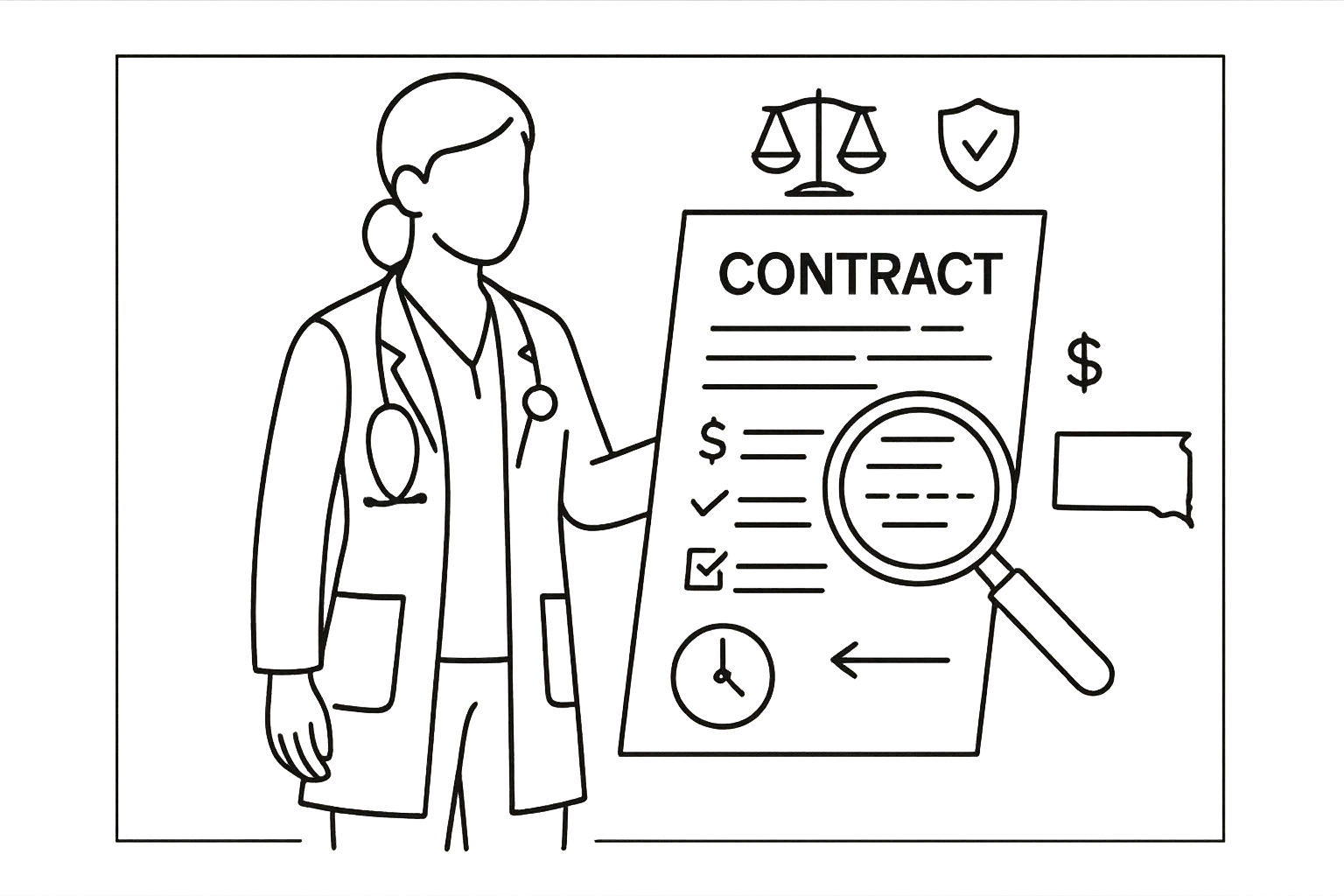
Employment and contractor agreements define a PA’s pay, duties, oversight, benefits, liability allocation, and exit obligations. Because the employer usually prepares the agreement, compensation definitions may favor the employer, repayment clauses may continue after employment ends, and restrictions may limit where the PA can work next. A line-by-line review translates those provisions into practical financial and professional consequences before the agreement is signed.
For South Dakota PAs, the review should also examine whether supervision and delegation language is consistent with the proposed practice structure and applicable regulatory requirements. Chelle Law focuses on income impact, regulatory exposure, malpractice responsibility, and professional mobility, then explains material concerns in plain language. Physician assistants can also follow professional advocacy and regulatory developments through the South Dakota Academy of Physician Assistants.
Compensation, Productivity, and Benefits
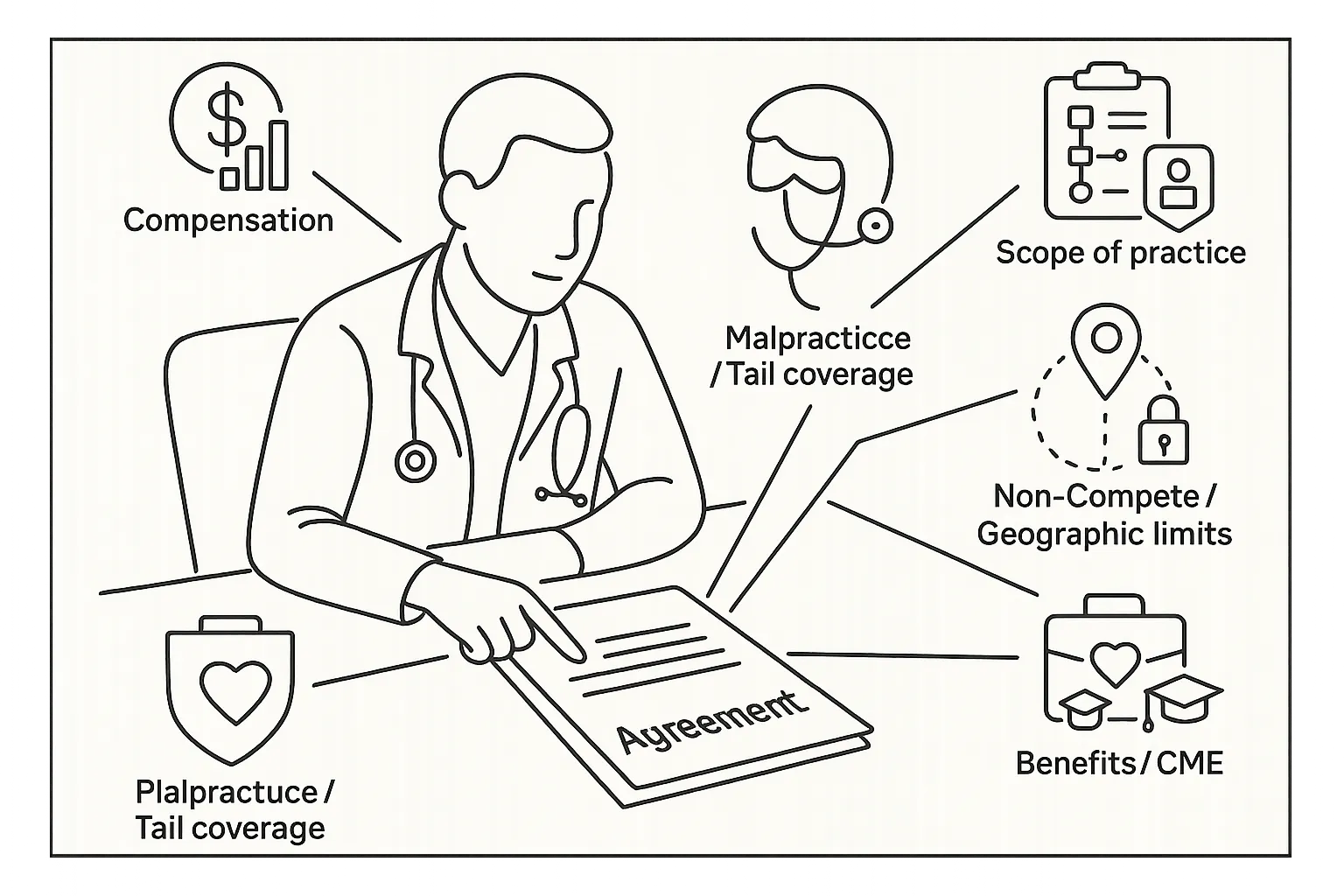
Compensation may consist of a fixed salary, a base salary plus productivity incentives, collections-based pay, or an RVU formula. A thorough review of PA compensation terms should determine which services count, when performance is measured, how payer adjustments or refunds are handled, and when bonuses or reconciliations are paid.
- Base salary with productivity incentives: The agreement should define the measurement period, productivity threshold, applicable metrics, and payment timing.
- Collections-based pay: The contract should explain when collections are treated as received and how denials, refunds, chargebacks, and outstanding receivables affect compensation.
- RVU compensation: The agreement should identify which RVUs count, the conversion factor, treatment of modifiers and global periods, and the reconciliation schedule.
Red flags include vague production definitions, unilateral changes to the formula, unclear payment timing, and negative accrual provisions that can carry a deficit forward or create a repayment demand. Benefits should be reviewed alongside cash compensation, including health coverage, retirement contributions, paid leave, CME time and allowances, licensing expenses, credentialing costs, and professional fees. The agreement should distinguish guaranteed benefits from policies the employer may change at its discretion.
Malpractice Coverage, Indemnification, and Liability
Malpractice provisions should identify the policy type, coverage limits, named insureds, and responsibility for premiums. Occurrence coverage generally applies to covered incidents occurring during the policy period, while claims-made coverage ordinarily requires continuous coverage or tail protection after the policy ends. If the employer provides a claims-made policy, the contract should state who purchases tail coverage and whether that responsibility changes based on resignation, termination without cause, or termination for cause.
Tail premiums can be a material expense, so a PA should not rely on an informal assurance that the employer will handle them. A detailed guide to tail insurance obligations for physician assistants can help clarify why the policy type and termination language must be read together.
Indemnification clauses also deserve close review. Some provisions require the PA to reimburse the employer for claims, losses, or legal expenses arising from broadly defined conduct. The review should consider whether the obligation is limited to appropriate circumstances, whether it is reciprocal, and whether malpractice coverage or employer risk-management obligations address the same exposure. License-defense coverage and duties to report claims, investigations, or adverse events should be identified separately rather than assumed to be part of ordinary malpractice protection.
Scope of Practice, Supervision, and Workplace Duties
A South Dakota PA agreement may address supervision, collaboration, delegation, prescribing, schedules, call coverage, practice locations, and approval requirements. Those terms should align with the position described by the employer and the regulatory framework administered by the South Dakota Board of Medical and Osteopathic Examiners. Contract language should not depend on an unworkable supervisory arrangement, require approval beyond what the parties can realistically provide, or place all responsibility for the employer’s compliance structure on the PA.
Particular attention should be given to clauses naming only one supervising physician without addressing absences or replacements, permitting material duty changes without consent, or allowing assignment to additional facilities without limits. Hospital positions may involve system credentialing and call requirements, surgical roles may require clarity about assistant-at-surgery work and global periods, and telehealth positions may involve multistate licensure and supervision terms. Private-practice offers may also contain buy-in or equity language that should be evaluated separately from ordinary compensation.
Restrictive Covenants, Termination, and Repayment Risk
Non-Compete and Non-Solicitation Restrictions
Restrictive covenants can limit a PA’s ability to accept another job, work within a geographic area, treat former patients, recruit employees, or communicate with referral sources after employment ends. A physician assistant non-compete review evaluates the restriction’s duration, geographic reach, covered activities, triggering events, and practical effect. This is particularly important when alternative positions are separated by substantial distances.
Enforceability depends on governing law and the specific facts, but practical risk exists even when a clause may be open to challenge. The agreement should be examined for restrictions that apply after termination without cause, cover locations where the PA never worked, or use broad non-solicitation language that interferes with ordinary professional relationships.
Notice, Final Compensation, and Repayment Obligations
Termination provisions should define without-cause notice, for-cause events, any opportunity to cure an alleged breach, and the parties’ obligations during the notice period. A focused review of termination language should also determine whether the employer may remove the PA from the schedule, stop productivity opportunities, or accelerate the final employment date while withholding compensation.
Signing bonuses, relocation assistance, retention payments, and other incentives may be subject to repayment if the PA leaves before a stated date. The contract should identify the triggering events, whether repayment is prorated, and whether an obligation survives employer-initiated termination. Post-termination compensation provisions should also explain how outstanding productivity pay, collections, or other earned amounts will be calculated and paid.
Contract Priorities by Career Stage and Practice Setting
New Graduate Physician Assistants
New graduates should confirm the scope and duration of orientation, available supervision, initial productivity expectations, and any conditions attached to training, loan assistance, signing bonuses, or relocation payments. A new graduate PA contract review can also identify restrictions that may make it difficult to change positions if the first role is not a good fit.
The written agreement should control rather than an informal promise about future schedule changes, compensation increases, or training opportunities. If the employer describes a ramp-up period, the contract should explain how long it lasts and whether productivity thresholds or guarantees change when it ends.
Experienced PAs and Specialized Roles
Experienced PAs may need the agreement to recognize an established patient base, referral relationships, specialty skills, leadership duties, or additional call responsibilities. Transition periods for productivity calculations should be realistic, and vague promises concerning partnership, ownership, or future compensation should be converted into measurable written terms when possible.
The practice setting changes the risk analysis. Hospital-employed PAs may face detailed credentialing and scheduling policies, surgical PAs need clarity about call and procedure compensation, telehealth PAs need workable multistate practice terms, and private-practice positions may combine employment provisions with ownership or buy-in obligations.
How the Attorney-Led Contract Review Process Works
Chelle Law conducts a focused review of the proposed agreement and related documents, such as the offer letter, compensation addendum, bonus agreement, job description, and supervision or delegation documents. The process is designed to identify material financial, regulatory, liability, and mobility risks rather than simply summarize the contract.
- Document and risk assessment: The attorney reviews compensation mechanics, repayment triggers, malpractice terms, duties, restrictive covenants, termination provisions, and incorporated policies.
- Prioritized explanation: Material concerns are organized by practical significance, with financial exposure quantified when the agreement provides enough information to do so.
- Suggested revisions: Proposed language may clarify payment timing, narrow repayment obligations, define productivity formulas, allocate tail responsibility, or limit post-employment restrictions.
- Negotiation support: If the employer responds, revised language can be evaluated so the PA understands what changed and which risks remain.
Review timing depends on the agreement’s length and complexity. The objective is not to promise a particular negotiation outcome, but to give the PA a clear understanding of the proposed obligations and a practical strategy for addressing important concerns.
South Dakota PA Pre-Signing Checklist
Before the review, gather the complete agreement and every document referenced by it. The physician assistant employment agreement checklist provides a broader framework, while the following items are especially useful for evaluating a South Dakota offer:
- The full employment or independent contractor agreement and all addenda.
- The offer letter, compensation plan, bonus or relocation agreement, and policies incorporated by reference.
- The job description and any supervision, collaboration, or delegation documents.
- A malpractice insurance summary identifying the policy type and coverage limits.
- Written details concerning practice locations, schedules, call coverage, credentialing, and productivity expectations.
Before signing, ask who pays for tail coverage, how production is calculated and reconciled, when earned compensation is paid after termination, and which events trigger repayment. Clarify vague productivity definitions, open-ended indemnification, unilateral location or duty changes, and non-compete provisions that apply even when the employer ends the relationship without cause. An offer may warrant reconsideration when material repayment, malpractice, or mobility risks remain unresolved and the employer will not provide reasonable clarification.
Review Your South Dakota PA Contract Before You Sign
Understand how the proposed agreement affects your compensation, malpractice obligations, supervision terms, termination rights, repayment exposure, and ability to accept a future position.
Contact Chelle Law