
Tennessee physician assistants practice within a framework administered by the Tennessee Board of Physician Assistants and, for certain collaboration, prescribing, and disciplinary matters, the Tennessee Board of Medical Examiners. A PA must hold a current Tennessee license and practice in collaboration with an appropriately licensed physician, osteopathic physician, or podiatrist. The authorized services must remain within the PA’s competence and the collaborating practitioner’s usual scope, with applicable protocols or a collaborative agreement maintained as required. These rules can affect contract language governing clinical authority, prescribing, chart review, remote-site coverage, and responsibility when a collaborator is unavailable. In healthcare markets such as Nashville and Memphis, an agreement may also involve multi-site assignments, credentialing conditions, productivity compensation, call coverage, or geographic restrictions. Contract review connects those operational terms to Tennessee requirements and helps identify financial, professional, and post-employment risks before the PA signs.
Chelle Law reviews physician assistant employment and independent contractor agreements for compensation formulas, malpractice insurance, collaboration provisions, termination rights, repayment obligations, and restrictive covenants. The analysis can clarify how separate provisions interact—for example, whether resignation triggers bonus repayment, tail insurance costs, and a non-compete at the same time. It can also identify ambiguous language or issues that may warrant clarification or revision without assuming that standard employer language is appropriate for the particular position.
Tennessee PA Employment and Contractor Agreements
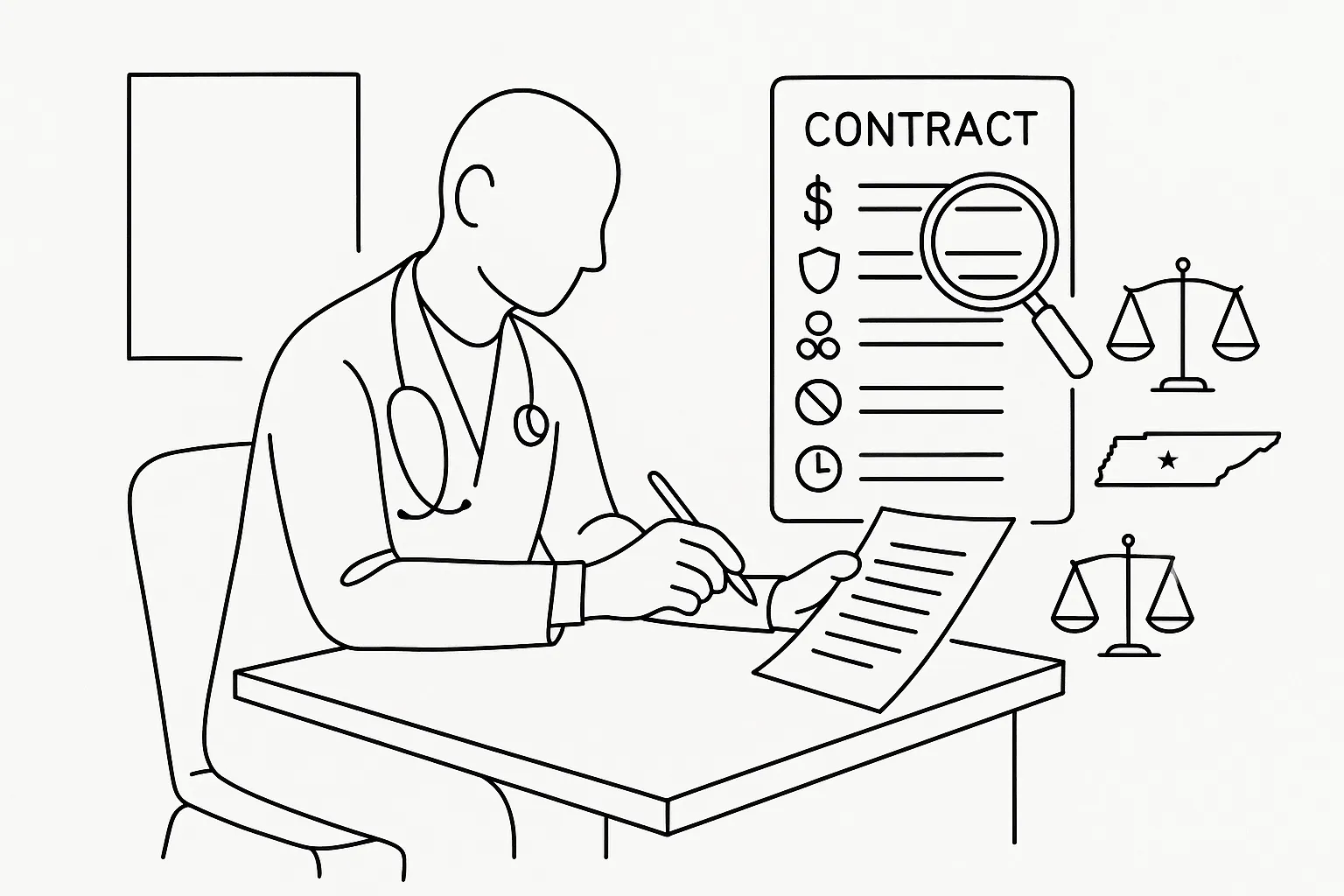
Employment Terms That Define the Position
A PA agreement typically combines clinical, operational, and financial terms. It may address compensation and benefits, productivity calculations, collaboration, permitted services, prescribing authority, call, scheduling, malpractice coverage, restrictive covenants, termination, credentialing, professional expenses, and work locations. Review can determine whether these provisions accurately reflect the position described during recruitment and whether the employer retains broad authority to change material duties after signing.
Offer letters, bonus plans, handbooks, and referenced policies can be just as important as the primary contract. If the agreement incorporates those documents or allows policies to be amended unilaterally, the PA may face changing expectations concerning schedules, benefits, productivity targets, or professional expenses. A complete physician assistant contract review evaluates the documents together rather than treating each provision in isolation.
W-2 Employment Compared With 1099 Contracting
A traditional employment agreement and an independent contractor arrangement can allocate taxes, benefits, insurance, business expenses, scheduling control, and administrative duties differently. A 1099 label does not by itself explain who pays licensing expenses, malpractice premiums, credentialing fees, continuing education costs, or travel between facilities. The agreement may also require the contractor to supply equipment, maintain separate coverage, or indemnify the contracting entity for specified losses.
A focused independent contractor agreement review can identify those allocations and compare the stated compensation with the expenses and protections the PA would assume. Classification, tax, and benefit questions may require separate professional guidance depending on the circumstances.
Compensation and Productivity Provisions

Base Salary, Collections, and RVU Formulas
PA compensation may consist of a fixed salary, collections-based pay, relative value unit production, or a combination of base compensation and incentives. An RVU formula generally converts measured clinical activity into pay through a contractual conversion factor, but the agreement may need to define which services count, when credit is assigned, how thresholds operate, and whether administrative work is included. Collections-based compensation introduces different concerns because payment may depend on actual receipts, payer adjustments, billing performance, and collection timing.
Potential problems include undefined metrics, retroactive formula changes, thresholds tied to base salary, delayed reporting, negative accrual, and reconciliation language that permits clawbacks. A PA compensation and productivity analysis can clarify the measurement period, conversion factor, reporting access, payment schedule, and financial downside of the proposed model.
Bonuses, Deductions, and Repayment Terms
Productivity and quality bonuses may depend on individual performance, collections, patient satisfaction, organizational targets, or continued employment through a payment date. Review can identify when a bonus becomes earned, whether the metrics may change, what records are available to verify the calculation, and what happens when employment ends before payment. These details can determine whether apparently attractive incentive compensation is realistically attainable.
Signing bonuses, relocation assistance, student loan payments, and other incentives may be subject to repayment if the relationship ends during a stated period. The provision may impose full or prorated repayment, distinguish among termination events, authorize deductions from final compensation, or include collection costs. The payment and deduction language also warrants review for treatment of advances, alleged overpayments, benefit costs, and other amounts the employer may seek to recover.
Malpractice Insurance and Tail Responsibility
Occurrence and Claims-Made Coverage
An occurrence policy generally covers an incident occurring during the policy period regardless of when the claim is later made. Claims-made coverage generally must be active when the claim is made, which may create a need for extended reporting protection after the working relationship ends. The agreement can identify the policy type, who provides and pays for coverage, any stated limits, and whether the PA has access to relevant policy information.
No material Tennessee PA-specific statute or board rule requiring a particular malpractice policy, tail arrangement, or contractual allocation of claims-made tail costs was identified in the reviewed authorities. As a result, the contract language is especially important to understanding the parties’ financial responsibilities; it should not be assumed that Tennessee law automatically assigns the expense to either party.
Tail Costs After Termination
Tail responsibility may change based on how the agreement ends. An employer might pay following termination without cause but allocate the cost to the PA after resignation, termination for cause, or failure to complete an initial term. Other provisions may require reimbursement of employer-paid premiums or make the PA responsible for obtaining proof of coverage within a short period.
Reviewing the agreement alongside an explanation of tail insurance for physician assistants can clarify how policy type, termination events, premium responsibility, and notice obligations work together. This analysis helps identify a possible post-employment expense or coverage gap before it becomes an immediate problem.
Tennessee Collaboration, Scope, and Practice Duties
Collaboration and Authorized Services
Tennessee requires a PA to practice in collaboration with a licensed physician, osteopathic physician, or podiatrist, as applicable. Authorized services must fall within the PA’s competence and the collaborating practitioner’s usual scope. Applicable protocols or a collaborative agreement must also be maintained and available to the boards, making contract language about the clinical relationship more than an internal staffing concern.
The agreement may identify a collaborator, allocate documentation duties, set internal clinical limits, or describe procedures for consultation and referral. Analysis can determine whether the role is described consistently across the contract, job description, protocol, and collaborative agreement. It can also flag uncertainty about what occurs if a designated practitioner leaves, becomes unavailable, or no longer covers a particular location.
Endorsed and Non-Endorsed Physician Assistants
A Tennessee PA with at least 6,000 documented postgraduate clinical hours may seek board endorsement and practice under a collaborative agreement rather than the protocol requirements applicable to a non-endorsed PA. Endorsement does not eliminate collaboration, consultation, referral, or agreement-maintenance duties. Contract language should therefore be evaluated in light of the PA’s actual endorsement status rather than using the same operational terms for every clinician.
An employer’s internal policies may impose requirements beyond the statutory baseline, but the agreement should clearly distinguish employment expectations from professional licensing obligations. Review can identify language that shifts broad compliance responsibility to the PA, permits unilateral expansion of duties, or assumes an endorsement or authority the PA does not hold.
Prescribing, Call, Credentialing, and Multiple Sites
Under required supervision or collaboration, a Tennessee PA may receive authority to prescribe legend drugs and Schedule II-V controlled substances within applicable protocols, agreements, scope, and board rules. Contract review can determine whether prescribing duties, medication-order authority, and compliance responsibilities align with the contemplated role. Broad language requiring the PA to perform all delegated services may deserve clarification when the actual specialty, experience, or credentialing limits are narrower.
Call and coverage provisions may address frequency, response times, remote availability, travel, additional compensation, and responsibility for cross-coverage. Credentialing and privileges can also affect the start date and the PA’s ability to generate revenue. If the employer may assign multiple facilities, the agreement can be evaluated for site boundaries, travel time, mileage, scheduling, collaborator availability, and the consequences of credentialing delays.
Non-Competes and Post-Employment Restrictions
Tennessee Law Applicable to PA Non-Competes
Tennessee has a statutory healthcare-provider non-compete safe harbor for specifically enumerated license categories, but physician assistants are licensed under Title 63, Chapter 19 and are not included in that list. A PA non-compete therefore should not be described as automatically validated by that statute. Ordinary Tennessee common-law reasonableness analysis remains material, and enforceability depends on the language and circumstances rather than a single contract label.
Tennessee generally disfavors non-competes, with restrictions assessed under reasonableness principles and construed in favor of the employee. Even so, a PA should not assume that a restrictive covenant is invalid or harmless. A focused physician assistant non-compete review can evaluate duration, geography, restricted activities, trigger events, and the clause’s practical effect on realistic employment options.
Geography, Activities, and Related Restrictions
A geographic restriction may be measured from one facility, every employer location, or any site where the PA provided services. The distinction can significantly change its reach in a metropolitan market or multi-site position. Activity restrictions may also extend beyond the PA’s specialty to administrative work, telehealth, or employment with an organization that offers competing services.
Non-solicitation provisions can restrict contact with patients, referral sources, employees, or business partners, while confidentiality clauses may define protected information broadly. Review can compare these provisions, identify overlapping restrictions, and determine whether they change based on resignation, termination without cause, or another event. The analysis should also consider whether the agreement provides a release, buyout, or written-waiver process.
Termination, Notice, and Exit Costs
For-Cause and Without-Cause Termination
Termination language determines how the working relationship may end and which obligations survive. Agreements commonly distinguish immediate for-cause termination from termination without cause after advance notice. Defined cause events may include licensing problems, credentialing loss, exclusion from government programs, policy violations, or specified misconduct, while some clauses use broad language that gives the employer substantial discretion.
The consequences should be assessed for each exit scenario, including final salary, earned bonuses, benefits, malpractice coverage, repayment duties, and restrictive covenants. Cure periods, notice delivery methods, continued work expectations, and the employer’s ability to remove the PA from the schedule during notice may also affect the practical value of the termination right.
Repayment, Dispute, and Survival Provisions
Clawbacks for signing incentives, relocation assistance, training costs, or student loan payments can turn an early departure into a substantial financial obligation. Review can determine whether repayment decreases over time, applies to every termination event, permits deduction from final pay, or includes interest and collection expenses. These provisions should be compared with the notice period and any employer right to terminate shortly after an incentive is paid.
Arbitration, choice-of-law, venue, attorney-fee, and survival clauses influence how a later dispute may proceed. They can affect cost, available procedures, location, and the ability to challenge a repayment demand. A PA contract termination review evaluates those procedural terms alongside the compensation, insurance, and post-employment provisions activated by departure.
Preparing for a Tennessee PA Contract Review
A useful review begins with the complete agreement, offer letter, amendments, bonus plans, referenced policies, job description, and any written summary of material recruiting promises. Relevant questions may concern work locations, collaborator arrangements, expected schedules, call frequency, credentialing status, outside employment, compensation projections, malpractice coverage, and planned start dates. Supplying the complete document set helps reveal conflicts or omissions that may not appear in the principal agreement alone.
Attorney-led analysis can explain how the material provisions affect income, professional responsibility, liability exposure, and career mobility. It can identify ambiguous or one-sided language, compare related clauses, flag potential repayment exposure, and outline targeted points that may warrant clarification or revision. The objective is a practical understanding of the proposed agreement before it is signed, renewed, amended, or terminated—not a prediction that every possible risk will occur.
Request a Tennessee Physician Assistant Contract Review
Chelle Law can review your PA employment or independent contractor agreement, explain material provisions, identify financial and professional risks, and flag terms that may warrant clarification or revision before you sign.
Contact Chelle LawExplore Physician Assistant Contract Guidance
Review attorney services, practical contract resources, and state-specific information for physician assistants.