
Physician assistants evaluating employment or independent contractor agreements in Utah must consider contract language alongside requirements administered by the Utah Division of Professional Licensing and the Utah Physician Assistant Licensing Board. Utah’s profession-specific rules address supervision, delegation, quality review, prescribing, and access to immediate electronic consultation when a PA is not under direct supervision. They also generally limit a supervising physician to four full-time-equivalent PAs unless the Division, working with the Board, grants prior approval based on extenuating circumstances and written justification. These requirements can affect staffing models, clinical responsibilities, coverage arrangements, and multi-site work in healthcare markets such as Salt Lake City and Provo. Contract review can determine whether the proposed role aligns with those operational requirements while identifying financial and professional risks involving compensation, call, malpractice insurance, termination, repayment obligations, and post-employment restrictions.
Utah’s physician assistant authorities regulate licensure and clinical practice but do not establish a PA-specific compensation formula, minimum employment term, malpractice-tail requirement, or worker-classification rule. Those issues depend heavily on the agreement itself and other applicable law. An attorney-led review evaluates how the provisions work together, explains their practical consequences, and flags language that may warrant clarification or revision before the PA signs.
Why Utah Physician Assistant Contract Review Matters

Aligning the Written Role With Utah Practice Requirements
A contract may describe duties broadly or allow an employer to change locations, schedules, procedures, and coverage assignments. Review can compare that language with the anticipated Utah working relationship, including supervision, delegation, consultation availability, quality-review parameters, prescribing responsibilities, and the services the PA will actually perform. This analysis is especially important when the position involves remote supervision, telehealth, multiple facilities, or an expanding clinical role.
The delegation-of-services arrangement and employment agreement may be separate documents, but conflicting or incomplete terms can still create operational problems. Contract analysis can identify whether the employer has clearly addressed supervising-physician availability, changes in supervision, credentialing dependencies, and what happens if the required practice arrangement cannot be maintained.
Evaluating the Agreement as an Integrated Risk Allocation
Many contract risks arise from interacting provisions rather than one isolated clause. A favorable salary can be offset by undefined productivity standards, extensive unpaid call, expensive tail coverage, or repayment obligations triggered by resignation. Similarly, a reasonable notice period may offer little protection if the employer can immediately terminate the agreement under broadly written cause provisions.
A focused physician assistant contract review can identify income risks, clarify continuing obligations, and evaluate provisions affecting licensure, liability exposure, and future mobility. These concerns can affect new graduates, experienced PAs changing specialties, and clinicians moving between employee and independent contractor roles.
Compensation, Productivity, and Benefits
Base Salary, RVUs, and Collections Formulas
PA compensation may consist of a fixed salary, productivity pay, collections-based compensation, or a combination of these models. Salary generally provides more predictable income, while productivity and collections formulas can transfer some billing, payer, documentation, and cash-flow risk to the PA. A compensation and productivity review can examine which services receive credit, when earnings are calculated, how adjustments are handled, and whether the employer may change the methodology.
For example, a formula paying $40 per credited RVU would produce $200,000 in RVU compensation for 5,000 credited RVUs. The actual result still depends on thresholds, conversion factors, exclusions, caps, attribution rules, and reconciliation language. Review can also identify negative accrual or draw provisions that allow a shortfall to carry forward, reduce future bonuses, or become repayable when employment ends.
Benefits, Bonuses, and Repayment Obligations
Health coverage, retirement contributions, paid leave, continuing medical education allowances, and reimbursement for licensure or prescribing-related expenses form part of total compensation. Relevant documents may address eligibility dates, vesting, reimbursement procedures, annual caps, rollover rules, and whether unused benefits are forfeited. If important benefits appear only in a policy manual, the agreement may also reserve broad authority to modify them.
Signing bonuses, relocation assistance, training expenses, and other advances can create substantial repayment exposure. Analysis can determine which events trigger repayment, whether the amount decreases as the PA completes the service commitment, and whether repayment applies when the employer ends the relationship without cause. Payment deadlines, setoff rights, and deductions from final compensation also warrant attention.
Malpractice Coverage and Utah Clinical Duties
Professional Liability and Tail Insurance
The agreement may provide occurrence or claims-made malpractice coverage. Occurrence insurance generally responds to covered acts occurring during the policy period even if the claim is filed later. Claims-made coverage may require tail insurance or another form of continuing protection after the policy ends. Reviewing malpractice insurance terms for physician assistants can clarify policy limits, named-insured status, retroactive dates, exclusions, and responsibility for post-employment coverage.
Tail obligations can create a significant expense when the PA must purchase coverage or reimburse the employer. The contract may allocate that cost differently depending on how employment ends, how long the PA worked, or whether a replacement policy provides prior-acts coverage. Coverage also needs to correspond to the services, specialties, and locations contemplated by the role.
Supervision, Delegation, and Quality Review
Utah requires supervision sufficient to protect patient health, safety, and welfare. When the PA is not under direct supervision, immediate electronic consultation with the supervising physician must be available, and the delegation-of-services agreement must specify appropriate quality-review parameters. Contract review can identify whether scheduling, remote coverage, call assignments, and multi-site expectations are consistent with the described supervision structure.
The supervising-physician ratio can also affect the feasibility of a staffing model. A Utah supervising physician generally may not supervise more than four full-time-equivalent PAs without prior Division approval, in collaboration with the Board, based on extenuating circumstances and written justification. A contract that depends on a different arrangement may require clarification about approvals, alternative supervision, and the PA’s status if the planned model cannot operate.
Prescribing, Authentication, and Changing Duties
Prescribing and other clinical responsibilities must remain within the PA’s Utah-authorized scope and applicable controlled-substance requirements. Utah rules also permit PAs to authenticate forms that may be authenticated by a physician’s signature, subject to the governing working-relationship and delegation requirements. Contract language can be evaluated for consistency with those boundaries without treating a broad job description as independent authority to perform every assigned task.
Provisions allowing unilateral changes to duties, schedules, sites, specialties, or supervising physicians deserve close review. Broad discretion may affect workload, commuting demands, credentialing, prescribing arrangements, and the services covered by malpractice insurance. Clear notice procedures and defined limits can make the practical scope of the position easier to evaluate.
Termination, Repayment, and Utah Restrictive Covenants
For-Cause and Without-Cause Termination
Termination provisions may distinguish between for-cause and without-cause termination, establish notice periods, and provide an opportunity to cure certain alleged breaches. Review can identify immediate termination triggers tied to licensure, credentialing, payer participation, supervision, conduct, productivity, or policy violations. It can also assess whether those triggers are objectively defined or give the employer broad discretion.
A dedicated physician assistant termination review can evaluate notice obligations, work expectations during the notice period, leave restrictions, severance conditions, and the consequences of an early departure. The interaction between termination rights and bonus repayment, tail insurance, and restrictive covenants is often as important as the notice period itself.
Final Compensation and Continuing Obligations
The agreement may address salary through the final workday, unused paid leave, expense reimbursements, earned bonuses, outstanding collections, and post-termination productivity reconciliations. Definitions of “earned” and “paid” can materially affect whether compensation remains payable after departure. Collections-based models may also leave an accounting window open for months after the PA stops working.
Repayment language may apply to draws, bonuses, relocation assistance, training costs, or employer-paid tail coverage. Review can determine the triggering events, calculation method, due date, prorating structure, and any right to deduct amounts from final pay. These provisions can create an immediate financial obligation at the same time the PA’s regular income ends.
Utah Non-Compete and Non-Solicitation Terms
Under Utah’s general post-employment restriction statute, a qualifying non-compete entered into on or after May 10, 2016, generally may not last longer than one year after employment ends. A covenant that violates the statutory duration limit is void, subject to statutory exceptions and other applicable requirements. Reasonable restrictions connected to certain severance arrangements or the sale of a business may receive different treatment.
Utah’s statutory definition of a post-employment restrictive covenant excludes nonsolicitation, nondisclosure, and confidentiality agreements, so those provisions require separate analysis under applicable law. A physician assistant non-compete review can evaluate duration, territory, restricted activities, termination triggers, facility coverage, and the relationship between the non-compete and related nonsolicitation terms. Utah law also provides potential cost, fee, and actual-damages consequences when an employer pursues an unenforceable post-employment covenant through litigation or arbitration, but enforceability remains dependent on the language and circumstances.
Common Red Flags in Utah PA Agreements
Financial and Liability Warning Signs
Compensation and liability provisions can create risks that are not obvious from the headline salary. Common warning signs include:
- Productivity formulas that do not define credited services, exclusions, chargebacks, thresholds, reconciliation procedures, or payment timing.
- Draw or negative-accrual provisions that carry deficits forward or convert them into debt at termination.
- Claims-made malpractice coverage without a clear allocation of tail or prior-acts coverage.
- Bonus, relocation, training, or insurance repayment obligations that do not decrease as the service period is completed.
- Indemnification language that may extend beyond the PA’s conduct, available insurance, or control.
Operational and Post-Employment Warning Signs
Operational ambiguity can create compliance, workload, and mobility concerns. Provisions warranting closer analysis may include:
- Vague supervision, delegation, consultation, quality-review, or prescribing language that does not reflect the anticipated Utah practice arrangement.
- Unrestricted authority to change duties, specialties, schedules, call coverage, or practice locations.
- Immediate termination triggers based on undefined performance or policy standards.
- Non-compete language exceeding Utah’s general statutory duration limit or covering services and facilities unrelated to the PA’s work.
- Broad non-solicitation, confidentiality, or future-employer notice provisions treated as though they are identical to a non-compete.
Arbitration, governing-law, venue, attorney-fee, and dispute-notice provisions also deserve attention. They can affect where a dispute proceeds, available procedures, and the expense of enforcing or defending contractual rights. Their significance is best assessed in the context of the complete agreement.
Preparing for an Attorney-Led Contract Review
Documents and Role Details to Gather
A complete review is easier when the PA provides the agreement and every incorporated exhibit, offer letter, job description, compensation plan, benefits summary, policy, and addendum. Helpful background may include anticipated Utah practice locations, supervising-physician arrangements, specialty, schedule, call expectations, telehealth duties, credentialing status, and prior productivity data. Recruitment promises that do not appear in the written documents are also important to identify.
A physician assistant employment agreement checklist can help organize the documents and issues requiring attention. Independent contractor candidates may also need to compare tax treatment, insurance obligations, expenses, control over work, and termination provisions with the realities of the proposed relationship.
What the Contract Review Can Address
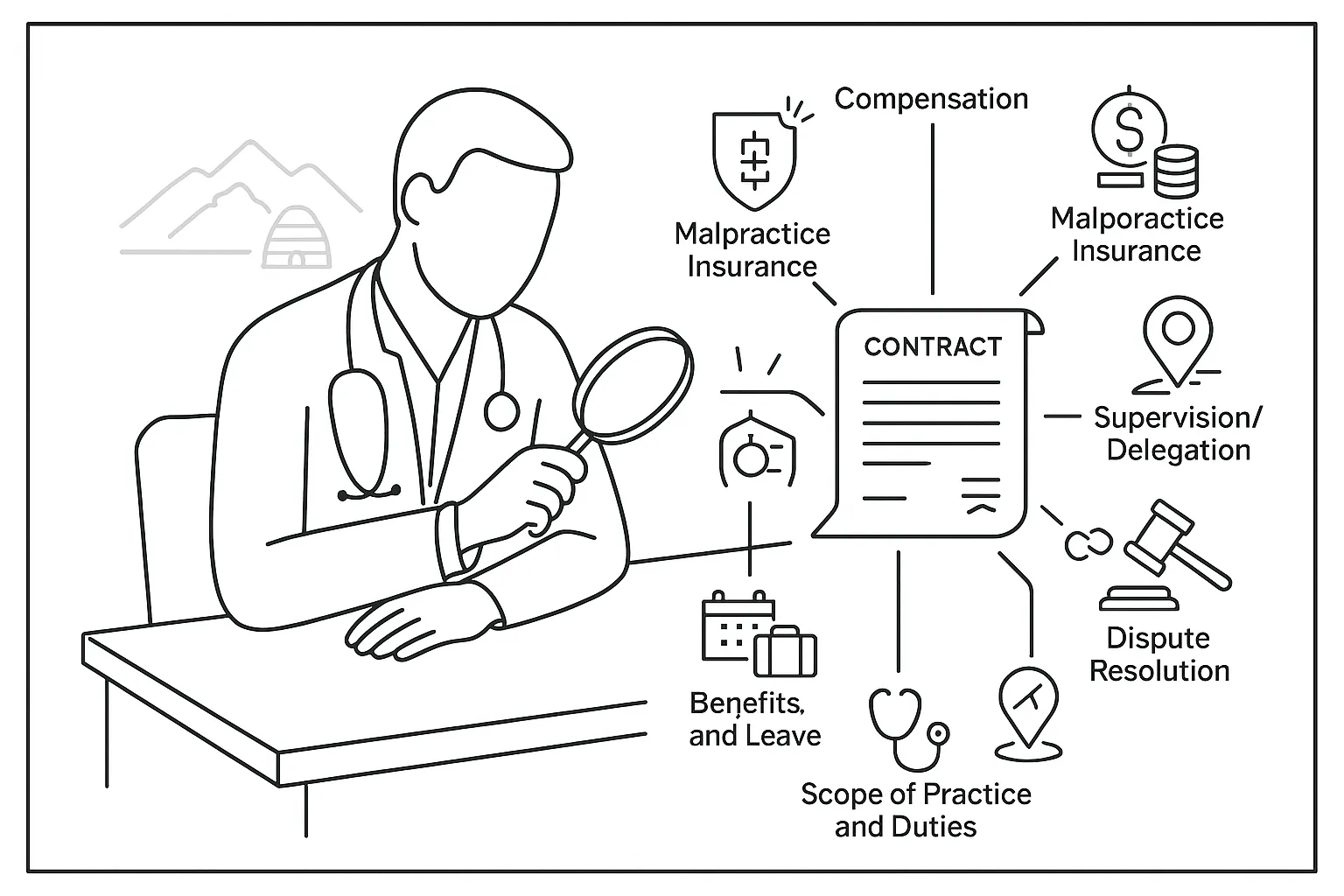
An attorney-led review examines the agreement as an integrated allocation of financial, operational, and legal risk. The analysis may test compensation calculations, identify negative accrual, clarify malpractice and tail obligations, review supervision-related language, evaluate termination and repayment triggers, and assess the practical reach of restrictive covenants.
Chelle Law provides remote contract review services for physician assistants. Depending on the engagement, the review may include written comments, proposed language, and a consultation explaining the agreement’s practical consequences. The objective is to help the PA understand material provisions and identify terms that may warrant clarification or revision before signing.
Speak With a Utah Physician Assistant Contract Lawyer Before You Sign
Chelle Law can review the agreement, explain its practical consequences, identify material risks, and flag compensation, malpractice, supervision, termination, repayment, or restrictive covenant terms that may warrant clarification or revision.
Request a Contract Review