
Physician assistants considering employment or independent contractor agreements in Utah must evaluate contract terms alongside the practice requirements administered by the Utah Division of Professional Licensing. Utah-specific rules affecting PA licensure, scope of practice, supervision, collaboration, delegation, and prescribing can shape whether a job description and clinical expectations are workable. Those concerns matter across healthcare markets such as Salt Lake City and Provo, where an agreement may also set compensation formulas, call duties, malpractice coverage, termination rights, and post-employment restrictions. Chelle Law reviews how those provisions fit together, including whether supervisory language is clear, productivity measures are defined, repayment obligations are limited, and malpractice responsibilities continue after departure. A Utah PA contract review helps translate legal and financial language into practical consequences before the PA signs, begins work, or accepts obligations that may affect income, licensure, liability exposure, and future mobility.
Why Contract Review Matters for Utah Physician Assistants

Many PA agreements use broadly employer-favorable language that can shift financial risk, leave supervision obligations unclear, or restrict a clinician’s options after employment ends. A focused review identifies how the compensation model operates, whether the assigned duties align with regulatory expectations, and which provisions could create out-of-pocket costs or interruptions in cash flow.
- Identify income risks involving collections timing, RVU reconciliation, negative accrual, and bonus calculations.
- Evaluate malpractice coverage, supervision, delegation, and prescribing language against the anticipated Utah role.
- Clarify exposure involving termination notice, restrictive covenants, bonus repayment, and tail insurance.
These issues affect new graduates, early-career clinicians, and experienced PAs changing roles. They can influence take-home compensation, licensing and credentialing concerns, and where the PA may practice after departure. Utah PAs may also consult the Utah Academy of Physician Assistants for professional information concerning statewide practice and advocacy issues.
Compensation, Productivity, and Benefits
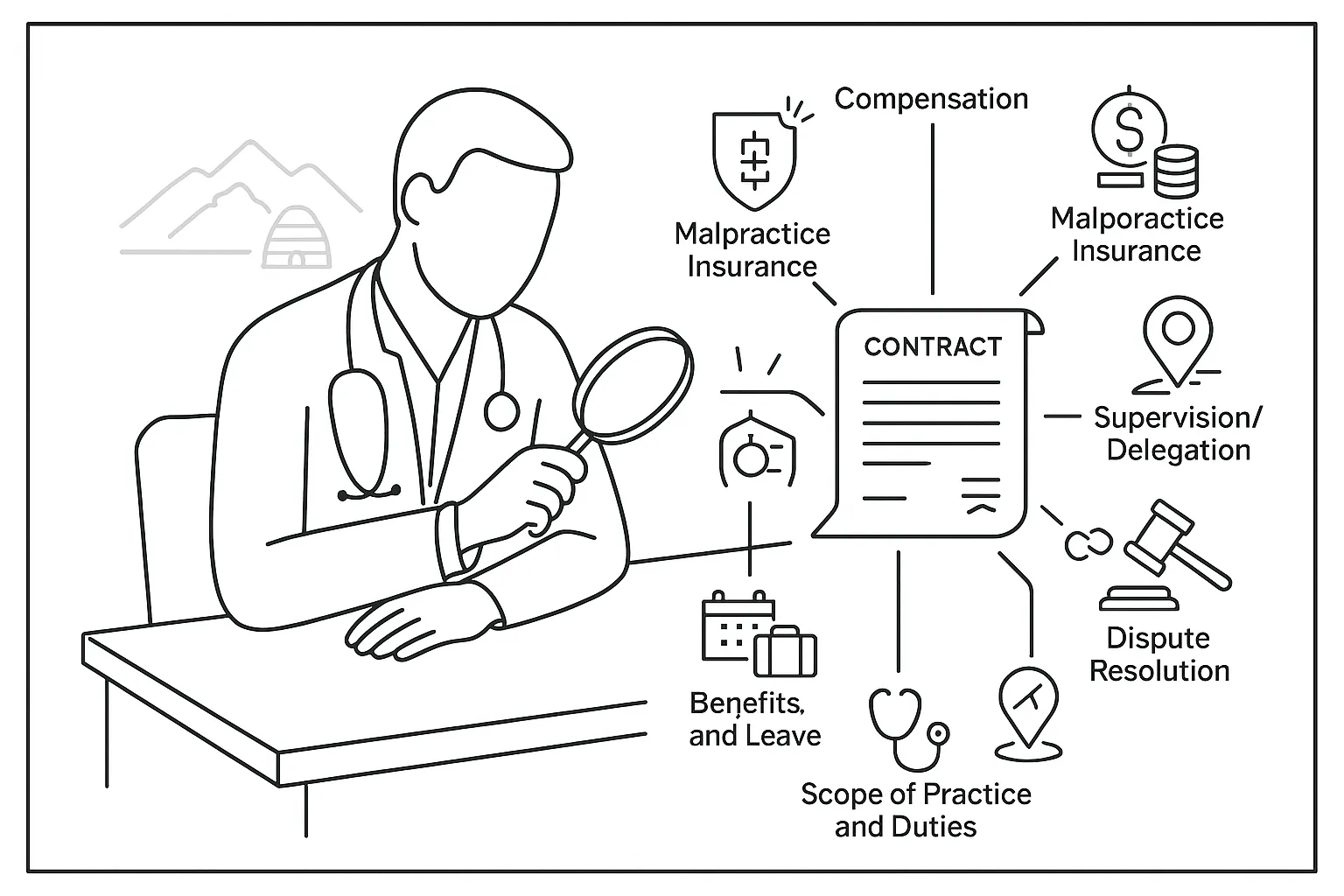
Salary and Productivity Formulas
PA compensation may consist of a fixed base salary, productivity pay, collections-based compensation, or a combination of these models. A salary provides greater predictability, while productivity and collections formulas can shift billing, payer, and cash-flow risk to the PA. A thorough review of PA compensation terms should address which services receive credit, when payments are calculated, how adjustments are handled, and whether the employer may change the formula.
For example, a formula paying $40 per RVU would produce $200,000 in RVU compensation for 5,000 credited RVUs. The practical result depends on conversion factors, crediting rules, thresholds, caps, exclusions, and reconciliation language. Negative accrual and draw provisions require particular attention because a shortfall may carry forward or become repayable when employment ends; PAs should understand how negative accrual provisions affect earned and future compensation.
Benefits, Bonuses, and Repayment Terms
Health coverage, retirement contributions, paid time off, continuing medical education allowances, and payment of licensure or DEA-related expenses form part of total compensation. The agreement should explain eligibility, vesting, reimbursement procedures, caps, and use-it-or-lose-it restrictions. Signing and relocation bonuses also warrant review because repayment clauses may require the PA to return all or part of a payment after an early departure, sometimes without accounting for the reason employment ended or the portion of the commitment already completed.
Malpractice Coverage and Utah Practice Duties
Professional Liability and Tail Insurance
The contract should identify whether the employer provides occurrence or claims-made malpractice coverage. Occurrence insurance generally covers acts occurring during the policy period even when a claim is filed later. Claims-made coverage may require tail insurance or another form of continuing protection after the policy ends. Reviewing malpractice insurance responsibilities helps clarify policy limits, named-insured status, retroactive dates, exclusions, and who must pay for post-employment coverage.
Tail obligations can create a substantial expense when the agreement assigns the cost to the PA or requires reimbursement if the employer purchases coverage. The same concerns apply to independent contractor arrangements, which may leave more responsibility with the clinician. Coverage should match the actual services and locations contemplated by the agreement, without an avoidable gap when the relationship ends.
Scope of Practice, Supervision, and Assigned Duties
Job descriptions can be broad, vague, or subject to unilateral expansion. The agreement should describe clinical duties, locations, schedules, call obligations, performance standards, and any supervision or collaboration expectations with enough detail to evaluate the position. Unclear terms may permit uncompensated work, create disputes over performance, or produce tension between employer expectations and Utah practice requirements.
Supervision and delegation language should also reflect how the PA will actually practice. Relevant provisions may address responsible physicians, on-site or remote availability, prescribing, chart review, signatures, telehealth, and the employer’s ability to change supervisory arrangements. Ambiguity can affect clinical autonomy, billing, credentialing, and regulatory compliance, particularly when the contract allows duties or locations to change without the PA’s consent.
Termination, Repayment, and Restrictive Covenants
Ending the Agreement and Receiving Final Pay
Termination provisions should distinguish between for-cause and without-cause termination, identify required notice periods, and explain any opportunity to cure an alleged breach. They should also address compensation earned but not yet paid, including productivity bonuses, collections, expense reimbursements, and final reconciliations. A focused termination clause review can reveal immediate termination triggers, notice-period obligations, severance conditions, and accounting windows that remain open after departure.
Repayment language may apply to draws, signing bonuses, relocation assistance, training expenses, or employer-paid tail coverage. The contract should specify the triggering events, calculation method, repayment deadline, and whether the obligation decreases over time. These details matter because a PA may otherwise face a large payment obligation at the same time employment income ends.
Non-Compete and Non-Solicitation Restrictions
Non-compete, non-solicitation, and non-interference provisions can limit future employment and professional relationships. Their practical impact depends on the restricted activities, geographic area, duration, triggering events, and available exceptions. Even when enforcement is uncertain or fact-dependent, broadly drafted restrictions may create leverage for an employer and make it harder for a PA to accept a nearby position.
A PA non-compete review should consider whether the restriction extends beyond the PA’s actual practice area, applies after every form of termination, or covers facilities and patients with whom the PA had no relationship. Related provisions governing confidential information, patient solicitation, employee recruitment, and notice to future employers should be evaluated together rather than in isolation.
Common Red Flags in Utah PA Agreements
Contract risk often arises from how multiple provisions interact rather than from a single clause. A seemingly favorable salary may be offset by an undefined bonus formula, broad call duties, expensive tail coverage, or repayment terms that apply whenever employment ends. Common warning signs include:
- Productivity formulas that do not define credited services, excluded payers, chargebacks, thresholds, or payment timing.
- Draw or reconciliation provisions that allow deficits to carry forward or become immediately repayable.
- Claims-made malpractice coverage without a clear allocation of tail insurance responsibility.
- Vague supervision, delegation, schedule, call, location, or duty provisions that the employer may change unilaterally.
- Broad non-compete or non-solicitation restrictions without reasonable limits or termination-based exceptions.
- Bonus, relocation, training, or insurance repayment obligations that do not decrease as the PA completes the required service period.
Dispute-resolution terms also deserve attention. Arbitration, governing-law, venue, attorney-fee, and indemnification clauses can affect where a dispute proceeds, what remedies are available, and which party bears the cost. These provisions should be reviewed in the context of the entire agreement and the PA’s actual role.
Preparing for an Attorney-Led Contract Review
A PA can make the review more efficient by providing the complete agreement together with every incorporated exhibit, offer letter, job description, compensation plan, benefits summary, policy, and addendum. Relevant background may include Utah licensure information, anticipated practice locations, supervision arrangements, call expectations, prior productivity data, and any promises made during recruitment that do not appear in the written contract.
An attorney-led review examines the agreement as an integrated allocation of financial, professional, and legal risk. That includes testing productivity calculations, identifying negative accrual, confirming malpractice and tail obligations, reviewing termination and repayment triggers, and assessing the practical reach of restrictive covenants. PAs preparing for review can also use a physician assistant employment agreement checklist to organize the provisions and supporting documents that require attention.
Chelle Law provides remote, attorney-led contract review services. Depending on the engagement, the review may include written comments or proposed language and a consultation explaining the agreement’s financial and legal consequences. The objective is to identify material risks before signature and provide practical recommendations concerning compensation, liability, regulatory duties, termination, repayment, and professional mobility.
Have Your Utah PA Contract Reviewed Before You Sign
Chelle Law can identify compensation, malpractice, supervision, termination, repayment, and restrictive covenant terms that may affect your income and professional mobility.
Contact Chelle Law