
Physician assistant contracts in Vermont should reflect both the clinician’s business terms and the professional requirements overseen by the Vermont Board of Medical Practice. Scope of practice, delegation, supervision or collaboration, prescribing responsibilities, and related practice requirements can affect how duties are assigned and how employer policies operate. These issues matter across healthcare markets such as Burlington and South Burlington, where PAs may work for hospitals, specialty groups, clinics, or other healthcare organizations with different compensation and coverage structures. Chelle Law reviews Vermont PA employment and independent contractor agreements to identify whether supervision language, job duties, compensation formulas, malpractice coverage, restrictive covenants, termination rights, and repayment provisions work together clearly. A careful review helps the PA understand not only what the agreement promises, but also how its provisions may affect income, professional responsibilities, liability exposure, and the ability to change employers.
Vermont PA Practice Requirements and Contract Terms
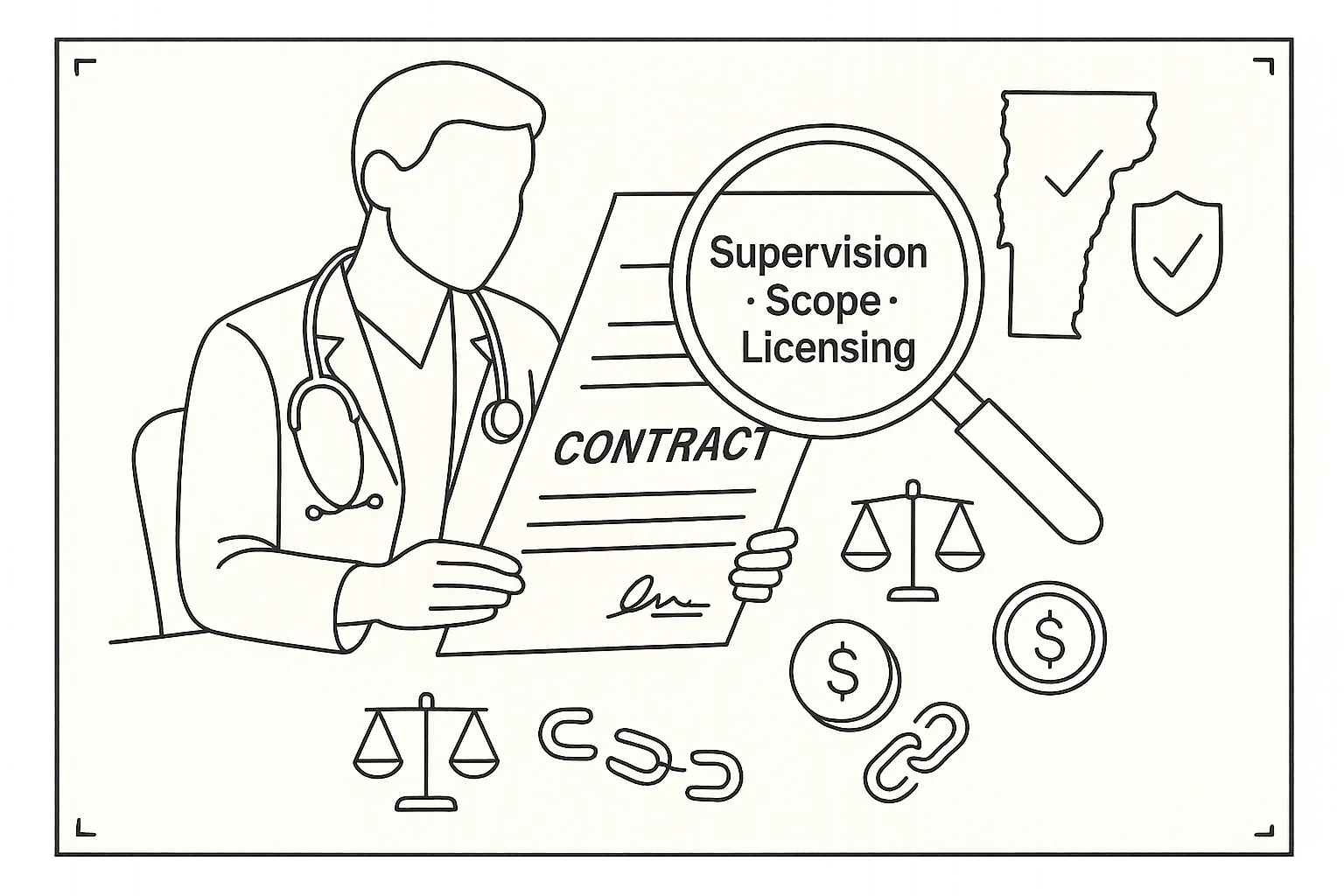
A Vermont PA agreement should be read alongside the professional requirements that apply to the clinician’s actual role. Contract language addressing supervision, collaboration, delegation, prescribing, specialty duties, and employer protocols should not create unclear or conflicting expectations. Provisions that allow duties or supervisory structures to change without meaningful limits may also affect performance standards, compensation, and professional risk. PAs accepting evolving clinical responsibilities should pay particular attention to provisions addressing scope expansion and changing job duties.
Employer-drafted agreements frequently emphasize operational flexibility while placing financial or professional risk on the PA. Common concerns include productivity formulas tied to collections or relative value units (RVUs), negative accrual or draw reconciliation, restrictive covenants, repayment obligations, and termination language that affects bonuses or benefits. Vermont PAs can also consult professional information from the Vermont Academy of Physician Assistants, while recognizing that general professional resources do not replace a review of the specific contract.
Compensation, Bonuses, and Employee Benefits

Base Salary and Productivity Compensation
A base salary offers predictability, while productivity and collections-based models transfer more variability to the PA. An RVU formula may multiply credited RVUs by a conversion factor and then apply thresholds, split rates, caps, or reconciliation rules. The agreement should explain how productivity is tracked, who controls coding and auditing, when calculations occur, and whether the employer may make retroactive adjustments. Collections-based compensation also requires attention to payer delays, denials, refunds, and expense deductions that may be outside the PA’s control.
A thorough PA compensation and productivity review should compare the stated formula with the definitions, exhibits, policies, and employer discretion provisions that determine how the formula actually operates. When quality measures or patient satisfaction scores affect compensation, the agreement should identify the measurement period, source of the data, and process for addressing disputed calculations.
Incentives, Benefits, and Malpractice Coverage
Signing bonuses, relocation assistance, and loan-repayment benefits often include clawbacks triggered by resignation, early departure, or termination for cause. The PA should understand the repayment trigger, amortization schedule, offset rights, and definitions of terms such as “cause” and “voluntary resignation.” Health coverage, retirement contributions, paid leave, and disability benefits should also be reviewed for eligibility periods, contribution formulas, accrual caps, and the treatment of unused benefits at termination.
Malpractice provisions require separate attention. Occurrence coverage generally protects incidents arising during the policy period, while claims-made coverage may require tail insurance after the policy ends. The agreement should state who pays for tail coverage, whether that responsibility changes based on the reason for termination, and whether defense or indemnity obligations continue for work performed during employment. Our guide to tail insurance for physician assistants explains why this provision can create a significant post-employment expense.
Supervision, Scheduling, and Clinical Duties
Contracts may reference a separate supervision, collaboration, delegation, or practice document. The PA should determine who prepares and maintains that document, whether the employer may change the supervising or collaborating professional, and how the parties will respond if the required practice arrangement becomes unavailable. The agreement should also allocate responsibility for maintaining required documentation and complying with applicable Vermont licensing and regulatory requirements.
Schedule provisions should define full-time status, regular shifts, weekend and holiday coverage, call obligations, administrative time, and work at additional locations. Vague language may allow substantial changes without corresponding compensation. Moonlighting restrictions should be evaluated for their effect on supplemental employment or locum tenens work, while job descriptions and performance standards should identify measurable expectations. PAs expecting call duties can use the guide to call schedules and coverage requirements to identify terms that should be clarified before signing.
Non-Competes and Other Restrictive Covenants
Restrictive covenants can affect a PA’s ability to remain in a preferred Vermont community after employment ends. A non-compete may restrict work within a defined area for a stated period, while a non-solicitation provision may limit contact with patients, referral sources, or employees. Confidentiality and non-disparagement clauses may impose additional continuing obligations. The practical effect depends on the provision’s wording, triggering event, duration, geographic reach, and the activities it prohibits.
A physician assistant non-compete review examines how the restriction would affect realistic employment options rather than considering the clause only in the abstract. Broad references to all practice patients, multiple employer locations, or undefined competitive activities can create uncertainty. The agreement should also be reviewed for exceptions, waiver provisions, buyouts, and language addressing whether the restriction applies after every type of separation.
Termination, Repayment, and Post-Employment Pay
Notice Periods and Termination Rights
Termination provisions determine how quickly either party may end the relationship and what financial consequences follow. Important terms include without-cause notice, definitions of cause, cure opportunities, immediate termination events, severance eligibility, and the effect of termination on accrued bonuses and benefits. A short notice period can increase income-interruption risk, while an overly broad cause definition may permit immediate termination and the loss of compensation that the PA expected to receive.
A focused contract termination review should also address final pay, benefit continuation, outstanding expense reimbursements, and the employer’s right to offset alleged debts. The contract should make clear whether productivity compensation or collections received after departure remain payable and when the employer must complete the final accounting.
Clawbacks and Repayment Obligations
Repayment provisions may apply to signing bonuses, relocation assistance, loan repayment, training expenses, advances, or guaranteed compensation. Negative accrual and draw reconciliation language may also allow an employer to recover amounts it characterizes as overpayments. The PA should identify each repayment trigger, whether the obligation decreases over time, when payment is due, and whether the employer may deduct amounts from final wages or other compensation.
These clauses should be considered together with the termination section. A benefit that appears favorable at signing can become a substantial debt if broad repayment language applies after events outside the PA’s control. Clear exceptions, proportional forgiveness, and a defined repayment schedule can materially change the practical risk.
Liability, Credentialing, and Professional Safeguards
Indemnification clauses allocate responsibility for claims, defense costs, and other liabilities. The agreement should distinguish acts performed within the scope of employment from conduct outside assigned duties and explain whether the employer’s defense and indemnity obligations survive termination. Provisions requiring the PA to reimburse defense costs or accept unusually broad contractual liability deserve careful review, particularly when separate malpractice language does not clearly address the same risks.
Credentialing and peer-review provisions may affect start dates, clinical privileges, compensation, and continued employment. The contract should clarify who manages credentialing applications, who pays associated costs, and what happens if credentialing is delayed or privileges are suspended. When adverse peer review or a licensing issue can trigger immediate termination, the PA should look for notice, an opportunity to respond, applicable appeal procedures, and clear treatment of compensation and benefits during the process.
Preparing for a Vermont PA Contract Review
Before signing, gather the offer letter, full employment or independent contractor agreement, compensation exhibits, bonus plans, relocation or repayment agreements, job description, benefit summary, malpractice documents, and any supervision or collaboration materials incorporated by reference. The physician assistant employment agreement checklist can help identify documents and provisions that should be reviewed together.
Common warning signs include undefined compensation metrics, unilateral authority to change duties or policies, broad restrictive covenants, unclear tail-insurance responsibility, retroactive pay adjustments, repayment obligations without proportional forgiveness, and immediate termination provisions tied to vague standards. Chelle Law provides an attorney-led, line-by-line review focused on how these provisions affect income, professional responsibilities, liability exposure, and career mobility. Reviewing the complete agreement before acceptance provides an opportunity to clarify ambiguities and identify potential negotiation points before the terms become binding.
Have a Vermont PA Contract Reviewed Before You Sign
Chelle Law can review your compensation, supervision, malpractice, restrictive covenant, termination, and repayment terms so you understand the agreement’s practical effect.
Contact Chelle Law