
Virginia physician assistants are licensed and regulated by the Virginia Board of Medicine, and their contracts must account for the Commonwealth’s practice-agreement framework. Unless an applicable exception applies, a PA practices as part of a patient care team under a written or electronic agreement with one or more patient care team physicians or podiatrists. That agreement addresses roles, evaluation, collaboration, consultation, and physician or podiatrist availability; prescribing authority may require additional detail. For PAs considering positions in Richmond, Virginia Beach, or another Virginia healthcare market, employment terms should be compared with the operative practice agreement, credentialing arrangement, assigned clinical duties, and authorized prescribing responsibilities. Contract review can also identify financial and professional risks involving compensation formulas, call coverage, multiple work locations, malpractice insurance, termination rights, bonus repayment, and post-employment restrictions.
A Virginia PA agreement often incorporates separate policies, compensation plans, benefit summaries, credentialing documents, and clinical protocols. Reviewing those materials together can reveal whether the employer retains broad discretion to change productivity standards, schedules, duties, or locations after signing. It can also clarify which obligations continue after employment ends, including repayment, tail insurance, confidentiality, and dispute-resolution requirements.
Virginia PA Agreements and Regulatory Requirements

Practice Agreements and Patient Care Team Roles
Virginia generally requires a physician assistant to practice as part of a patient care team under a written or electronic practice agreement unless a statutory exception applies. The practice agreement defines the PA’s roles and functions, establishes an evaluation process, and addresses collaboration, consultation, and the availability of a patient care team physician or podiatrist. Employment language concerning supervision, autonomy, delegation, or clinical decision-making should be evaluated against those requirements rather than read in isolation.
Review can identify inconsistencies between the employment agreement and the documents governing day-to-day practice. It can also clarify responsibility for maintaining the practice agreement, documenting required evaluations, replacing a departing patient care team physician or podiatrist, and addressing interruptions that may affect the PA’s ability to work.
Prescribing Authority and Credentialing Arrangements
A Virginia PA may prescribe controlled substances and devices only as authorized through the applicable practice agreement, facility credentialing and privileging arrangement, or statutory authorization to practice without a practice agreement. When prescribing is covered by a practice agreement, the agreement must identify the permitted schedules and categories of drugs and devices within the PA’s scope and the collaborating physician’s or podiatrist’s proficiency. An addendum is required if prescriptive authority is added later.
The employment contract can be reviewed for provisions addressing credentialing delays, prescribing limitations, loss or modification of privileges, and compensation while approvals remain pending. Virginia also generally requires treatment and prescribing to arise from a bona fide practitioner-patient relationship. Controlled-substance prescribing for oneself or a family member is generally prohibited, subject to limited exceptions and recordkeeping requirements.
Employment, Independent Contracting, and Limited Exceptions
Virginia permits specified professional entities, hospitals, and commercial enterprises with physician- or podiatrist-supervised medical facilities to employ physician assistants. Services remain subject to sound medical practice, patient safety, and the applicable practice agreement or facility credentialing arrangement. Contract language cannot authorize unlicensed practice or duties exceeding the PA’s lawful authority.
W-2 employment and 1099 independent contracting also differ in tax treatment, benefits, workplace control, and responsibility for professional expenses. A review of the practical W-2 versus 1099 considerations for physician assistants can help determine whether the agreement clearly allocates taxes, insurance, licensing costs, equipment, administrative support, and other expenses.
Virginia law describes a contingent-effective pathway through which a PA with the required specialty-specific clinical experience, physician or podiatrist attestation, and Virginia Board of Medicine approval may practice without a written or electronic practice agreement. Because the provision has a contingent effective date, its current applicability and satisfaction of all prerequisites require verification before an agreement relies on that pathway.
Compensation, Productivity, and Benefits
Salary, Collections, and RVU Formulas
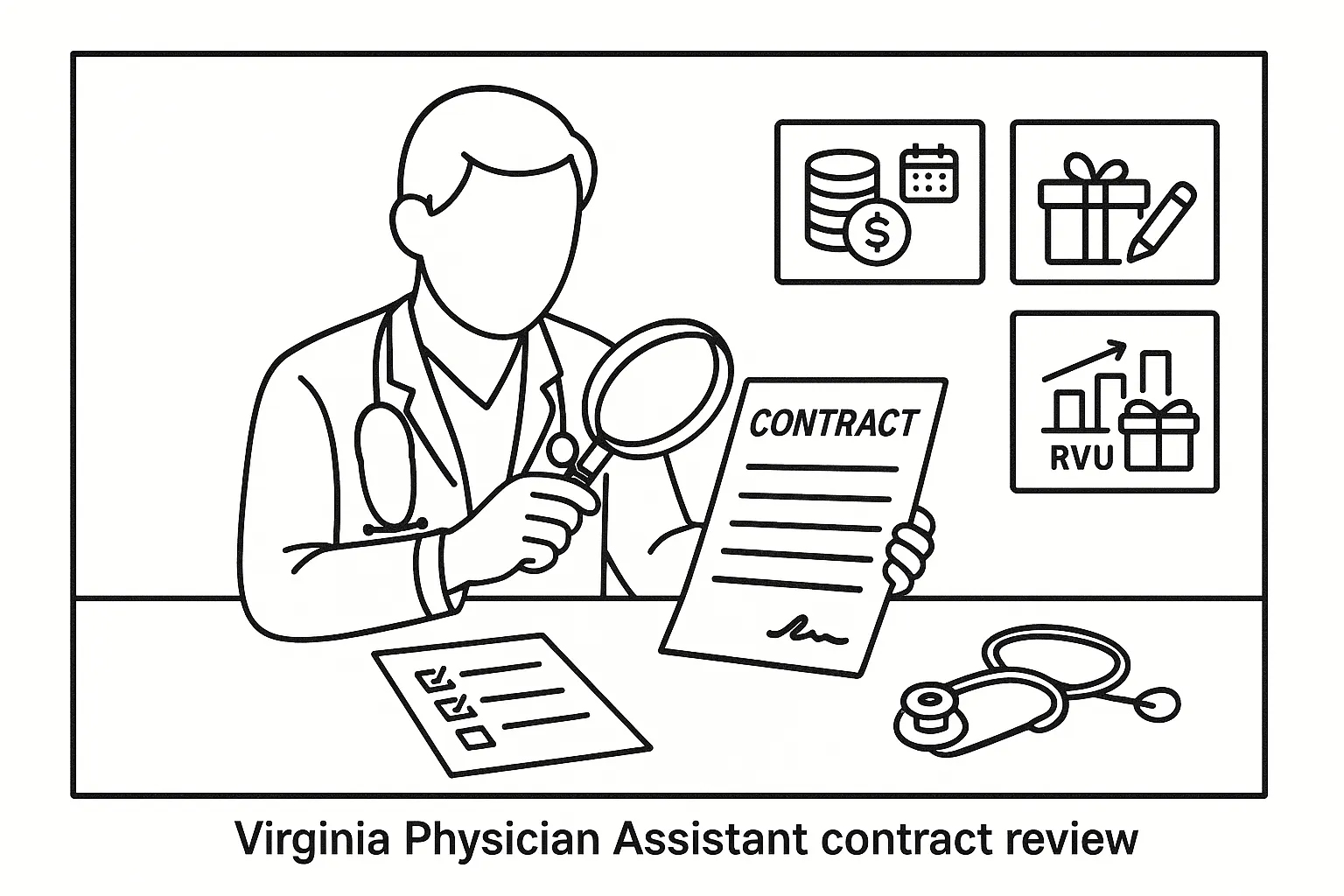
PA compensation may consist of a fixed salary, collections-based pay, an RVU formula, or a base amount combined with variable compensation. Analysis can determine how services are credited, when calculations occur, which reports the PA may inspect, and whether the employer may change thresholds, conversion factors, or other formula components. A focused physician assistant compensation and productivity review can flag unclear calculations and discretion that may affect expected earnings.
- Collections-based compensation: Review can clarify how payer delays, denials, refunds, chargebacks, collection periods, and post-termination receipts affect compensation.
- RVU-based compensation: Material terms include the type of RVU credited, conversion factor, threshold, coding responsibility, calculation period, and process for questioning reports.
- Base pay with a productivity component: The contract may treat the base as guaranteed compensation or as an advance against future production. Negative accrual provisions can carry a shortfall into later periods or create repayment exposure.
Bonuses, Repayment Obligations, and Benefits
Signing bonuses, relocation assistance, retention payments, and educational benefits frequently include repayment obligations tied to continued employment. Review can identify whether repayment is triggered by resignation, termination for cause, or employer-initiated termination without cause. It can also evaluate proration, forgiveness dates, repayment deadlines, interest, and any right to deduct disputed amounts from compensation.
Health coverage, retirement contributions, paid time off, continuing medical education allowances, professional dues, and licensing or credentialing expenses may appear in the agreement or a separate policy. When benefits are incorporated only by reference, the contract may not guarantee that the policy will remain unchanged. The complete review should identify which expenses are reimbursable, whether reimbursement requires continued employment, and what happens to accrued compensation or benefits at termination.
Clinical Duties, Scheduling, and Work Locations
Scope, Specialty Duties, and Performance Standards
Clinical-duty provisions should be specific enough to explain the specialty, patient population, procedures, documentation responsibilities, administrative work, and performance expectations attached to the position. Broad language allowing the employer to assign any lawful duty may create uncertainty if the PA expects to work within a defined specialty or practice setting. Review can compare those provisions with the practice agreement, credentialing documents, and represented role.
Performance standards may address patient volume, chart completion, quality measures, coding, attendance, or compliance with changing employer policies. Analysis can identify whether standards are objective, whether the PA receives notice of material changes, and whether failure to meet a discretionary target could affect compensation or trigger termination for cause.
Call Coverage, Floating, and Multiple Sites
Scheduling terms can define regular hours, weekends, holidays, administrative time, patient-volume expectations, and the process for modifying shifts. Call provisions warrant particular attention because a broadly drafted clause may permit expanded after-hours responsibilities without a corresponding change in compensation. The agreement can be compared with common PA call schedule and coverage terms, including frequency, response time, backup availability, coverage locations, and additional pay.
Floating and multi-site clauses may affect commute time, travel costs, schedule predictability, and the PA’s assigned specialty. Review can determine whether the employer may add facilities unilaterally, whether mileage or travel time is reimbursed, and whether reassignment can materially change clinical responsibilities. Telehealth duties may also require clarification concerning work location, scheduling, credentialing, and the states in which patients are located.
Malpractice Coverage and Contractual Liability
Policy Type, Limits, and Tail Coverage
The reviewed Virginia authorities do not establish a material physician-assistant-specific requirement mandating malpractice insurance, tail coverage, or a particular allocation of claims-made tail costs between the parties. Those issues therefore require clear contractual treatment. Relevant provisions include the policy type, limits, carrier, covered services, premium responsibility, and whether coverage extends to all assigned facilities and duties.
Occurrence coverage generally applies to covered incidents occurring during the policy period even when a claim is reported later. Claims-made coverage generally depends on the policy being active when the claim is reported, potentially creating a need for extended reporting coverage after employment. The agreement can be evaluated alongside an explanation of tail insurance for physician assistants to determine who bears that expense and whether allocation changes based on the reason employment ends.
Indemnification, Defense, and Reporting Duties
Indemnification language may allocate responsibility for claims, losses, regulatory issues, billing disputes, or third-party conduct. Review can flag provisions that shift business liabilities to the PA or extend beyond available insurance. It can also clarify whether the employer provides a defense for services performed within authorized employment duties, who selects counsel, and who controls settlement decisions.
Notice provisions may require prompt reporting of claims, adverse events, licensing matters, investigations, or potential coverage issues. These obligations should be read with the agreement’s termination and cooperation clauses because some duties continue after the PA leaves. A complete analysis can identify indefinite obligations or reporting requirements that are difficult to satisfy.
Virginia Non-Competes and Related Restrictions
Virginia’s Health Care Professional Non-Compete Prohibition
Virginia prohibits an employer from entering into, enforcing, or threatening to enforce a covenant not to compete with a health care professional. The statutory definition includes individuals licensed by the Virginia Board of Medicine and therefore encompasses physician assistants. A Virginia PA contract review can identify language that expressly restricts competitive employment or may function as a non-compete despite a different label.
Virginia also has a separate termination-related limitation under which a non-compete is unenforceable when an employer discharges an employee without severance or another disclosed monetary payment, unless the discharge is for cause. For physician assistants, however, the broader health care professional prohibition is the more directly applicable rule. A Virginia physician assistant non-compete review can evaluate the text and practical effect of the restriction.
Non-Solicitation, Confidentiality, and Other Post-Employment Terms
Non-solicitation, confidentiality, trade-secret, patient-contact, and property-return clauses may impose obligations distinct from a covenant not to compete. Their scope depends on the language used and the conduct restricted. Review can identify overbroad definitions of patients, employees, referral sources, confidential information, or solicitation and determine whether the agreement distinguishes targeted solicitation from general advertising or ordinary professional contact.
Post-employment provisions may also address patient notices, record access, credentialing communications, use of professional biographies, and removal from employer websites. These terms can affect continuity of care and the PA’s transition to another position even when a traditional non-compete is prohibited.
Termination, Repayment, and Dispute Provisions
For-Cause and Without-Cause Termination
Termination provisions determine how the relationship can end and which obligations follow. For-cause definitions may include loss of licensure, exclusion from a payer program, credentialing problems, policy violations, failure to satisfy performance standards, or alleged misconduct. Review can distinguish serious events that may justify immediate termination from correctable issues for which notice and an opportunity to cure may be appropriate.
Without-cause termination language typically establishes a notice period but may not explain what happens during that period. Important questions include whether the employer may remove the PA from the schedule, whether salary and benefits continue, whether the PA must remain available, and whether unused notice affects repayment obligations. A focused physician assistant contract termination review can evaluate these provisions together.
Final Compensation, Repayment, and Dispute Procedures
The agreement may address final salary, productivity reconciliation, collections received after departure, unused paid time off, expense reimbursement, bonus repayment, malpractice tail costs, and return of employer property. Review can identify whether the employer claims a right to offset disputed amounts against compensation and whether repayment applies after an employer-initiated termination without cause.
Arbitration, governing-law, venue, limitation-period, and attorney-fee provisions affect the cost and practicality of resolving a dispute. Analysis can determine whether procedures are mutual, where proceedings must occur, which remedies remain available, and whether referenced policies create additional administrative steps before a claim may be brought.
What to Provide for a Virginia PA Contract Review
A useful review includes the complete contract, offer letter, practice agreement, addenda, compensation plan, benefit summary, malpractice information, credentialing materials, and relevant written communications. Providing all related documents allows the reviewer to identify conflicting terms, missing details, and employer discretion that may not be apparent from the principal agreement alone.
Chelle Law reviews physician assistant contracts to explain compensation, regulatory alignment, malpractice obligations, restrictive language, termination consequences, and provisions that may warrant clarification or revision. The goal is to help the PA understand the agreement’s financial and professional effect before signing or taking steps to leave a position. Contract review does not guarantee a particular result and is not a substitute for confirming current licensing, credentialing, or practice-agreement requirements with the appropriate authorities.
Speak With a Virginia Physician Assistant Contract Lawyer Before You Sign
Chelle Law can review your agreement, identify financial and professional risks, explain how key provisions interact, and flag terms that may warrant clarification or revision.
Request a Contract ReviewExplore Physician Assistant Contract Guidance
Learn more about Chelle Law’s physician assistant contract services, practical resources, and state-specific guidance.