
Virginia physician assistants practice under requirements administered by the Virginia Board of Medicine, including state-specific rules involving licensure, supervision, collaboration, delegation, prescribing, and clinical scope. Those requirements can affect how an employment or independent contractor agreement assigns duties, identifies supervising relationships, addresses prescribing responsibilities, and allocates compliance risk. Whether a PA is evaluating an opportunity in Virginia Beach, Richmond, or another Virginia healthcare market, the contract should align operational expectations with the authority the PA may exercise under state rules. It should also clearly address compensation, scheduling, malpractice coverage, restrictive covenants, termination rights, and repayment obligations. Chelle Law reviews these provisions together because an employer-favorable term in one section can affect income, licensing exposure, professional autonomy, or the ability to accept another position after the relationship ends.
Virginia PA Contract Types and Regulatory Considerations

Employment and Independent Contractor Agreements
W-2 employment agreements and 1099 independent contractor agreements differ in tax treatment, benefits eligibility, employer control, and allocation of professional expenses. An employment agreement commonly includes a salary, tax withholding, benefits, and employer-directed policies. An independent contractor agreement may offer higher gross compensation while requiring the PA to address taxes, benefits, insurance, and other expenses independently. PAs considering this structure should understand the broader W-2 versus 1099 contract differences rather than relying solely on the agreement’s label.
Contract review should examine schedule control, performance standards, facility access, credentialing procedures, billing arrangements, and responsibility for professional expenses. These terms help reveal the practical working relationship and may expose inconsistencies between the classification selected by the employer and the control described in the agreement.
Virginia contract language should also be evaluated against requirements administered by the Virginia Board of Medicine. Provisions addressing supervision, delegation, collaboration, prescribing, and assigned clinical duties should not create ambiguity about the PA’s authority or compliance responsibilities. Physician assistants can also consult the Virginia Academy of Physician Assistants for professional advocacy and regulatory updates relevant to practice in the state.
Compensation, Bonuses, and Benefits
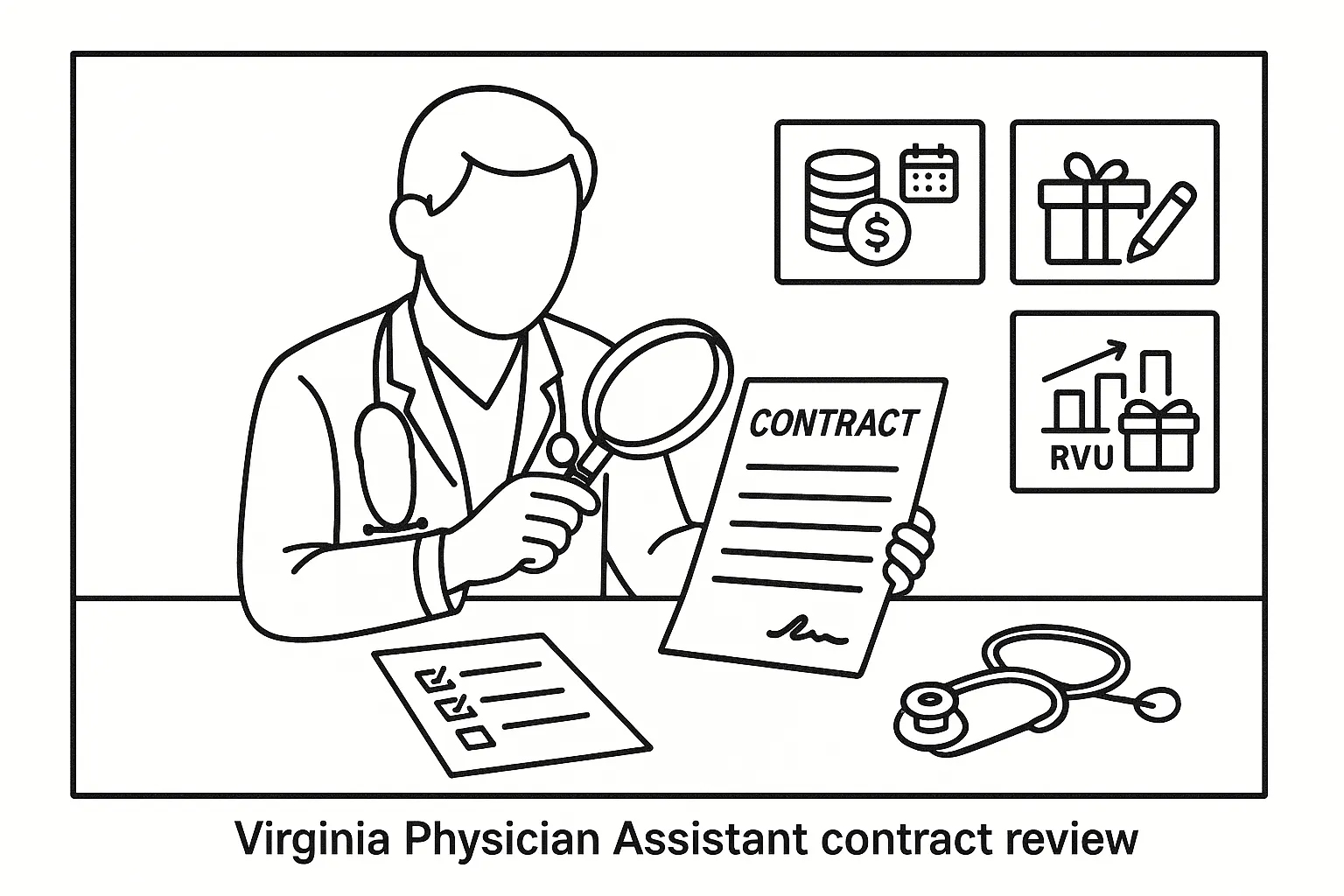
Salary and Productivity Compensation
PA compensation may consist of a fixed salary, collections-based pay, an RVU formula, or a base guarantee combined with variable compensation. Each model should define how work is credited, when calculations occur, which reports the PA may inspect, and whether the employer can revise a conversion factor or reconcile prior payments. An attorney conducting a PA compensation and productivity review can identify unclear formulas and employer discretion that may reduce expected earnings.
- Collections-based compensation: Pay depends on amounts collected rather than services performed. The agreement should address payer delays, denials, refunds, chargebacks, collection periods, and the PA’s access to supporting reports.
- RVU-based compensation: The contract should identify which RVUs count, the conversion factor, applicable thresholds, coding responsibility, calculation periods, and procedures for challenging an inaccurate report.
- Base salary with a productivity overlay: The agreement should clarify whether the base is guaranteed compensation or an advance against production. Negative accrual and draw provisions may carry shortfalls into later periods or create repayment exposure.
Incentives, Repayment Terms, and Benefits
Signing bonuses, relocation assistance, and loan-repayment benefits often include clawbacks tied to the length of employment. The agreement should specify whether repayment is triggered by resignation, termination for cause, or employer-initiated termination without cause, as well as whether the obligation is prorated. Reviewing sign-on bonus repayment terms before accepting funds can prevent an unexpected debt when employment ends.
Health insurance, retirement contributions, paid time off, continuing medical education allowances, licensing expenses, and credentialing support should also be reviewed carefully. A contract may reference an employer policy without guaranteeing that the policy will remain unchanged. PAs should determine who pays for state licensing, prescribing credentials, hospital privileges, background checks, professional dues, and required continuing education.
Scope of Practice, Supervision, and Workload
Clinical-duty provisions should be consistent with Virginia requirements and specific enough to establish what the employer expects. Contract review should address supervision or collaboration language, delegation, prescribing responsibilities, required protocols, documentation standards, and the process for changing a supervising or collaborating physician relationship. Vague language can create operational uncertainty or assign the PA responsibility for circumstances outside the PA’s control.
Scheduling terms should identify regular hours, weekend and holiday responsibilities, administrative time, patient-volume expectations, and the locations where the PA may be assigned. Call obligations require particular attention because a broad clause may allow the employer to expand after-hours duties without additional compensation. A clear agreement should address call frequency, response expectations, coverage locations, and pay; these issues are discussed further in the guide to PA call schedules and coverage requirements.
Multi-site and floating provisions should define the geographic area, travel expectations, reimbursement, and whether reassignment can materially change the PA’s schedule or specialty responsibilities. References to “clinical autonomy” are most useful when paired with objective duties and decision-making standards rather than aspirational language alone.
Malpractice Insurance, Tail Coverage, and Liability
Malpractice provisions should identify the policy type, coverage limits, carrier, covered services, and responsibility for premiums. Occurrence coverage generally addresses covered incidents occurring during the policy period even if a claim is reported later. Claims-made coverage generally depends on the policy being active when the claim is reported, which may make extended reporting coverage necessary after employment ends.
If the employer provides claims-made insurance, the contract should expressly allocate responsibility for tail coverage. That responsibility may vary depending on whether the PA resigns, is terminated for cause, or is terminated without cause. Because this obligation can create a significant post-employment expense, PAs should review the agreement alongside a practical explanation of tail insurance for physician assistants.
Indemnification and defense provisions also require careful review. The agreement should explain whether the employer will defend and indemnify the PA for services performed within the authorized scope of employment, who controls the defense, and how claims or adverse events must be reported. Overbroad indemnification language may shift business or third-party liability to the PA beyond available insurance protection.
Non-Competes and Other Restrictive Covenants
Restrictive covenants can affect where and how a Virginia PA works after leaving an employer. A review should consider the restriction’s duration, geographic reach, prohibited services, triggering events, and the employer interests the clause purports to protect. Even before enforceability is tested, an expansive restriction can affect negotiations with prospective employers and limit practical mobility.
Non-solicitation and confidentiality provisions may separately regulate communications with patients, employees, referral sources, and business contacts. Definitions should be narrow enough to distinguish prohibited solicitation from ordinary professional relationships or general advertising. A focused physician assistant non-compete review can identify problematic triggers, oversized geographic limits, and missing exceptions for circumstances such as employer breach or termination without cause.
Potential safeguards include defined geographic boundaries, reasonable time limits, limits tied to services actually performed, and appropriate patient or referral-source carveouts. The agreement should also clarify whether restrictions apply to telehealth, community health work, emergency services, or locations where the PA never practiced.
Termination, Repayment, and Dispute Terms
Termination provisions determine how quickly either party may end the relationship and what financial obligations follow. For-cause definitions should be specific, provide an appropriate opportunity to cure correctable conduct, and distinguish serious misconduct from an ordinary contract dispute. Without-cause termination language should identify the required notice period, whether the employer may remove the PA from the schedule during notice, and whether compensation and benefits continue through the termination date.
A comprehensive contract termination review should also evaluate accrued compensation, unused paid time off, final productivity reconciliation, bonus repayment, tail insurance, credentialing notifications, record access, and post-employment restrictions. Repayment provisions are particularly concerning when they apply after an employer terminates the PA without cause or when the contract permits the employer to offset disputed amounts against final wages or other compensation.
Arbitration, governing-law, venue, and attorney-fee provisions affect the cost and practicality of enforcing contractual rights. Review should determine whether dispute procedures are mutual, where proceedings must occur, what remedies remain available, and whether the selected process imposes a disproportionate burden on the PA.
When to Obtain a Virginia PA Contract Review
Attorney review is especially valuable when an agreement includes unclear supervision or scope language, variable compensation without meaningful reporting rights, negative accrual, broad call or floating duties, a claims-made malpractice policy without clear tail allocation, restrictive covenants, or substantial repayment obligations. These provisions can interact, so reviewing one clause in isolation may not reveal the agreement’s full financial and professional effect.
The PA should provide the complete agreement, offer letter, addenda, referenced compensation plans, benefit summaries, and relevant communications. Chelle Law’s review process includes attorney analysis and an explanation of identified risks, financial terms, and potential negotiation points. Contract review cannot guarantee a particular outcome, but it gives the PA a clearer understanding of the obligations and options before signing.
Review Your Virginia PA Contract Before You Sign
Chelle Law reviews compensation, scope-of-practice language, malpractice coverage, restrictive covenants, termination rights, and repayment obligations so you can make an informed decision about your agreement.
Contact Chelle LawExplore Physician Assistant Contract Guidance
Learn more about Chelle Law’s contract review services, practical PA resources, and state-specific guidance.