
Physician assistant contracts in West Virginia must account for the employment arrangement and the practice framework administered by the West Virginia Board of Medicine and the West Virginia Board of Osteopathic Medicine. A PA may not practice independently of a collaborating physician and may practice only under an active practice notification filed with the appropriate board. For physician assistants considering positions in Charleston, Huntington, Morgantown, or another West Virginia market, these requirements can affect contract provisions addressing collaboration, clinical duties, prescribing authority, credentialing, and changes to the practice relationship. Chelle Law reviews employment and independent contractor agreements to identify compensation risk, repayment exposure, malpractice obligations, restrictive covenants, and termination consequences. Reading the business and regulatory provisions together can help a West Virginia PA determine whether the written role reflects the proposed position and whether important terms require clarification or revision before signing.
A contract may also give the employer broad authority to change schedules, facilities, duties, productivity standards, or collaborating physicians. Those provisions can affect income, workload, regulatory compliance, and the practical ability to leave the position. A focused physician assistant contract review evaluates how these terms operate together rather than assessing salary, malpractice coverage, or termination rights in isolation.
West Virginia PA Licensure and Practice Requirements
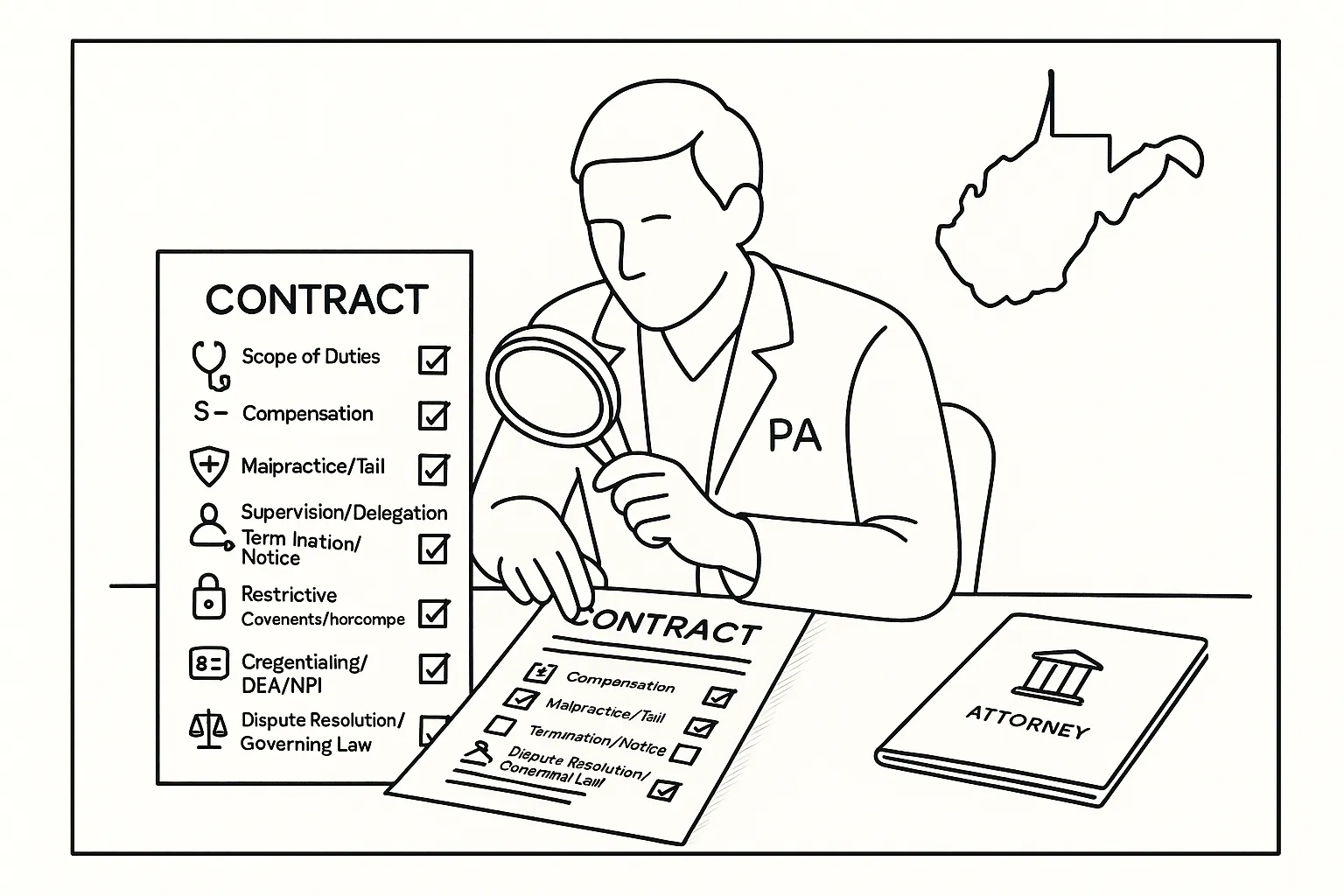
Practice Notifications and Physician Collaboration
West Virginia physician assistants are licensed under the Physician Assistants Practice Act by either the West Virginia Board of Medicine or the West Virginia Board of Osteopathic Medicine. State law does not permit independent PA practice. A physician assistant must practice under an active practice notification filed with the appropriate board and in collaboration with a physician whose oversight, direction, and evaluation support meaningful collaboration.
Contract review can determine whether the agreement accurately describes the collaborating relationship and addresses what happens if the designated physician leaves, becomes unavailable, or no longer satisfies the practice arrangement. Provisions allowing an employer to change the collaborating physician or collaboration model without limits warrant particular attention because an operational change may also affect the PA’s ability to continue practicing under the contemplated terms.
Scope of Practice, Prescribing, and Individual Responsibility
A West Virginia PA’s practice must remain consistent with the PA’s education, training, experience, and competence; the collaborating physician’s scope; facility credentialing; and applicable board rules. Physician assistants may prescribe, dispense, and administer controlled substances, prescription drugs, and devices subject to statutory limits. Those limits include a prohibition on Schedule I prescribing and a limit of no more than a three-day supply of a Schedule II narcotic.
A physician assistant remains individually responsible and liable for the care provided. A healthcare facility is legally responsible for the PA’s acts or omissions only when the PA is employed by or on behalf of the facility. The agreement’s malpractice, indemnification, job-duty, and contractor provisions therefore require careful comparison with the actual working relationship. West Virginia also permits PAs to sign specified documents within their scope, but not a certificate of merit for a medical-malpractice claim against a physician.
Effective August 1, 2025, West Virginia law prohibits a physician assistant from assisting in gender-reassignment surgery or providing gender-altering medication to a person under 18, subject to statutory exceptions. Because a violation carries mandatory license-revocation consequences, a role involving potentially affected services requires especially careful evaluation of clinical duties, protocols, and employer policies.
Clinical Duties, Scheduling, and Practice Structure
Job Duties, Call Coverage, and Work Locations
The contract or an incorporated job description may define patient-care duties, procedures, administrative work, chart-completion expectations, call coverage, and work at multiple facilities. Review can identify whether the employer may materially expand these responsibilities or reassign the PA to another clinic, hospital, or service line without consent. A location clause also matters when compensation, commuting time, credentialing, or a post-employment restriction depends on where the PA works.
Expected hours, weekend obligations, call frequency, response times, schedule changes, and additional-site coverage need enough detail to evaluate the workload. The agreement may treat call as part of base compensation, provide separate call pay, or award productivity credit. Comparing the offer with common PA call and coverage provisions can reveal obligations that are not evident from the stated salary.
Credentialing, Start Dates, and Employer Structure
Operational terms may assign responsibility for board filings, payer credentialing, hospital privileges, DEA registration, NPI-related tasks, and professional fees. Because credentialing delays can affect a PA contract, review should determine whether compensation begins on a fixed date, after all approvals are obtained, or only when the PA starts treating patients. The agreement may also allow termination or defer benefits if credentialing is not completed by a stated deadline.
West Virginia imposes certificate and ownership requirements on corporations performing medical acts through physician assistants. An authorized medical corporation may practice through licensed physicians, podiatrists, or physician assistants, and a PA may be an employee without being a shareholder. Contract review does not replace entity-level compliance analysis, but it can flag provisions that leave the identity of the employer, facility, management company, or responsible contracting party unclear.
Compensation, Productivity, and Bonus Terms

Salary, Collections, and RVU Formulas
PA compensation may consist of a guaranteed salary, base pay plus productivity, collections-based compensation, an RVU formula, or a combination of these models. A meaningful compensation and productivity review examines the definitions, calculations, reconciliation periods, reporting rights, and deductions that determine actual earnings—not only the headline salary or conversion factor.
Under a base-plus-productivity model, the agreement may reconcile results monthly, quarterly, or annually. Analysis can identify whether a shortfall creates negative accrual that carries into a later period. A collections model may need to address payer delays, denials, refunds, and chargebacks, while an RVU provision may depend on whether services are billed, allowed, collected, or otherwise credited. Shared visits, global services, documentation requirements, and the employer’s ability to modify the formula can materially affect the result.
Bonuses, Deductions, and Repayment Exposure
Quality incentives, productivity bonuses, signing bonuses, relocation assistance, and student-loan payments can create repayment obligations that survive termination. The relevant language may define the measurement period, payout date, vesting schedule, triggering events, and whether an incentive is guaranteed or discretionary. Reviewing physician assistant sign-on bonus repayment terms can help identify whether repayment is prorated and whether interest, fees, or collection costs may be added.
Deductions and adjustments also deserve attention. These may include benefit contributions, billing expenses, overpayment recovery, payer adjustments, or chargebacks for uncollected services. Access to detailed productivity reports, notice before retroactive changes, and a defined process for questioning a calculation can reduce uncertainty about earned compensation.
Malpractice Coverage and Restrictive Covenants
Claims-Made Coverage, Occurrence Policies, and Tail Insurance
Malpractice provisions may identify the policy type, coverage limits, covered services, premium responsibility, consent-to-settle rights, and protection after employment ends. An occurrence policy generally covers acts occurring during the policy period even when a claim is asserted later. Claims-made coverage generally requires coverage to remain in effect when the claim is made, which can create a need for an extended reporting endorsement, commonly called tail coverage.
No West Virginia PA-specific statute requiring an employer to provide malpractice or tail coverage was identified. The agreement therefore needs to allocate these obligations expressly. Review can determine whether tail responsibility changes depending on who terminates the relationship, whether the PA must obtain specified limits by a deadline, and whether the employer can recover the cost through deductions or reimbursement provisions. Chelle Law’s guide to tail insurance for physician assistants explains the practical significance of this issue.
West Virginia Non-Compete and Non-Solicitation Terms
Restrictive covenants can limit where a physician assistant works, the services the PA may provide, and contact with patients, referral sources, or employees after separation. Their practical effect depends on duration, geographic reach, covered activities, employer locations, and the events that trigger the restriction. A clause applying after every form of separation may present different risk from one limited to a voluntary resignation or a specific termination event.
West Virginia has a statutory non-compete limitation that expressly applies to contracts between a physician and an employer. That statute does not expressly cover physician assistants, and no broader PA-specific non-compete statute was identified. A physician assistant non-compete review can evaluate the actual contract language without assuming that a physician-specific limitation protects a PA.
Review can also flag restrictions tied to every employer facility, including locations where the PA never worked, or language that prohibits general medical practice rather than defined services. Non-solicitation provisions may need to distinguish active solicitation from contact independently initiated by a patient or employee. Any geographic carveout, existing-relationship exception, or buyout mechanism is most useful when stated clearly in the signed agreement.
Termination, Final Pay, and Continuing Obligations
For-Cause and Without-Cause Termination
Termination provisions determine how the relationship ends, how much notice is required, and which obligations survive. For-cause definitions may address material breach, fraud, loss of licensure, exclusion, criminal conduct, or failure to satisfy performance standards. Review can identify subjective definitions, immediate-termination rights, and whether the PA receives notice and an opportunity to cure a remediable issue.
A without-cause provision permits termination without proving a contractual breach, usually after a stated notice period. The agreement may need to clarify whether the PA continues working, remains paid if removed from the schedule, or can receive payment in lieu of notice. A focused PA contract termination review evaluates these terms alongside malpractice, non-compete, and repayment provisions.
Final Compensation, Clawbacks, and Surviving Terms
Final-pay language may address salary through the separation date, accrued benefits, earned bonuses, post-departure collections, severance, and unresolved productivity reconciliations. In a collections-based model, the contract may specify whether the PA receives credit for services performed before departure but collected afterward. Silence on this issue can leave a significant portion of expected compensation uncertain.
Clawbacks may apply to signing bonuses, relocation assistance, student-loan payments, training expenses, or other advances. The repayment provision may define the remaining balance, vesting method, acceleration events, interest, administrative fees, and collection remedies. These terms need to be read with the termination clause because the amount owed may depend on which party ends the relationship and why.
West Virginia Physician Assistant Contract Review
Employment and Independent Contractor Agreements
The contract’s label does not resolve every issue created by the working relationship. An independent contractor agreement may shift responsibility for taxes, benefits, professional expenses, insurance, and business operations to the PA while still imposing detailed scheduling or exclusivity requirements. Review can compare the stated classification with the economic terms and identify provisions that deserve clarification from the employer or a tax professional.
Dispute-resolution language may require arbitration or court litigation and may select a particular governing law or venue. A forum outside West Virginia can increase the expense and complexity of a dispute. Fee-shifting clauses, limitations on remedies, class or collective action waivers, and expedited injunctive relief for an alleged restrictive-covenant violation also merit careful analysis.
Documents and Contract Red Flags to Review
Contract review is most useful before the agreement is signed or the offer deadline expires. Relevant documents may include the offer letter, employment or contractor agreement, job description, compensation schedules, practice-notification or collaboration materials, bonus terms, handbook provisions incorporated by reference, and other exhibits. Reviewing the complete set helps identify conflicts between the offer summary and the binding contract.
Common issues include vague compensation definitions, negative accrual, unilateral deductions, unclear tail responsibility, broad restrictive covenants, changeable duties or locations, open-ended call obligations, credentialing contingencies, and repayment terms triggered by separation. Chelle Law can analyze these provisions, explain their practical effect, and identify language that may warrant clarification or revision before the PA decides whether to sign.
Speak With a West Virginia Physician Assistant Contract Lawyer Before You Sign
Chelle Law reviews PA agreements to identify compensation risk, collaboration terms, restrictive covenants, malpractice obligations, termination consequences, and provisions that may warrant clarification or revision.
Request a Physician Assistant Contract ReviewExplore Physician Assistant Contract Guidance
Find attorney-led review services, practical contract resources, and state-specific guidance for physician assistants.