
Physician assistant contracts in West Virginia must account for both the employment deal and the practice framework overseen by the West Virginia Board of Medicine. For PAs working in Charleston, Huntington, or Morgantown, contract terms concerning scope of practice, supervision, delegation, prescribing, and credentialing can affect whether the written duties match state-specific practice requirements. Those regulatory concerns often intersect with compensation formulas, call coverage, multi-site assignments, malpractice insurance, and termination rights. Chelle Law reviews employment and independent contractor agreements to identify provisions that may shift income risk, expand repayment obligations, or restrict a PA’s next opportunity. A state-specific review also examines whether the employer can change the supervising relationship, duties, schedule, or practice location without meaningful limits. Reading these provisions together before signing helps a West Virginia PA understand both the financial bargain and the compliance consequences of the proposed role.
West Virginia PA Contract Terms and Practice Requirements
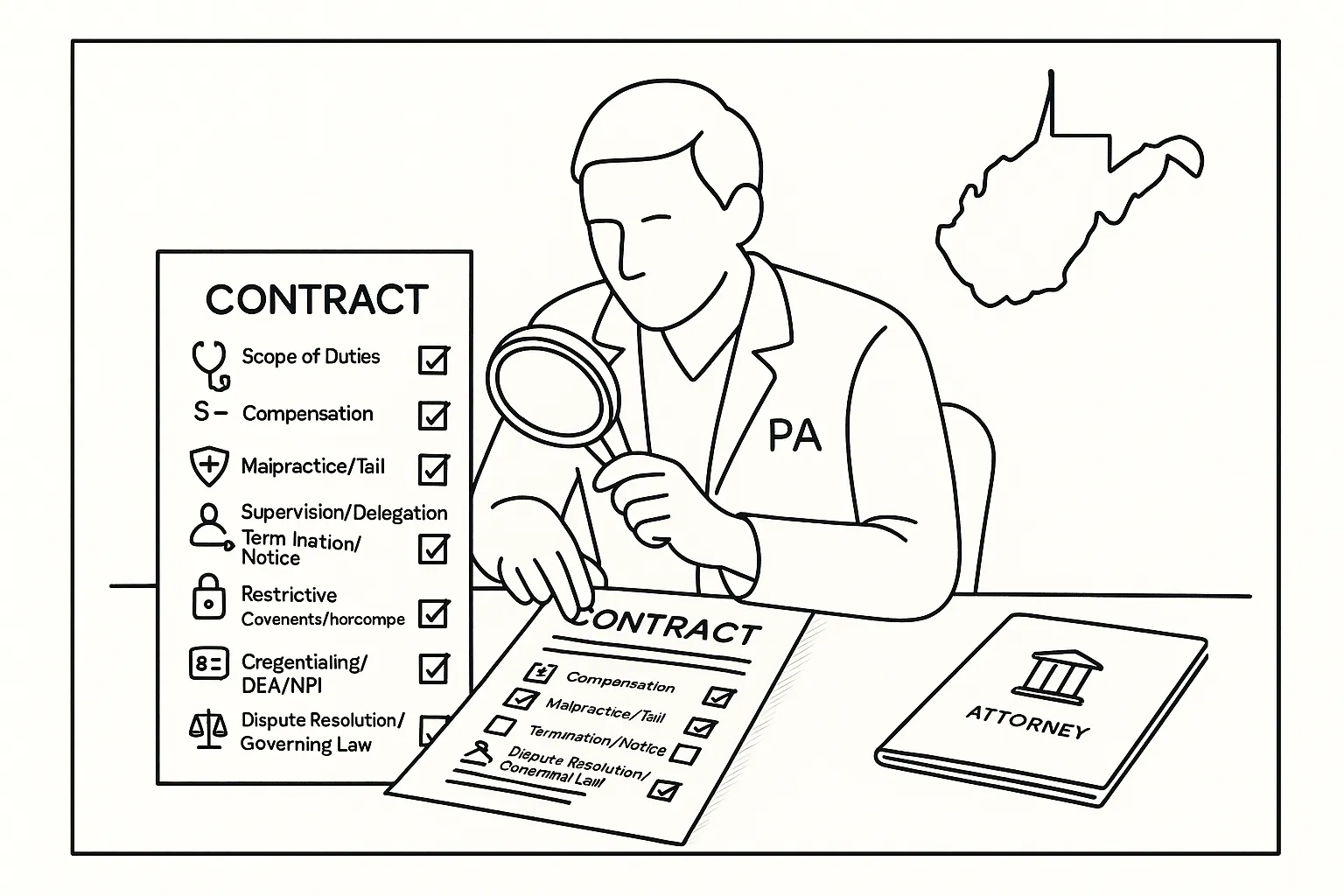
A physician assistant agreement should use clear language for the terms that materially affect clinical practice, compensation, and career mobility. At minimum, the document should address:
- Scope of duties, job description, practice locations, and schedule expectations.
- Base pay, productivity compensation, collections, RVU formulas, bonuses, and deductions.
- Malpractice insurance, policy type, coverage limits, and tail obligations.
- Supervision, delegation, prescribing responsibilities, and changes to the supervising relationship.
- Termination events, notice periods, final compensation, and repayment obligations.
- Non-compete, non-solicitation, confidentiality, and other post-employment restrictions.
- Credentialing, DEA and NPI responsibilities, dispute resolution, governing law, and venue.
Ambiguity in these areas can shift operational and financial risk to the PA. Vague supervision language may create compliance concerns, while an imprecise compensation formula can obscure how productivity becomes take-home pay. Employer-favorable definitions of terms such as “cause,” “gross misconduct,” or “productivity shortfall” may also affect termination rights, incentive compensation, and repayment exposure.
Physician assistants evaluating West Virginia employment offers can also consult the West Virginia Academy of Physician Assistants for professional and legislative updates. Those materials do not replace a contract-specific legal review, but they may provide useful context for developments affecting PA practice in the state.
Scope of Practice, Supervision, and Work Locations
The agreement should contain a precise job description or incorporate one as an exhibit. Duties may include patient care, procedures, administrative work, chart completion, call coverage, and work at multiple facilities. The contract should clearly identify the PA’s primary location and explain when the employer may require work at another clinic, hospital, or facility.
Supervision and delegation provisions should align with the role contemplated by the employer and West Virginia practice requirements. The contract should explain how the supervising relationship, prescribing responsibilities, protocols, and related documents are handled. Language allowing the employer to change the supervising physician, clinical duties, practice location, or supervision model unilaterally may expose the PA to altered responsibilities or compliance concerns.
Scheduling, Call Coverage, and Performance Expectations
Expected hours, weekend duties, call frequency, schedule changes, and multi-site assignments should be stated with enough specificity to evaluate the workload. A PA should also determine whether call is included in base compensation, separately paid, or tied to productivity credit. Reviewing call schedule and coverage requirements can reveal obligations that are not apparent from the stated salary.
If performance metrics affect compensation or continued employment, the contract should define the measurement method, access to supporting data, and any opportunity to correct a shortfall before penalties or termination. Moonlighting restrictions should likewise be clear rather than leaving all outside professional activity to employer discretion.
Compensation, Productivity, and Financial Risk

Compensation is often the most consequential part of a PA agreement. A meaningful review of compensation and productivity terms examines not only the headline salary or conversion factor but also the definitions, calculations, reconciliation periods, reporting rights, and deductions that determine actual earnings.
Base Salary, Collections, and RVU Models
Common models include a guaranteed base salary, base pay with productivity adjustments, collections-based compensation, and RVU-based pay. Under a base-plus-productivity structure, the contract should state whether reconciliation occurs monthly, quarterly, or annually and whether a shortfall creates negative accrual that carries into a later period. A collections model should explain how payer delays, denials, refunds, and chargebacks affect credit for services already performed.
RVU compensation converts clinical work into units under a stated conversion factor. For example, 4,000 credited RVUs multiplied by a $40 conversion factor equals $160,000 in calculated productivity compensation. The agreement should identify whether credit depends on billed, allowed, or collected services and how shared visits, global services, and documentation are treated. Definitions such as “productive RVU” and “billable encounter,” along with unilateral employer adjustment rights, deserve close review.
Bonuses, Repayment Terms, and Pay Transparency
Quality incentives, productivity bonuses, signing bonuses, relocation assistance, and student loan payments may appear favorable while creating substantial repayment obligations. The contract should define the measurement period, payout date, whether the incentive is discretionary or contractual, and what happens when employment ends before payment. Any sign-on bonus repayment language should identify the amount owed, vesting schedule, triggering events, interest, fees, and whether repayment is prorated.
Deductions and withholdings should also be transparent. Relevant terms include payroll taxes, benefit contributions, billing fees, overpayment recovery, payer adjustments, and chargebacks for uncollected services. Detailed productivity reports, notice before retroactive adjustments, and a procedure for disputing calculations can reduce the risk of disagreements over earned compensation.
Malpractice Coverage and Post-Employment Restrictions
Non-Compete and Non-Solicitation Clauses
Restrictive covenants can affect where a physician assistant works, which patients or employees the PA may contact, and what activities are permitted after separation. The practical impact depends on the restriction’s duration, geographic reach, covered services, employer locations, and triggering events. A provision that applies after every form of separation may carry different risk from one limited to a voluntary resignation or a particular type of termination.
A focused PA non-compete review considers whether the language extends beyond the employer’s actual operations, restricts general medical practice rather than defined activities, or applies to facilities where the PA never worked. Non-solicitation and confidentiality provisions should also distinguish prohibited conduct from patients or employees who independently contact the PA.
Some agreements include limited geographic carveouts, exceptions for pre-existing relationships, or a buyout. A buyout formula should be evaluated for affordability and clarity, while any carveout should be written directly into the contract. The agreement should also explain how the employer determines whether prohibited solicitation occurred.
Malpractice Insurance and Tail Obligations
Malpractice provisions should identify the policy type, applicable limits, covered services, and who pays the premium. An occurrence policy generally covers acts occurring during the policy period even if a claim is asserted later. Claims-made coverage generally requires coverage to be in effect when the claim is made, which can create a need for tail coverage after employment ends.
If the employer uses a claims-made policy, the agreement should allocate responsibility for an extended reporting endorsement. The PA should know whether the employer purchases tail after every separation or only after specified events, such as termination without cause. If the PA must pay, the contract should address the purchase deadline, required limits, proof of coverage, and any related reimbursement or repayment provisions. A detailed guide to tail insurance for physician assistants can help clarify why this obligation matters before the contract is signed.
Termination, Clawbacks, and Final Compensation
Termination language determines how the relationship ends and what financial obligations survive. Cause definitions commonly address matters such as material breach, fraud, loss of licensure, or criminal conduct, but some contracts also use subjective performance standards. The agreement should state whether notice and an opportunity to cure are available. Without-cause termination terms should identify the required notice period and what happens if the employer removes the PA from the schedule during that period.
A comprehensive contract termination review also examines final salary, accrued benefits, earned bonuses, collections received after departure, severance, and continuing malpractice obligations. In collections-based arrangements, the contract should explain whether the PA receives credit for services performed before termination but collected afterward.
Clawbacks may apply to signing bonuses, relocation payments, student loan assistance, training expenses, or other advances. Repayment mechanics should specify the balance, vesting method, acceleration events, interest, administrative fees, and collection remedies. These provisions should be read together with the termination clause because the financial result may differ depending on who ends the agreement and why.
Credentialing, Dispute Terms, and Attorney Review
Operational provisions should state who initiates and pays for professional licensing, payer credentialing, hospital privileges, DEA registration, and NPI-related tasks. Because credentialing delays can create contract risks, the agreement should explain whether pay begins on a fixed date, after credentialing, or only after the PA starts seeing patients. It should also address whether a delay permits termination or changes repayment obligations.
Dispute provisions determine whether disagreements proceed through arbitration or court litigation and where a claim must be brought. Governing-law and venue clauses that point outside West Virginia may increase expense and complexity. The agreement should also clarify available remedies, fee-shifting language, class or collective action waivers, and whether the employer may seek immediate injunctive relief for an alleged restrictive-covenant violation.
An attorney review is most useful before the agreement is signed or an offer deadline expires. The PA should provide the complete offer letter, employment or contractor agreement, job description, productivity schedules, supervision documents, bonus terms, and other incorporated exhibits. High-priority concerns include vague compensation definitions, negative accrual, unilateral deductions, unclear tail responsibility, broad restrictive covenants, changeable supervision terms, misaligned contractor provisions, and repayment obligations triggered by separation.
Review Your West Virginia PA Contract Before Signing
Chelle Law reviews physician assistant agreements for compensation risk, supervision terms, restrictive covenants, malpractice obligations, termination rights, and repayment exposure.
Contact Chelle LawExplore Physician Assistant Contract Guidance
Find attorney-led review services, practical contract resources, and state-specific guidance for physician assistants.