
Physician assistant employment and independent contractor agreements in Wisconsin must account for the professional requirements overseen by the Wisconsin Medical Examining Board, including state-specific considerations involving PA scope of practice, supervision, delegation, and prescribing. Those requirements can affect how an agreement defines clinical duties, supervisory relationships, work locations, and responsibility for maintaining compliance. PAs evaluating opportunities in Milwaukee, Madison, and other Wisconsin healthcare markets also need to understand how compensation formulas, malpractice coverage, restrictive covenants, termination rights, and repayment obligations may affect their income and mobility. Chelle Law reviews these provisions together rather than treating them as isolated clauses because a favorable salary can be undermined by an unclear productivity formula, expensive tail obligation, broad noncompete, or difficult exit provision. A focused review explains the practical consequences of the proposed terms before the PA signs.
Why Contract Review Matters for Wisconsin Physician Assistants

Physician assistant agreements are generally drafted to protect the employer’s operational and financial interests. A single provision can reduce take-home pay, create an unexpected repayment obligation, restrict post-employment opportunities, or leave the PA responsible for malpractice tail coverage. A line-by-line review identifies how the provisions interact and whether the written agreement reflects the position described during recruitment.
The review should also consider whether supervision, delegation, and clinical-duty provisions are consistent with the Wisconsin practice setting described to the PA. Regulatory information and advocacy materials from the Wisconsin Academy of Physician Assistants may provide useful professional context, but they do not replace a legal review of the proposed agreement. The purpose of attorney review is not to promise a particular outcome; it is to identify and explain financial, regulatory, and mobility risks so the PA can make an informed decision.
Compensation, Productivity, and Benefits Terms
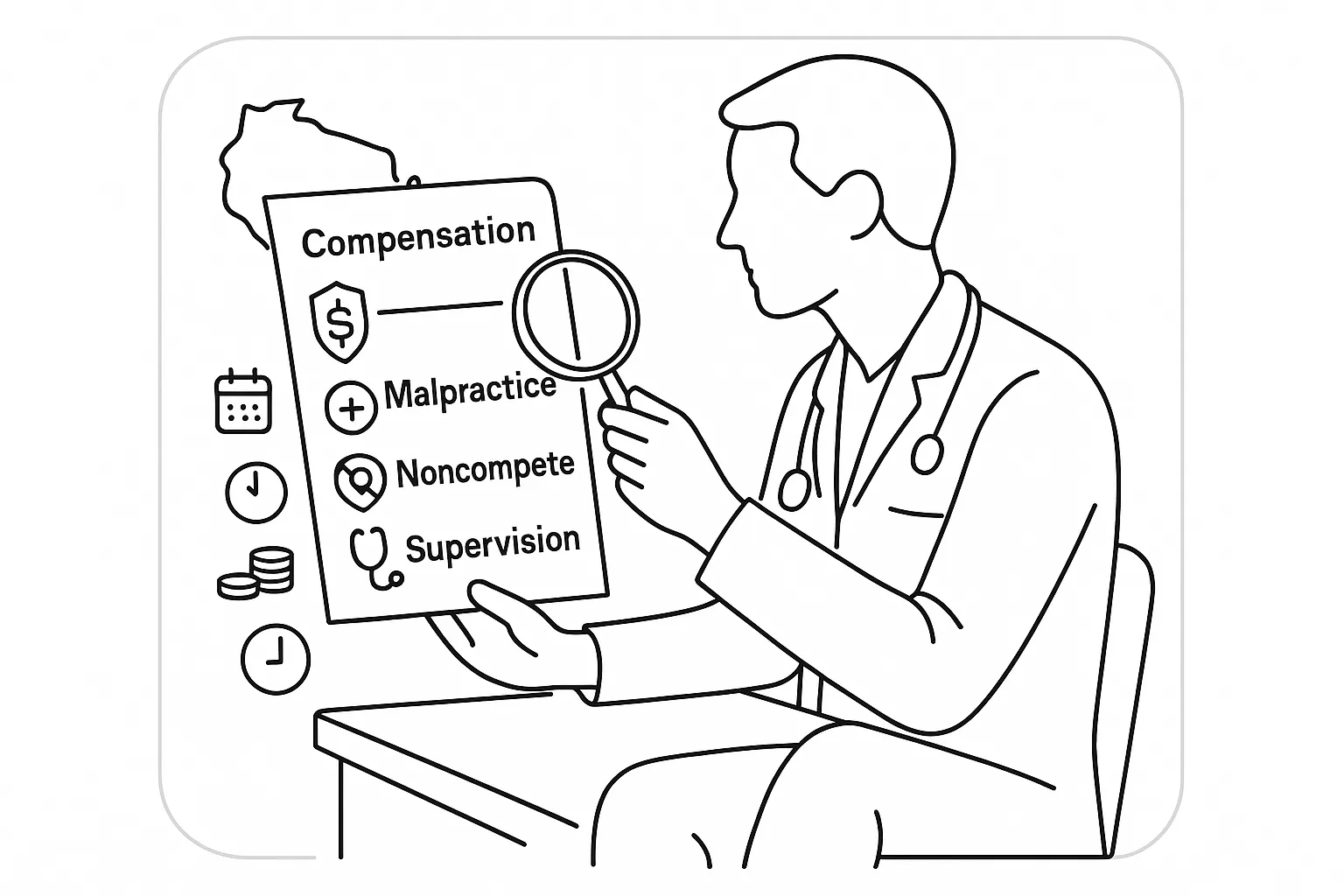
Compensation may include a guaranteed base salary, collections-based pay, an RVU formula, or a combination of salary and incentives. A thorough PA compensation and productivity review examines the definitions, thresholds, measurement periods, payment dates, reconciliation procedures, and employer discretion built into the formula. The agreement should make clear whether the stated salary is a true guarantee or may be reduced through offsets, draws, recoupment, or productivity conditions.
- Collections-based compensation: Confirm how collections are defined, when they are credited, how refunds or denials are handled, and whether the PA can review the employer’s calculations.
- RVU compensation: Identify the RVU schedule, applicable multiplier, threshold, excluded services, coding-adjustment process, and timing of incentive payments.
- Draws and negative accrual: Determine whether a shortfall carries forward and whether repayment exposure is capped or limited in time.
- Bonuses: Review objective triggers, partial-year calculations, payment deadlines, and any forfeiture or clawback language.
- Benefits: Evaluate health coverage, retirement contributions, paid leave, CME allowances, licensing expenses, eligibility dates, and vesting requirements as part of total compensation.
Signing bonuses, relocation assistance, and training payments can improve the initial offer but may also create repayment exposure if employment ends early. The contract should state whether repayment is prorated, which termination events trigger it, and whether the obligation applies when the employer ends the relationship without cause.
Malpractice Coverage and Restrictive Covenants
Malpractice provisions should identify the type of policy, coverage limits, responsibility for premiums, and any post-employment obligation. Occurrence coverage generally protects covered events that occur during the policy period, even if a claim is made later. Claims-made coverage ordinarily requires continued protection for claims reported after the policy ends, making responsibility for PA tail insurance an important contract issue. Ambiguous language can leave the PA responsible for a substantial expense after departure.
Indemnification language also deserves careful attention because it may attempt to shift liability beyond the PA’s own conduct. The agreement should not be read as though malpractice insurance and indemnification are interchangeable; each provision can create a different type of exposure.
Noncompete and non-solicitation clauses can restrict where a PA works, which services the PA performs, and whether the PA may interact with former patients, referral sources, or employees. A physician assistant noncompete review evaluates the duration, geographic reach, prohibited activities, triggering events, and practical effect of the restriction without assuming that every covenant will be treated the same way. Even when enforceability is uncertain, broad language can create negotiation pressure, relocation costs, or dispute risk.
Supervision, Workload, and Termination Provisions
The agreement should describe the PA’s clinical duties, supervisory structure, practice locations, schedule, call responsibilities, and documentation expectations with enough specificity to avoid material surprises. Supervision and delegation language should fit the contemplated Wisconsin practice arrangement and explain how a change in supervising physician, staffing model, or worksite will be addressed. Multi-site assignments and remote coverage should not be left solely to undefined employer discretion when they materially affect travel, workload, or compliance responsibilities.
Work hours, clinic sessions, patient-volume expectations, and on-call duties can affect both compensation and job sustainability. When call is required, the contract should address frequency, response expectations, coverage locations, and whether compensation is included in salary or paid separately. The related guide to call schedules and coverage requirements explains why operational expectations should be documented rather than left to informal practice.
Termination provisions determine how the relationship can end and what happens financially afterward. A focused contract termination review should address without-cause notice, for-cause events, opportunities to cure alleged breaches, immediate termination rights, final compensation, outstanding collections, bonus eligibility, tail coverage, and repayment obligations. Notice periods should be evaluated alongside restrictive covenants and start-date requirements for a future position because those provisions collectively control the PA’s ability to transition.
How to Identify and Negotiate Contract Risk
Effective review focuses on how the language will operate in realistic circumstances, not merely whether a topic appears somewhere in the agreement. Common warning signs include undefined compensation terms, discretionary bonuses, broad restrictive covenants, unclear tail responsibility, indefinite repayment obligations, and vague supervision or performance standards.
- Ask who pays for tail coverage under each possible termination scenario.
- Request written definitions for collections, RVUs, thresholds, multipliers, and reconciliation periods.
- Clarify which events activate a noncompete, non-solicitation restriction, or repayment obligation.
- Confirm how supervisory changes, multi-site work, schedule changes, and additional call duties will be handled.
- Seek objective performance standards and a defined process for disputing compensation calculations or alleged deficiencies.
Negotiation priorities should be based on the magnitude and likelihood of the risk. Compensation provisions may need clearer calculations and reporting rights; malpractice language may need an express allocation of tail costs; restrictive covenants may need narrower activities, geography, or duration; and termination language may need a workable notice period or cure opportunity. The goal is not to request changes indiscriminately but to focus on provisions that materially affect income, liability, compliance, and future employment.
Recruitment promises about schedule, compensation, leadership duties, location, or advancement should be incorporated into the controlling documents. Differences among an offer letter, emails, and the formal contract can create avoidable disputes, particularly when the agreement contains an integration clause stating that prior discussions are not binding.
Wisconsin PA Pre-Signing Checklist
Before signing, a Wisconsin PA should verify that the complete agreement accurately states the financial and professional terms of the position. Important review steps include:
- Confirm licensure, credentialing, payer-enrollment, and start-date conditions, including responsibility for related costs and delays.
- Calculate expected compensation under realistic patient-volume and payer-mix assumptions rather than relying only on headline salary figures.
- Verify malpractice policy type, tail responsibility, indemnification language, and any reporting obligations.
- Review supervision, delegation, prescribing, duties, work locations, call coverage, and schedule expectations together.
- Compare termination rights, notice periods, restrictive covenants, final-payment terms, and bonus or relocation repayment provisions.
- Make sure negotiated changes and recruitment promises appear in the final written agreement before signing.
Credentialing and licensure contingencies deserve particular attention when the proposed start date is firm or compensation does not begin until approvals are complete. The discussion of credentialing delays and contract risks identifies issues that can arise when the agreement does not clearly allocate delay-related consequences.
Attorney review is especially useful when the agreement contains productivity compensation, a noncompete, claims-made malpractice coverage, substantial repayment obligations, multi-site duties, or an independent contractor structure. Chelle Law reviews the complete agreement, explains the practical effect of key clauses, and can provide written comments or proposed revisions when appropriate.
Review Your Wisconsin PA Contract Before Signing
Chelle Law can identify compensation, malpractice, supervision, termination, repayment, and restrictive-covenant risks in your proposed physician assistant agreement.
Contact Chelle Law