
Signing bonuses are a common recruiting incentive hospitals, health systems, and private practices use to attract physicians, particularly in competitive specialties and underserved regions. The payment may help with relocation, onboarding expenses, or the financial transition into a new position, but it often comes with a repayment obligation if the physician leaves before completing a stated service period.
The financial risk depends on more than the bonus amount. A contract may require repayment after voluntary resignation, termination for cause, loss of licensure or privileges, credentialing problems, or failure to satisfy defined productivity milestones. It may also require repayment of the gross bonus rather than the amount the physician received after withholding, permit deductions from final compensation, or make the entire balance immediately due.
Chelle Law reviews physician agreements to identify those triggers, determine how the repayment formula interacts with termination and compensation provisions, and evaluate the language under the controlling state law. Having reviewed thousands of physician contracts nationwide, we have seen how seemingly small drafting choices can turn a reasonable recruitment incentive into a substantial liability. This guide explains how signing bonus agreements work, what affects enforceability, the defenses physicians may raise, and the terms worth negotiating before signing.
Key Takeaways
- Physician signing bonuses often include clawback clauses requiring repayment if the physician leaves, is terminated, or fails to satisfy defined milestones.
- Enforceability depends on the contract language, including the repayment triggers, proration terms, calculation method, and length of the service commitment.
- Physicians should negotiate objectively verifiable triggers, proportional repayment, a specific definition of “cause,” and clear repayment mechanics before signing.
- Potential defenses include employer breach, ambiguity, misrepresentation, impossibility, and arguments that the repayment provision operates as an unreasonable penalty.
- State wage laws, restrictive covenant rules, and malpractice insurance arrangements may materially affect how a repayment obligation operates.
How Physician Signing Bonus Agreements Work

Hospitals, health systems, and private groups offer signing bonuses to make an employment offer more attractive or offset relocation and onboarding costs. A physician agreement may structure the incentive as an up-front lump-sum payment, staged payments tied to the start date or credentialing, or relocation and onboarding reimbursement treated like a bonus for repayment purposes. Physicians should distinguish these payments from guaranteed salary and separately review any relocation allowance terms.
- An up-front lump-sum payment made after signing or beginning employment.
- Staged payments tied to the start date, credentialing, or initial productivity targets.
- Relocation or onboarding reimbursement labeled as a bonus but subject to similar repayment obligations.
The employer typically pairs the payment with a repayment or “clawback” clause. That provision identifies the events that trigger repayment, the amount owed, the length of the service commitment, and any schedule for payment or deductions. Employers generally prefer broad triggers, while physicians benefit from narrow, objective events and a balance that decreases as the service commitment is completed.
Signing bonuses may also be tied to a guaranteed salary period, an initial productivity ramp-up, or a commitment to serve a particular community. Large health systems sometimes use standardized bonus forms across multiple jurisdictions, even though local wage laws and other state requirements may differ. A detailed guide to physician signing bonus repayment terms can help physicians identify the provisions that require closer review.
Repayment Triggers and Contract Terms That Affect Enforceability
Common Events That Trigger Bonus Repayment
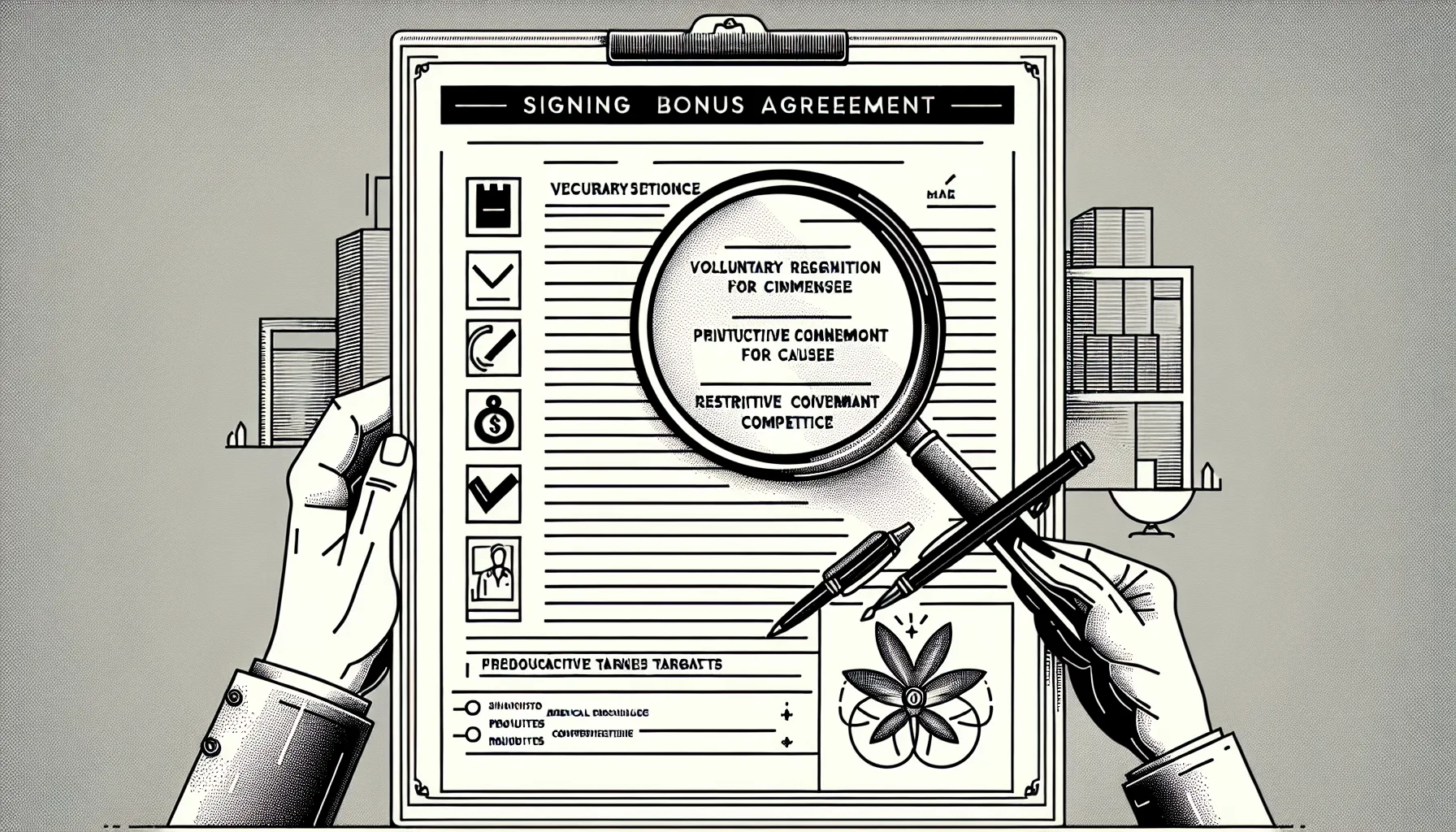
A clawback provision should state exactly when repayment becomes due. Common triggers include voluntary resignation during a defined period, termination for cause, failure to obtain or maintain medical staff privileges or licensure, breach of a restrictive covenant, and failure to satisfy productivity or quality metrics when the bonus is expressly linked to those standards.
- Voluntary resignation within a defined period, commonly stated as 12 to 36 months.
- Termination for cause under the agreement’s definition of cause.
- Failure to obtain or maintain required medical licensure, credentialing, or staff privileges.
- Breach of a noncompete or another restrictive covenant, sometimes framed as a separate measure of damages.
- Failure to satisfy RVU, productivity, or quality requirements expressly connected to the payment.
Whether one of these events actually requires repayment depends on the clause’s specificity and its interaction with the rest of the agreement. “Termination for cause” can be especially contentious when the employer uses a broad definition that includes subjective performance expectations. Physicians should seek an enumerated definition of cause, notice when a problem can be corrected, and a reasonable opportunity to cure before repayment is triggered.
Productivity-based triggers also require objective standards. The agreement should identify the applicable measurement period, RVU methodology, data source, attribution rules, and consequences of circumstances outside the physician’s control. These provisions should be considered alongside a focused review of physician compensation and RVU terms.
Proration, Repayment Calculations, and Acceleration
Several drafting details may distinguish a reasonable reimbursement obligation from an overly aggressive clawback. The clause should use clear language, establish a defined service period, explain whether the balance is prorated, and provide a calculation method. It should also address whether repayment is based on the gross bonus or the net amount received after taxes and withholding.
- Clear triggers: The contract should describe the precise event that causes repayment rather than relying on vague performance or conduct standards.
- Proportional repayment: The balance should ordinarily decrease as the physician completes the required service period.
- Defined calculation: The agreement should explain whether repayment is calculated using the gross payment, the net amount received, or another stated formula.
- Payment mechanics: The clause should state when repayment is due, whether installments are available, and whether interest or collection costs may apply.
- Offsets and remedies: The contract should address whether the employer may deduct the balance from final wages, bonuses, accrued compensation, or benefits.
- Acceleration: Language making the entire balance immediately due after any alleged breach deserves careful review.
For example, if a physician completes 18 months of a 36-month service commitment, a proportional formula recognizes the value already provided. A requirement to repay the entire amount despite substantial performance may create a significantly harsher result. Physicians can also negotiate a short repayment window tied to costs the employer can identify, installment options, and language preventing unilateral deductions where state law does not permit them.
Defenses to Repayment Claims and State-Law Considerations
Employer Breach, Ambiguity, and Other Potential Defenses
Physicians are not necessarily required to accept every repayment demand at face value. The contract, the employer’s performance, recruitment communications, and the circumstances surrounding departure may support defenses or negotiating leverage. Potential arguments include employer breach, ambiguity in the clawback language, fraud or misrepresentation, impossibility, frustration of purpose, unconscionability, or a contention that the amount functions as an unreasonable penalty rather than compensation for an actual loss.
- Employer breach: The employer failed to provide promised resources, compensation, staffing, or support necessary for the physician to perform.
- Credentialing delays: Employer-controlled delays prevented the physician from starting work or satisfying productivity requirements.
- Ambiguous drafting: The agreement does not clearly identify the triggering event, amount owed, or method of calculation.
- Fraud or misrepresentation: The employer materially misrepresented duties, call expectations, facility resources, or other recruitment terms.
- Impossibility or frustration: Licensure, immigration, or credentialing circumstances made performance impossible.
- Penalty or unconscionability arguments: The amount demanded bears little relationship to the employer’s loss or imposes a severely one-sided obligation.
Evidence matters when asserting these defenses. Physicians should preserve offer letters, recruitment emails, productivity reports, credentialing records, notices of breach, and communications about promised staffing or resources. If the dispute follows departure, the repayment demand should also be evaluated alongside the agreement’s notice requirements and the rules for terminating a physician contract.
How State Law and Related Contract Terms Change the Analysis
State law can materially affect enforcement, available remedies, and the employer’s ability to collect the claimed balance. Some states restrict deductions from final wages or require specific written authorization before an employer may offset a debt against compensation. State contract law also affects how courts analyze ambiguity, penalties, unconscionability, and the remedies available after an alleged breach.
Restrictive covenant law is another important consideration. California generally prohibits employee noncompetes, subject to limited statutory exceptions, while other jurisdictions may permit carefully limited restrictions or impose profession-specific requirements. As noncompete rules change, employers may rely more heavily on repayment provisions or other financial disincentives. Physicians should therefore examine a clawback together with the agreement’s noncompete and restrictive covenant provisions, rather than treating each clause in isolation.
Malpractice coverage can also create a separate departure expense. Some employers provide occurrence coverage, while others use claims-made coverage and assign responsibility for tail insurance when employment ends. If a contract connects a bonus, tail reimbursement, or departure payment, it should clearly explain whether those obligations are separate, cumulative, or subject to proration. A dedicated malpractice and tail insurance review can clarify the potential cost before the physician accepts the offer.
Compensation structures vary by specialty, employer, and market as well. Academic centers and health systems may use base salary plus productivity and quality incentives, while rural or hard-to-recruit positions may rely more heavily on guarantees and signing bonuses. These market differences influence the value of the payment and the leverage available in negotiations, but they do not replace analysis of the actual contract and controlling state law. Physicians can use the state-specific physician contract review pages to find guidance for the jurisdiction governing their agreement.
How to Negotiate Safer Physician Signing Bonus Terms
A physician usually has the most leverage before accepting the offer or receiving the payment. The objective is not necessarily to eliminate repayment altogether, but to ensure the obligation is understandable, proportional, and tied to events the physician can reasonably control.
- Clarify the payment type. Determine whether the payment is a signing bonus, relocation reimbursement, salary advance, retention payment, or another form of compensation.
- Narrow the triggers. Limit repayment to specific, objectively verifiable events, such as voluntary resignation during a stated service period.
- Require proration. The balance should decline monthly or according to another clearly stated formula as the physician completes the commitment.
- Define cause. Ask the employer to identify the events constituting cause and provide notice and an opportunity to cure when appropriate.
- Address termination without cause. The physician should not automatically owe repayment when the employer elects to end the relationship without alleging wrongdoing.
- Define the repayment amount. State whether the physician owes the gross payment, the net amount received, or a formula accounting for taxes and withholding.
- Separate tail insurance obligations. Avoid combining malpractice tail costs and bonus repayment unless their relationship is clearly explained.
- Negotiate payment options. Consider installments or a reasonable payment period instead of immediate acceleration of the full balance.
- Put every promise in writing. Recruitment assurances should appear in the signed agreement or an incorporated addendum.
These revisions can protect the physician’s finances while giving the employer a reasonable remedy if the agreed service commitment is not completed. A clear alternative is often more persuasive in negotiation than simply asking the employer to delete the provision. Physicians should also confirm that the bonus terms do not conflict with the termination, compensation, restrictive covenant, credentialing, or malpractice sections elsewhere in the agreement.
When to Seek Physician Contract or Repayment-Dispute Counsel
Legal review is especially important when a repayment clause applies to termination “for any reason,” uses vague performance standards, requires repayment of the full gross amount, permits immediate deductions, or combines the bonus with tail insurance and restrictive covenant obligations. Review before signing provides the best opportunity to clarify the language and negotiate proportional terms.
If an employer has already demanded repayment, counsel can examine whether the stated trigger occurred, whether the employer performed its own obligations, and whether the calculation follows the agreement and controlling law. Prompt review also helps preserve evidence concerning recruitment representations, credentialing delays, unpaid compensation, and the circumstances of termination. Chelle Law provides focused physician contract review under attorney Robert Chelle’s guidance for physicians evaluating an offer or responding to a repayment claim.
Frequently Asked Questions
When can a physician signing bonus require repayment?
A repayment obligation may apply when the contract clearly identifies a triggering event, such as voluntary resignation during the service period, termination for defined cause, loss of required licensure or privileges, or failure to satisfy expressly stated conditions. Enforceability ultimately depends on the agreement and controlling state law.
What terms most affect whether a signing bonus clawback is enforceable?
Important terms include the clarity of the triggering events, the length of the service commitment, whether repayment is prorated, how the amount is calculated, and whether the obligation reasonably compensates the employer rather than operating as a penalty.
How can physicians reduce signing bonus repayment risk before signing?
Physicians can negotiate narrow and objective triggers, proportional repayment, a specific definition of cause, notice-and-cure protections, clear gross-versus-net repayment language, and installment options. Every negotiated protection should appear in the signed agreement or an incorporated addendum.
Can an employer deduct a signing bonus from a physician’s final paycheck?
That depends on the contract and applicable state wage law. Some jurisdictions restrict deductions or require written authorization, so the agreement should address offsets expressly and should not be assumed to override statutory protections.
Can employer credentialing delays or misrepresentations defeat a repayment claim?
They may support defenses or negotiating leverage when the employer’s conduct prevented performance or materially contradicted recruitment promises. Physicians should preserve credentialing records, emails, offer documents, and evidence concerning promised resources or duties.
Should repayment apply if the employer terminates the physician without cause?
The contract should answer this directly. Physicians commonly seek language eliminating repayment when the employer terminates without cause or, at minimum, limiting the obligation to a prorated amount so the employer cannot end the relationship and demand the entire bonus.
Have a Physician Signing Bonus Reviewed
Chelle Law can review the repayment triggers, proration formula, termination language, and related contract provisions before you sign or after an employer makes a repayment demand.
Contact Chelle LawExplore Physician Contract Guidance
Review legal services, practical contract resources, and state-specific guidance for physician employment agreements.