
Medical malpractice insurance is more than a benefit listed in a physician employment agreement. The type of coverage determines which professional-liability claims may be protected, when a claim must be made or reported, and what happens after the physician leaves the employer. Claims-made and occurrence policies can both cover patient-care liability, but they use different coverage triggers and create different post-employment risks.
Those differences can materially change the value of an offer. A physician covered under a claims-made policy may face a significant tail obligation at departure, while occurrence coverage generally continues to protect covered incidents that happened during the policy period without a separate tail purchase. The analysis also depends on the retroactive date, reporting language, exclusions, policy limits, defense-cost provisions, prior-acts coverage, and the circumstances under which employment ends.
This guide explains how each coverage form works, why an extended reporting period does not correct every policy limitation, and how malpractice obligations interact with termination and compensation terms. Chelle Law’s physician malpractice and tail insurance review evaluates the agreement alongside available insurance documents so the physician can identify gaps, contingent expenses, and provisions that may warrant clarification before signing.
Key Takeaways
- Coverage triggers differ: Occurrence coverage follows a covered incident that happens during the policy period. Claims-made coverage generally depends on when a claim is first made, while some claims-made-and-reported forms also impose a specific reporting deadline.
- Departure can create a coverage gap: A physician leaving claims-made coverage may need an extended reporting period, qualifying prior-acts coverage, or another valid arrangement for later claims arising from earlier care.
- Tail coverage has limits: Tail ordinarily extends the time to report qualifying claims. It does not rewrite the retroactive date, remove exclusions, or expand the underlying scope of covered services.
- Responsibility must be allocated: The employment agreement needs to address who pays for post-employment protection under resignation, termination, non-renewal, disability, retirement, and transaction-related scenarios.
- The policy controls actual protection: Contract language, certificates, declarations, endorsements, and policy terms must be reviewed together rather than relying on a general promise that malpractice insurance will be provided.
What Triggers Claims-Made and Occurrence Coverage?

An employer’s commitment to provide professional-liability insurance does not, by itself, establish how the coverage responds. The policy form, named insureds, covered services, effective dates, endorsements, and exclusions determine the actual protection. The National Association of Insurance Commissioners’ medical malpractice insurance guidance describes the central timing distinction between claims-made and occurrence coverage, but the wording of the physician’s specific policy remains controlling.
Claims-Made and Claims-Made-and-Reported Policies
A claims-made policy generally responds when a covered claim is first made against the insured during the policy period or an applicable extended reporting period. Some forms are written as claims-made-and-reported coverage and also require the claim to be reported to the insurer within the time specified by the policy. That distinction matters because a physician may receive notice of a claim during the policy period but lose coverage if a separate reporting requirement is not satisfied.
Coverage also ordinarily depends on the alleged professional service occurring on or after the policy’s retroactive date. Definitions of a claim, notice requirements, related-claim provisions, and knowledge exclusions can further affect whether the policy responds. Contract review therefore needs to distinguish the general coverage label from the policy’s actual timing mechanics.
Occurrence Policies
An occurrence policy generally covers a qualifying incident that took place while the policy was active, even if the patient asserts the claim after the policy period or the physician’s employment has ended. Coverage remains tied to the policy in effect when the covered care occurred. As a result, occurrence coverage ordinarily avoids the need to purchase tail solely because the physician leaves the employer.
That advantage does not eliminate the need to examine limits, exclusions, covered locations, insured status, and defense provisions. The physician must also confirm that the arrangement is genuinely occurrence-based rather than a claims-made policy combined with an employer promise to address future claims.
Tail Coverage, Retroactive Dates, and Prior Acts
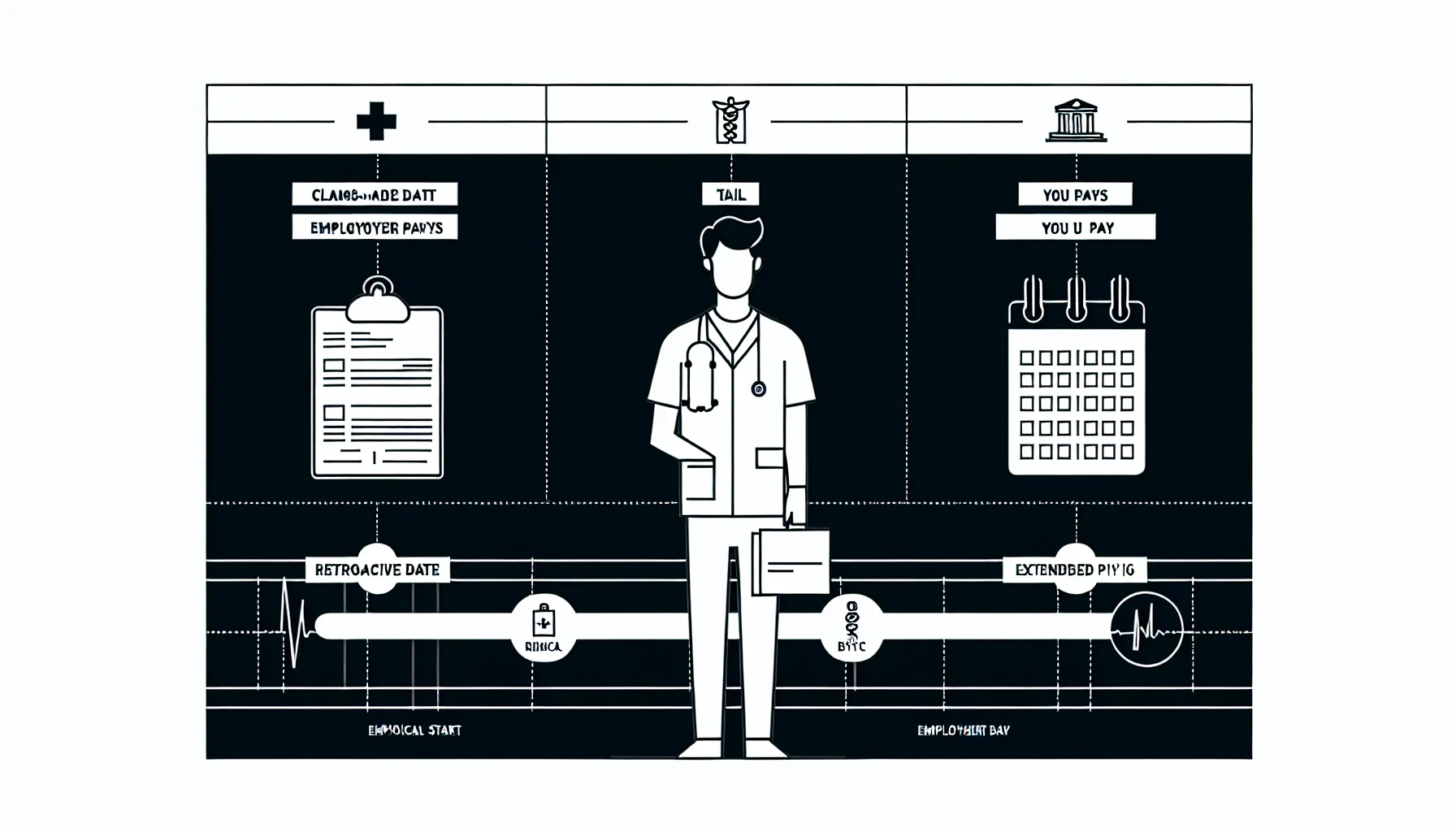
Claims can arise months or years after the underlying treatment. If claims-made coverage ends when employment terminates, later claims involving care provided during the job may require an extended reporting period or a replacement policy that covers prior acts. Continued protection is not automatic merely because the employer’s broader insurance program remains in place; the result depends on insured status, policy termination terms, reporting requirements, and any applicable endorsements.
What an Extended Reporting Period Does—and Does Not Do
Tail coverage is commonly structured as an extended reporting period. It permits qualifying claims to be reported after a claims-made policy ends when the underlying act otherwise falls within that policy’s covered period. The extension may last for a defined number of years or may be written without a stated reporting cutoff, depending on the endorsement and governing requirements.
An extended reporting period does not ordinarily broaden the services covered by the original policy. It also does not correct an unfavorable retroactive date, eliminate an exclusion, increase inadequate limits, or create prior-acts protection for care that was never within the policy’s coverage grant. Physicians can review these distinctions in greater depth in Chelle Law’s guide to tail insurance for physicians.
Retroactive Dates and Replacement Coverage
The retroactive date identifies the earliest professional services potentially covered under a claims-made policy, subject to the policy’s remaining terms. Moving that date forward can leave earlier care outside the replacement policy. A physician changing employers should compare the prior policy, the new policy, and any tail endorsement to determine whether continuous protection exists.
Prior-acts coverage, sometimes called nose coverage, may allow a new policy to respond to qualifying services performed before its effective date. It is not interchangeable with tail coverage in every situation. The new insurer’s retroactive date, exclusions, insured definitions, and treatment of known or previously reported matters all require review before the physician relies on replacement coverage.
Who Bears the Cost After Employment Ends?
A physician employment contract may place the entire tail obligation on the employer, assign it to the physician, or divide responsibility according to how and why employment ends. Common triggers include resignation, termination without cause, termination for cause, non-renewal, disability, retirement, death, a practice sale, or another change in control. The agreement may also condition employer payment on a minimum period of service or require the physician to reimburse a declining portion of the cost.
The financial effect cannot be evaluated from a universal premium formula. Cost varies with specialty, location, limits, claims history, carrier pricing, policy maturity, and the length or form of the reporting extension. Physicians comparing offers can request a current estimate based on the actual policy rather than relying on a general industry multiple.
Occurrence coverage has economic value because it generally removes a separate tail-purchase obligation for covered incidents during the policy term. Conversely, a physician-paid tail obligation can reduce the effective value of salary, a signing bonus, or relocation assistance. Reviewing that contingent cost alongside the broader physician compensation structure provides a more accurate comparison between offers.
Tail allocation must also be coordinated with the agreement’s separation provisions. Notice periods, repayment obligations, and the definition of cause can influence both the timing and cost of departure. Chelle Law’s resource on terminating a physician contract explains how these provisions can interact when employment ends.
Review the Employment Agreement and Insurance Documents Together
A sentence stating that the employer will provide malpractice insurance is not a substitute for reviewing the available coverage documents. Recent American Medical Association guidance on tail insurance likewise identifies post-employment protection as an important contract issue, particularly for physicians moving from training into practice. The physician should compare the agreement with the declarations, endorsements, certificates, and policy summary when those documents are available.
- Whether coverage is occurrence, claims-made, claims-made-and-reported, or part of a self-insured arrangement
- The named insureds, covered services, locations, and applicable retroactive date
- Per-claim and aggregate limits, including whether shared limits apply
- Material exclusions affecting procedures or services the physician expects to perform
- Who pays for tail or prior-acts coverage under each termination scenario
- The required duration, deadline, carrier, and proof of any extended reporting period
- How mergers, acquisitions, practice sales, and policy replacements affect prior services
- Whether defense expenses reduce the liability limit or are paid outside it
- Who controls defense counsel, settlement decisions, notice, and cooperation obligations
Defense provisions deserve separate attention because policy structures vary. An insurer may have a duty to defend, a duty to reimburse covered defense expenses, or another contractual obligation. Defense costs may be inside the liability limit, reducing the amount available for settlement or judgment, or outside the limit. Consent-to-settle language and cooperation requirements can also affect the physician’s professional record and control over a claim.
Missing retroactive dates, undefined tail obligations, exclusions inconsistent with expected duties, and reliance on documents that the employer can change unilaterally are important physician contract red flags. The review should also determine which document controls if the employment agreement conflicts with a handbook, insurance summary, or later policy endorsement.
Coverage During Job Changes, Practice Sales, and Other Transitions
Employment transitions create risk because the contract and insurance policy may not end on the same date or use the same definitions. A physician may stop treating patients before the formal termination date, remain covered for administrative duties, or continue working during a notice period. The agreement and policy documents need to clarify when insured status ends and which party must report a claim or potential claim discovered during the transition.
A merger, acquisition, or practice sale can introduce additional questions. The transaction documents may replace an existing policy, move physicians into another insurance program, or allocate responsibility for earlier services between entities. Contract analysis can identify whether the employment agreement guarantees continuous protection, requires proof of tail or prior-acts coverage, and addresses what happens if the successor does not assume the former employer’s obligations.
Coverage treatment may also depend on applicable law and the nature of the arrangement. For example, a federal contracting provision requires at least a three-year extended reporting endorsement for specified claims-made medical-liability policies, illustrating that tail duration can be set by a governing contract or regulation rather than assumed to be unlimited. The relevant rule appears in 48 C.F.R. § 52.237-7.
State rules and approved policy forms can also matter. New York regulations, for example, recognize both claims-made and occurrence forms for physician primary medical malpractice coverage and define concepts such as retroactive-date, prior-acts, and tail coverage. Physicians evaluating a New York agreement can consult the New York coverage regulation and Chelle Law’s New York physician contract guidance. These examples reinforce why the actual policy, contract, and governing requirements matter more than broad assumptions about a region or employer type.
How to Compare Malpractice Terms Before Signing
A meaningful comparison starts with the coverage form and follows the physician through each possible exit scenario. The physician can estimate the potential tail expense, identify whether prior-acts coverage is available, and determine whether the proposed retroactive date preserves continuity. An offer with lower stated compensation may provide greater total value if it includes occurrence coverage or reliable employer-funded post-employment protection.
Proposed revisions may address employer-paid tail after termination without cause, non-renewal, disability, retirement, or a transaction; shared-cost arrangements tied to years of service; or documented replacement coverage that protects qualifying prior acts. The precise solution depends on the policy and employment structure. Any agreed protection belongs in the signed contract or a binding incorporated document rather than a recruiting statement or an expectation that the issue will be resolved later.
The final analysis should connect malpractice coverage to compensation, termination, repayment obligations, and mobility. A comprehensive physician employment contract review can evaluate those provisions as an integrated allocation of financial and professional risk rather than treating insurance as an isolated benefit.
Frequently Asked Questions
What is the main difference between claims-made and occurrence malpractice coverage?
Occurrence coverage generally protects a covered incident that happened while the policy was active, even if the claim is filed later. Claims-made coverage generally depends on when the claim is first made, and a claims-made-and-reported policy may also require notice to the insurer within a specified reporting period.
Why can claims-made coverage create risk after a physician leaves a job?
A patient may assert a claim after the physician’s employment and claims-made coverage have ended. Without an applicable extended reporting period, qualifying prior-acts coverage, or another valid arrangement, the physician may lack protection for earlier care.
Does a physician need tail insurance with occurrence coverage?
Occurrence coverage generally does not require a separate tail purchase because covered incidents remain tied to the policy in effect when they occurred. The physician still needs to verify insured status, limits, exclusions, and the services covered by the policy.
Does tail coverage fix an incorrect retroactive date or policy exclusion?
Generally, no. Tail coverage ordinarily extends the time to report qualifying claims under the terminated policy, but it does not rewrite the retroactive date, remove exclusions, increase limits, or cover services outside the original policy’s scope.
Who pays for tail coverage under a physician employment agreement?
Responsibility depends on the contract. The employer may pay, the physician may pay, or the parties may divide the cost according to whether employment ends through resignation, termination, non-renewal, disability, retirement, or a practice transaction.
Which malpractice insurance documents should a physician review?
Useful documents include the employment agreement, declarations, certificates, policy summaries, endorsements, coverage limits, the retroactive date, material exclusions, reporting provisions, and proof of required tail or prior-acts coverage. These materials help determine whether the insurance arrangement matches the contract.
Review Your Malpractice Coverage Before You Sign
Chelle Law reviews policy types, tail obligations, retroactive dates, reporting requirements, and termination triggers so physicians can understand the financial and professional risks in an agreement.
Contact Chelle Law