
Malpractice insurance is not merely a standard benefit in a physician employment agreement. It determines which professional activities are insured, how a claim will be defended, what limits are available, and whether protection continues after the physician leaves. A general promise that an employer will “provide coverage” may leave unresolved questions about the policy type, retroactive date, exclusions, defense expenses, settlement authority, and responsibility for tail coverage.
Those details can create substantial financial and professional exposure. Under a claims-made policy, for example, a physician may need an extended reporting endorsement or prior-acts coverage to avoid a gap after employment ends. Coverage may also be narrower than the physician’s actual duties if the policy excludes moonlighting, telemedicine, supervision, services at additional facilities, or work performed in another state. The malpractice provision therefore needs to be evaluated with the physician’s duties, termination rights, indemnification language, and outside-activity restrictions.
This resource explains how common physician malpractice policies allocate risk and identifies the documents and contract terms that warrant careful review. Chelle Law compares the employment agreement with available policy materials, evaluates post-employment obligations, and flags provisions that may leave coverage uncertain. The objective is to understand what is insured, who bears each cost, and what happens when the physician changes employers, carriers, practice settings, or states.
Key Malpractice Insurance Takeaways
- The policy controls the actual protection: Physicians should obtain the declarations page, coverage summary, endorsements, or complete policy rather than relying exclusively on a general promise in the employment agreement.
- Policy type affects post-employment exposure: Occurrence and claims-made coverage operate differently, and claims-made protection may require tail coverage or successor-policy prior-acts coverage after employment ends.
- Limits do not tell the whole story: Aggregate structure, deductibles, self-insured retentions, defense costs, settlement authority, and exclusions can materially change the value of the coverage.
- Contract provisions allocate transition costs: Tail responsibility may depend on whether the physician resigns, is terminated without cause, completes the term, retires, becomes disabled, or is terminated for cause.
- Reporting obligations are not interchangeable: Policy notice requirements, claim reporting, insurer reporting, and federal National Practitioner Data Bank rules involve different standards and consequences.
How Physician Malpractice Coverage Is Structured

The policy structure determines when coverage responds, which incidents fall within the insured period, and whether protection follows the physician after a job transition. Cost and availability also vary by specialty, location, limits, claims history, and employer arrangement. No policy type is universally preferable in every setting; the practical question is whether the available coverage matches the physician’s duties and allocates transition risk clearly.
Occurrence and Claims-Made Policies
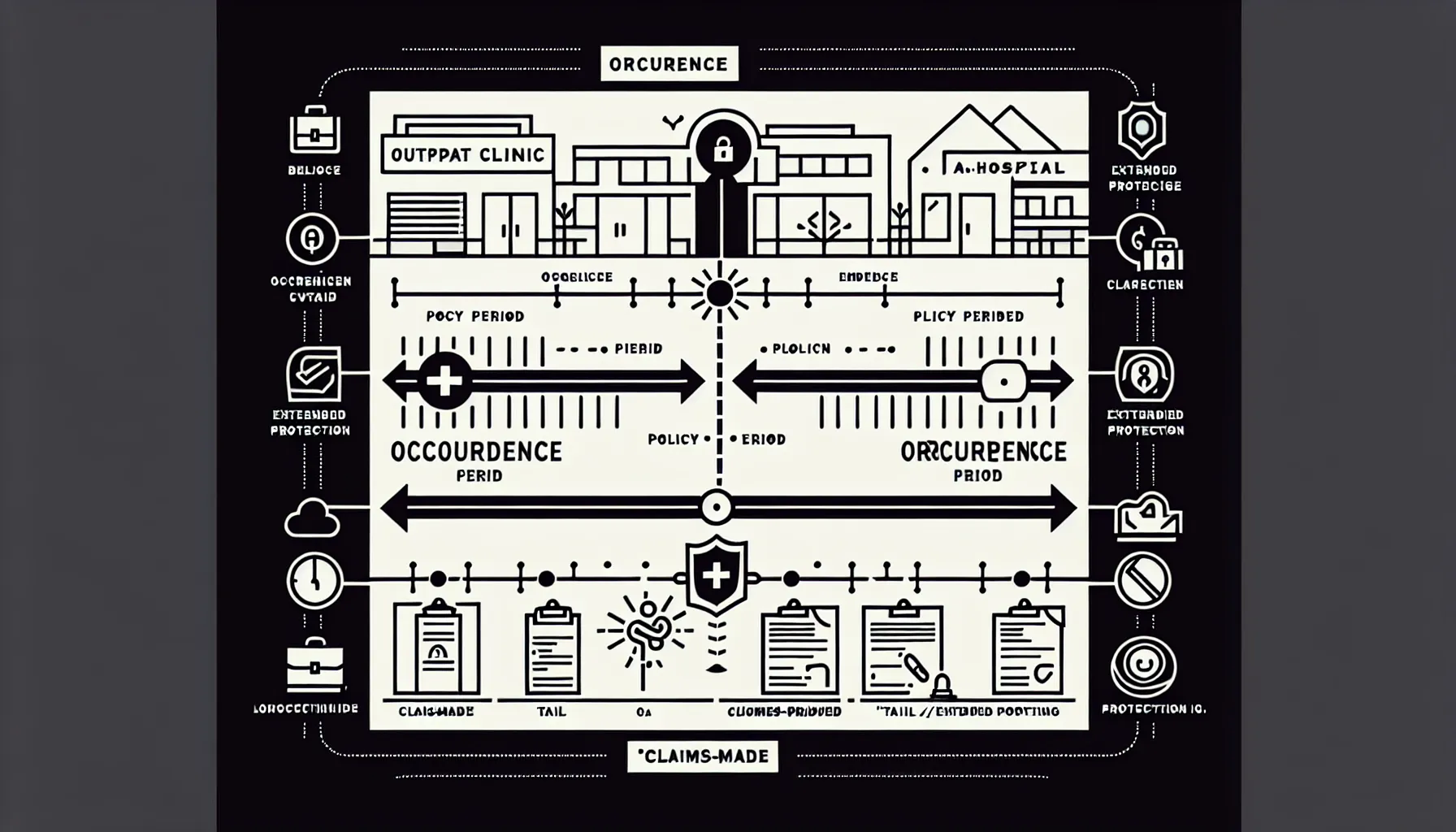
An occurrence policy generally covers a covered incident that takes place while the policy is in force, even if the claim is asserted after the policy period ends. Because protection is tied to when the incident occurred, a physician typically does not need an extended reporting endorsement for that insured period. Occurrence coverage may offer greater certainty after departure, but premiums, limits, exclusions, and the employer’s financial arrangement still require review.
A claims-made policy generally responds when a claim is reported during the policy period or an applicable extended reporting period, provided the underlying incident occurred on or after the policy’s retroactive date and the other policy conditions are satisfied. Care delivered while a policy was active can remain uninsured if the resulting claim is reported after coverage ends and no tail or equivalent prior-acts protection applies. The National Association of Insurance Commissioners provides additional background on medical malpractice policy structures, while Chelle Law’s guide to claims-made and occurrence coverage examines how those distinctions affect physician contracts.
Employer Policies, Individual Coverage, and Insured Status
Many employed physicians participate in an employer-sponsored policy, self-insurance program, or group arrangement. Participation alone does not answer whether the physician is a named insured, shares an aggregate limit, owes a deductible or retention, or has coverage for every contracted location and service. The policy wording and endorsements establish the actual protection, so the agreement should be compared with the declarations page, coverage summary, and available policy documents.
An individual or excess policy may be relevant when employer limits are insufficient for the physician’s circumstances or when certain activities fall outside the group policy. Examples can include approved outside work, volunteer services, consulting, locum assignments, and services performed after a job change. A physician considering outside clinical work also needs to compare the insurance terms with the agreement’s moonlighting restrictions and approval requirements.
Policy Terms That Determine the Scope of Protection
A policy’s headline limits provide only part of the coverage analysis. Physicians also need to understand how the aggregate is calculated, whether defense expenses reduce the available limits, which activities are excluded, and who controls the defense and settlement. These provisions can affect both personal exposure and the physician’s professional record.
Limits, Defense Costs, and Settlement Decisions
Medical liability limits are commonly expressed as a per-claim amount and an aggregate amount. A physician should determine whether the aggregate is individual or shared across a group, because unrelated claims may reduce a shared limit. The documents may also impose a deductible or self-insured retention and should identify who is responsible for that amount.
Defense expenses may be paid outside the liability limits or may erode the amount available to resolve a claim. Settlement provisions also differ. Some policies require the physician’s consent, while others give the insurer broader authority; a hammer clause may shift additional financial risk to a physician who rejects a recommended settlement. Current AMA liability coverage guidance reinforces the importance of verifying these provisions under the actual policy rather than assuming a standard market approach.
Retroactive Dates, Covered Duties, and Notice Requirements
The retroactive date under a claims-made policy identifies how far back the policy reaches for covered professional services. If that date does not extend to the physician’s earlier clinical work, a gap may exist unless a prior policy, tail endorsement, or successor-policy arrangement preserves coverage. A carrier change is therefore not merely an administrative event; it requires verification that prior acts remain protected.
Coverage also needs to follow the physician’s actual work. Relevant questions include whether the policy applies to telemedicine, interstate practice, call coverage, supervision, administrative duties, services at satellite facilities, locum work, and approved outside activities. The physician should also understand what constitutes an incident or claim, where notice must be sent, the applicable deadline, and whether the reporting process remains accessible after employment ends.
Tail Coverage and Protection During Job Transitions
When claims-made coverage ends, an extended reporting endorsement—commonly called tail coverage—can allow later reporting of claims arising from covered care provided before the policy terminated. Tail does not ordinarily insure new services performed after departure. It extends the reporting opportunity for prior work, subject to the endorsement’s duration, limits, exclusions, and other terms.
Employment agreements allocate tail costs in different ways. An employer may pay in all circumstances, place the obligation on the physician, or make responsibility depend on how employment ends. The result may differ following resignation, termination without cause, termination for cause, nonrenewal, retirement, disability, or completion of the initial term. AMA materials describe tail premiums as commonly falling around two to three times the final annual premium, but that is only a qualified rule of thumb; actual cost can vary substantially by specialty, jurisdiction, insurer, limits, claims history, and reporting period. The separate guide to physician tail insurance explains how these obligations can change the cost of leaving a position.
Prior-acts coverage, sometimes called nose coverage, may offer another continuity solution. Instead of purchasing an extended reporting endorsement from the former carrier, a successor policy may adopt the earlier retroactive date and cover qualifying prior services. The physician must confirm the date, covered activities, limits, exclusions, and relationship between the old and new policies. A verbal assurance that the new employer will “pick up prior acts” is not a substitute for written policy confirmation.
How Employment Contracts Allocate Malpractice Risk
The malpractice section cannot be evaluated in isolation. Termination language may determine who purchases tail, when proof of coverage must be supplied, and whether the employer can obtain coverage and charge the physician if the physician does not act. A short notice period combined with physician-funded tail can create an immediate expense at the same time that signing-bonus, relocation, or other repayment obligations become due. A physician termination contract review can identify how these provisions operate together before notice is given.
Indemnification and hold-harmless provisions present a separate layer of risk. The agreement may address responsibility for conduct within the scope of employment, excluded acts, violations of employer policy, billing issues, or services the employer characterizes as unauthorized. Broad indemnification language can shift liabilities beyond an ordinary malpractice claim, while narrow language may leave uncertainty about defense obligations when the physician’s interests diverge from those of the employer or insurer.
Reporting provisions also require precise reading. Notice to an employer or insurer under a policy is different from insurer reporting of a malpractice payment or another reportable action under federal law. The National Practitioner Data Bank regulations establish distinct reporting rules, and the consequences can depend on the disposition of the matter and the legal basis for the report. Contract language should not collapse policy notice, incident reporting, claim reporting, and regulatory reporting into a single undefined obligation.
Documents and Questions to Review Before Signing
A physician evaluating a job offer should request more than a one-sentence description of malpractice coverage. Depending on what the employer can provide, useful materials may include the declarations page, certificate or coverage summary, relevant endorsements, a specimen policy, and written confirmation of tail or prior-acts arrangements. The contract can then be checked against the insurance documents for inconsistencies or unanswered questions.
- Is the coverage occurrence-based, claims-made, self-insured, or part of another risk arrangement?
- Who is insured, and are the aggregate limits individual or shared?
- What are the per-claim and aggregate limits, deductibles, and self-insured retentions?
- Do defense expenses reduce the liability limits?
- What retroactive date applies, and does it preserve coverage for prior services?
- Are every location, jurisdiction, facility, and contracted duty covered?
- How do consent-to-settle provisions and any hammer clause operate?
- What events trigger tail responsibility, and what duration and limits are required?
- How are incidents and claims reported during and after employment?
- Do the policy, employment agreement, and indemnification provisions allocate risk consistently?
Malpractice terms also need to be compared with compensation, restrictive covenants, call duties, outside-work limitations, and the physician’s expected tenure. A high salary may be less attractive if departure creates an expensive uninsured transition, while employer-funded tail may materially improve the overall offer. A comprehensive physician employment agreement review can evaluate these interacting provisions rather than treating insurance as a stand-alone benefit.
Frequently Asked Questions
What is the difference between occurrence and claims-made malpractice insurance?
Occurrence insurance generally covers a qualifying incident that takes place during the policy period, even if the claim is filed later. Claims-made insurance generally requires the incident to fall on or after the applicable retroactive date and the claim to be reported while the policy or an extended reporting period is active, subject to the policy’s other terms.
When does a physician need tail coverage?
Tail coverage is commonly relevant when claims-made coverage ends and a later claim could arise from care delivered before termination. Whether tail is necessary depends on the former policy, its retroactive date, the available reporting period, and whether a successor policy provides equivalent prior-acts coverage.
Who pays for a physician’s tail insurance?
Tail responsibility is a contract term rather than a universal rule. An agreement may place the cost on the employer or physician, divide it, or allocate it according to whether employment ends through resignation, termination, nonrenewal, retirement, disability, or another event. The required coverage, payment process, and proof obligations also need to be clarified.
What malpractice policy limits should a physician verify?
A physician should verify the per-claim and aggregate limits, whether the aggregate is individual or shared, and whether defense expenses reduce the available limits. Deductibles, self-insured retentions, excess coverage, specialty, practice location, and employer structure can also affect the adequacy of the protection.
Does employer malpractice insurance cover moonlighting and telemedicine?
Not necessarily. Coverage depends on the policy’s insured services, locations, jurisdictions, exclusions, and any employer approval conditions. A physician should obtain written confirmation for permitted moonlighting, telemedicine, volunteer services, locum work, or other outside activities and arrange separate protection when those services are excluded.
What insurance documents should a physician request before accepting an offer?
Useful documents may include the declarations page, certificate or coverage summary, relevant endorsements, and the complete or specimen policy when available. The physician should use those materials to verify the insurer, insured status, policy type, limits, retroactive date, defense-cost treatment, settlement terms, exclusions, reporting procedure, and post-employment coverage obligations.
Review Your Malpractice Coverage Before You Sign
Chelle Law reviews physician agreements for coverage gaps, tail obligations, indemnification concerns, and insurance terms that may create unexpected financial or professional exposure.
Contact Chelle LawExplore Physician Contract Guidance
Find physician-focused legal services, practical contract resources, and guidance organized by state.