
A physician bonus can materially change the value of an employment offer, but the advertised rate rarely tells the entire story. Productivity thresholds, attribution rules, quality measures, payment dates, and employer-controlled adjustments all affect whether the physician can earn and verify the incentive. A bonus arrangement can also create financial exposure when the agreement permits delayed reconciliation, repayment demands, or forfeiture after notice of termination.
The practical question is not simply how large the potential bonus appears. Physicians need to understand which services generate credit, who controls the underlying data, how operational barriers affect performance, and when compensation becomes earned and payable. These issues differ among wRVU, collections, quality, sign-on, retention, relocation, and hybrid plans. They can also interact with taxes, worker classification, malpractice obligations, restrictive covenants, and state wage-payment rules.
Chelle Law evaluates the complete economic arrangement during physician contract review. That analysis includes the written formula, incorporated compensation policies, reporting rights, reconciliation procedures, termination provisions, and clawback language. Reviewing those terms together helps a physician determine whether the proposed bonus is realistically attainable, whether the calculation can be audited, and which provisions may warrant clarification or revision before the agreement is signed.
Key Points About Physician Bonus Compensation
- A bonus needs an auditable formula. The documents can identify the production source, code set, threshold, conversion factor, attribution rules, payment period, and applicable adjustments.
- Employer operations affect physician performance. Credentialing delays, staffing, scheduling capacity, payer enrollment, referrals, and access to facilities can determine whether a target is attainable.
- Payment and reconciliation terms matter. Monthly, quarterly, and annual plans allocate cash-flow and true-up risk differently.
- Repayment exposure can continue after employment. Sign-on obligations, alleged overpayments, tail insurance, and other departure costs may become due at the same time.
- Federal reference materials do not replace the contract. CMS payment data, tax guidance, and worker-classification standards must be applied to the agreement’s actual language and circumstances.
What the Bonus Provision Actually Controls

Physician compensation is rarely limited to guaranteed salary. An incentive plan can influence workload, clinical priorities, patient access, documentation practices, and the amount of financial risk allocated to the physician. A high stated conversion rate may have limited value if the threshold is excessive, important services receive no credit, or the employer retains broad discretion to change the methodology.
A useful review begins by identifying every document that governs the bonus. The employment agreement may contain only a summary while a compensation plan, handbook, policy, or annual schedule supplies the operative definitions. Those documents may address which services qualify, how shared encounters are attributed, whether administrative work receives credit, and whether the employer can revise the plan during the contract term. If the agreement incorporates another document, the physician needs access to the version that will apply.
The plan must also be evaluated against working conditions that affect performance. Referral patterns, payer mix, staffing shortages, operating-room access, scheduling limits, credentialing delays, and employer-imposed administrative duties can make a target difficult to reach even when the physician works efficiently. A formula that ignores those constraints transfers operational risk to the physician without necessarily giving the physician control over the outcome.
Clarity and legal effect are separate questions. Clear drafting identifies each input and explains how it is measured. The legal consequences of withholding, forfeiture, deductions, or recoupment may depend on the agreement and the law governing it. There is no single national rule that determines when every physician bonus becomes earned or whether an employer can offset an alleged debt against final wages.
How Common Physician Bonus Models Allocate Risk
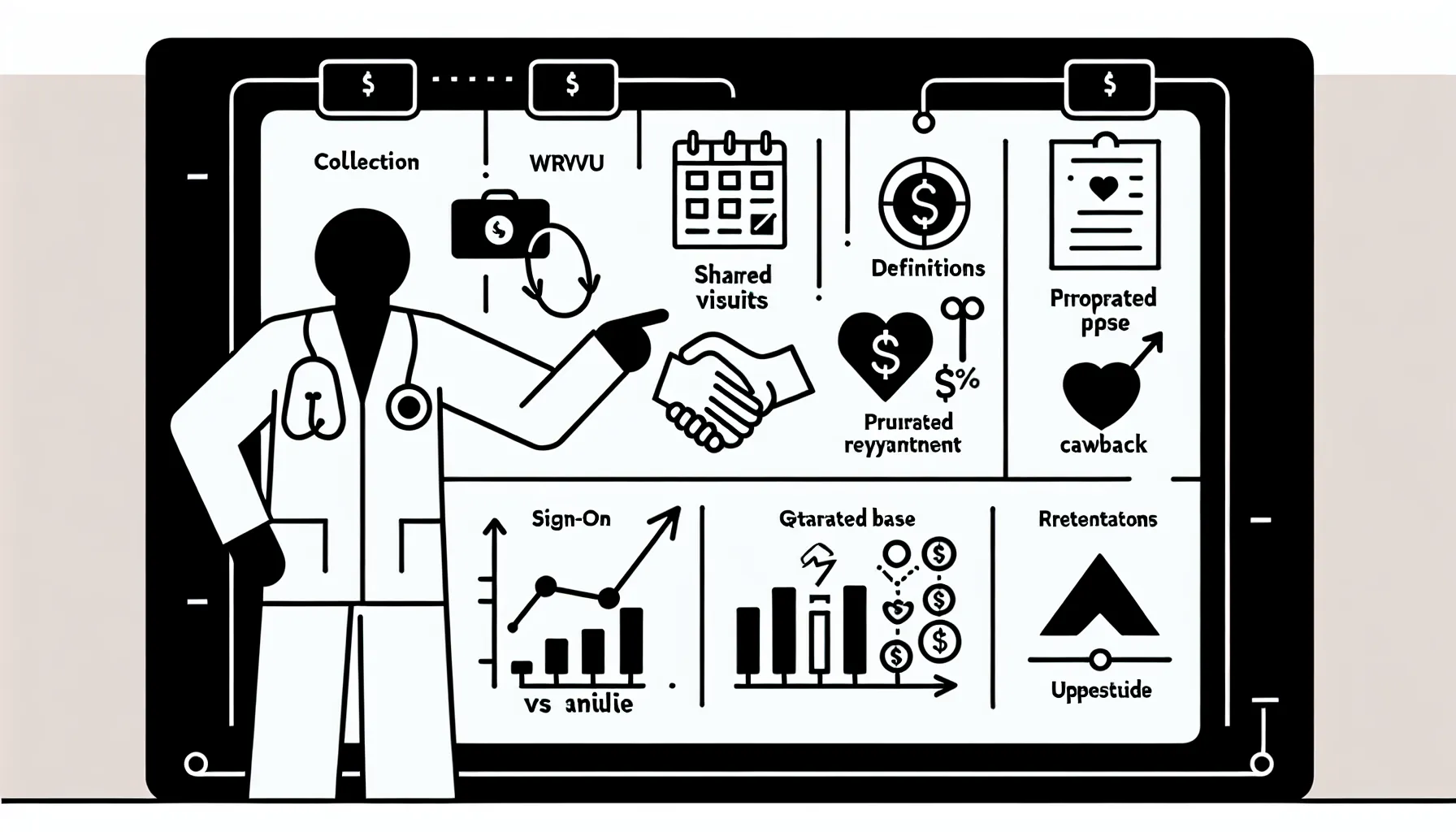
Employers use different labels for physician incentive plans, but most arrangements rely on several recurring models. Each model allocates operational and financial risk differently. Understanding the calculation method is therefore more useful than focusing on the plan’s name or maximum advertised payout.
Productivity, wRVU, and Collections Incentives
A common productivity formula pays a stated amount for work Relative Value Units above a threshold: (actual wRVUs minus threshold wRVUs) multiplied by the contractual conversion factor. Variations may add tiers, payout percentages, quality modifiers, minimum production requirements, or caps. A thorough wRVU compensation analysis examines the threshold, rate, measurement period, proration method, eligible services, and attribution of shared or supervised care.
The agreement also needs to identify the source of its values. The Centers for Medicare & Medicaid Services publishes and periodically revises Physician Fee Schedule relative value files, including 2026 materials. Those files are Medicare payment inputs; they do not independently establish a physician’s contractual compensation. A plan may use CMS work RVUs, total RVUs, a specified historical file, commercial values, modified code values, or an employer-created methodology.
Accordingly, the documents can specify the applicable file or schedule, effective date, code set, treatment of deleted or revised codes, and handling of later CMS changes. Geographic practice-cost adjustments and Medicare conversion factors do not automatically apply to a wRVU bonus merely because the employer references CMS data. The compensation language determines how the selected information enters the calculation, subject to applicable law.
Ramp-up periods deserve separate attention. Credentialing, payer enrollment, staffing, and referral development can delay production during the first months of employment. If an annual threshold is applied without proration, a physician starting midyear may need to overcome a target that assumes a full year of established practice. The same concern applies when leave, reduced schedules, or employer-imposed service interruptions occur.
Collections plans measure revenue rather than units of clinical work. A physician may receive a percentage of gross collections, net collections, professional receipts, or another defined amount. The calculation may exclude refunds, payer take-backs, contractual write-offs, bad debt, billing expenses, laboratory revenue, or facility fees. Because these deductions can materially reduce the payout, the agreement needs precise definitions and access to the reports used to apply them.
Quality, Recruitment, Retention, and Hybrid Plans
Quality incentives may use patient satisfaction, readmission rates, care-gap closure, access, panel management, documentation, cost efficiency, clinical outcomes, or adherence to specified protocols. The physician may be measured individually, by department, or across an entire system. Contract analysis can identify the metric, weighting, data source, risk adjustment, measurement period, and consequences of factors the physician does not control. A broader review of quality and productivity incentives can help place those provisions in context.
Sign-on, relocation, and retention payments operate differently because they are often paid before the physician completes the required service period. The documents may characterize the payment as compensation, an advance, a forgivable loan, or another obligation. Early departure can trigger repayment of all or part of the amount, sometimes within a short period. Important questions include whether forgiveness is prorated, which termination events trigger repayment, and whether exceptions apply when the employer ends employment without cause or fails to provide the promised position.
A focused review of signing bonus repayment provisions also considers interest, collection costs, payroll offsets, and the relationship between the main employment agreement and a separate promissory note. The repayment document may contain obligations that are broader than the offer letter’s summary.
Hybrid plans combine guaranteed salary with productivity, quality, collections, or retention components. A larger guarantee can improve income stability but limit upside. A heavily incentive-based arrangement may reward high production while exposing the physician to changes in referrals, payer mix, staffing, scheduling, or organizational policy. The appropriate balance depends on specialty, practice setting, local demand, operational support, and the physician’s tolerance for variable income.
Turning Source Data Into an Actual Bonus Payment
Even a mathematically simple formula can produce disputes when the parties do not agree on its inputs. A complete provision identifies how services are recorded, when credit is recognized, which reports control, and how corrections are made. Encounter-based models may also need rules for telemedicine, consultations, phone services, split visits, supervision, teaching, research, and administrative duties.
Thresholds, Reporting, and Reconciliation
Thresholds can be annual, quarterly, monthly, or tied to another measurement period. The provision can clarify whether production carries forward between periods, whether a deficit must be recovered before later incentives accrue, and how a partial year is treated. Blended plans also need a stated weighting for each component so that the employer cannot alter the economic balance through an unpublished calculation.
Monthly payments provide faster cash flow but may rely on estimates that require later reconciliation. Quarterly payments may offer more complete data, while annual payment concentrates the physician’s risk and can make the bonus function as a retention device. In every model, the documents can identify the payout deadline, the data cutoff, and whether compensation earned before termination remains payable after the physician leaves.
A true-up compares prior payments with final production, collections, or quality data. The agreement can define the look-back period, records used, treatment of coding changes and payer take-backs, and deadline for making an adjustment. Open-ended reconciliation rights create uncertainty because a payment may remain subject to challenge long after the physician has relied on it.
Reporting rights are essential to an auditable plan. Depending on the model, relevant information may include CPT-level production, wRVU detail, collections by date of service, deduction summaries, quality scores, attribution reports, and the employer’s actual calculation. The physician also needs a reasonable period to question discrepancies and a defined process for reviewing disputed data.
Taxes and Employment Classification
Bonuses paid to employed physicians are generally treated as W-2 supplemental wages subject to withholding. Under the IRS Employer’s Tax Guide for 2026, separately identified supplemental wages may generally qualify for a 22% federal withholding method when its requirements apply. Special rules apply when an employee’s supplemental wages exceed $1 million, including withholding at 37% on the excess.
Withholding is not the same as final income-tax liability. A physician may ultimately owe more or less after considering total income, deductions, estimated payments, and state or local taxes. The timing of a payment can also affect cash flow, retirement contributions, deferred compensation, and other benefit calculations, even when the gross bonus remains unchanged.
An independent contractor may receive compensation reported on Form 1099 and generally bears different tax and benefit responsibilities. However, the contract’s label does not by itself determine legal classification. Standards can differ under the Internal Revenue Code, Fair Labor Standards Act, state wage laws, benefit laws, and other statutes. The Department of Labor’s 2025 enforcement guidance also changed the federal agency’s approach to FLSA investigations while litigation and rule reconsideration continued. Physicians comparing W-2 employment and 1099 contracting therefore need to consider more than the bonus percentage.
Clawbacks, Wage Offsets, and Departure Risk
Recoupment provisions are a frequent source of post-employment disputes. A limited correction process may permit recovery of a documented clerical or billing overpayment. Broader language can authorize retroactive formula changes, lengthy audits, offsets against unrelated compensation, or repayment based on an employer’s unilateral determination. Those provisions can convert compensation that appeared final into a continuing contingent liability.
A more predictable arrangement identifies the audit window, evidence required to support an adjustment, method for calculating the amount, and process for raising a dispute. It may also address payment deadlines, installment options, interest, collection expenses, and whether the employer can deduct the alleged debt from salary or final wages. A contractual debt claim, a payroll correction, and a wage deduction are not necessarily treated the same way under applicable law.
Termination language often determines whether the physician receives a pending incentive. Some plans require active employment on the payout date even when the services were completed earlier. Others distinguish between resignation, termination without cause, termination for cause, disability, or an employer breach. Bonus terms therefore need to be read with the notice period, final compensation clause, for-cause definition, and related provisions considered during a physician contract termination review.
State law may determine when incentive compensation becomes earned, when it must be paid, and whether deductions or offsets are permitted. Outcomes vary substantially by jurisdiction and by the wording of the plan. A national employer’s standard compensation policy cannot be assumed to operate identically in every state, particularly when final-paycheck rules or wage-deduction restrictions apply.
Specialty and Related Contract Costs
A bonus formula must fit the physician’s actual specialty and practice environment. Procedural and surgical specialties may depend on operating-room access, equipment, anesthesia support, or downstream collections. Primary care plans may emphasize patient panels, access, care-gap closure, or population-health measures. Academic physicians may receive credit for teaching, research, publications, leadership, or institutional service. If those activities affect compensation, their values and documentation requirements belong in the governing documents rather than an informal explanation.
Regional practices and employer type also affect plan design. A hospital, academic institution, private group, or management organization may allocate revenue and overhead differently. Market data can provide context, but a benchmark does not establish what a particular physician will earn. The physician’s schedule, support, referral base, payer mix, and assigned duties remain central to the analysis.
Malpractice insurance can amplify the financial consequences of departure. A claims-made policy may require tail coverage after employment, while occurrence coverage generally handles later claims arising from covered acts during the policy period without a separate tail policy. The agreement may allocate tail expense according to the reason employment ends. A malpractice and tail insurance review can identify whether a physician might face a bonus repayment and substantial coverage cost at the same time.
Restrictive covenants can add relocation and career disruption to those expenses. A physician who must repay an incentive, purchase tail coverage, and leave the restricted area may incur costs far greater than the original bonus. Reviewing physician non-compete terms alongside the compensation provisions provides a clearer picture of the agreement’s total post-employment risk.
Contract Terms That Make a Bonus More Predictable
Warning signs include phrases such as “adjusted RVUs,” “reasonable collections,” or “as determined by employer” without definitions. Other concerns include discretionary approval after the physician meets the stated target, systemwide metrics with no weighting, no access to supporting data, unlimited audit periods, and authority to offset alleged overpayments against unrelated compensation. The risk increases when the employer can change the methodology without advance notice or the physician’s consent.
A clearer productivity provision identifies the source schedule, applicable year, eligible services, threshold, conversion factor, payout frequency, and true-up process. A collections plan defines the revenue measure and every permitted deduction. A quality plan lists the metrics, weights, data source, measurement period, and treatment of organizational performance outside the physician’s control.
Repayment language can specify the trigger, forgiveness schedule, amount due, supporting documentation, dispute procedure, and effect of different termination events. If a bonus depends on remaining employed through a payment date, the agreement can clarify the treatment of incentives attributable to work completed before departure. These details do not guarantee a particular outcome, but they make the economic bargain easier to evaluate.
Illustrative drafting might describe a defined payment for each eligible work RVU above a stated threshold, payable within a fixed period after the quarter, with adjustments limited to documented errors identified during a specified review window. That language still must fit the governing law, specialty, employer structure, related policies, and overall agreement. A formula should not be copied into a contract without considering how it interacts with those provisions.
Frequently Asked Questions
What are the most common physician bonus structures?
Common models include wRVU productivity bonuses, collections or net-revenue percentages, quality incentives, and sign-on, retention, or relocation payments. Hybrid plans combine guaranteed salary with one or more incentive components. Each model allocates operational and financial risk differently, so the definitions and payment conditions matter as much as the advertised rate.
How is a physician wRVU bonus usually calculated?
A common formula subtracts a stated threshold from the physician’s eligible wRVUs and multiplies the excess by a contractual dollar amount. The agreement can identify the source schedule, effective date, qualifying services, attribution rules, threshold, conversion factor, payout period, proration method, and any caps or quality modifiers.
Do CMS RVU values automatically control a physician’s bonus?
No. CMS RVU files are Medicare payment inputs and are updated periodically; they do not independently create a contractual compensation entitlement. The agreement may adopt a particular CMS file, work RVUs, total RVUs, modified code values, or an employer-created methodology. The controlling documents need to explain which source applies and how later revisions are handled.
Can an employer withhold a bonus after a physician gives notice?
The answer depends on the agreement, incorporated plan terms, and applicable state law. Important questions include whether the physician must remain employed on the payout date, whether compensation attributable to completed work is payable after termination, and whether the employer may delay payment while completing a defined reconciliation.
When can a physician be required to repay a bonus?
Repayment may follow a documented overpayment or early departure under a sign-on, retention, relocation, or forgivable-loan arrangement. The documents can define the trigger, forgiveness schedule, amount due, deadline, interest, and exceptions based on why employment ends. State law may separately affect wage deductions and payroll offsets.
What records help a physician audit bonus compensation?
Useful records may include CPT-level production, wRVU detail, collections reports, deduction summaries, quality scores, attribution data, and the calculations used for each payout or true-up. The agreement can state how often reports are provided, how long the physician has to question them, and how disputed calculations will be reviewed.
Have Your Physician Bonus Terms Reviewed
Chelle Law reviews bonus formulas, source data, payment conditions, reporting rights, true-ups, clawbacks, and related contract provisions so you can understand the financial risk before signing.
Contact Chelle Law