
Physician compensation agreements can be difficult to evaluate because salary, RVUs, productivity thresholds, conversion factors, bonuses, guarantees, and reconciliation provisions often interact. A compensation formula that appears straightforward in an offer letter may operate very differently once productivity targets, exclusions, repayment provisions, or termination terms are applied.
A physician compensation and RVU review evaluates how compensation is actually calculated and paid. The review can address base salary, wRVU credit, conversion factors, productivity thresholds, bonus formulas, guarantees, clawbacks, reconciliation procedures, audit rights, and what happens to earned compensation when employment ends.
Chelle Law provides attorney-led physician compensation and RVU contract reviews nationwide. We help physicians understand the financial mechanics of the agreement, identify provisions that may reduce expected compensation, and determine which terms may warrant clarification or negotiation before signing.
Key Takeaways
- Physician compensation and RVU review focus on which services generate credit, the applicable conversion factor, and whether ancillary services, shared visits, or modifiers are included in RVU calculations.
- Base compensation, guarantees, and ramp-up provisions are reviewed to assess income stability, including how and when clawbacks may apply and whether benchmarks are defined by specialty and region.
- Review addresses audit rights, payment timing, and reconciliation processes, including access to billing data, correction windows, and limits on retroactive compensation adjustments.
- Post-employment provisions that affect earnings—such as tail insurance obligations, restrictive covenants, and limitations on telemedicine or academic work—are evaluated to understand downstream financial impact.
- Legal review helps quantify compensation risk, including tail exposure and repayment obligations, and assesses how state-specific non-compete and malpractice rules affect the enforceability of pay-related terms.
How Physician Compensation Models Are Evaluated

Physician compensation arrangements generally fall into three categories: straight salary, productivity-based compensation (commonly RVU-driven), and blended models that combine guaranteed pay with incentives. Each structure carries different financial risks that are evaluated during contract review.
- Straight salary arrangements provide predictable income and are more common in academic settings and large health systems. While compensation is fixed, many employers still track productivity internally and may use those metrics to inform renewal terms, reassignment, or future compensation adjustments.
- Productivity-based compensation ties earnings directly to measured work output. RVU-driven models can reward high clinical volume but shift financial risk to the physician when referrals fluctuate, payer mix changes, or administrative burdens limit billable activity. Review focuses on how RVUs are calculated, credited, and reconciled over time.
- Blended compensation models typically include a guaranteed base during an initial period, followed by incentive compensation or conversion to full productivity pay. These structures are common for newly trained physicians or roles designed to build volume. The review evaluates how guarantees phase out, whether benchmarks are realistic, and how compensation changes after the transition period.
Market and regional factors also influence compensation structure. Practice setting, cost of living, and institutional priorities affect how salary guarantees, productivity targets, and incentives are designed. Contract review considers whether compensation expectations align with the clinical environment and whether pay terms remain sustainable over the duration of the agreement.
When evaluating an offer, ask for a sample year of productivity expectations, payer mix assumptions, and how overhead is allocated (employed models often deduct facility collections before calculating incentive pay). A detailed physician compensation and RVU review is easier when you understand how productivity benchmarks work, as discussed in the Medscape compensation report.
RVU Fundamentals in Physician Compensation Agreements
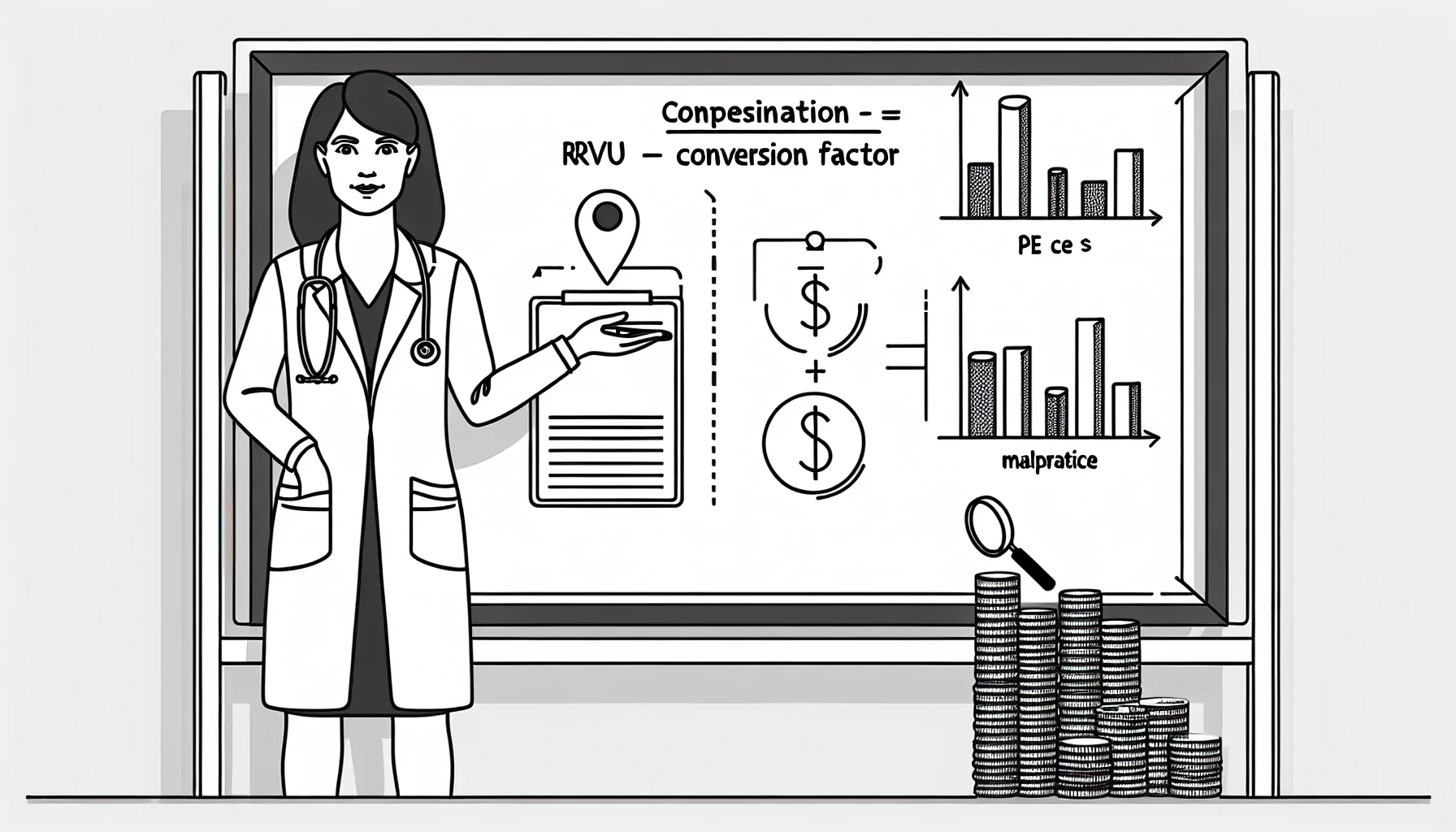
Relative Value Units (RVUs) are the foundation of most productivity-based physician compensation models. They are used to measure physician work and, in some structures, associated practice expense and malpractice components tied to billed services.
Compensation is commonly calculated by multiplying RVUs produced by an employer-defined conversion factor. That conversion factor can vary significantly by employer and may apply only to work RVUs (wRVUs) or to a blended formula that includes additional RVU components. Review focuses on which RVU definition is used, how RVUs are credited, and whether thresholds, caps, or exclusions apply.
These distinctions matter because physicians with similar clinical volume can earn materially different compensation depending on how RVUs are counted and converted. The compensation review evaluates whether ancillary services, procedures, shared or split visits, and modifiers generate RVU credit and whether production expectations align with the clinical environment.
A focused RVU review also examines reporting transparency, access to RVU data, and reconciliation processes, enabling physicians to verify production and identify discrepancies before compensation disputes arise.
Key Elements of RVU-Based Compensation Reviewed
What Generates RVU Credit and How Production Is Measured
Compensation review examines which services generate RVU credit and how production is measured. Agreements vary on whether credit is given for face-to-face visits, procedures, diagnostic interpretations, shared or split visits, teaching activities, telemedicine, or team-based care involving advanced practice providers. Review focuses on how RVUs are attributed, whether administrative or rounding time is excluded, and how production is documented.
Work RVUs Versus Total RVUs and Credit Allocation
Most productivity models rely on work RVUs, which reflect physician effort, whereas others incorporate total RVUs, which include practice expense and malpractice components. Review evaluates which RVU definition applies, how split or shared billing is handled, and how RVUs are allocated when multiple clinicians are involved in the same encounter.
Benchmarks, Targets, Guarantees, and Ramp-Up Periods
RVU benchmarks and production targets are assessed for alignment with specialty and regional targets. Review considers whether ramp-up periods or income guarantees are provided, how long they last, and whether repayment or clawback provisions apply. Particular attention is paid to how guarantees phase out and whether repayment obligations are tied to objective production shortfalls.
Payment Timing, Audits, and Reconciliation
Compensation review addresses when payments are issued, how often reconciliations occur, and what audit rights the employer retains. Agreements are evaluated for access to billing and RVU data, defined correction periods, and limits on retroactive compensation adjustments that could reduce previously paid amounts.
Compensation disputes in Ohio often stem from unclear productivity formulas, which is why a detailed Physician Compensation and RVU Review is so important.
Contract Provisions That Affect Take-Home Pay
Guaranteed Compensation, Adjustments, and Clawbacks
Base salary and guarantee provisions are reviewed to assess income stability and repayment risk. Clawback language is evaluated to determine duration, triggers, and whether repayment is tied to measurable production metrics rather than discretionary performance assessments.
Bonus Structures and Quality-Based Incentives
Quality and performance incentives are assessed to determine how they are measured, whether metrics are within the physician’s control, and how case mix, payer mix, or administrative factors affect payouts. Review focuses on whether bonus structures meaningfully supplement compensation or introduce volatility.
Restrictive Covenants and Post-Employment Compensation Risk
Post-employment restrictions can materially affect future earning capacity. Review evaluates how restrictive covenants interact with compensation, including limitations on future practice, telemedicine activity, or academic work, and how enforceability varies by state.
Malpractice Coverage, Tail Obligations, and Indemnification
Malpractice and tail insurance provisions are reviewed for their direct financial impact. Compensation analysis considers whether claims-made coverage requires physician-paid tail, whether employer-paid tail is available under certain termination scenarios, and how indemnification obligations may shift financial risk after employment ends.
Termination Provisions and Final Compensation
Termination language is reviewed to determine how final compensation, bonus proration, and outstanding payments are handled. Definitions of for-cause termination, notice requirements, and employer rights to withhold compensation are evaluated for their effect on income during transitions.
Non-RVU Compensation Components
Review also accounts for compensation elements not captured by RVUs, including call pay, administrative time, stipends, retirement contributions, loan repayment assistance, and CME benefits. These components are considered when assessing total compensation value and comparing offers.
State-Specific Compensation and Regulatory Issues
Physician compensation terms are shaped not only by contract language but also by state law and regulatory frameworks that affect enforceability and revenue attribution. Compensation and RVU review evaluate how these state-level factors interact with pay structure, post-employment restrictions, and malpractice obligations.
Non-Compete Enforcement and Contractual Limits by State
Non-compete enforceability varies widely. Some states broadly prohibit physician non-competes, while others enforce carefully drafted restrictions subject to reasonableness requirements. Recent legislative and judicial developments in several states have narrowed permissible scope, duration, or imposed additional notice and disclosure requirements. Review assesses how governing state law affects restrictive covenants tied to compensation, future practice limitations, and post-employment income risk.
Regulatory and Licensing Factors Affecting Compensation
Compensation arrangements may also be affected by federal and state regulatory rules, including Stark Law considerations, anti-kickback principles, and state-specific billing or enrollment requirements. The review considers whether compensation structures properly account for referral restrictions, payer rules, supervision requirements, and licensing limitations that may affect productivity credit or revenue recognition, particularly when physicians practice across state lines or via telemedicine.
Relocation and Multi-State Practice Considerations
Physicians evaluating offers in different states face additional variables, including differences in malpractice coverage norms, tail insurance practices, non-compete enforceability, and regional compensation expectations. Compensation review addresses how relocation affects coverage obligations, post-employment restrictions, and income stability, so offers can be evaluated on a comparable basis.
When to Have Physician Compensation and RVU Terms Reviewed
Compensation and RVU review is most helpful when agreements rely heavily on productivity-based pay, include complex audit or reconciliation provisions, impose restrictive covenants, or involve relocation or multi-state practice. Review focuses on identifying compensation risk, clarifying how pay is calculated and adjusted, and evaluating whether contractual protections align with applicable state law.
A focused attorney review typically examines conversion factors, benchmarks, audit rights, clawback provisions, termination effects on compensation, restrictive covenants, and malpractice-related costs that affect net earnings. Where appropriate, review includes proposing targeted revisions or clarifications to reduce financial exposure and improve predictability.
Frequently Asked Questions About Physician Compensation and RVU Review
What is an RVU-based physician compensation model?
An RVU-based compensation model ties some or all physician compensation to measured productivity. Many agreements use work RVUs, or wRVUs, multiplied by a contractual conversion factor. The agreement should clearly identify which RVUs count, the applicable threshold or target, the conversion factor, and how production is measured and reported.
What should physicians review in an RVU compensation formula?
Physicians should review the wRVU conversion factor, productivity threshold, measurement period, credit for procedures and shared services, bonus calculations, reconciliation procedures, audit rights, and any exclusions or caps that could reduce compensation. The agreement should also explain when RVUs are credited and when productivity compensation is paid.
What is a wRVU conversion factor?
A wRVU conversion factor is the dollar amount paid for each work RVU under the compensation formula. For example, if the agreement pays $50 per wRVU above a specified threshold, the conversion factor is $50. Physicians should understand whether the factor applies to all production or only to wRVUs above a threshold.
What compensation terms should physicians review besides RVUs?
Physicians should also review base salary, guarantees, signing bonuses, quality incentives, call compensation, collections-based payments, repayment obligations, expense deductions, malpractice costs, benefit value, and what happens to earned compensation when employment ends.
What is compensation reconciliation in a physician contract?
Reconciliation is the process used to compare compensation already paid with compensation actually earned under the contract formula. Physicians should understand how often reconciliation occurs, what data is used, whether negative balances carry forward, and whether the employer can recover previously paid compensation.
Does Chelle Law review physician compensation and RVU contracts nationwide?
Yes. Chelle Law provides attorney-led physician compensation and RVU contract reviews nationwide. Reviews can address salary, wRVUs, conversion factors, productivity thresholds, bonuses, guarantees, reconciliation provisions, audit rights, repayment obligations, and other compensation terms.
Understand How Your Physician Compensation Formula Actually Works
Salary, wRVUs, conversion factors, productivity thresholds, bonuses, reconciliation provisions, and repayment obligations can materially change the value of a physician employment agreement. Chelle Law provides attorney-led physician compensation and RVU reviews nationwide.
Request a Compensation and RVU ReviewExplore More Physician Contract Guidance
Browse additional physician contract review services, detailed resources, and state-specific guidance involving compensation, employment agreements, restrictive covenants, malpractice coverage, and termination rights.