
Multi-site assignments are increasingly common for nurse practitioners (NPs) as healthcare systems expand clinic networks, consolidate services, and use flexible coverage models. An employment or independent contractor agreement may require work across clinics, urgent care centers, hospital units, telehealth panels, or outreach locations, each with different scheduling, productivity, credentialing, and liability concerns. Before signing, an NP should understand how the contract defines assigned sites, allocates travel time and expenses, credits compensation, and addresses supervision and malpractice coverage. A line-by-line nurse practitioner contract review can identify provisions that create unexpected financial exposure, compliance concerns, or restrictions on future employment.
Key Takeaways
- Confirm how the agreement defines assigned sites and whether the employer can change locations without advance notice or a compensation adjustment.
- Require clear rules for attributing collections, RVUs, bonuses, and negative accrual across locations.
- Address mileage reimbursement, transportation expenses, and whether travel between sites is compensable time.
- Verify malpractice coverage, tail responsibility, supervision, credentialing, EHR access, and liability allocation for every assigned location.
- Review how reassignment, site closure, credentialing delays, and termination affect pay and future practice restrictions.
How Multi-Site NP Assignments Create Contract Risk
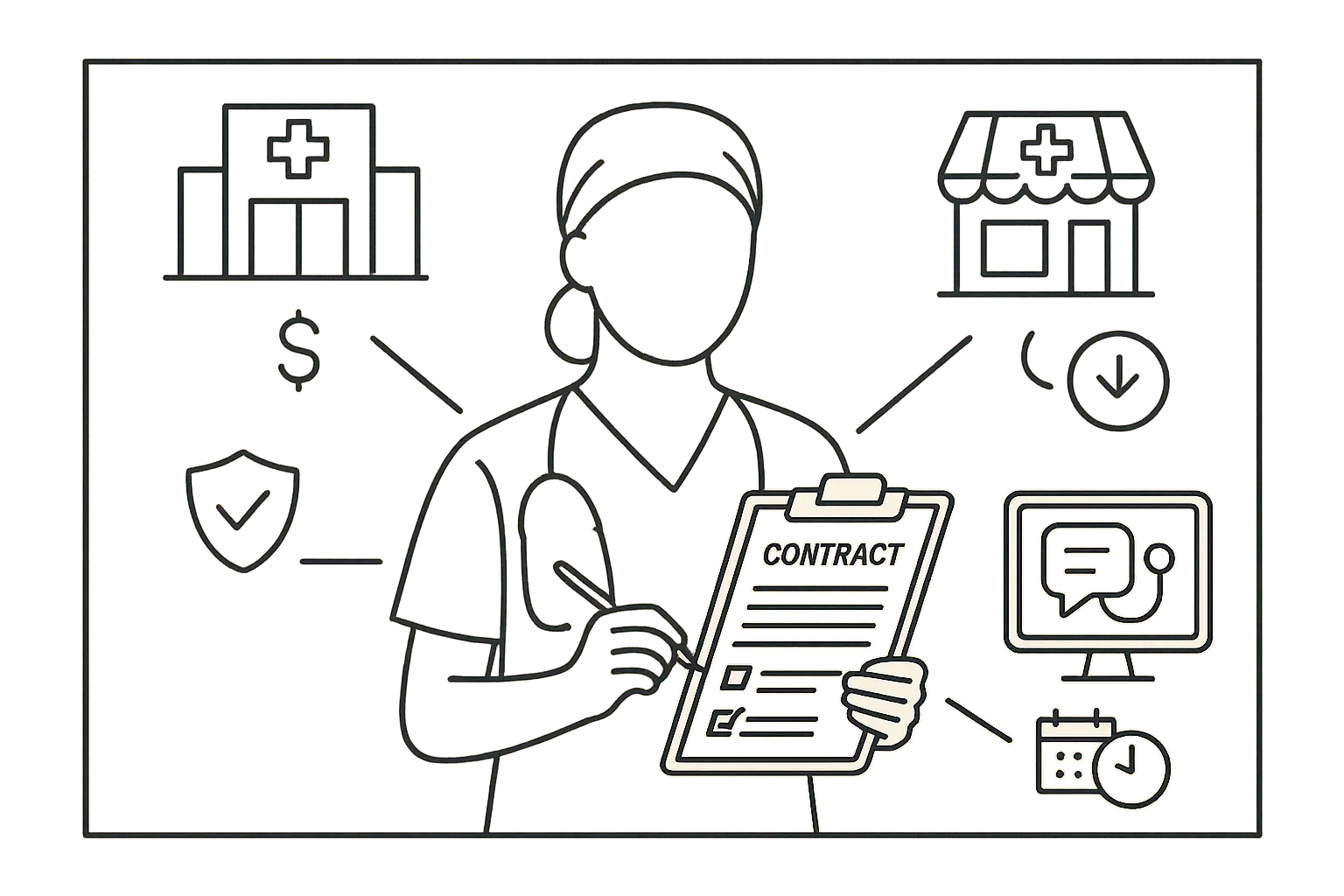
A multi-site assignment requires an NP to provide clinical services at more than one location under a single agreement. Employers may use this model to respond to changing patient demand, cover staffing gaps, or centralize administrative oversight. The arrangement can combine locations with different patient volumes, payer mixes, clinical duties, EHR systems, supervision structures, and credentialing requirements.
The contract determines whether that operational flexibility primarily benefits the employer or also protects the NP. Broad language may allow the employer to reassign locations, change schedules, or redirect productivity credit without addressing the effect on income or travel. Multi-site provisions can also affect malpractice coverage, restrictive covenants, patient follow-up obligations, and the NP’s responsibility when working for different facilities or legal entities.
Location, Scheduling, Travel, and Compensation Terms
Assigned Locations, Schedule Changes, and Travel
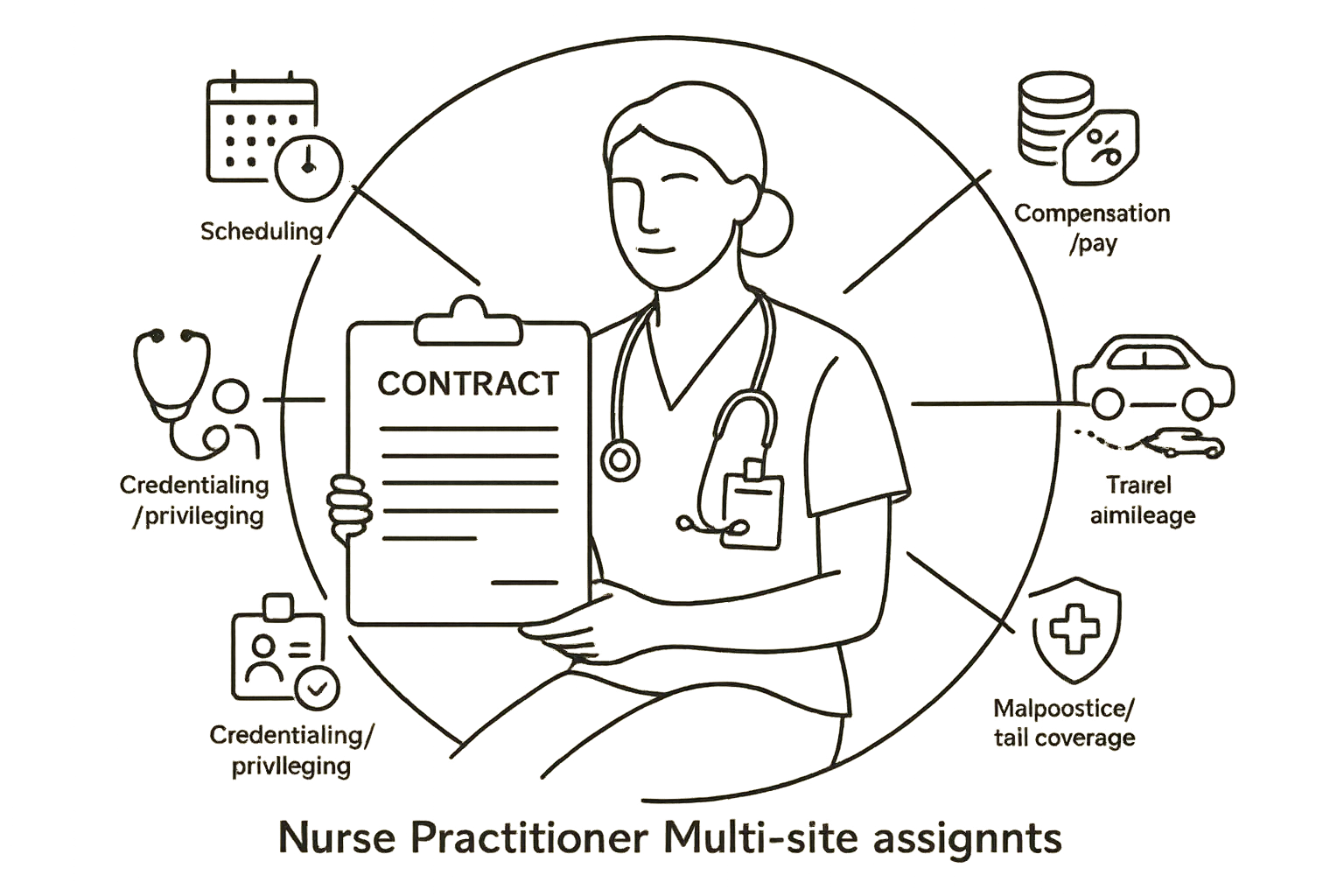
The agreement should define the NP’s regular locations and establish a process for adding or changing sites. Language such as “flexible coverage as needed” may give the employer broad reassignment authority without specifying notice, distance limits, schedule protections, or pay adjustments. The contract should also identify minimum and maximum clinical hours, call obligations, who controls the schedule, and whether service at multiple locations counts as one workday. These terms are especially important when evaluating broader NP schedule control issues.
Travel provisions should state whether the employer reimburses mileage or other transportation expenses and whether time spent traveling between assigned sites is compensable. The agreement should distinguish ordinary commuting from employer-directed travel during the workday. Without clear language, travel may be treated inconsistently or excluded from productivity and pay calculations.
Base Pay, Collections, RVUs, and Bonuses Across Sites
Multi-site compensation may include a guaranteed salary, collections-based pay, RVU productivity, or a hybrid formula. A thorough NP compensation and productivity review should determine how encounters are credited when care spans locations, whether the formula uses gross or net collections, which payer adjustments apply, and how RVU thresholds and conversion rates are calculated.
- Confirm whether each location maintains a separate productivity pool or whether all encounters are combined.
- Identify how telehealth follow-ups, telephone triage, care coordination, and cross-site encounters receive credit.
- Review bonus thresholds, reconciliation periods, payer adjustments, and the timing of productivity reports.
- Determine whether negative accrual allows a shortfall at one site to reduce future compensation earned elsewhere.
For example, an agreement might pay a percentage of collections above a salary guarantee. If the employer transfers the NP to a site with lower patient volume or a less favorable payer mix, the NP may be unable to reach the threshold. Negative accrual or repayment language can make that reassignment even more consequential by carrying the shortfall into a later compensation period.
Clinical Operations, Credentialing, and Patient Care
Operational differences between locations can affect productivity, documentation, and patient safety. Sites may use different EHR systems, access permissions, scheduling platforms, and clinical workflows. The contract should address who provides training and credentials, when access must be available, and whether documentation or administrative work is included in productivity expectations. Delayed access or duplicate documentation can reduce collections or RVU production while increasing the risk of incomplete records.
Credentialing and privileging timelines may also differ by facility. The agreement should allocate responsibility for applications, renewals, fees, DEA registration where applicable, state licensure, and hospital privileges. It should explain what happens to salary, start dates, and site assignments if credentialing is delayed or denied, particularly when the delay results from the employer’s administrative process rather than the NP’s failure to provide required information.
Patient volume and clinical duties should be evaluated by location rather than treated as interchangeable. An urgent care center, primary care clinic, hospital unit, and telehealth panel may involve different visit complexity and follow-up responsibilities. The agreement should clarify patient assignment, responsibility for outstanding results or follow-up after reassignment, handoff procedures, and whether time spent coordinating care across sites is recognized in workload or compensation expectations.
Malpractice, Supervision, Billing, and Regulatory Compliance
Malpractice Coverage and Liability Allocation
The NP should determine whether the employer provides occurrence or claims-made malpractice insurance, the applicable policy limits, and whether every assigned site and legal entity is covered. A malpractice and tail insurance review can clarify who pays for tail coverage after termination and whether work at external or affiliated locations falls within the employer’s policy.
Independent contractor and multi-employer arrangements require particular attention to indemnification and personal insurance obligations. The agreement should identify which entity is responsible for claims arising from work performed within the assignment and whether the NP must maintain separate professional liability coverage. Vague indemnity language or coverage that excludes an assigned location may create personal financial exposure.
Supervision, Scope of Practice, Credentialing, and Billing
Supervision and collaboration requirements may vary by jurisdiction, facility, and practice setting. The contract should identify the responsible physician or other required structure for each location and explain how that arrangement changes after reassignment. A focused supervision and collaboration agreement review can compare the contractual duties with the applicable state licensing or regulatory requirements and the NP’s authorized scope of practice.
Billing across locations may involve different payer enrollment, facility billing, site-of-service rules, or claim-submission processes. The agreement should clarify who controls billing, how denied claims affect collections or productivity, and whether the NP bears any risk for employer billing errors or credentialing lapses. Revenue attribution should also account for payer mix and encounters that involve more than one site.
Negotiating Protections for Multi-Site Work
Protective contract language should limit ambiguity while recognizing that an employer may need reasonable staffing flexibility. The agreement can define regular and temporary locations, establish advance-notice requirements, set a maximum travel radius, and require mutual agreement or a compensation adjustment for material changes. It can also guarantee minimum compensation when an employer-directed transfer reduces patient volume or prevents the NP from meeting a productivity threshold.
- Define “site,” regular assignments, temporary coverage, and the process for adding locations.
- Specify mileage reimbursement, transportation expenses, and treatment of inter-site travel time.
- Use transparent attribution rules for collections, RVUs, bonuses, and cross-site encounters.
- Address credentialing deadlines, EHR access, training, and pay during employer-caused delays.
- Identify malpractice coverage and supervision arrangements for every location.
- Create a process for resolving site-specific scheduling, billing, or clinical leadership disputes.
Restrictive covenants also require careful review because a broadly drafted restriction may use every assigned location as the center of a separate prohibited area. An NP should examine the geographic scope, duration, covered activities, triggering events, and effect of employer-directed reassignment through a dedicated non-compete review. The agreement should not leave the NP uncertain about which locations will affect post-employment practice options.
Multi-Site Agreement Review Checklist
Before signing a multi-site agreement, compare the written terms with the employer’s description of the anticipated schedule and locations. Provide reviewing counsel with the proposed contract, offer letter, compensation exhibits, communications about site assignments, expected schedules, and any available productivity targets. The following questions can help identify provisions requiring clarification:
- Which locations are mandatory, and how much notice is required before reassignment?
- How are visits credited when a care episode spans two locations or includes telehealth?
- Who controls billing, and how do denied claims affect productivity compensation?
- What patient volume, payer mix, visit types, and clinical duties are expected at each site?
- Who pays for travel, credentialing, licensure, privileging, training, and required insurance?
- What happens to pay if a site closes, credentialing is delayed, or the employer reduces available work?
- Do malpractice coverage, supervision arrangements, and restrictive covenants apply appropriately to every location?
Frequently Asked Questions
Can an employer assign a nurse practitioner to any location?
The answer depends on the assignment language in the contract. Broad provisions may permit the employer to add or change locations, while more protective terms identify regular sites, notice requirements, distance limits, and compensation adjustments for material reassignments.
Should travel between assigned sites be addressed in the NP contract?
Yes. The agreement should distinguish ordinary commuting from employer-directed travel and state whether mileage, transportation expenses, and time spent traveling between sites will be reimbursed or compensated.
How should productivity be credited when an NP works at multiple locations?
The contract should explain how collections, RVUs, bonuses, telehealth follow-ups, and encounters spanning multiple sites are attributed. It should also disclose thresholds, reconciliation periods, payer adjustments, and any negative accrual.
What malpractice terms matter in a multi-site assignment?
The NP should verify the coverage type, policy limits, covered entities and locations, personal insurance requirements, indemnification terms, and responsibility for tail coverage if the policy is claims-made.
What happens if credentialing at one location is delayed?
The agreement should state whether the NP will receive salary, be reassigned, or experience a delayed start when credentialing is incomplete. It should also allocate application duties, fees, deadlines, and responsibility for employer-caused administrative delays.
Can a non-compete apply around every location where the NP works?
A contract may attempt to define the restricted area by reference to multiple assigned sites. The NP should review which locations count, the geographic radius, duration, covered activities, triggering events, and the effect of temporary or employer-directed assignments.
Review Your Multi-Site NP Contract Before You Sign
Chelle Law reviews location assignments, compensation formulas, travel provisions, malpractice coverage, supervision requirements, and post-employment restrictions so you can understand the practical risks in your agreement.
Contact Chelle Law