

Relief veterinarians provide temporary, recurring, emergency, or multi-location coverage when a veterinary practice needs additional clinical capacity. Depending on the assignment, compensation may take the form of an hourly rate, a guaranteed shift payment, a daily stipend, a percentage of production or collections, or a blended formula. The advertised rate is only the starting point. The agreement determines whether the veterinarian is paid for charting, travel, on-call time, extended shifts, canceled assignments, and revenue collected after the engagement ends.
The financial value of relief work also depends on how the parties allocate taxes, benefits, professional expenses, and liability coverage. A higher contractor rate may need to cover self-employment taxes, estimated tax payments, health insurance, retirement contributions, licensing expenses, and malpractice premiums that an employer might otherwise pay. Production formulas introduce another layer of risk because attribution rules, discounts, refunds, delayed collections, and negative accrual can reduce compensation in ways that are not obvious from the percentage alone.
Chelle Law reviews relief veterinarian agreements to evaluate the complete compensation structure rather than a single headline number. Contract analysis can identify unclear payment definitions, classification concerns, cancellation exposure, insurance obligations, post-termination deductions, and restrictions on accepting other assignments. Understanding how these provisions interact helps a veterinarian compare opportunities and identify terms that may warrant clarification or revision before signing.
Key Takeaways
- Relief veterinarian pay commonly combines hourly, shift, stipend, production, or collections-based compensation.
- The economic value of a W-2 or contractor offer depends on taxes, benefits, insurance costs, expenses, and the actual degree of workplace control.
- Production formulas need clear rules for revenue attribution, exclusions, adjustments, reporting, reconciliation, and negative accrual.
- Scheduling provisions can determine whether canceled shifts, overtime, travel, call-backs, and administrative work are compensated.
- Malpractice coverage, restrictive covenants, repayment clauses, and termination terms can materially affect the value and risk of an assignment.
Define the Relief Assignment Before Comparing Rates

Relief work ranges from a single fill-in shift to a recurring weekly schedule or a months-long placement during a leave or vacancy. Emergency hospitals may need overnight or call coverage, while general practices may use relief veterinarians for predictable daytime blocks. The scope of the assignment affects more than the rate: it determines the veterinarian’s time commitment, travel burden, expected caseload, administrative duties, and ability to accept work elsewhere.
A useful agreement identifies the facilities where services may be required, the anticipated schedule, the process for adding shifts, and whether the practice can reassign the veterinarian among locations. It can also clarify whether the veterinarian must attend meetings, complete records outside scheduled hours, supervise staff, remain available after a shift, or respond to follow-up questions about prior cases. Those obligations carry economic value even when they do not involve a new patient appointment.
Worker Classification Requires More Than a Contract Label
Some practices hire relief veterinarians as W-2 employees, while others characterize them as independent contractors. A W-2 arrangement ordinarily involves payroll withholding and may include employer-funded benefits, professional liability insurance, paid training, or reimbursement of business expenses. A contractor may receive a higher gross rate and greater flexibility but commonly assumes responsibility for taxes, benefits, insurance, and other operating costs.
The label in the agreement does not resolve classification. The IRS examines behavioral control, financial control, and the parties’ relationship under its common-law classification framework. The Fair Labor Standards Act uses a separate economic-reality analysis, and unemployment, workers’ compensation, and state wage laws may apply additional tests. The U.S. Department of Labor proposed another change to its federal framework in February 2026, with greater emphasis on control and the worker’s opportunity for profit or loss, but that proposal does not itself change existing law.
Because different legal tests serve different purposes, a veterinarian could encounter different classification analyses under federal tax, federal wage-hour, and state law. Relevant facts may include who sets the schedule, controls clinical protocols, supplies equipment and staff, evaluates performance, bears business risk, and permits work for competing practices. Chelle Law’s guide to W-2 and 1099 veterinary arrangements explains the practical contract distinctions in greater detail.
Scheduling, Call, and Multi-Location Duties Affect Effective Pay
An eight-hour daytime shift is easier to price than fragmented coverage, overnight availability, or a schedule that may extend until the last patient is discharged. Compensation language can distinguish scheduled clinical hours from on-call availability, call-backs, after-hours charting, and work beyond the planned shift. It can also define any premium for nights, weekends, holidays, emergency caseloads, or short-notice coverage.
Multi-site work adds questions about mileage, travel time, lodging, meals, and the geographic limits of reassignment. A veterinarian who reserves a full day may lose other opportunities if the practice shortens or cancels the shift. Minimum shift lengths, cancellation deadlines, cancellation fees, and reimbursement for nonrefundable travel expenses can therefore be as important as the nominal hourly rate. State law may also affect reimbursement, overtime, wage payment, and contractor rules, so a national form may not address every jurisdiction-specific issue.
Fixed, Variable, and Blended Compensation Models
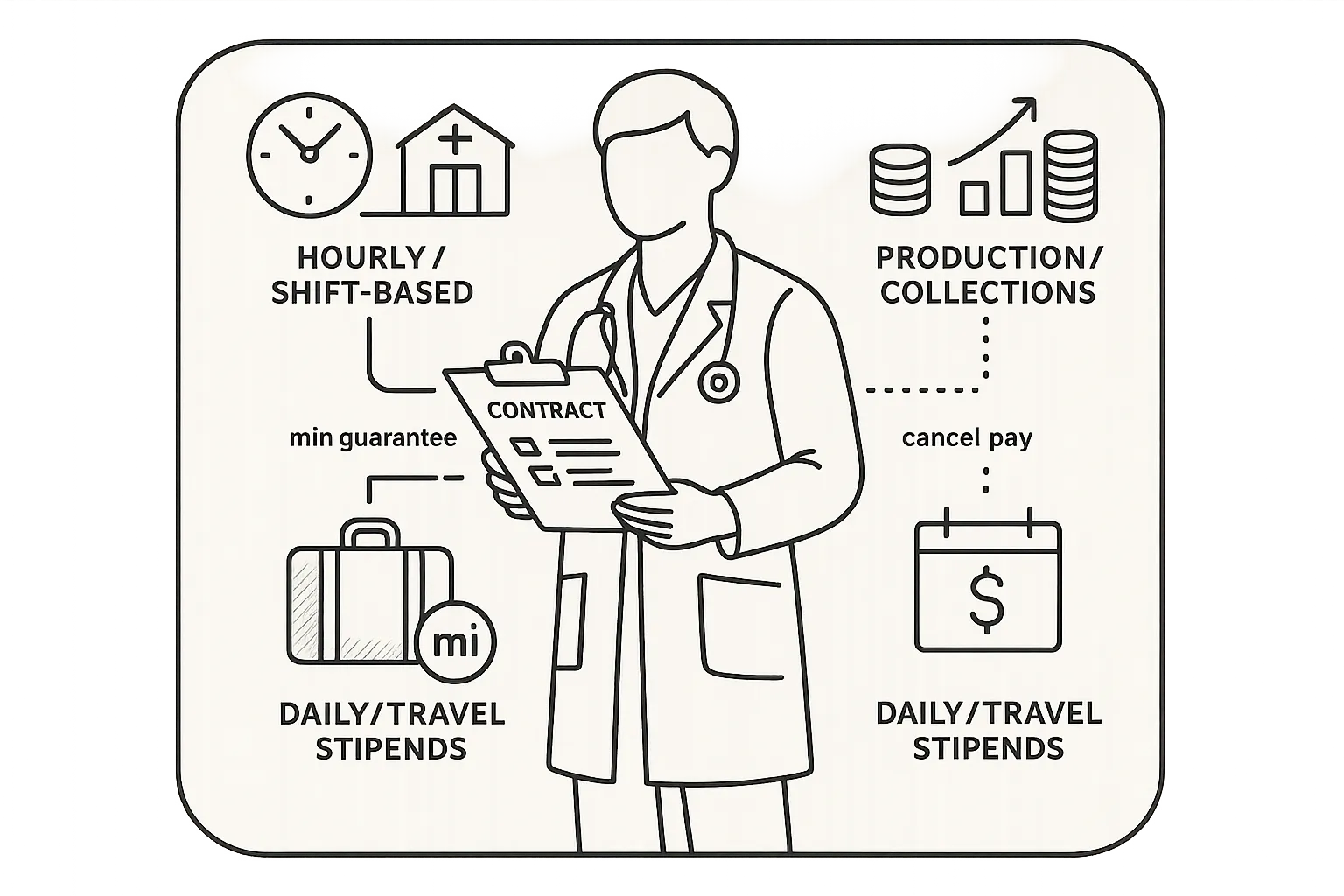
No national veterinary rule establishes one required method for paying relief veterinarians. The compensation model is primarily contractual, subject to applicable wage, tax, classification, and professional-practice requirements. Comparing offers therefore requires examining both the payment method and every condition that can increase, delay, or reduce the amount ultimately received.
Hourly Rates, Shift Guarantees, and Daily Stipends
Hourly pay provides a straightforward relationship between time worked and gross compensation. The agreement still needs to define when compensable time begins and ends, whether required charting is included, and how additional time is approved and paid. A high hourly rate may be less valuable if the practice guarantees only a few hours, frequently cancels shifts, or expects significant unpaid administrative work.
A per-shift guarantee can provide greater income certainty when the assignment has a predictable duration. The language may specify the hours included in the guarantee, an additional hourly rate once the shift exceeds that period, and premiums for emergency or after-hours work. Without those details, a flat shift payment could cover substantially more work than the veterinarian anticipated.
Daily stipends are often used for longer locum placements or assignments requiring travel. A stipend may be intended as clinical compensation, expense reimbursement, or both, and the agreement needs to distinguish among those categories. Travel provisions can separately address mileage, airfare, lodging, meals, parking, licensing costs, and payment for time spent traveling.
Production, Collections, and Blended Formulas
Variable compensation may pay a percentage of production or collections. Production generally credits qualifying services when they are performed or billed, while collections-based pay depends on money the practice actually receives. Collections can be difficult for a short-term veterinarian to verify because patient payments, insurer payments, refunds, and chargebacks may occur after the final shift.
A blended arrangement may offer a guaranteed shift rate plus an additional percentage above a stated threshold. This structure can combine predictable income with upside from a busy caseload, but its value depends on the threshold, attribution rules, exclusions, and reconciliation process. A veterinarian comparing these models can use a veterinary compensation and ProSal review to test the language against realistic examples rather than relying on the stated percentage.
Audit the Production Formula, Not Just the Percentage
A production percentage is meaningful only after the agreement defines the revenue to which it applies. Two practices can offer the same percentage while producing very different compensation because they use different rules for diagnostics, pharmacy sales, shared cases, discounts, refunds, and technician-assisted services. The contract can also determine whether credit is recorded on the date of service, the billing date, or the date payment arrives.
- Revenue attribution: How is credit divided when multiple veterinarians or team members participate in a case?
- Included services: Do surgery, diagnostics, medications, food, boarding, and other charges count toward the formula?
- Gross or net amounts: Which fees, discounts, write-offs, refunds, or processing costs may be deducted before applying the percentage?
- Reporting access: What reports will the practice provide, and will they contain enough data to verify the calculation?
- Reconciliation timing: When are bonuses calculated, and how long may the practice make retroactive adjustments?
- Dispute procedures: How can the veterinarian question missing credit or inaccurate data, particularly after the assignment ends?
Negative accrual arises when an advance, draw, or guarantee exceeds the amount generated under the variable formula and the deficit carries into a later period. The agreement may treat the deficit as a future offset, an amount repayable at termination, or an obligation that resets periodically. Those outcomes are economically different. The language can clarify whether deficits cross pay periods, whether they are capped, and whether the veterinarian remains responsible after the relationship ends.
Sample calculations often expose ambiguity more effectively than a formula stated in the abstract. Useful examples include a slow shift, a high-production shift, a refund posted after payment, and a final reconciliation following termination. The discussion of veterinary negative accrual provides additional context for evaluating carryforward provisions and repayment exposure.
Calculate Taxes, Benefits, Expenses, and Insurance
Gross compensation is not the same as economic value. A W-2 offer may include the employer’s share of payroll taxes, health coverage, retirement contributions, paid leave, continuing education support, licensing reimbursement, and malpractice insurance. A contractor may need to purchase or fund those items independently. Comparing only the stated rates can therefore make an offer with substantial cost shifting appear more favorable than it is.
Independent contractors generally calculate self-employment tax on net earnings and ordinarily make estimated tax payments because wage withholding does not occur. Additional Medicare tax may apply depending on total income and filing status. The precise result depends on deductions, other income, entity structure, and individual circumstances, so the contract rate needs to leave room for professional tax advice rather than assuming one universal adjustment. Current IRS self-employment tax guidance explains the federal framework.
The agreement may also address licensing fees, controlled-substance registrations, professional memberships, continuing education, equipment, uniforms, and travel expenses. Signing, retention, or relocation payments require separate attention when they are subject to repayment. Important terms include the events that trigger repayment, whether the amount declines over time, whether repayment applies after termination without cause, and whether the practice can deduct the balance from final compensation.
Professional liability coverage warrants policy-specific review. Occurrence coverage generally responds based on when the incident occurred, while claims-made coverage generally depends on when the claim is made and whether qualifying coverage remains in force. Tail or extended reporting coverage may be relevant after a claims-made policy ends, but it is not automatically required in every arrangement.
The veterinarian can verify the policy form, retroactive date, limits, exclusions, covered locations and services, reporting requirements, and consent-to-settle terms. The contract can then identify who obtains and pays for any required extended reporting coverage and whether responsibility changes with the reason for termination. Chelle Law’s veterinary tail insurance guide explains how these provisions can affect post-employment exposure.
Protect Income and Mobility When the Assignment Ends
Relief veterinarians often commit valuable calendar time before a shift occurs. If the practice can cancel without notice or payment, the veterinarian bears the entire scheduling risk and may be unable to replace the lost work. A contract can address a minimum shift guarantee, a cancellation deadline, a percentage or flat cancellation fee, and reimbursement of nonrefundable travel costs. It can also explain what happens when the veterinarian arrives but the practice closes early or has insufficient demand.
Termination language affects final compensation as well as future assignments. Relevant provisions include the notice period, the practice’s ability to remove scheduled shifts during notice, the deadline for paying outstanding production, access to supporting reports, and the treatment of later refunds or chargebacks. Open-ended reconciliation rights may allow deductions long after the veterinarian can meaningfully verify the underlying records. A focused termination provision review can identify notice, final-pay, and repayment concerns before either party ends the relationship.
Noncompete, nonsolicitation, exclusivity, and moonlighting provisions can be unusually consequential for a relief veterinarian who works with several practices. A restriction drafted for a full-time associate may cover every facility in a corporate network even if the veterinarian served only one location for a short period. Other clauses may prohibit outside work during the agreement or define solicitation broadly enough to capture general advertising and preexisting professional relationships.
The Federal Trade Commission’s 2024 nationwide noncompete rule is not currently in effect or enforceable. Noncompete analysis therefore continues to depend on applicable state law, contract doctrine, the clause’s wording, and relevant judicial decisions. Potential revisions may include limiting the restriction to locations where services were actually performed, narrowing the prohibited activity, reducing the duration, and excluding relationships that predate the assignment. Chelle Law offers a dedicated review of veterinary restrictive covenants for this analysis.
Questions to Resolve Before Accepting Relief Work
A practical contract review connects the pay formula to the way the assignment will operate. The most significant concern may not be the nominal rate; it may be an undefined shift, an unverified collections formula, an unexpected tail obligation, or a restriction that interferes with other relief work. The following questions can help identify where the written terms need greater precision:
- Does the written classification match the practice’s actual level of control and the veterinarian’s opportunity to operate independently?
- What hours, locations, administrative duties, call obligations, and response times are included in the stated rate?
- Is there a minimum shift guarantee, and what compensation applies when a shift is shortened or canceled?
- How are production or collections attributed, reported, adjusted, and reconciled?
- Can negative accrual, refunds, chargebacks, or bonus repayments reduce final compensation?
- Who pays travel, licensing, continuing education, taxes, benefits, malpractice premiums, and any required tail coverage?
- Do noncompete, nonsolicitation, exclusivity, or moonlighting clauses reach beyond the work actually performed?
- What happens to scheduled shifts, outstanding production, records access, and insurance obligations after termination?
These provisions need to be evaluated together. For example, a contractor rate may appear attractive until travel, taxes, insurance, and cancellations are included, while a production bonus may offer little value without reliable attribution reports. Chelle Law can analyze how the terms allocate financial and professional risk and identify provisions that may warrant clearer language before the veterinarian commits to the assignment.
Frequently Asked Questions
Which pay structure is most predictable for a relief veterinarian?
An hourly rate with guaranteed hours or a defined shift payment usually provides more predictable gross compensation than a purely production- or collections-based formula. Predictability still depends on cancellation rights, overtime terms, included administrative work, and whether the practice can shorten or reassign the shift.
How is collections-based relief veterinarian pay calculated?
Collections-based compensation applies a stated percentage to qualifying payments received by the practice for attributed services. The agreement needs to define gross or net collections, included revenue, attribution, refunds, write-offs, reporting access, and how payments received after the assignment ends will be reconciled.
Can a relief veterinarian be responsible for negative accrual?
That depends on the compensation language. A contract may carry a deficit into future periods, deduct it from later bonuses, require repayment, or reset the balance. The veterinarian can examine whether accrual is capped, how long it continues, and what happens to any balance at termination.
Does a 1099 form automatically make a relief veterinarian an independent contractor?
No. Tax reporting and contract labels do not by themselves determine legal status. The IRS, federal wage law, and state laws may use different tests that consider control, financial independence, the parties’ relationship, and other facts about how the work is actually performed.
Is malpractice tail coverage always required for relief veterinary work?
No. The need for tail or extended reporting coverage depends on the policy type, policy wording, retroactive date, reporting period, applicable law, and contract. The agreement can identify the coverage provided and who pays for any post-termination protection that is actually required.
What contract terms protect a relief veterinarian from canceled shifts?
Potential protections include guaranteed minimum hours, a required cancellation deadline, a flat or percentage-based cancellation fee, and reimbursement for nonrefundable travel expenses. The agreement can also address shortened shifts, facility closures, and cancellations during a termination notice period.
Have Your Relief Veterinarian Agreement Reviewed Before Signing
Chelle Law can evaluate the pay formula, classification language, cancellation terms, malpractice obligations, deductions, and restrictive covenants so you understand the offer’s practical value and risk.
Contact Chelle Law