

Relief veterinarians—sometimes called locums, relief vets, or float vets—provide short-term, recurring, emergency, or multi-location coverage for veterinary practices. Their compensation may be based on an hourly rate, a guaranteed shift payment, a daily stipend, production, collections, or a combination of these methods. Although a rate may look attractive, the actual value of an offer depends on scheduling guarantees, tax classification, expense reimbursement, and the contract’s payment formula.
These details matter because relief veterinarians often assume responsibilities that are not reflected in the advertised rate. Travel between locations, canceled shifts, on-call coverage, delayed collections, negative accrual, malpractice insurance, and restrictive covenants can materially affect take-home pay and professional mobility. W-2 and independent contractor arrangements also allocate taxes, benefits, insurance expenses, and workplace control differently.
Chelle Law reviews relief veterinarian agreements to identify unclear compensation terms, classification concerns, repayment exposure, insurance obligations, and restrictions that may extend beyond the work performed. The goal is to determine how the agreement operates in practice, compare the stated rate with the veterinarian’s actual financial obligations, and negotiate clearer protections before the contract is signed.
Key Takeaways
- Common relief veterinarian pay models include hourly or shift rates, production or collections percentages, and daily stipends.
- W-2 versus independent contractor status changes tax responsibility, access to benefits, malpractice obligations, and the practical value of the stated rate.
- Production and collections formulas should define attribution, exclusions, reports, reconciliation dates, and the treatment of negative accrual.
- Written terms should address minimum hours, cancellation pay, travel reimbursement, malpractice coverage, and any tail insurance obligation.
- Broad restrictive covenants, vague payment formulas, uncapped deductions, and classification concerns warrant careful review before signing.
Relief Veterinary Work and Employment Arrangements

Relief veterinary work covers a broad spectrum, including a single short-term fill-in assignment, recurring weekly shifts, emergency-only coverage, and a long-term locum placement during a leave or vacancy. The nature of the assignment affects compensation, scheduling obligations, tax treatment, and liability exposure. A veterinarian regularly working under a practice’s direction may face a different contractual arrangement than a professional who independently accepts occasional shifts from multiple clinics.
W-2 Employee Versus Independent Contractor Status
Many practices classify relief veterinarians as independent contractors, while others hire them as W-2 employees. A W-2 employer withholds payroll taxes and may provide benefits, malpractice insurance, and employment protections. The practice also commonly exercises greater control over the veterinarian’s schedule and clinical duties.
An independent contractor may receive greater scheduling flexibility and higher gross compensation but is generally responsible for self-employment taxes, health insurance, retirement savings, and potentially professional liability expenses. The contract’s label is not the only consideration when evaluating status; the parties should assess how the working relationship actually operates. Veterinarians comparing these arrangements can review the practical differences in the W-2 versus 1099 veterinarian guide.
Classification affects more than taxes. The agreement should explain who controls hours, protocols, evaluations, equipment, staffing, and the ability to work for other practices. A contractor designation paired with substantial employer control may create misclassification concerns and should be evaluated in light of the applicable facts and law.
Schedules, On-Call Coverage, and Multiple Locations
Relief shifts may involve scheduled daytime coverage, split shifts, overnight emergency work, or an on-call rotation. Block shifts of eight to twelve hours are generally easier to price than fragmented or swing coverage. The agreement should distinguish compensation for scheduled hours, time spent on call, call-backs, work beyond the scheduled shift, and required response times.
Multi-location assignments create additional questions about mileage, travel time, overnight lodging, and the practice’s ability to reassign the veterinarian. Shift types, anticipated patient volume, required locations, and continuing coverage obligations should be stated in writing. Minimum shift lengths and cancellation terms are particularly important when a veterinarian reserves time and turns down other work.
Common Relief Veterinarian Pay Models
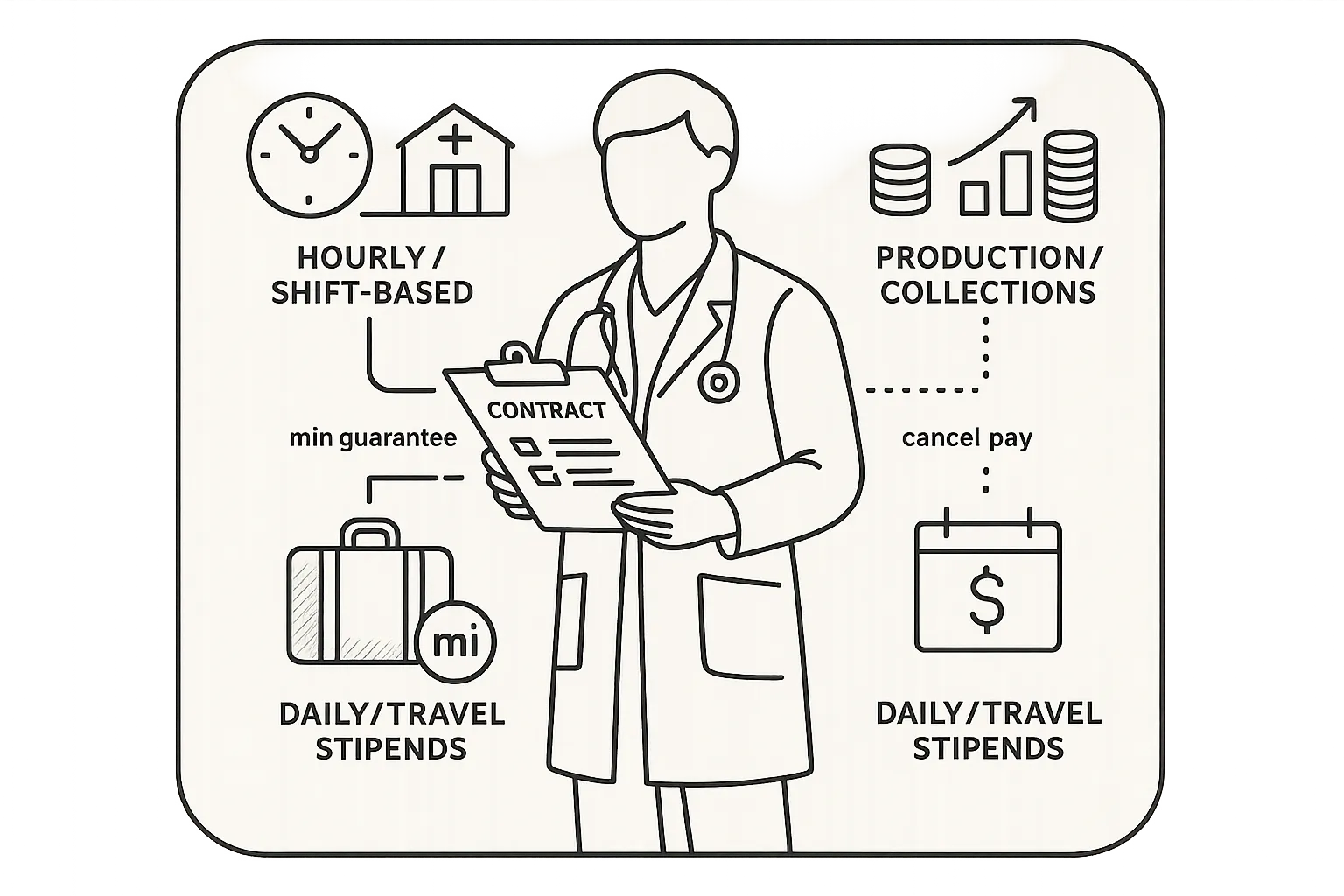
Relief veterinarians encounter several compensation models. Some practices use one method for every assignment, while others combine a guaranteed rate with production incentives, travel reimbursement, or an emergency premium. A meaningful comparison requires looking beyond the headline number and calculating the expenses and risks allocated to the veterinarian.
Hourly and Shift-Based Compensation
Hourly and per-shift rates are common for short-term relief work. These models provide predictable gross compensation regardless of production and are relatively simple to administer. They may, however, undercompensate a veterinarian who handles a demanding emergency caseload or consistently generates substantial revenue without receiving a production component.
The agreement should state the scheduled shift length, the rate for additional time, and whether charting or other required work after the shift remains compensable. After-hours and emergency coverage may justify a premium. Minimum shift guarantees, cancellation pay, and compensation for required travel can help protect the veterinarian when the practice changes its staffing plans.
Production, Collections, Stipends, and Travel Reimbursement
A practice may pay a percentage of billed production or collected revenue, particularly when a relief veterinarian manages a high-value or complex caseload. Production-based compensation credits specified services when they are performed or billed, while collections-based compensation depends on payment received by the practice. Collections may be more difficult for a short-term veterinarian to monitor because payment can arrive after the assignment ends.
Daily or flat-rate stipends are also common for long-distance locum and multi-clinic work. A stipend may assume a specific shift length or caseload, so the contract should identify what happens when the assignment extends beyond those expectations. Travel provisions should address mileage or a negotiated allowance, required lodging, meals or per diem, and whether travel time is compensated.
Blended models may offer a guaranteed amount plus a production bonus. These arrangements can provide security and upside, but only when the formula is clearly defined. A detailed veterinary compensation and ProSal review can test the formula against sample scenarios and identify deductions that reduce the apparent rate.
Production, Collections, and Negative Accrual
Compensation tied to production or collections requires precise definitions. The agreement should explain whether the percentage applies to gross or net amounts, which services count, and how discounts, refunds, pharmacy sales, diagnostics, and shared cases are treated. It should also identify whether revenue is credited on the date of service, billing, or payment.
- Attribution: Identify how the practice assigns services when multiple veterinarians or technicians participate in a case.
- Included revenue: Define whether surgery, diagnostics, pharmacy items, and other charges count toward compensation.
- Adjustments: State how discounts, refunds, write-offs, and payment disputes affect the formula.
- Reporting: Require regular statements showing the data used to calculate compensation.
- Reconciliation: Establish when calculations occur and how the veterinarian may dispute an error.
Negative accrual occurs when a draw or guarantee exceeds the compensation generated under the production formula and the deficit carries forward or becomes repayable. The contract should state whether deficits can roll from one period to another, how long the practice may reconcile prior payments, and what happens when the relationship ends. Credit card disputes, refunds, and other chargebacks should not remain open indefinitely.
Sample calculations can reveal issues that are difficult to see in a formula alone. Relief veterinarians should request a regular reconciliation schedule, supporting reports, reasonable limits on retroactive adjustments, and a process for challenging inaccurate data. The separate guide to veterinarian negative accrual explains how these carryforward provisions can affect earned compensation.
Benefits, Taxes, and Professional Liability Coverage
Gross compensation does not show the complete value of a relief position. A W-2 veterinarian may receive health insurance, retirement contributions, paid time off, continuing education support, licensing reimbursement, and employer-paid payroll taxes. An independent contractor commonly must replace these benefits and budget for self-employment taxes and estimated payments, making a higher gross rate less valuable than it initially appears.
The contract should also identify whether bonuses carry repayment obligations and whether the practice pays licensing fees, continuing education expenses, or other professional costs. If the position includes a signing or relocation payment, the repayment trigger, prorating method, and amount owed at termination should be written clearly rather than left to a later policy.
Professional liability coverage is another central concern. An occurrence policy generally covers an incident that occurred while the policy was active even if the claim is reported later. A claims-made policy generally responds when the claim is made while qualifying coverage remains in effect, which may create a need for tail or other extended reporting coverage after the veterinarian leaves.
The agreement should specify the policy type, limits, covered services, and the party responsible for tail coverage. It should also explain whether that responsibility changes based on the reason for termination. Because the financial exposure can be significant, veterinarians should review the veterinary tail insurance guide and negotiate employer-paid coverage, cost sharing, or another clearly defined arrangement where appropriate.
Contract Risks for Relief Veterinarians
Relief roles create contractual risks that can quietly reduce compensation or restrict future opportunities. Noncompete and nonsolicitation provisions are particularly important for veterinarians who accept shifts across multiple practices. Enforceability varies by jurisdiction, but even a clause that may ultimately be challenged can create expense and uncertainty.
- Overbroad territory: A restriction may cover every practice location even when the veterinarian worked at only one site.
- Disproportionate triggers: A brief relief assignment may activate the same restriction imposed on a long-term associate.
- Undefined solicitation: The clause may fail to distinguish general advertising from direct solicitation of clients or staff.
- Outside-work restrictions: A moonlighting or exclusivity clause may prevent the veterinarian from accepting other relief shifts.
Possible negotiation points include limiting the restriction to locations where the veterinarian actually worked, shortening its duration, narrowing the prohibited activity, and excluding preexisting professional relationships. A focused review of veterinary restrictive covenants can assess the clause in the context of the applicable jurisdiction and the veterinarian’s expected assignments.
Termination provisions also affect pay security. Without guaranteed shifts or cancellation protection, a practice may eliminate expected income on short notice. The agreement should address notice, final compensation, post-termination reconciliation, access to supporting payment records, and limits on retroactive deductions. Veterinarians facing these provisions can use a contract termination review to evaluate notice obligations and final-pay risks before ending the relationship.
Negotiating a Relief Veterinarian Agreement
A targeted negotiation should prioritize pay certainty, liability protection, and professional mobility. The veterinarian should first confirm the working relationship and then compare the stated compensation with taxes, insurance expenses, unpaid administrative time, travel, and lost income from cancellations.
- Define W-2 or independent contractor status and ensure the written terms reflect the actual relationship.
- Establish minimum guaranteed hours, per-shift minimums, overtime terms, and cancellation fees.
- Include clear production or collections definitions, sample calculations, reports, and reconciliation dates.
- Limit negative accrual periods, post-termination deductions, and repayment exposure.
- Address travel time, mileage, lodging, and other expenses associated with multi-site assignments.
- Identify the malpractice policy type and responsibility for tail or extended reporting coverage.
- Narrow restrictive covenants and exclude locations or relationships unrelated to the relief assignment.
Broad noncompetes, vague collections formulas, long reconciliation windows, uncapped tail obligations, undefined buy-in language, and potential misclassification are significant warning signs. At Chelle Law, Robert Chelle reviews these provisions, explains their practical effect, and provides proposed revisions designed around the veterinarian’s compensation, obligations, and future plans.
Frequently Asked Questions
What are the most common relief veterinarian pay structures?
Relief veterinarian compensation commonly includes hourly rates, guaranteed shift payments, daily stipends, production percentages, collections-based pay, or a combination of these methods. The agreement should define minimums, expenses, reporting, and any adjustments that can reduce the stated amount.
How does collections-based pay work for a relief veterinarian?
Collections-based pay gives the veterinarian a percentage of qualifying payments the practice receives for attributed services. The contract should define gross versus net collections, included services, attribution rules, adjustments, reporting access, and the reconciliation schedule.
What does negative accrual mean in a veterinary pay formula?
Negative accrual means a compensation deficit may carry forward when a draw or guarantee exceeds the amount generated under the applicable formula. Veterinarians should determine whether the deficit is repayable, how long it can carry forward, and what happens to it at termination.
Should a relief veterinarian work as a W-2 employee or an independent contractor?
The better arrangement depends on the actual working relationship and financial terms. W-2 status may include tax withholding, benefits, and employer-provided coverage, while contractors commonly assume their own taxes, benefits, and business expenses. The contract label should be evaluated alongside the practice’s actual level of control.
Who pays for malpractice tail coverage in a relief veterinarian agreement?
Responsibility depends on the policy, contract, and applicable circumstances. The agreement should identify whether coverage is occurrence or claims-made and state who pays for any required tail coverage, including whether responsibility changes based on the reason for termination.
What cancellation protections should a relief veterinarian request?
A relief veterinarian may request a minimum shift guarantee, a cancellation fee, a required notice period, and reimbursement for nonrefundable travel expenses. These terms help protect income when the veterinarian reserves time or declines other assignments in reliance on the scheduled shift.
Review Your Relief Veterinarian Agreement Before You Sign
Chelle Law can evaluate compensation formulas, contractor classification, malpractice obligations, cancellation protections, and restrictive covenants so you understand the practical value and risk of the offer.
Contact Chelle Law