

A veterinary employment contract renewal is not merely an extension of the existing relationship. A renewal draft may preserve the agreement’s familiar structure while changing how production is calculated, when bonuses are earned, who pays for professional liability coverage, or how the veterinarian may leave the practice. Even a short amendment can incorporate new policies or revise provisions that affect income, mobility, workload, and financial exposure.
The most consequential changes are not always highlighted. A revised ProSal formula may shift more risk to the associate, an expanded restrictive covenant may limit future employment, and a new repayment clause may make departure expensive. Renewal language can also change work locations, call obligations, outside-employment restrictions, termination notice, or the economics of a promised ownership opportunity.
Chelle Law reviews the proposed renewal together with the current agreement, compensation exhibits, incorporated policies, and related documents. That comparison helps identify what changed, how multiple clauses interact, and which provisions may warrant clarification or revision before the veterinarian signs.
Key Takeaways
- Compare the renewal against the signed agreement rather than reviewing the new document in isolation.
- Confirm the precise ProSal, production, collection, deduction, and reconciliation mechanics that determine compensation.
- Evaluate restrictive covenants under current state law because no nationwide federal noncompete ban is currently in effect.
- Verify the professional liability policy type, retroactive date, prior-acts coverage, reporting requirements, and responsibility for tail or equivalent coverage.
- Calendar automatic-renewal and nonrenewal deadlines, and examine whether incorporated policies can be changed without mutual consent.
- Review changes to scheduling, locations, exclusivity, liquidated damages, repayment obligations, and ownership terms as carefully as changes to salary.
Start by Comparing the Entire Contract Package
A renewal can appear straightforward when it states that the existing contract will continue for another year. The legal effect may be broader if the renewal replaces prior exhibits, incorporates an updated employee handbook, or authorizes the practice to revise compensation and operating policies. The review therefore needs to include more than the signature page.
Compare the renewal line by line with the signed agreement and assemble every document it incorporates. Relevant materials may include compensation schedules, bonus plans, insurance declarations, ownership letters, policy manuals, offer letters, and prior amendments. If the renewal conflicts with an earlier promise, the documents need to clarify which provision controls.
- Identify additions, deletions, and changed definitions.
- Confirm whether the renewal replaces the agreement or merely amends selected terms.
- Determine whether oral assurances or offer-letter terms appear in the binding documents.
- Check whether the practice may change policies, schedules, locations, or compensation unilaterally.
- Calendar the deadline for renewal, nonrenewal, and without-cause termination notice.
Compensation Changes Can Shift More Risk to the Veterinarian
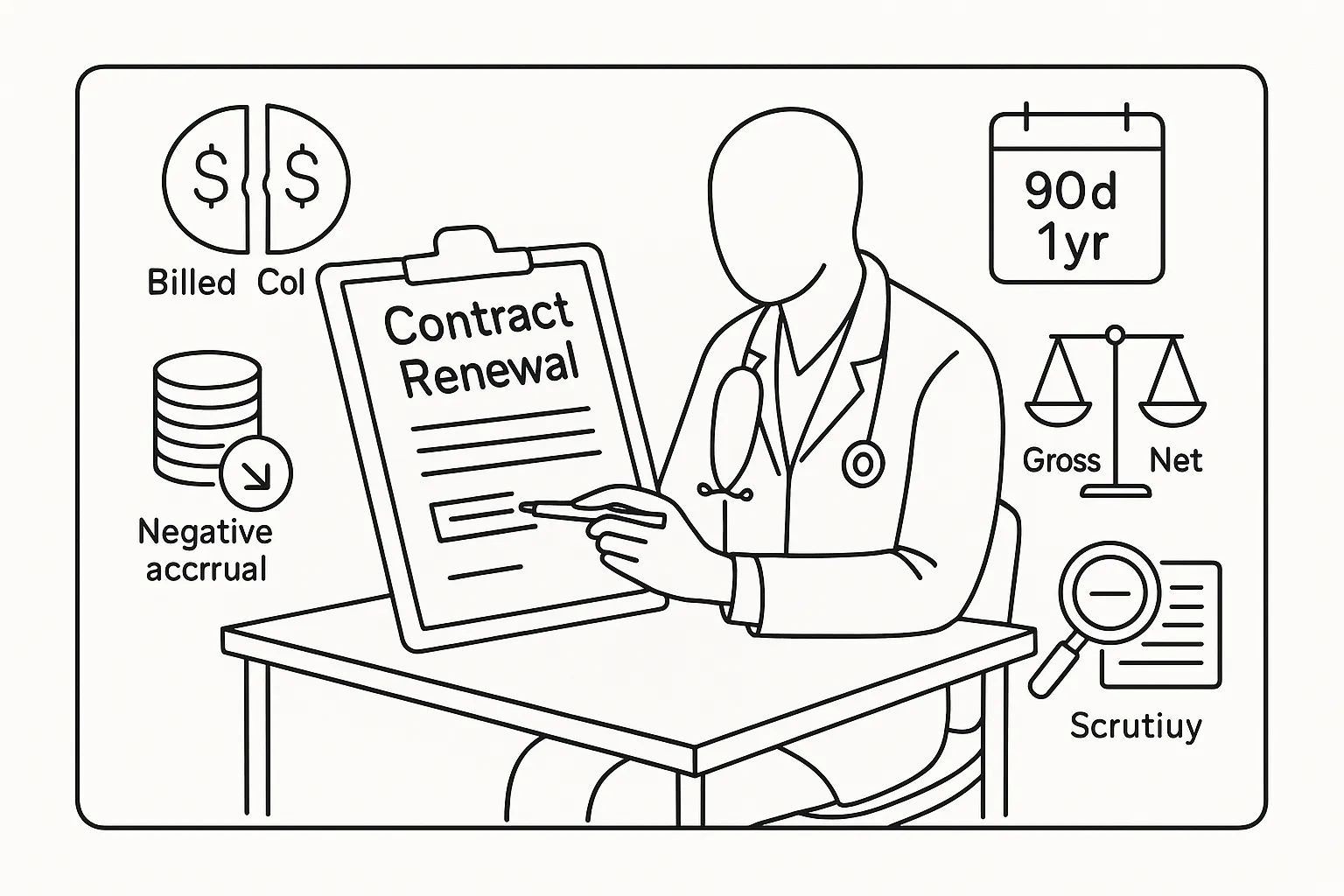
Renewal is a common point for a practice to revise base salary, production percentages, bonus thresholds, or the revenue credited to an associate. A higher production percentage is not necessarily an improvement if the guarantee decreases, the threshold increases, or more deductions are taken before production is calculated. A comprehensive veterinary compensation and ProSal review examines the formula as a whole rather than focusing on a single percentage.
Production, ProSal, and Collections Formulas
ProSal generally combines guaranteed compensation with production-based earnings, but the contract controls the actual calculation. The renewal needs to define whether production is based on billed revenue, adjusted production, or money the practice collects. It should also identify excluded services, discounts, refunds, laboratory expenses, merchant fees, and other deductions that reduce credited revenue.
Timing matters as much as the percentage. Important questions include when production is measured, how often the practice reconciles the account, when a bonus becomes earned, and whether the veterinarian can inspect the supporting records. A bonus tied to clinic-wide profitability or a manager’s subjective assessment may be less predictable than one based on objective and verifiable criteria.
- Does the formula use billed, adjusted, or collected revenue?
- Which discounts, refunds, fees, and costs reduce production credit?
- Is the salary a true guarantee, a recoverable draw, or an advance against future production?
- When are reconciliations completed, and when must earned bonuses be paid?
- Can the practice revise the formula during the renewal term?
Negative Accrual, Deductions, and Retroactive Adjustments
Negative accrual permits a production shortfall from one period to reduce earnings in a later period. Depending on the wording, the practice may also charge an associate for refunds, returned products, unpaid balances, or adjustments recorded months after treatment. The balance can become difficult to eliminate when it rolls forward indefinitely, particularly during leave or a seasonal decline in appointments. Veterinarians facing this structure may benefit from a closer explanation of how negative accrual affects production pay.
The renewal can define permitted offsets, documentation requirements, lookback periods, and whether a negative balance survives termination. Federal law does not generally create a right to commissions above applicable wage requirements; promised commissions and deductions are often governed by the contract and state wage-payment law. The U.S. Department of Labor’s commission guidance also notes that pay arrangements remain subject to applicable minimum-wage and overtime rules for covered employees. Classification and state law therefore matter when evaluating deductions, chargebacks, and final compensation.
Other renewal risks include retroactive recalculation rights and language allowing the practice to recover an alleged overpayment without a clear time limit. The agreement can instead require written documentation, a defined dispute process, and objective limits on when completed compensation calculations may be reopened.
Restrictive Covenants Require a Current State-Law Review
Practices sometimes use renewal to expand a noncompete, add a nonsolicitation clause, restrict outside veterinary work, or impose liquidated damages for joining a competitor. The practical effect depends on the prohibited activities, locations, duration, triggering events, and remedies. A covenant tied to every practice location may cover a much larger area than one measured from the associate’s primary clinic.
There is no currently effective nationwide federal rule invalidating employee noncompetes. The Federal Trade Commission reports that its noncompete rule is not in effect and was removed from the Code of Federal Regulations effective February 12, 2026. As a result, enforceability remains primarily dependent on state law and applicable contract principles. Veterinarians reviewing a renewal should not assume that the proposed covenant is valid—or invalid—without examining the governing jurisdiction and precise wording. Chelle Law’s veterinary noncompete review focuses on those contract-specific details.
Noncompetes, Nonsolicitation, Exclusivity, and Damages
California provides an important statutory example: Business and Professions Code section 16600 broadly voids contractual restraints on engaging in a lawful profession, trade, or business, subject to statutory exceptions. That rule should not be generalized to other states. Other jurisdictions may enforce appropriately drafted restrictions, require particular notice or consideration, permit judicial modification, or distinguish among noncompetition, customer nonsolicitation, employee nonsolicitation, confidentiality, and trade-secret provisions.
A nonsolicitation provision is not automatically enforceable merely because it is labeled differently from a noncompete. Its validity and practical reach may depend on the definition of solicitation, the client relationships covered, passive advertising exceptions, confidential information, and whether the clause effectively prevents the veterinarian from working in the market. Likewise, a six- or twelve-month period may be a negotiation position, but it is not a universal legal standard.
The renewal also needs to be checked for exclusivity restrictions and predetermined damages. A clause may bar relief work even when it does not involve a competitor, or require a substantial payment if the associate violates a covenant or leaves before a stated date. The amount, trigger, geographic reach, and interaction with termination provisions all warrant review.
Insurance and Termination Terms Control the Cost of Leaving
Professional liability and termination clauses often receive less attention than salary, but together they can determine whether departure creates a large financial obligation. Renewal may switch the insurance carrier, change the policy form, shift premium responsibility, shorten the notice period, or expand the grounds for immediate termination.
Claims-Made Coverage, Prior Acts, and Tail Responsibility
An occurrence policy generally responds based on when the covered incident occurred, even if a claim is reported after the policy period. Claims-made coverage typically requires the claim to be made and reported while the policy or an applicable reporting extension remains active. When claims-made coverage ends, tail coverage, extended reporting protection, or replacement coverage that includes prior acts may be necessary.
The labels alone do not answer every coverage question. The veterinarian should review the declarations page, policy limits, retroactive date, reporting requirements, exclusions, and endorsements. If the practice changes carriers, the renewal documents need to clarify whether the replacement policy covers prior acts or whether the former policy will receive an extended reporting endorsement. The price of tail protection is highly variable and may depend on the carrier, specialty, claims history, limits, jurisdiction, and employment circumstances; a fixed percentage of the annual premium should not be treated as universal.
A malpractice and tail insurance review can identify who must maintain coverage during employment, the notice period, and after termination. It can also determine whether responsibility changes based on who ends the relationship or whether the veterinarian completes the required notice period.
Notice, Cause, Cure Periods, and Repayment Obligations
A renewal may shorten without-cause notice, broaden the definition of cause, or eliminate a cure period that appeared in the prior agreement. Vague standards such as unsatisfactory performance or unprofessional conduct may give the practice substantial discretion, while immediate termination can affect unpaid production, insurance, repayment obligations, and eligibility for severance.
The contract should be read as an integrated exit plan. A veterinarian who gives notice may still be scheduled for the entire notice period, placed on administrative leave, or restricted from beginning another position. The agreement may also accelerate repayment of a signing bonus, relocation payment, continuing education expense, or other benefit. A focused review of veterinary termination terms can clarify the required notice method, cure rights, compensation through departure, and the consequences of leaving before the notice period ends.
Renewal Can Expand Duties, Locations, and Outside-Work Restrictions
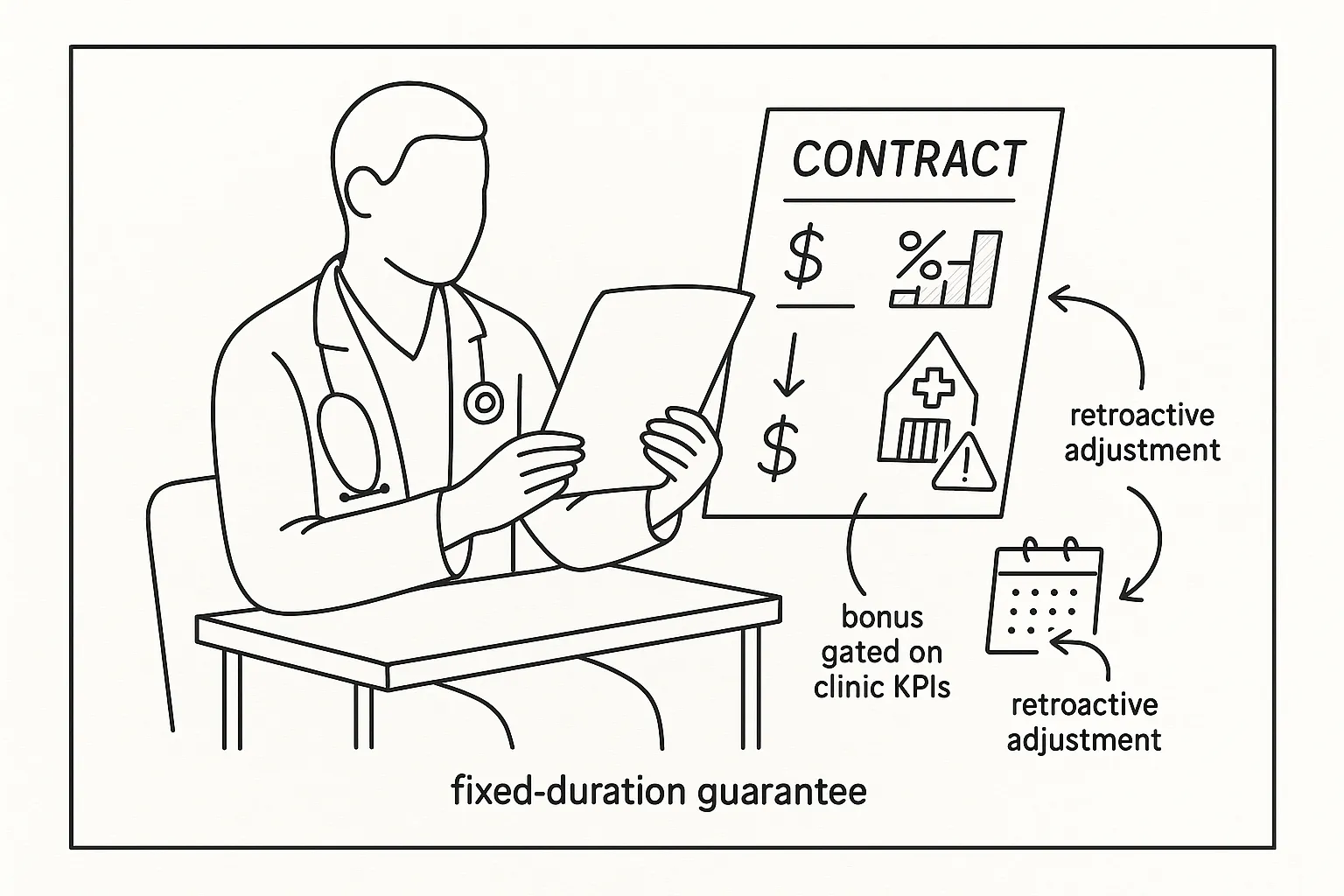
Operational changes can materially alter a job even when compensation remains the same. Renewal language may authorize assignments at additional hospitals, increase weekend or emergency coverage, require more administrative work, or impose tighter control over relief shifts and moonlighting. These changes can affect commute time, production opportunity, childcare, and the veterinarian’s ability to earn outside income.
Review the expected clinical schedule, appointment volume, on-call duties, weekend rotation, administrative responsibilities, and continuing education requirements. Multi-location language needs to identify the permitted locations, travel expectations, reimbursement, and whether travel time affects scheduled hours. The practice’s discretion to modify these terms should also be compared with the veterinarian’s right to decline a material change or end the agreement. Chelle Law’s guide to veterinary schedules and call duties explains additional questions to address.
Classification deserves separate attention when the renewal changes an employee relationship into an independent-contractor arrangement or uses contractor language while preserving extensive practice control. The contract label does not necessarily determine legal classification. Tax responsibility, benefits, insurance, schedule control, equipment, payment structure, and the parties’ actual working relationship may all be relevant under applicable law.
Ownership Promises Need Defined Economics and Exit Terms
Practices frequently raise partnership or ownership during renewal discussions, but a statement that an associate may become an owner is not the same as a binding pathway. The documents need to identify eligibility requirements, timing, valuation, voting rights, distributions, capital contributions, access to financial information, and the process for approving the transaction.
Potential pitfalls include a mandatory buy-in, valuation methods controlled by the current owner, long performance-based earnouts, and repurchase provisions that discount the veterinarian’s interest upon departure. The veterinarian should also understand whether the employment agreement, restrictive covenant, and ownership documents impose separate obligations. A buy-in may make little economic sense if the associate can be terminated from employment while remaining responsible for debt or being forced to sell the ownership interest at an unfavorable price.
Before relying on a promised opportunity, review the practice’s financial records and the written path to ownership. The veterinary ownership pathways resource provides a broader overview of buy-ins, start-ups, and acquisition structures.
A Practical Checklist Before Signing the Renewal
Begin the review well before the contractual deadline. Waiting until the final week reduces the time available to obtain compensation reports, insurance documents, policy manuals, or proposed ownership terms. It may also allow an automatic-renewal provision to extend the existing agreement before the parties resolve disputed changes.
- Compare the proposed renewal with every prior agreement and amendment.
- Calculate compensation under realistic production, collection, deduction, and leave scenarios.
- Request the professional liability declarations page and confirm the retroactive date, prior-acts protection, and reporting obligations.
- Map every noncompete radius and identify the activities, locations, and clients covered by each restriction.
- Identify exclusivity, moonlighting, liquidated-damages, and repayment provisions.
- Confirm scheduling, call, weekend, travel, and multi-location expectations.
- Review termination notice, cause definitions, cure periods, final compensation, and post-employment obligations together.
- Require ownership or buy-in promises to be supported by defined economics, timelines, and exit provisions.
- Ask whether material amendments require mutual written consent or may be imposed through a policy change.
Proposed revisions need to match the actual risk. Examples may include defining credited revenue, limiting negative accrual, requiring documentation for deductions, preserving prior-acts insurance, narrowing a restrictive covenant, adding objective cure rights, or clarifying repayment obligations. The appropriate language depends on the agreement, applicable law, and the veterinarian’s priorities.
Frequently Asked Questions
What is the first document I should review when renewing a veterinary contract?
Start with the signed employment agreement and compare it with the renewal, every amendment, and all incorporated exhibits or policies. Reviewing the renewal alone may miss changed definitions, replaced compensation schedules, or conflicts with earlier promises.
Can a veterinary practice change my ProSal formula at renewal?
A practice may propose a different formula for the new term, but whether it can impose changes during an existing term depends on the contract and applicable law. Review the guarantee, threshold, credited revenue, deductions, reconciliation process, and amendment language before accepting the revised formula.
Is there a federal ban on veterinary noncompetes?
No currently effective nationwide federal rule prohibits veterinary employee noncompetes. The FTC rule is not in effect and was removed from the Code of Federal Regulations effective February 12, 2026, so enforceability generally depends on state law and the covenant’s wording.
What insurance records should I request before renewing?
Request the declarations page and information identifying the policy type, limits, retroactive date, prior-acts coverage, exclusions, reporting requirements, and carrier. If coverage is claims-made, determine who purchases tail, extended reporting, or equivalent protection when the policy ends.
Can an automatic-renewal clause extend an unfavorable veterinary contract?
Yes. If the required nonrenewal notice is not delivered on time and in the specified manner, the agreement may renew for another term. Calendar the deadline and determine whether the renewed term preserves existing provisions or permits new terms through an amendment or policy change.
When is attorney review particularly important for a veterinary renewal?
Review is particularly valuable when the renewal changes compensation, restrictive covenants, insurance, termination, repayment, scheduling, classification, or ownership terms. It can also help when the renewal incorporates new policies or conflicts with the existing agreement.
Review Your Veterinary Renewal Before You Sign
Chelle Law can analyze the proposed renewal, compare it with your current agreement, identify material changes, and explain which compensation, insurance, restriction, termination, or ownership terms may warrant clarification or revision.
Contact Chelle LawExplore Veterinary Contract Resources
Review related legal services, practical contract guides, and state-focused veterinary contract information.