
A nurse practitioner telehealth agreement governs much more than the ability to work remotely. It can determine where the NP may treat patients, who maintains required licenses and registrations, how virtual services generate compensation, and which party bears the cost of technology, malpractice protection, and post-employment obligations. Because telehealth crosses clinical, regulatory, billing, and technology systems, a seemingly favorable offer can create substantial risk when those responsibilities are not clearly allocated.
The provisions also interact. Credentialing delays may reduce visit volume and productivity pay; a changing payer policy may affect collections; and multistate duties may increase licensing expenses or create prescribing restrictions. Claims-made insurance can leave the NP responsible for tail coverage after termination, while broadly drafted repayment or restrictive-covenant language may make leaving the position more expensive than anticipated.
Chelle Law reviews telehealth contracts to identify these connections and explain their practical consequences. The analysis includes clinical duties, patient-location requirements, compensation formulas, administrative work, billing controls, technology obligations, malpractice coverage, termination rights, and restrictions that may continue after the relationship ends.
Key Issues in an NP Telehealth Agreement
- Confirm how the organization verifies the patient’s location and the legal authority permitting practice in each jurisdiction.
- Test salary, encounter, RVU, and collections formulas against realistic visit volume and required non-visit work.
- Identify responsibility for credentialing, platforms, equipment, security safeguards, technical support, and vendor failures.
- Determine whether malpractice coverage is occurrence or claims-made and whether the NP could owe for tail insurance.
- Evaluate termination rights, repayment obligations, restrictive covenants, arbitration, and other surviving provisions.
Define Where and How the NP May Practice
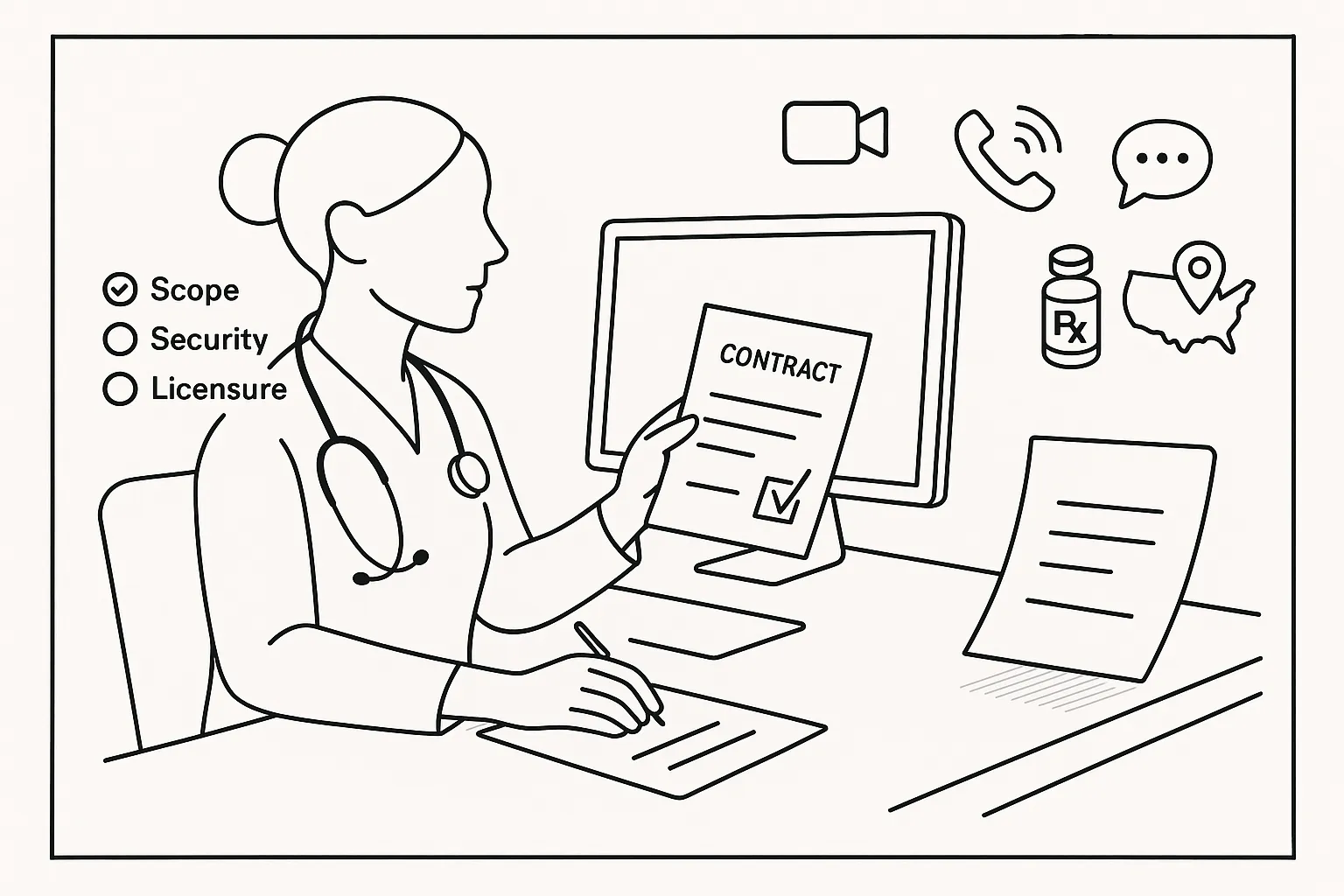
The agreement needs a workable description of the remote clinical services assigned to the NP. Depending on the role, those services may include history-taking, chronic disease management, medication management, virtual triage, asynchronous patient messages, and follow-up care. High-acuity triage or emergency disposition carries different practical risk from routine follow-up visits, so the documents should identify escalation procedures, available clinical support, and circumstances requiring an in-person evaluation.
Broad provisions allowing an employer to add duties deserve careful analysis. Any added service must remain consistent with the NP’s licensure, competence, prescriptive authority, and applicable practice requirements. A focused review of scope-of-practice provisions in NP contracts can help distinguish a reasonable flexibility clause from language that transfers too much regulatory risk to the practitioner.
Patient Location, Licensure, and Multistate Authority
Telehealth authority generally turns on where the patient is physically located during the encounter, not merely where the NP or employer maintains an office. Current federal telehealth guidance recommends verifying patient location before each visit because cross-state requirements differ. The contract and operating policies should identify who performs that verification and which legal pathway authorizes the NP to practice in each jurisdiction, such as a full license, temporary authority, reciprocity, a compact privilege, or a telehealth registration. The HHS cross-state licensing guidance provides a useful overview, but the controlling requirements remain jurisdiction-specific.
The agreement should allocate responsibility for applications, renewals, fees, continuing requirements, and monitoring legal changes. It also should explain whether the employer may add states unilaterally and whether the NP receives compensation for the time and expense required to secure additional authority. The NP should not be contractually obligated to treat a patient in a jurisdiction where the necessary authorization is missing or expired.
Prescribing, Care Modalities, and Clinical Protocols
Prescribing language must account for the NP’s state authority, patient-location law, federal registration requirements, and any applicable telemedicine exception or in-person-evaluation rule. The temporary DEA and HHS extension governing certain COVID-era controlled-substance telemedicine flexibilities ran through December 31, 2025. A 2026 agreement should therefore require compliance with the federal rule or further extension actually in effect when care is delivered rather than assuming the former temporary framework remains available.
The documents also need to distinguish video, audio-only, and asynchronous services. Clinical authorization, privacy compliance, and payer reimbursement are separate questions; permission to provide a service does not guarantee that a payer will reimburse it. Protocols can clarify documentation, informed-consent practices, prescribing limitations, escalation steps, and who monitors changes affecting each modality.
Connect Compensation to Billing and Operational Reality

Telehealth compensation may use a guaranteed salary, a per-encounter rate, collections, work relative value units, or a base salary with productivity incentives. Each structure shifts a different kind of risk. Per-visit pay exposes the NP to fluctuations in scheduled volume and cancellations, while collections-based compensation can depend on payer denials, billing delays, coding decisions, and collection practices outside the NP’s control.
A detailed NP compensation and productivity review examines the formula, conversion factor, threshold, appointment template, reconciliation period, and authority to modify rates. The agreement also needs to identify whether compensation is based on billed charges, allowed amounts, actual collections, encounters, or RVUs. Similar terminology can produce materially different results.
Payer Changes, Reporting Rights, and Clawbacks
Medicare telehealth payment rules remain date-sensitive and can vary by service, practitioner type, patient location, and legislative extension. CMS indicates that after September 30, 2025, many pre-pandemic geographic and originating-site restrictions generally returned for non-behavioral-health services, subject to exceptions and temporary extensions. Current CMS telehealth service and payment materials should be checked when compensation depends on Medicare volume. A contract should not permit payer-policy changes to alter the NP’s compensation invisibly or without a defined calculation method.
Reporting rights matter when the employer controls scheduling, coding, claims submission, and collections. The NP needs enough detail to compare completed work with productivity statements and identify missing encounters, coding adjustments, denials, or delayed payments. Audit language should also provide a reasonable process for raising calculation errors.
Clawback provisions may authorize the recovery of alleged overpayments, payer recoupments, coding changes, or unearned advances. Review should focus on the lookback period, documentation required, dispute rights, wage deductions, and whether the NP can be charged for mistakes caused by employer personnel or systems. Open-ended repayment language can convert previously paid compensation into a significant future liability.
Administrative Time and Telehealth Expenses
Virtual care includes work that may not appear in the scheduled visit count. Patient messages, chart completion, prescription requests, care coordination, meetings, training, quality reviews, and technology troubleshooting can consume substantial time. The compensation terms should reveal whether this work is included in salary, separately paid, or built into productivity expectations.
The financial analysis should also account for computers, cameras, secure internet service, software subscriptions, licensing fees, workspace requirements, and other business expenses. If equipment or connectivity standards change, the contract or incorporated policy should identify who pays for required upgrades. These costs affect the position’s actual net value even when the stated salary appears competitive.
Allocate Credentialing, Technology, and Performance Risk
Credentialing and enrollment can delay the NP’s ability to treat patients or generate billable services. The agreement should identify who submits applications, supplies supporting information, monitors payer enrollment, and provides access to the electronic medical record, scheduling platform, and patient portal. It also should explain whether compensation begins before approvals are complete and whether productivity thresholds are adjusted during a delay.
When supervision or collaboration is required for the position, the employment contract, clinical protocols, and attached practice documents need to work together. Important subjects include communication, chart review, prescribing, availability, reporting, and responsibility when a collaborating clinician is unavailable. A separate review of supervision and collaboration documents can uncover obligations that are not apparent from the primary employment agreement.
Performance standards may measure visit volume, patient satisfaction, response times, quality metrics, protocol compliance, or documentation completion. Those standards are most useful when they are objective and account for conditions controlled by the organization, including staffing, scheduling, patient mix, credentialing, and platform uptime. If performance affects pay or continued employment, the calculation and review process should be understandable before the NP signs.
Cybersecurity, Audio-Only Care, and Vendor Responsibility
Technology provisions should go beyond a general promise to comply with privacy law. The documents can allocate responsibility for security risk analysis, identity authentication, encryption, access controls, device management, recordings, automated transcripts, breach response, vendor selection, business-associate arrangements, and technical support. The NP also needs a reporting process for outages or suspected security incidents that does not require independent remediation of employer-controlled systems.
Audio-only care requires particular attention because the technology used affects the compliance analysis. HHS explains that audio-only telehealth can be permissible under HIPAA when reasonable safeguards are used, while electronic technologies such as applications, VoIP systems, and stored recordings may implicate Security Rule requirements. The organization’s policies should reflect the distinctions described in the HHS guidance on audio-only telehealth.
Review Malpractice Coverage and Contractual Liability
The contract should identify whether the organization provides professional liability insurance or requires the NP to obtain an individual policy. Relevant details include policy limits, covered jurisdictions and services, defense arrangements, notice duties, exclusions, consent-to-settle language, and whether defense costs reduce the available limits. Multistate practice and reliance on employer-selected technology make vague coverage descriptions particularly risky.
Occurrence coverage generally addresses covered incidents that happen during the policy period even if a claim is asserted later. Claims-made coverage ordinarily requires coverage to remain active when the claim is made or requires an extended reporting endorsement after the policy ends. The agreement needs to state who purchases tail coverage, when it is required, and whether responsibility changes based on resignation, termination without cause, or termination for cause. Chelle Law’s guidance on tail insurance for nurse practitioners explains the financial importance of that distinction.
Indemnification can create obligations beyond the malpractice policy. A broad clause might require the NP to reimburse the organization for losses involving billing, privacy events, platform failures, or the conduct of other clinicians. The indemnity, insurance, limitation-of-liability, and defense provisions should be read together to determine whether the contract assigns the NP responsibility for circumstances controlled by the employer or its vendors.
Understand Scheduling, Termination, and Post-Employment Limits
A remote position can still impose rigid scheduling and availability obligations. The contract may establish minimum visits, evening or weekend coverage, message-response deadlines, on-call duties, or authority to change service lines and shifts. The language should distinguish scheduled clinical work from unpaid availability and connect minimum volume expectations to the organization’s responsibility for supplying patients, staff support, and functional technology.
Termination terms determine the notice required, events permitting immediate separation, and financial obligations that survive. A review of NP termination provisions can clarify for-cause definitions, cure opportunities, without-cause notice, final productivity reconciliation, patient handoffs, benefits, record access, and malpractice responsibilities. It is also important to determine whether the organization can deactivate the NP’s systems during a notice period and whether compensation continues if no work is assigned.
Signing bonuses, retention payments, relocation assistance, training expenses, and student-loan benefits may be repayable if the relationship ends early. The repayment trigger, proration method, deadline, and treatment of employer-initiated termination need to be explicit. Otherwise, compensation received at the beginning of the relationship may become a substantial debt at departure.
Restrictive covenants are unusually complex in remote practice because the NP, employer, patients, and competing services may be located in different states. The FTC’s 2024 nationwide noncompete rule is not in effect or enforceable following federal-court litigation, so enforceability generally remains dependent on applicable state law, judicial precedent, worker status, and the wording of the restriction. A telehealth non-compete review should separately examine geography, covered services, patient and employee nonsolicitation, confidentiality, patient-transition duties, choice of law, forum selection, and arbitration.
Questions to Resolve Before Accepting the Position
A telehealth contract is best evaluated as an integrated allocation of financial, clinical, and regulatory risk. The NP should be able to trace how patient location affects licensure, how credentialing affects productivity, how payer rules affect compensation, and how termination changes insurance or repayment obligations. Unclear terms may warrant clarification or revision before the offer is accepted.
- How is patient location verified before every encounter, and who approves new jurisdictions?
- Who obtains and pays for licenses, registrations, prescribing authority, and credentialing?
- Does the pay formula account for administrative work, cancellations, denials, and technology downtime?
- Can payer or productivity rules change without a signed amendment?
- Who bears the cost of equipment, cybersecurity safeguards, malpractice insurance, and tail coverage?
- What compensation, repayment, insurance, and restrictive-covenant obligations survive termination?
Frequently Asked Questions
Must a telehealth NP contract identify every state where patients may be treated?
The agreement should identify the approved jurisdictions or establish a clear process for adding them. It should also allocate responsibility for patient-location verification, licenses, registrations, renewals, and fees. The NP’s duties need to remain conditional on having the authority required in the patient’s location.
How should a contract address patient messages and other non-visit work?
The compensation provisions should explain whether documentation, patient messages, prescription requests, care coordination, meetings, training, and technology troubleshooting are included in salary, paid separately, or incorporated into productivity expectations. This information allows the NP to evaluate actual working time and effective compensation.
Can Medicare telehealth changes affect an NP’s productivity pay?
Yes. Payment rules can vary by service, practitioner type, patient location, and the law or payer policy in effect at the time. If compensation depends on collections, RVUs, or payable encounters, the agreement should explain how coding or coverage changes affect the calculation and whether the employer may revise the formula.
Who pays for tail insurance after a telehealth position ends?
The answer depends on the policy and contract language. The agreement should identify whether coverage is occurrence or claims-made, when tail coverage is required, who purchases it, and whether responsibility changes according to the reason employment ends.
How can a non-compete apply to a remote nurse practitioner?
A telehealth restriction may refer to the NP’s location, patient locations, an employer market, named competitors, or particular services. Because federal and state rules can differ, the restriction should be evaluated under the applicable law together with nonsolicitation, confidentiality, choice-of-law, forum-selection, and arbitration provisions.
When is attorney review particularly useful for a telehealth agreement?
Review is especially useful when the role involves multistate practice, controlled-substance prescribing, complex productivity compensation, broad clawbacks, claims-made insurance, extensive indemnification, bonus repayment, or post-employment restrictions. An attorney can analyze how those provisions interact and identify terms that may warrant clarification or revision.
Have a Telehealth NP Agreement Reviewed Before You Sign
Chelle Law can analyze compensation, multistate duties, prescribing provisions, technology obligations, malpractice coverage, termination rights, and post-employment restrictions so you can understand the agreement’s practical risks.
Contact Chelle LawExplore Nurse Practitioner Contract Guidance
Find contract review services, practical resources, and state-focused guidance for nurse practitioners.