

Veterinarian call coverage compensation determines how an associate is paid for remaining available after hours, responding remotely, and returning to the clinic for urgent cases. Call may be compensated through a flat stipend, hourly or premium pay, production credit, or a combination of these methods. The employment agreement should define these duties and payment formulas clearly rather than leaving important terms to a schedule, handbook, or informal conversation.
Call provisions affect more than immediate earnings. They can change a veterinarian’s schedule, travel requirements, personal time, malpractice exposure, and ability to accept emergency or relief work after employment ends. Common problems include vague definitions of call, opaque ProSal formulas, incorrect production attribution, surprise tail insurance obligations, mandatory multi-location coverage, and restrictive covenants tied to emergency work.
Chelle Law reviews call requirements within the complete veterinary employment agreement, including compensation, scheduling, professional liability coverage, termination rights, and post-employment restrictions. A careful review can determine whether the employer’s expectations are measurable, whether compensation accounts for the work performed, and whether the contract protects the veterinarian if call volume, assigned locations, or employment status changes.
Key Call Coverage Contract Takeaways
- Define call and on-call duties precisely, including response times, methods of response, travel expectations, in-clinic responsibilities, and who initially triages calls.
- Negotiate a written compensation formula covering stipends, hourly or premium pay, production credit, reconciliation procedures, and any negative accrual.
- Address minimum pay, short-notice schedule changes, shift cancellations, multi-location assignments, travel time, and mileage reimbursement.
- Clarify malpractice coverage, defense and indemnification, and responsibility for any required tail coverage when employment ends.
- Review termination and non-compete provisions so call duties do not unnecessarily restrict future emergency, relief, or locum work.
Why Call Coverage Terms Matter in a Veterinary Contract
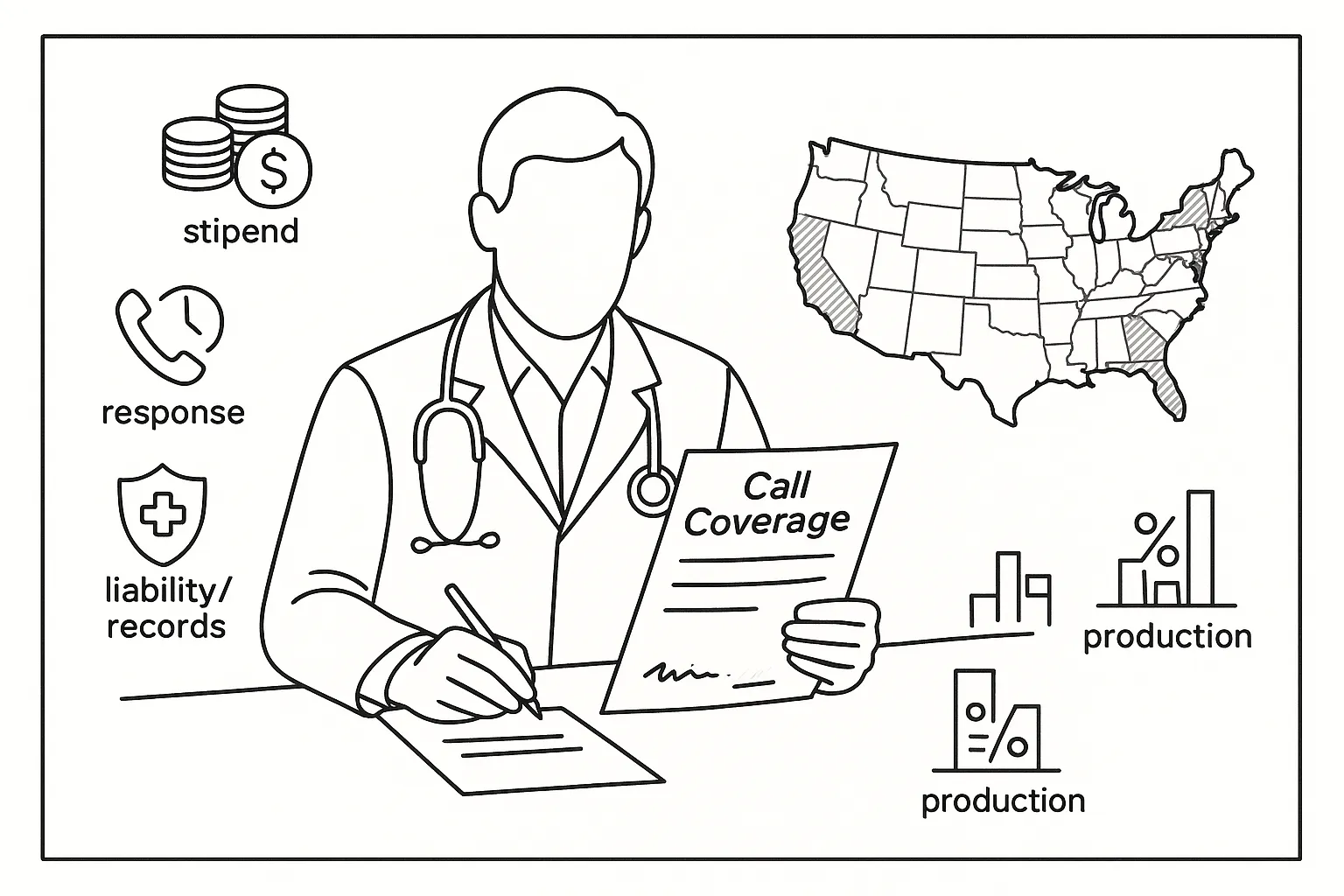
Call coverage is more than an administrative detail because it directly affects income, work-life balance, and professional risk. Associates can lose significant compensation when call cases are not credited correctly under ProSal or another production formula. Undefined expectations about availability, response times, support staffing, and travel can also produce an unpredictable workload, particularly when an employer operates multiple hospitals.
The contract should explain whether call means remaining reachable, providing telephone triage, handling remote communications where permitted, traveling to the hospital, or remaining on site after normal hours. It should also identify who screens the initial request, what support staff will be available, how quickly the veterinarian must respond, and whether assigned call frequency can be changed unilaterally. The related guide to veterinary schedules and call duties explains how these obligations interact with ordinary work hours and schedule control.
How call is defined and paid shapes income predictability. A flat monthly or weekly stipend is relatively easy to understand, while percentage-of-production credits can vary significantly and may undercompensate the veterinarian if production thresholds, attribution rules, or negative accrual distort the result. The agreement should therefore state not only the rate but also how the employer calculates, reports, and reconciles call-related compensation.
Call terms also affect work-life balance. Requirements to remain reachable, respond within a short period, or travel among several facilities can create burnout if the contract does not establish reasonable frequency, advance notice, and procedures for shift changes. Professional liability presents another concern because emergency decisions may be made with limited staffing, incomplete records, or little time. The agreement should identify the coverage available for after-hours care and the employer’s obligations if a claim arises.
Restrictive covenants can create a separate career risk if broadly drafted language prevents the veterinarian from accepting nearby emergency, urgent-care, or relief work after departure. Non-compete law varies substantially by state and can change over time, so call obligations and post-employment restrictions should be reviewed under the law governing the agreement rather than evaluated through informal promises or assumptions.
Common Veterinarian Call Compensation Models

Veterinary employers commonly use a stipend, hourly or premium payment, production credit, or a blended arrangement. Each model has different consequences for predictability, administrative transparency, and compensation when actual call volume exceeds expectations. The written agreement should explain which model applies and whether separate forms of payment can be earned during the same call period.
Flat Stipends for On-Call Availability
A fixed stipend pays the veterinarian for remaining available during a designated period, regardless of whether a patient ultimately requires treatment. Stipends are simple and predictable and may work well when call volume is low or when an employer wants to budget consistently for emergency coverage. They can undercompensate veterinarians, however, when call volume is high, required responses frequently include in-clinic work, or substantial follow-up documentation is expected.
The agreement should state whether the stipend covers availability only or also includes remote consultations, record review, telephone triage, and in-clinic treatment. It should identify the applicable call period, payment timing, expected frequency, and any separate compensation triggered when the veterinarian reports to the hospital. Compensation may vary by market, practice type, specialty, and expected call intensity, so a rate should be evaluated together with the actual workload rather than in isolation.
Hourly or Premium Pay for Call-Back Work
Some employers pay an hourly or agreed premium rate when a veterinarian is called into the clinic. This model can better reflect the time spent treating emergency cases, but the agreement should explain when paid time begins and ends, whether a minimum call-back payment applies, and how remote work is recorded. Any reference to overtime should be reviewed in light of the veterinarian’s classification, job duties, and applicable law rather than assumed to apply automatically.
Travel terms deserve particular attention. The contract should clarify whether mileage, drive time, and travel between locations are compensated, especially when the employer can assign call at multiple hospitals. It should also address what happens when the veterinarian is called to a facility that was not part of the original schedule. A minimum payment or cancellation stipend can protect the associate when a scheduled call shift is cancelled, reassigned, or substantially shortened on little notice.
Production and Collections Credit for Call Cases
Under ProSal or another production-based arrangement, the veterinarian may receive credit for revenue associated with call cases. Common structures include a percentage of production or collections for services personally rendered, as well as enhanced credit for designated emergency work. The formula should specify whether compensation is based on production, adjusted production, or collections and which diagnostics, pharmacy charges, procedures, and other services are attributed to the veterinarian. The veterinary production pay guide provides additional context for these distinctions.
Production arrangements require transparent accounting and consistent access to reports showing how cases and collections are attributed. The agreement should address reconciliation timing, treatment of unpaid accounts, shared cases, refunds, discounts, and services performed by support staff. Monthly or quarterly reconciliation affects how quickly adjustments occur and whether short-term fluctuations can materially reduce compensation.
Negative accrual is another important issue. If production does not meet an agreed threshold, the employer may attempt to carry the deficit forward and offset future compensation. The contract should state whether deficits carry over, whether they are capped or forgiven, and how they are treated when employment ends. A focused review of ProSal and compensation terms can identify formulas that may not credit call work as expected.
Call Duties, Scheduling, and Payment Terms to Negotiate
When reviewing a veterinary associate contract, call-related language should be evaluated for precision. The strongest provisions distinguish on-call availability from on-site after-hours work and identify required response times, permitted methods of response, patient triage procedures, and available support. They also explain whether field visits, remote consultations, record completion, client communications, and follow-up treatment are part of the assigned duty.
Compensation language should state when the veterinarian earns a stipend, hourly payment, premium rate, or production credit. If production determines pay, the formula should explain attribution and reconciliation, including whether diagnostics, pharmacy revenue, surgery, and shared cases count toward the veterinarian’s production. If availability alone is compensated, the contract should clarify whether additional payment applies when the veterinarian is called into the clinic.
The contract should not rely on vague language permitting the employer to establish compensation later through policy. Written, numeric terms reduce the risk that payment practices will change after signing. If part of the formula appears in an exhibit, handbook, or compensation plan, the agreement should explain whether the employer may amend that document unilaterally and what notice must be provided.
Schedule Changes, Shift Swaps, PTO, and Multiple Locations
Scheduling terms should identify expected call frequency, advance notice, procedures for shift trades, and the employer’s ability to add or reassign coverage. A veterinarian may seek minimum guaranteed call opportunities if call pay is a material part of expected compensation. Conversely, the agreement can place limits on the number of assigned shifts so the employer cannot expand call duties indefinitely without additional pay or consent.
If the practice can cancel scheduled call, the veterinarian may request a minimum cancellation payment, particularly when the associate reserved personal time or declined other work. The agreement should also explain how call affects paid time off and whether the veterinarian must arrange replacement coverage before using approved leave. Advance-notice requirements can reduce last-minute additions and make the schedule more predictable.
When an employer operates several hospitals, the contract should identify the facilities where call may be assigned and address additional travel. Open-ended language allowing work at any current or future location can materially expand the veterinarian’s obligation. Geographic limits, mileage reimbursement, adequate notice, compensation for inter-facility travel, and rules for overlapping demands can reduce that uncertainty.
Malpractice Insurance and Liability During Call
Call work raises distinct liability issues because it often involves emergent decisions made with limited staffing and time. The veterinarian should determine whether the individual or the practice is the named insured for call cases, which locations and services are covered, and whether the policy applies to remote advice or off-site care required by the employer. Larger groups may provide malpractice insurance while still requiring veterinarians to sign records and treatment plans in a manner that exposes the individual to a claim.
The employment agreement should address the employer’s obligation to defend and indemnify the veterinarian for claims arising from authorized care provided during employer-mandated call. That protection should be reviewed for exclusions, reimbursement obligations, and conduct that may fall outside the employer’s coverage. The veterinarian should also understand whether the employer controls the defense and whether cooperation obligations continue after employment ends.
The policy form matters at separation. A claims-made policy may require an extended reporting endorsement, commonly called tail coverage, while an occurrence policy generally responds based on when the incident occurred. The claims-made and occurrence coverage guide explains this distinction in greater detail.
Tail coverage can represent a significant expense depending on the policy, practice, and coverage history. The contract should state who pays for it and whether responsibility changes based on the reason employment ends. Some agreements require the departing veterinarian to pay regardless of whether the employer terminates without cause, while others allocate the cost based on tenure or the party initiating termination. A dedicated malpractice and tail insurance review can identify obligations that may otherwise become apparent only after notice is given.
Termination and Call-Related Restrictive Covenants
Termination clauses and restrictive covenants can interact with call work in ways that limit future employment, especially in geographically concentrated veterinary markets. The agreement should explain the required notice period, whether call duties continue during that period, and whether the employer can remove scheduled shifts or production opportunities after notice is given. It should also address post-termination billing or collection responsibility for call cases handled near the separation date.
Non-compete enforceability differs by state and depends on current law and the language of the agreement. A broad restriction covering multiple years, counties, or employer locations can interfere with a veterinarian’s ability to work in emergency or urgent-care settings nearby. Restrictions tied to every facility in a corporate network can be particularly problematic when the veterinarian never worked at or generated goodwill for most of those locations.
Negotiation may focus on reducing the duration and geographic scope, tying the restricted area to locations where the veterinarian actually worked, and excluding facilities opened after signing. Veterinarians who regularly provide emergency or on-call services may also seek a carve-out for temporary relief, locum, emergency, or specialty work that does not meaningfully compete with the former practice. Chelle Law’s veterinary non-compete review evaluates these provisions in the context of the governing state law and the associate’s anticipated career plans.
Post-employment call obligations should also be limited. An agreement should not require continued availability, unpaid transition services, or open-ended client follow-up after employment ends. Any required transition work should have a defined duration, scope, and compensation method. The veterinarian should likewise understand whether unfinished records, client communications, or pending case responsibilities must be completed before the final paycheck or production reconciliation is issued.
Negotiation Priorities, Clause Concepts, and Red Flags
Effective negotiation begins with understanding the expected frequency and intensity of call. A veterinarian should ask how often associates are scheduled, how many calls typically require an in-clinic response, which locations are covered, and what support is available after hours. Those operational facts make it easier to determine whether the proposed stipend, hourly rate, or production credit reasonably reflects the obligation.
Important negotiation priorities include:
- Use written, numeric formulas for call compensation rather than vague promises or discretionary policies.
- Define on-call availability, on-site work, response time, triage responsibility, remote work, and required follow-up.
- Provide minimum pay when a scheduled shift is cancelled or reassigned with short notice.
- Address travel reimbursement, mileage, drive time, and call assignments at multiple facilities.
- Require transparent production reports and clear reconciliation rules when call pay depends on ProSal or collections.
- Clarify malpractice protection and responsibility for tail coverage under each termination scenario.
- Narrow restrictive covenants and consider an appropriate carve-out for emergency, relief, or locum work.
Possible clause concepts for negotiation include a provision stating that the veterinarian receives a defined stipend for each scheduled call period and a separate hourly or premium payment when required to report to the clinic. A production clause can identify the percentage credited, the included revenue categories, the reconciliation schedule, and the treatment of any negative accrual. A tail provision can allocate the extended reporting endorsement based on whether the veterinarian resigns, the employer terminates without cause, or the parties mutually agree to end employment. These concepts must be adapted to the actual agreement and applicable law rather than copied without review.
Common red flags include vague definitions that allow the employer to expand call duties without additional pay, unlimited negative accrual, and mandatory multi-location assignments without travel reimbursement. Other concerns include unilateral authority to change the compensation plan, no access to production reports, unclear malpractice protection, and a requirement that the veterinarian pay all tail costs regardless of the termination reason.
A broad non-compete tied to every employer location is another warning sign, particularly when the veterinarian expects to continue emergency or relief work in the same region. Call terms should also be reviewed alongside the termination provision because a long notice period, repayment obligation, or sudden loss of scheduled shifts can change the practical cost of leaving. The veterinary contract termination review addresses these connected separation risks.
Even relatively small clarifications can prevent substantial disputes. A defined response period, a written method for crediting shared cases, a cap on negative accrual, or a clear tail allocation may materially affect earnings and professional mobility over the life of the agreement. An attorney-led review can identify how the call provision interacts with the rest of the contract before the veterinarian signs or begins renegotiating existing terms.
Frequently Asked Questions
What is veterinarian call coverage compensation?
Veterinarian call coverage compensation is the payment an employer provides for remaining available after hours, responding remotely, or returning to the clinic. It may consist of a stipend, hourly or premium pay, production credit, or a combination of these methods.
How do stipend, hourly, and ProSal models differ for call pay?
A stipend provides a fixed payment for availability, while hourly or premium pay compensates time spent responding or working at the clinic. ProSal and other production models base compensation on credited production or collections, making attribution rules, reporting, reconciliation, and negative accrual especially important.
What call duties should a veterinary contract define?
The contract should define required availability, response time, remote and in-clinic responsibilities, patient triage, support staffing, call frequency, assigned locations, travel expectations, record completion, and procedures for schedule changes or shift swaps.
Who should pay for malpractice tail coverage after call work?
Responsibility depends on the policy type and negotiated contract language. The agreement should state whether the employer or veterinarian pays for any required tail coverage and whether that allocation changes based on resignation, termination without cause, tenure, or another separation event.
Can a non-compete restrict emergency or relief veterinary work?
A broadly drafted non-compete may restrict nearby emergency, urgent-care, relief, or locum work, subject to the governing state law. Veterinarians may negotiate a narrower duration and geographic area, limits based on actual work locations, or an appropriate carve-out for specified services.
When should a veterinarian have call coverage terms reviewed?
Review is useful before signing an offer, accepting a revised compensation plan, taking on additional call locations, or renegotiating an existing agreement. The review should consider call duties together with compensation, malpractice insurance, termination, repayment obligations, and restrictive covenants.
Review Your Veterinary Call Coverage Terms
Chelle Law can review call compensation, scheduling, production credit, malpractice coverage, termination rights, and restrictive covenants before you sign or renegotiate a veterinary contract.
Contact Chelle LawExplore Veterinary Contract Guidance
Review related legal services, practical resources, and state-specific veterinary contract information.