

Negative accrual is one of the most misunderstood and potentially costly terms in veterinary associate compensation packages. It generally arises when an associate’s credited production or collections do not support the guaranteed draw or advance already paid by the practice. The employer records the difference as a negative balance and may carry it forward, recover it from future production compensation, offset it against a bonus, or demand repayment when employment ends.
New graduates and experienced associates can both be surprised by paycheck shortfalls, clawbacks, and lingering deficits they did not anticipate. The financial effect depends on how the agreement defines production, collections, attribution, reconciliation, carryforward, and forgiveness. Negative accrual can also affect buy-in eligibility, termination decisions, signing-bonus repayment, restrictive covenants, and professional liability insurance obligations.
Before signing, a veterinarian should understand how the compensation formula operates during both strong and slow production periods. Chelle Law reviews these provisions in the context of the complete employment agreement, including compensation formulas, repayment clauses, malpractice coverage, termination rights, and applicable state law. This guide explains how negative accrual is calculated, which contract clauses create or limit it, practical negotiation options, and when an attorney-led review may help protect cash flow and professional mobility.
Key Takeaways
- Veterinarian negative accrual occurs when a guaranteed draw or other advance exceeds credited production compensation, creating a deficit that may affect later pay.
- Before signing, confirm how the contract defines production and collections, when reconciliation occurs, and whether negative balances carry forward, are capped, or are forgiven.
- Potential protections include regular itemized accountings, a reasonable carryforward cap, time-limited repayment, and forgiveness after a defined employment period.
- Unlimited carryforward, undefined attribution methods, annual-only reconciliation, and immediate repayment upon termination are significant compensation red flags.
- Negative accrual should be reviewed alongside signing bonuses, restrictive covenants, termination language, buy-in terms, and malpractice insurance obligations.
What Negative Accrual Means in Veterinary Compensation
Guaranteed Draws, Production Shortfalls, and Repayment Obligations
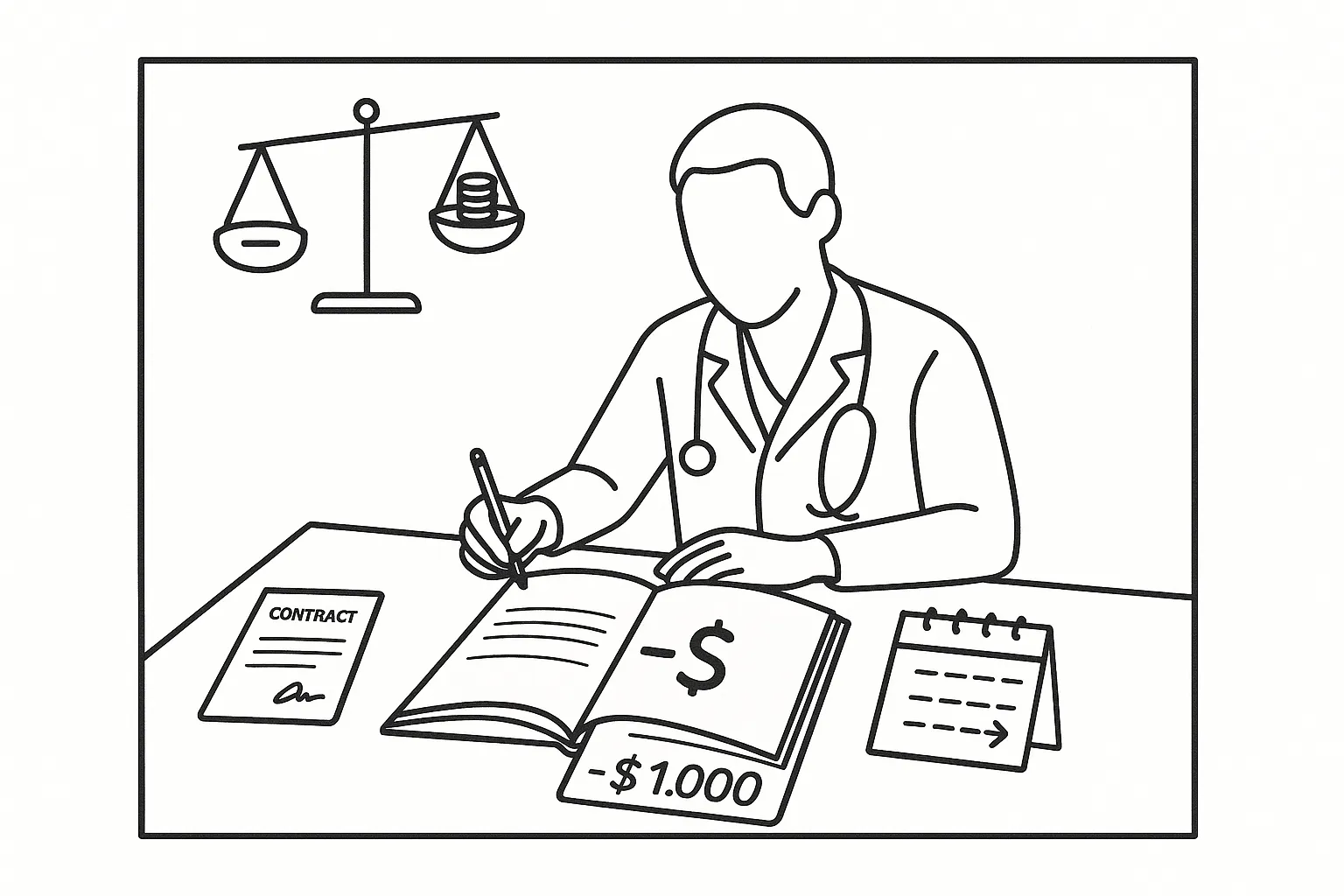
Negative accrual refers to a situation in which an associate’s earned compensation, usually calculated from production or collections, falls below the guaranteed draw or base amount advanced by the employer. The shortfall becomes an accrual or negative balance that the practice tracks and may seek to recover through reductions in future production pay, bonus offsets, final-pay reconciliation, or a separate repayment demand. Whether the employer can use a particular recovery method depends on the agreement and applicable law.
The issue frequently appears in ProSal and other production-based models. A practice advances predictable compensation during the year and later compares that amount with the associate’s credited production. If production is slow, the employer records a deficit that may continue from month to month unless the contract limits carryforward, forgives the balance, or establishes a cap. Veterinarians considering this structure should understand both the written formula and the practical operation of ProSal compensation.
Contracts may state that “negative accruals carry forward until satisfied” or that the associate must repay any remaining balance upon termination. Pay close attention to whether the agreement requires immediate repayment, permits monthly or quarterly reconciliation, or forgives the balance after a specified period. A draw described as guaranteed compensation may create a very different obligation from an advance expressly made against future production.
A signing bonus or relocation payment can create a related but distinct repayment obligation if employment ends early. For example, an agreement may require the associate to repay all or part of a bonus when the veterinarian leaves before completing a stated service period. The contract should distinguish bonus repayment from production negative accrual rather than combining both obligations into an undefined balance.
How Veterinary Negative Accrual Is Calculated
Collections, Production Percentages, and ProSal Formulas
Veterinary practices do not all define or credit production in the same way. The compensation formula should identify the applicable percentage, the revenue included in the calculation, and whether credits are based on charges, collected revenue, or another measure. Common approaches include:
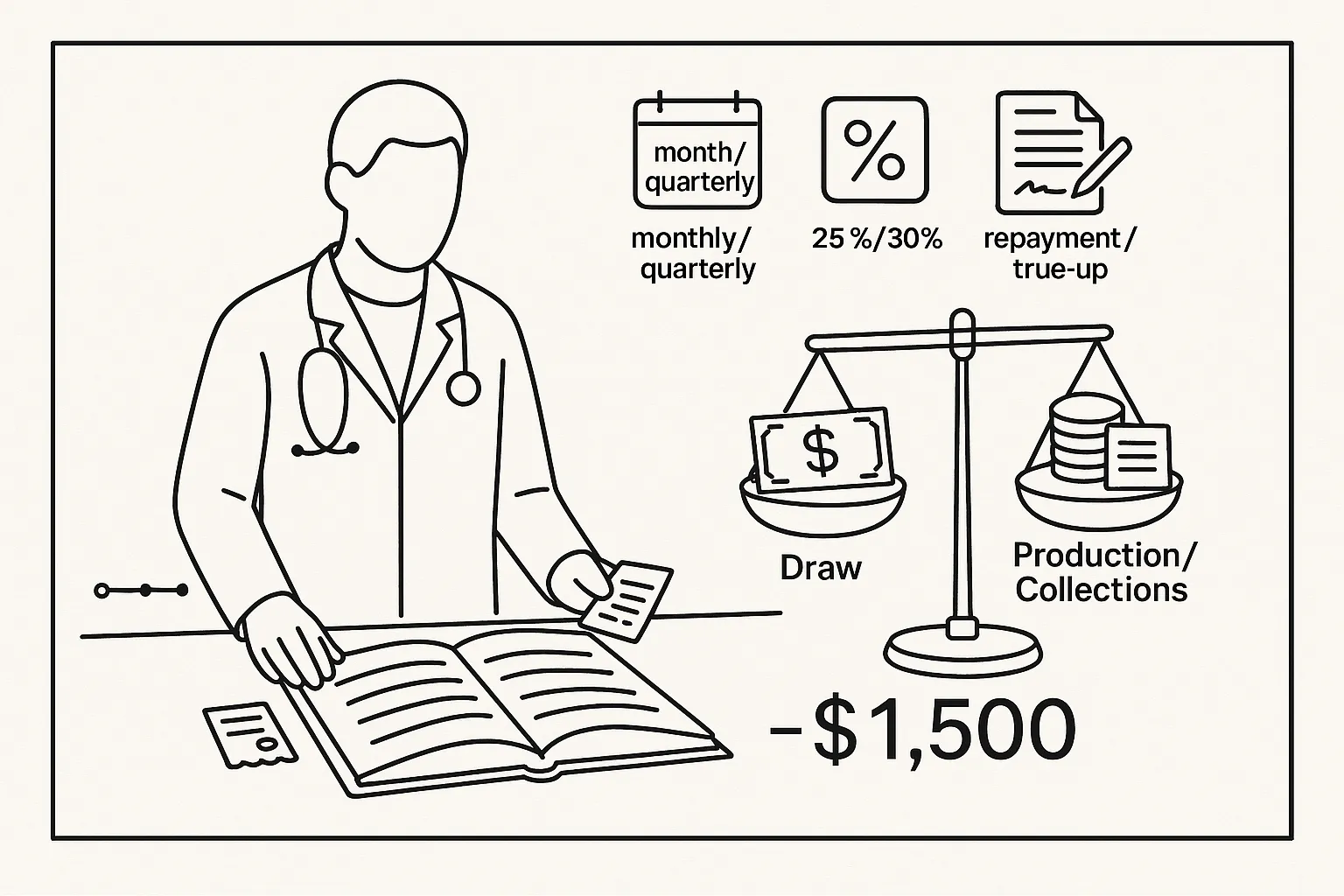
- Collections-based compensation: The employer credits the veterinarian with a percentage of cash actually received and attributed to that associate. If the associate receives a $6,000 draw but earns only $4,500 under the collections formula, the difference is a $1,500 deficit.
- Production based on charges or revenue: Some employers calculate compensation from gross charges or recognized revenue rather than collected cash. This may reduce exposure to slow patient payments, but the agreement still needs clear exclusions and attribution rules.
- ProSal compensation: ProSal generally combines regular base payments with a production percentage and periodic reconciliation. A negative balance may arise when credited production does not support the amounts already paid.
- Salary with a true-up: Even an agreement described as salaried may contain a later reconciliation that effectively converts part of the compensation into production-based pay after a guaranteed period.
The calculation may also depend on discounts, refunds, pharmacy revenue, diagnostic charges, shared cases, support-staff work, accounts receivable, and how services are attributed when multiple providers participate. The agreement should explain which items receive production credit and whether the employer can modify those rules. Our guide to veterinary production pay discusses these variables in greater detail.
Worked Examples and Reconciliation Timing
Consider a collections-based plan with a $6,000 monthly draw, $18,000 in collections attributed to the associate, and a 25% compensation rate. The veterinarian earns $4,500 under the production formula, leaving a $1,500 difference. If the contract carries that amount forward, the associate may need to generate enough compensation in a later period to cover both the current draw and the prior deficit before receiving additional production pay.
A ProSal agreement with quarterly reconciliation creates a different timing concern. Several slower months may be combined before the veterinarian receives a detailed true-up. If the base draw exceeds credited production during that period, the accumulated deficit can exceed several months of expected production compensation before the associate sees a complete accounting. Monthly statements give the veterinarian an earlier opportunity to identify attribution problems, coding errors, or an unrealistic compensation threshold.
A signing bonus presents another example. If an associate receives $15,000 subject to a 12-month service requirement and leaves after nine months, the repayment provision determines whether the entire amount or a prorated portion is due. The agreement may permit an offset against the final paycheck or require payment after departure. Veterinarians should review bonus and repayment clauses separately instead of assuming the production formula controls them.
These examples show why the exact definitions of “collections,” credited production, attribution methods, reconciliation frequency, and employer remedies matter. A percentage that appears competitive can produce disappointing compensation if the threshold is unrealistic, the practice controls case assignment, or significant revenue is excluded from the calculation.
Financial and Career Risks of a Negative Balance
Negative accrual can directly affect take-home pay. If the employer pays a draw during each pay period but later identifies a production shortfall, it may attempt to deduct the balance from future compensation or demand repayment when employment ends. That can leave an associate unexpectedly short on housing costs, student loan payments, relocation expenses, or other household obligations. New graduates may be especially vulnerable when they rely on a higher draw while building a client base and adjusting to practice workflows.
The agreement should state whether the draw is an unconditional salary guarantee or an advance subject to reconciliation. It should also explain whether a negative balance may reduce regular wages, only offset future production bonuses, or become payable at termination. Because state wage-deduction rules differ, contractual authorization does not necessarily resolve every enforceability question.
Negative accrual can also complicate partnership, profit-sharing, and buy-in opportunities. Some practices require associates to clear all deficits before becoming eligible to purchase an ownership interest or participate in profits. When negotiating a buy-in pathway, the veterinarian should determine whether historical negative accrual affects valuation, equity, the purchase price, or eligibility and whether repayment terms are reasonable and time-limited.
A clause requiring immediate repayment upon departure can create a financial barrier to exercising a without-cause termination right. The risk is greater when the veterinarian must simultaneously repay a signing bonus, cover relocation reimbursement, purchase tail insurance, or comply with a restrictive covenant. The contract should therefore be evaluated as a whole rather than treating the compensation formula as an isolated provision.
Contract Clauses and Negotiation Protections
Draws, True-Ups, Caps, Carryforward, and Forgiveness
The draw provision should specify whether each payment is guaranteed compensation or an advance against future earnings. The reconciliation clause should then explain how credited production is compared with the draw, how partial months and leaves are treated, and when the practice must provide an accounting. Without these details, the associate may be unable to independently verify the reported balance.
Important contract terms to review include:
- Production and collections definitions: The agreement should identify included revenue, excluded items, refunds, discounts, shared cases, and the method used to attribute work to the associate.
- Reconciliation schedule: Monthly, quarterly, and annual true-ups change how quickly a deficit becomes visible and how long accounting errors can remain unresolved.
- Carryforward: The contract should state whether a deficit moves into the next period and whether later production must first eliminate that balance.
- Caps: A maximum dollar amount or a limit based on one to three months of draw may prevent an open-ended balance from accumulating.
- Forgiveness: The agreement may forgive the deficit after continuous employment for a stated period or after the associate achieves objective production milestones.
- Termination treatment: The contract should explain whether the balance is forgiven, offset, prorated, invoiced, or accelerated when employment ends.
Protective language may require the employer to reconcile compensation monthly and provide an itemized statement with each pay stub. The accounting should show attributed revenue, the applicable percentage, exclusions, prior balances, current draw payments, and the resulting positive or negative balance. The veterinarian should also have a reasonable period to question errors.
Other possible protections include limiting carryforward to a defined amount, requiring automatic forgiveness after 12 to 24 months of continuous employment, and prohibiting immediate acceleration at termination. A repayment obligation may instead be spread over a reasonable period or limited to future production compensation. The precise language should account for applicable state law and the practice’s actual compensation system.
Red flags include unlimited carryforward, no cap or forgiveness mechanism, undefined collections, employer-controlled attribution methods, silence regarding reconciliation timing, and immediate repayment without a payment schedule. Associates should also question language that ties forgiveness or buy-in eligibility to vague performance standards the employer can change unilaterally. A focused veterinary compensation and ProSal review can identify how these clauses operate together.
State Law, Termination, and Malpractice Insurance
State law can affect wage deductions, post-employment repayment obligations, and restrictive covenants. California generally prohibits employee non-compete agreements and has employee-protective wage rules that may restrict certain clawbacks or deductions. Other states may enforce reasonable repayment or restrictive-covenant provisions depending on the language, circumstances, duration, geographic scope, and asserted business interest.
Massachusetts, Colorado, and other states have enacted statutes limiting non-competes or imposing notice, consideration, compensation, or other requirements. Because these rules continue to vary and change, a provision that may be enforceable in one jurisdiction may be limited in another. Veterinarians should obtain advice based on the law governing their agreement rather than relying on a national generalization. Chelle Law provides veterinary contract review by state for associates evaluating jurisdiction-specific terms.
Termination language deserves particular attention because it determines when a negative balance becomes due. The contract should distinguish voluntary resignation, termination without cause, termination for cause, nonrenewal, and a practice-initiated schedule or location change. An associate should also understand the required notice period and whether the employer can stop scheduling appointments during notice while the compensation deficit continues to affect the final accounting. Our guide to terminating a veterinary contract explains related departure issues.
Professional liability coverage can add another financial exposure. A claims-made policy may require tail coverage after employment ends, while occurrence coverage generally addresses covered incidents that occurred during the policy period without requiring the same type of tail policy. Some employers pay for tail coverage, while others assign the cost to the associate or condition employer payment on completing a notice period or satisfying repayment obligations.
The contract should identify the policy type and state who pays for tail coverage following voluntary termination, termination without cause, termination for cause, and nonrenewal. Associates should be cautious when employer-paid tail depends on first clearing a negative accrual or remaining employed for an extended period. Depending on the coverage and circumstances, tail insurance may create a substantial additional departure cost. A malpractice and tail insurance review can clarify these obligations before signing.
When to Seek a Veterinary Contract Review
Consider consulting an attorney before signing when the agreement includes production-based pay, ProSal, guaranteed draws with reconciliation, signing or relocation bonuses, restrictive covenants, unclear malpractice coverage, or a possible ownership pathway. Review is particularly important when the formula is difficult to reproduce from the contract or when the employer has not provided a sample production report.
- Production-based pay, ProSal, or draw provisions with reconciliation terms you do not fully understand.
- Signing bonuses, relocation reimbursement, student loan assistance, or other amounts tied to a service requirement.
- Non-compete or non-solicitation provisions that may restrict future employment after departure.
- Ambiguous claims-made, occurrence, or tail insurance language.
- Buy-in, ownership, or profit-sharing terms that do not explain valuation or the treatment of negative balances.
Bring the complete contract, all referenced compensation policies, bonus documents, recent pay statements if available, sample production reports, and summaries of any verbal promises. An attorney can explain how the formula affects expected compensation, identify provisions that may create an open-ended balance, and propose language addressing carryforward, itemized statements, forgiveness, and repayment timing.
A review can also address employer-paid tail coverage, restrictive covenants, termination rights, and the interaction between several repayment obligations. Chelle Law reviews veterinary agreements line by line and provides practical edits tailored to the compensation model, the veterinarian’s priorities, and the governing legal landscape.
Frequently Asked Questions
What is veterinarian negative accrual?
Veterinarian negative accrual is a compensation deficit that arises when credited production pay is less than the guaranteed draw or advance already paid by the practice. Depending on the contract, the employer may carry the deficit forward, offset it against future production compensation, or seek repayment when employment ends.
How is negative accrual calculated under ProSal or collections-based pay?
The practice compares the draw or guaranteed payment with compensation earned under the stated production formula. For example, a $6,000 draw minus $4,500 in credited compensation leaves a $1,500 deficit. The result depends on the percentage, included revenue, attribution method, exclusions, and reconciliation period.
Can a veterinary practice carry negative accrual forward indefinitely?
The answer depends on the contract and applicable law. An agreement may permit continued carryforward, impose a dollar or time cap, or forgive the balance after a defined period. Associates should avoid assuming that a deficit disappears at year-end unless the agreement expressly says so.
What contract terms can limit negative accrual risk?
Useful terms may include clear production and collections definitions, monthly itemized reconciliation, a reasonable carryforward cap, objective attribution rules, forgiveness after a stated employment period, and limits on repayment acceleration. The appropriate language depends on the compensation system and governing state law.
Does state law affect deductions or repayment of negative accrual?
Yes. State wage-deduction, repayment, and post-employment enforcement rules vary. Written contract language may not authorize every proposed deduction or clawback, so veterinarians should have the provision reviewed under the law governing their agreement.
What happens to negative accrual when a veterinarian leaves a practice?
The termination clause may require repayment, permit an offset against earned compensation, establish an installment schedule, or forgive the balance in certain circumstances. The veterinarian should also account for signing-bonus repayment, notice requirements, restrictive covenants, and any tail insurance obligation that becomes due at departure.
Understand Your Negative Accrual Risk Before Signing
Chelle Law can review your veterinary compensation formula, reconciliation terms, repayment obligations, termination provisions, and related contract risks.
Contact Chelle LawExplore Veterinary Contract Guidance
Review services, practical resources, and state-specific information for veterinary employment agreements.