

Negative accrual can turn an apparently predictable veterinary compensation package into an unexpected debt. The issue arises when compensation already paid to an associate—often described as a draw, advance, or guaranteed base—exceeds the amount earned under the contract’s production or collections formula. Depending on the agreement, the practice may carry that difference into the next reconciliation period, apply future production compensation to the balance, offset a later bonus, or assert a repayment obligation when employment ends.
The practical impact cannot be determined from the production percentage alone. Definitions of credited revenue, collections, discounts, refunds, shared cases, reconciliation periods, and case attribution can materially change the calculation. A veterinarian may also face a deficit because the practice controls scheduling, staffing, pricing, appointment volume, or work locations. New graduates are particularly exposed while building speed and a client base, but experienced associates can encounter the same problem after a location change, extended leave, or reduction in assigned cases.
Chelle Law reviews negative-accrual language as part of the complete veterinary agreement rather than treating it as an isolated formula. That analysis may include compensation definitions, accounting rights, carryforward limits, payroll deductions, termination treatment, signing-bonus repayment, malpractice coverage, and restrictive covenants. This article explains how negative accrual works, why contract labels are not conclusive, which provisions affect the financial outcome, and how federal and state wage rules may limit particular recovery methods.
Key Takeaways
- Negative accrual generally develops when compensation paid in advance exceeds the amount credited under a production or collections formula.
- The agreement must be read closely to determine whether a payment is a guaranteed wage, a recoverable advance, or a draw reconciled against later production.
- Production definitions, attribution rules, excluded revenue, reconciliation timing, and employer-controlled scheduling can be as important as the stated percentage.
- Caps, forgiveness provisions, itemized accountings, and limits on termination repayment are contractual protections that may be requested, not universal legal requirements.
- Payroll deductions, final-wage offsets, and separate repayment claims require different legal analysis under federal law, state wage statutes, and the governing contract.
How Negative Accrual Works in Veterinary Pay Plans
A Guaranteed Salary Is Not Necessarily the Same as a Recoverable Draw
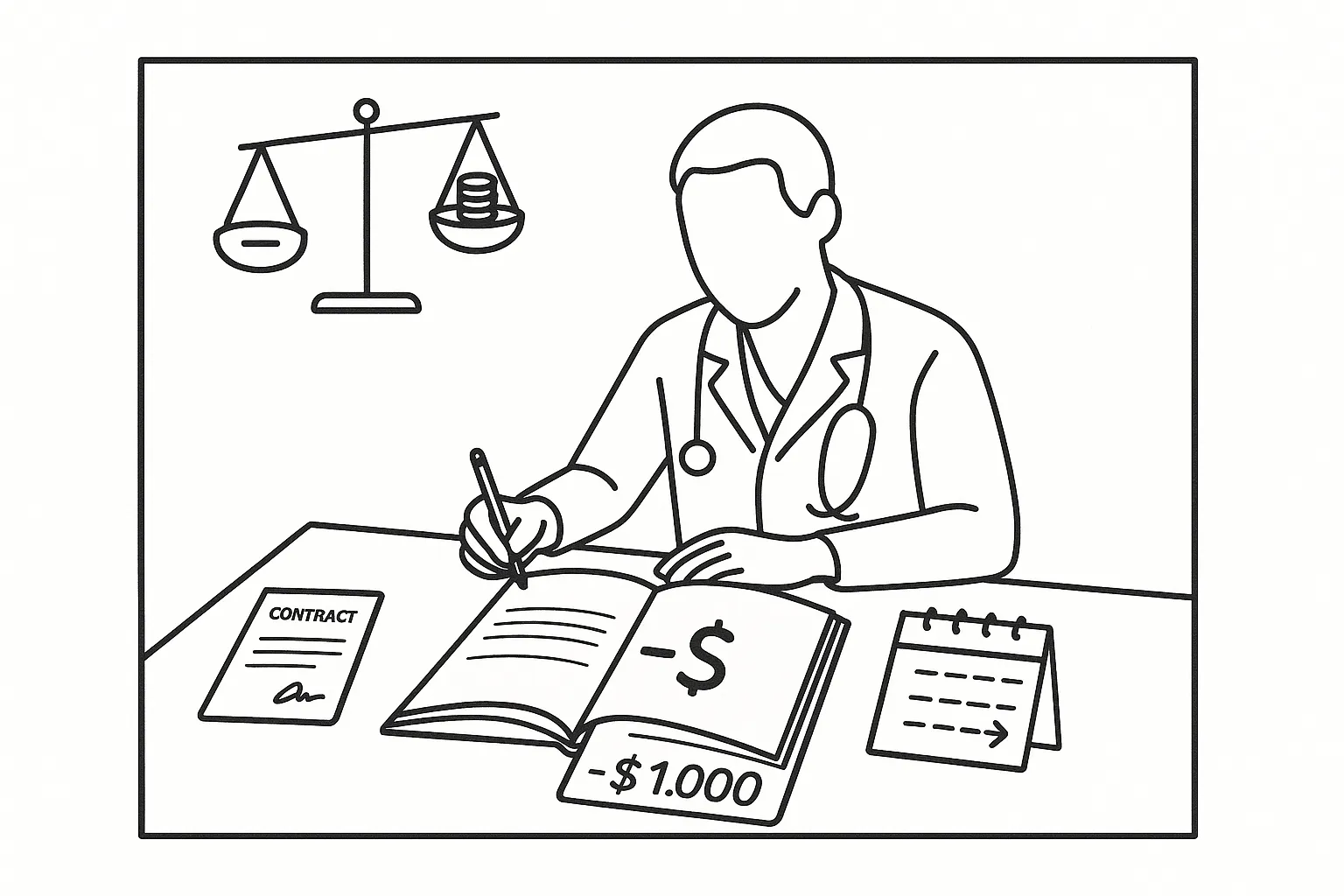
A veterinary practice may use the terms salary, base, draw, advance, or guarantee when describing regular compensation. Those labels do not necessarily produce the same contractual or wage-law result. An unconditional salary generally suggests that the stated amount is earned for performing the required work, while an advance against future production may be subject to reconciliation. Some agreements combine the concepts by guaranteeing a base for an introductory period and converting it into a recoverable production draw later.
The operative language matters more than the heading attached to the provision. Contract analysis can determine whether a shortfall merely reduces a future production bonus, carries into later periods, becomes a debt at termination, or may be deducted from wages. It is also important to identify whether the practice can change the draw, production percentage, or attribution policy without the veterinarian’s written agreement.
Negative accrual often appears in ProSal arrangements. ProSal generally combines regular payments with compensation tied to production and a later true-up, but individual agreements vary considerably. Veterinarians evaluating this model can review a broader explanation of how ProSal compensation operates and obtain a focused compensation and ProSal contract review.
A separate signing bonus, relocation payment, or student-loan contribution can create another repayment obligation. Those amounts may be forgiven over a defined service period and do not automatically become part of the production deficit. Combining bonus repayment and negative accrual into one undefined balance makes it difficult to determine what is owed, when it becomes due, and whether different repayment conditions apply.
Calculating the Production Deficit
Production Definitions and Attribution Rules Control the Result
A percentage is meaningful only when the agreement identifies the revenue to which it applies. Collections-based compensation typically credits the veterinarian with a percentage of cash received and attributed to that associate. A production formula may instead use gross charges, recognized revenue, or another measure. A nominal salary can also contain a year-end true-up that makes part of the compensation dependent on production.
The calculation may be affected by discounts, refunds, uncollected accounts, pharmacy sales, diagnostic charges, boarding revenue, shared cases, support-staff services, and procedures performed by more than one clinician. The agreement or incorporated compensation policy may also determine who receives credit when one veterinarian examines the patient and another performs the procedure. A detailed explanation of these variables is available in Chelle Law’s guide to veterinary production pay.
- Collections model: Compensation depends on money actually received and credited to the veterinarian, making collection delays and write-offs potentially significant.
- Gross-production model: Compensation is based on charges or recognized revenue, although exclusions and adjustments can still reduce credited production.
- ProSal model: Regular draw payments are compared with compensation generated under the stated production formula at scheduled intervals.
- Salary with reconciliation: A plan described as salaried may still expose the veterinarian to a true-up if the agreement makes some payments recoverable.
A Worked Example Shows Why Reconciliation Timing Matters
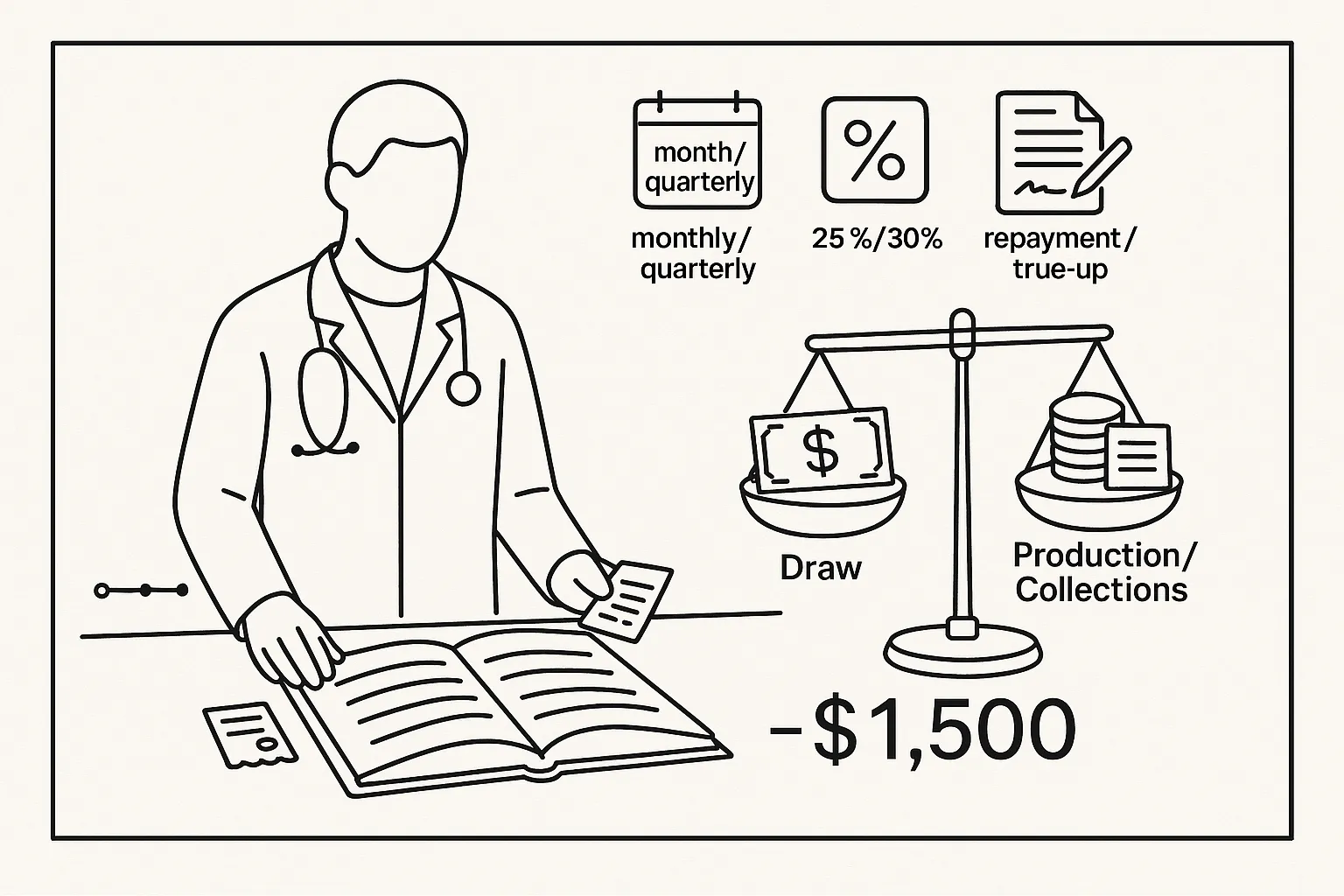
Assume an associate receives a $6,000 monthly draw and is credited with $18,000 in collections at a 25% compensation rate. The production formula generates $4,500, leaving a $1,500 shortfall. If that amount carries forward, the veterinarian may need to earn enough during the next period to cover both the new draw and the existing $1,500 balance before receiving additional production compensation.
Quarterly or annual reconciliation can allow several slow months to accumulate before the associate receives a complete accounting. Monthly statements provide an earlier opportunity to detect missing cases, coding errors, excluded revenue, or an unrealistic production threshold. The statement is most useful when it separately identifies attributed revenue, adjustments, the applicable percentage, draw payments, prior balances, and the resulting positive or negative amount.
The practice’s operational decisions can also affect the result. An associate may have limited ability to increase production if the employer controls appointment volume, staffing, equipment, pricing, or work location. A competitive-looking percentage may therefore produce disappointing compensation when the underlying assumptions do not match the associate’s actual schedule and resources.
Financial and Professional Consequences
A carried deficit can reduce or eliminate future production bonuses even after performance improves. If the agreement authorizes additional recovery, the practice may also attempt a payroll deduction, offset against final compensation, invoice after departure, or separate contractual claim. These methods are not interchangeable. Each requires analysis of the agreement, the veterinarian’s employment classification, and the federal and state rules governing the proposed recovery.
The cash-flow effect can be significant for associates managing student loans, housing expenses, relocation costs, and other fixed obligations. New graduates may receive a draw based on expected future productivity while they are still developing clinical speed and a client base. Experienced veterinarians can encounter similar deficits after parental or medical leave, a transfer to a slower location, reduced staffing, or an employer-imposed schedule change.
Negative accrual may also influence a veterinarian’s ability to leave the practice. A contract can permit without-cause termination yet require the remaining balance to be paid immediately after notice or departure. That obligation may arise at the same time as a signing-bonus clawback, relocation repayment, tail-insurance expense, or income interruption caused by a restrictive covenant. Chelle Law’s resource on terminating a veterinary contract addresses the broader departure analysis.
Ownership and profit-sharing provisions can create another consequence. Some agreements condition buy-in eligibility on clearing compensation deficits or meeting production standards. The documents may not explain whether an old negative balance affects valuation, the purchase price, distributions, or the date on which the associate becomes eligible. These issues require separate analysis from the basic production calculation.
Contract Terms That Can Limit Negative-Accrual Exposure
Accounting Rights, Caps, and Forgiveness Provisions
The strongest protection is a formula that can be reproduced from the contract and the practice’s reports. Definitions can identify which revenue is included, how refunds and discounts are handled, who receives credit for shared cases, and whether compensation policies may be changed unilaterally. The reconciliation provision can then specify the reporting period, treatment of partial months and leave, and deadline for raising accounting questions.
Caps and forgiveness terms are contractual strategies rather than rules that every practice must offer. A cap may limit the deficit to a fixed amount or a defined number of draw payments. A forgiveness provision may eliminate the balance after continuous employment for a stated period or when objective production milestones are reached. Other language may prevent immediate acceleration at termination or permit any valid repayment obligation to be satisfied over time.
- Clear compensation definitions: Identify the production measure, percentage, included revenue, exclusions, adjustments, and attribution method.
- Regular itemized reports: Require enough information to verify current production, prior balances, draw payments, and the resulting reconciliation.
- Carryforward limits: State whether deficits cross monthly, quarterly, or annual boundaries and whether a maximum balance applies.
- Objective forgiveness: Define when a balance is eliminated rather than leaving forgiveness to an undefined performance standard.
- Termination treatment: Explain whether a balance is forgiven, offset, prorated, invoiced, or accelerated under each termination scenario.
- Dispute procedures: Give the veterinarian a reasonable opportunity to question attribution errors or accounting discrepancies.
Potential red flags include unlimited carryforward, undefined collections, annual-only accounting, employer-controlled attribution rules, retroactive formula changes, and immediate repayment without a stated calculation or payment schedule. A sample production report can reveal practical details that the contract does not fully explain. If the employer relies on a separate compensation policy, that document should be reviewed with the agreement before signing.
Bonus and relocation obligations also need their own definitions, forgiveness schedules, and termination triggers. A review of veterinary bonus and repayment clauses can identify whether several obligations could become due simultaneously or be combined in a final reconciliation.
Wage Law, Worker Classification, and Final Pay
Federal law does not generally determine every commission or contract payment promised above statutory wage requirements. It can, however, restrict deductions that reduce a covered nonexempt employee below the required minimum wage or overtime compensation. The U.S. Department of Labor’s Fair Labor Standards Act guidance explains the federal wage floor. Whether that rule affects a particular recovery depends on matters such as exempt status, the type and timing of the deduction, and whether the practice is reducing wages or asserting a separate contractual debt.
Employee-versus-independent-contractor status also matters. On February 26, 2026, the Department of Labor announced a proposed rule that would replace the 2024 federal classification framework with a streamlined economic-reality analysis emphasizing control and opportunity for profit or loss while also considering skill, permanence, and integration. The 2026 classification proposal remains pending, and state wage, unemployment, workers’ compensation, and tax standards may use different tests. A contract’s use of the term independent contractor does not settle the classification question.
This distinction is important because employee wage-deduction protections may not apply in the same way to a properly classified independent contractor. Veterinarians working relief or contractor arrangements can review the differences discussed in Chelle Law’s W-2 versus 1099 guide. Classification analysis remains separate from whether the compensation formula itself is clear and commercially reasonable.
Final-pay rules are also jurisdiction-specific. The Fair Labor Standards Act does not require immediate payment of a final paycheck, but state statutes may establish earlier deadlines, regulate deductions from earned wages, require written authorization, or impose penalties for nonpayment. The Department of Labor’s final-paycheck guidance directs workers to state labor agencies when state law supplies additional protections. A clause authorizing repayment therefore does not automatically establish that the practice may deduct the entire amount from final wages.
The termination provision must also be read with malpractice and restrictive-covenant language. Claims-made coverage may create a tail-insurance obligation after employment, while occurrence coverage generally addresses covered incidents occurring during the policy period without the same type of tail policy. Because policy wording and contract allocation control, veterinarians can use a malpractice and tail insurance review to evaluate that separate departure expense.
Review the Entire Compensation Package Before Signing
Attorney review is particularly useful when the agreement contains ProSal, a recoverable draw, production-based compensation, a long reconciliation period, signing or relocation incentives, or an unclear final-pay provision. The same is true when the written formula cannot be reproduced from a sample report or the practice retains broad discretion over attribution, exclusions, scheduling, or compensation-policy changes.
A complete review should include the employment or contractor agreement, incorporated compensation policies, bonus documents, sample production reports, and any written explanation of verbal promises. Recent pay statements can also help when the veterinarian is reviewing a renewal or an existing deficit. These materials allow the compensation formula to be evaluated alongside termination rights, restrictive covenants, insurance obligations, and other provisions that affect the cost of departure.
Chelle Law can identify ambiguous definitions, open-ended carryforward language, conflicting repayment provisions, and terms that may warrant clarification or revision. The goal is to help the veterinarian understand how the agreement allocates financial risk during both productive and slow periods—not merely whether the stated production percentage appears competitive.
Frequently Asked Questions
What does negative accrual mean for a veterinarian?
Negative accrual is a compensation deficit that generally arises when a veterinarian receives more through a draw or advance than the amount credited under the contract’s production formula. The agreement may carry that balance forward, apply later production compensation to it, or assert a repayment obligation when employment ends.
How is negative accrual calculated in a ProSal plan?
The practice compares compensation generated under the stated production formula with the draw already paid. For example, a $6,000 draw minus $4,500 in credited compensation produces a $1,500 shortfall. The result also depends on revenue definitions, exclusions, attribution rules, and the reconciliation period.
Can a veterinary practice deduct negative accrual from wages?
Not every contractual repayment provision authorizes every payroll deduction. Federal law may restrict deductions that reduce a covered nonexempt employee below minimum wage or required overtime, while state law may impose additional authorization, timing, and final-pay requirements. Exempt status, worker classification, and the recovery method all matter.
Does a negative balance automatically disappear at year-end?
No. The answer depends on the agreement. A contract may carry the deficit into the next year, cap it at a stated amount, forgive it after a defined period, or limit recovery to future production compensation. A veterinarian should not assume year-end forgiveness unless the documents provide for it.
What provisions can reduce negative-accrual risk?
Potential contractual protections include precise production definitions, objective attribution rules, regular itemized accountings, a carryforward cap, time-based forgiveness, limits on unilateral formula changes, and clear treatment of the balance at termination. These are negotiated terms rather than universal legal requirements.
What happens to negative accrual when a veterinarian leaves?
The termination language may provide for forgiveness, an offset against compensation, installment repayment, or immediate acceleration. Final-wage deductions and separate repayment claims require different analysis. Signing-bonus repayment, notice obligations, restrictive covenants, and tail-insurance costs may create additional departure expenses.
Understand Negative Accrual Before Accepting the Pay Plan
Chelle Law can review the production formula, reconciliation process, carryforward language, repayment terms, and related risks in your veterinary agreement.
Contact Chelle LawExplore Veterinary Contract Guidance
Find legal services, practical contract resources, and state-focused guidance for veterinary professionals.