

A notice period is the contractual timeframe a veterinary associate or employer must provide before ending employment. It can look simple on paper—give a specified number of days or weeks of notice and then leave—but unclear resignation procedures can delay a departure or create a dispute over whether notice was properly delivered. Veterinarians should read the notice clause together with the agreement’s broader contract termination requirements, rather than treating it as an isolated administrative term.
In practice, notice provisions are a frequent source of unexpected financial loss, lingering liability, and career restrictions. We review veterinary contracts containing vague trigger dates, compensation changes during notice, bonus clawbacks, notice-linked non-competes, and surprise tail insurance obligations. These terms are especially important when income depends on ProSal, production percentages, or collections and the employer controls the final reconciliation after the associate leaves.
This guide explains common veterinarian notice period traps, how they interact with malpractice coverage and compensation models, and the practical consequences for future employment. It also identifies contract language that may clarify notice delivery, preserve compensation, allocate tail insurance costs, and separate resignation procedures from restrictive covenants or ownership opportunities. Because enforceability and available remedies vary by jurisdiction, the entire agreement should be evaluated under the law governing the contract.
Key Takeaways
- Treat notice terms as negotiable and insist on clear start dates, end dates, and accepted delivery methods.
- Require compensation continuity during notice, including an understandable calculation for ProSal, production, or collections-based pay.
- Confirm the malpractice policy type and obtain a clear written allocation of any tail coverage expense.
- Review notice-linked penalties, bonus repayment obligations, buy-in conditions, and restrictive covenants before signing.
- Consider an attorney-led review when resignation terms affect compensation, liability coverage, or future employment.
What a Veterinary Contract Notice Period Controls

A notice period is the contractual timeframe an associate must give an employer before resigning or, depending on the agreement, the timeframe the employer must provide before termination. Although the provision appears procedural, it can control several high-stakes issues for veterinarians:
- Compensation continuity: Does base pay, ProSal, or a production percentage continue during notice? Some agreements change production-based compensation while requiring the same clinical workload.
- Bonus recapture: Employers may condition signing or retention bonuses on remaining employed for a minimum term and require repayment after an early departure.
- Malpractice coverage: The policy may end with employment, leaving the associate responsible for tail coverage if the policy is claims-made.
- Restrictive covenants and buy-ins: Notice can trigger non-compete obligations, affect ownership eligibility, or establish deadlines for exercising contractual rights.
Veterinary income is commonly tied to ProSal, production, or collections-based compensation. A poorly drafted notice clause can therefore turn a resignation into months of disputed production pay or a significant final reconciliation. A focused review of veterinary compensation terms should address what is earned during notice, when production is credited, and how the final payment is calculated.
Common Notice-Period Traps in Veterinary Employment Contracts
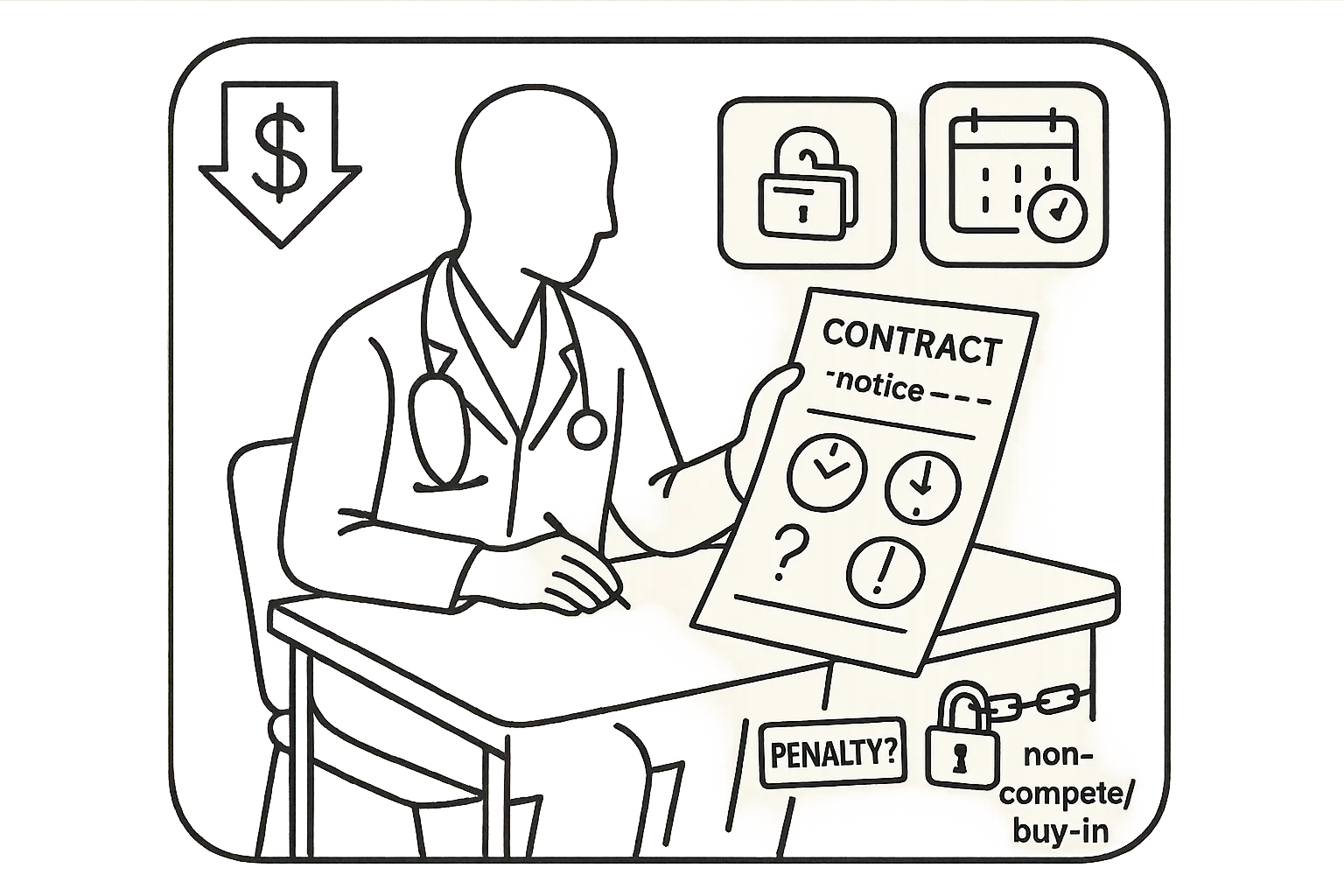
Several recurring notice provisions can affect a departing veterinarian’s final compensation, liability exposure, and ability to begin another position. The practical risk depends on the wording of the entire agreement, the facts surrounding the departure, and the law governing the contract.
Unclear Notice Timing, Penalties, and Final Pay
Contracts sometimes state that resignation becomes effective a certain number of days after notice is “received” without identifying an accepted delivery method or the person authorized to receive it. That ambiguity can create disputes over whether the clock began when the veterinarian told a manager, sent an email, delivered a letter, or received written acknowledgment. It can also affect the date on which compensation, benefits, malpractice coverage, and post-employment obligations change.
Associates should also look for fixed penalties, liquidated damages, or provisions allowing the employer to withhold final compensation while completing a reconciliation. The practical consequences may include unpaid days, delayed eligibility for new employment, unexpected deductions, or a contested final accounting. Whether a specific penalty or deduction is enforceable depends on the contract and applicable law, so the provision should not be evaluated from its label alone.
Production Pay, Bonuses, and Negative Accrual
Veterinarians paid through ProSal, production percentages, or collections may face special risks during notice. An employer may attempt to suspend production compensation while keeping the associate on the clinical schedule, carry a productivity shortfall forward as negative accrual, or delay the final bonus until all accounts have been reconciled. The contract should state whether production is credited when services are performed, invoiced, or collected and explain how work completed before departure will be treated.
- Does base salary and production compensation continue throughout the notice period?
- Can negative accrual be carried forward or deducted from final compensation?
- When is the final production or collections reconciliation completed?
- Does resignation trigger repayment of a signing, retention, or relocation bonus?
Bonus repayment terms deserve separate attention because an otherwise compliant resignation may still trigger a substantial clawback. A bonus and repayment clause review can identify whether repayment is prorated, whether it depends on the reason for termination, and whether the employer may deduct the amount from final compensation.
Non-Competes, Non-Solicitation Terms, and Buy-In Deadlines
Some agreements connect notice compliance to restrictive covenants or ownership opportunities. For example, a veterinarian may lose a potential buy-in by providing less than a stated notice period, or the agreement may attempt to extend a non-solicitation or non-compete restriction when notice is not delivered in the prescribed manner. These provisions can affect both the associate’s immediate departure and long-term mobility.
- A contract may require 90 days’ notice to preserve eligibility for a practice buy-in.
- A resignation provision may purport to change the duration or application of a post-employment restriction.
- A tail insurance benefit may be conditioned on complying with a non-compete or not joining a specified competitor.
Non-compete enforceability varies considerably by state and can change over time. Before relying on a restriction—or assuming it is invalid—a veterinarian should obtain a jurisdiction-specific review of the veterinary non-compete, including its geographic scope, duration, restricted activities, and connection to the notice provision.
How Notice Periods Affect Malpractice and Tail Coverage
Professional liability coverage generally uses either an occurrence or claims-made structure. An occurrence policy covers incidents that occur during the policy period, subject to its terms, even if a claim is later asserted. A claims-made policy generally responds to covered claims made while the policy is active and may require tail coverage after the underlying policy ends.
Corporate groups and private practices may use claims-made coverage. If that coverage ends with employment, the veterinarian may need tail insurance for later claims arising from work performed while employed. Some employers pay for tail only when the associate provides a minimum amount of notice, complies with post-employment restrictions, or leaves under an approved form of termination; other agreements allocate the entire cost to the departing associate.
- Confirm whether the policy is occurrence or claims-made.
- Identify when the employer’s coverage ends after termination.
- Determine who must obtain and pay for tail coverage.
- Review whether tail payment is conditioned on notice timing, the reason for termination, or compliance with a restrictive covenant.
The agreement should allocate these responsibilities in writing rather than leaving them to an employer policy that can be changed or interpreted later. Veterinarians who need a deeper explanation of policy structure and post-employment protection can review the veterinary tail insurance guide.
Financial and Career Consequences of Problematic Notice Terms
The downstream effects of a poorly drafted notice clause can extend beyond the final workday. Immediate income loss may result from withheld production compensation, negative accrual, bonus recoupment, or disputed deductions. A veterinarian may also face a significant tail insurance expense at the same time that compensation from the former practice is delayed.
- Immediate income loss: Production adjustments, signing-bonus repayment, or negative accrual can erase a meaningful portion of expected earnings.
- Reduced career mobility: Notice-linked non-competes or extended post-employment restrictions may narrow available positions or geographic markets.
- Liability exposure: An unclear transition from employer coverage can leave the veterinarian facing an unexpected tail obligation.
- Hiring friction: A prospective employer may be unable to establish a start date while the prior notice period or restriction remains disputed.
Associates can be delayed from starting new jobs because of unresolved notice disputes or threats to enforce post-employment restrictions. These problems are easier to address before signing, when the parties can clarify the departure process without the pressure of an active resignation.
How to Negotiate Safer Veterinary Notice Provisions
Notice language is often negotiable, particularly when an associate has in-demand skills, specialty training, or competing offers. The objective is not simply to shorten the notice period. A safer provision clearly defines delivery, preserves earned compensation, addresses malpractice coverage, and prevents unrelated penalties or restrictions from being triggered by a procedural mistake.
Contract Language and Redlines to Consider
The following examples illustrate issues that may be addressed in a redline. They should be tailored to the complete agreement and applicable law rather than inserted without review:
- Clear notice delivery: “Notice shall be deemed given on the date it is received by Employer through personal delivery, certified mail with return receipt, or email to the designated human resources address.”
- Compensation continuity: “Associate shall continue to receive base salary and production-based compensation calculated according to Section X throughout the notice period, subject to the regular reconciliation process.”
- Tail coverage: “Employer shall maintain professional liability coverage for acts performed during employment. If coverage is claims-made, Employer shall obtain and pay for appropriate tail coverage upon termination, subject to the expressly stated exceptions in this agreement.”
- Limited damages: Remove an automatic penalty or define a reasonable, supportable limitation instead of permitting open-ended deductions.
- Separate ownership and restrictive covenants: State that buy-in eligibility and the duration of post-employment restrictions will not change solely because of a technical notice-delivery dispute.
Before signing, review the notice clause against a practical checklist: Is the effective date and delivery method clear? Does production-based pay continue? How is the final reconciliation handled? Does notice trigger bonus repayment, tail expense, liquidated damages, or loss of buy-in eligibility? Can the employer require call coverage, additional shifts, or work at multiple locations during the notice period?
An attorney-led review is particularly useful when the agreement contains a ProSal or collections formula that is difficult to reconcile, claims-made coverage without a clear tail commitment, notice-linked restrictive covenants, or a multi-year bonus repayment schedule. Chelle Law’s veterinary employment contract review examines the agreement line by line and can recommend targeted revisions based on the contract’s governing law and the associate’s priorities.
Notice periods are not a mere formality. They intersect with compensation, malpractice coverage, final accounting, and future employment. Whether the associate is a new graduate reviewing a first ProSal agreement or an experienced clinician moving between practices, addressing unclear timing, compensation changes, and notice-linked obligations before signing can reduce the risk of an expensive dispute at departure.
Frequently Asked Questions
What notice period traps should veterinarians watch for?
Common traps include ambiguous delivery or trigger dates, suspended production compensation, negative accrual, signing-bonus clawbacks, fixed resignation penalties, notice-linked non-competes, loss of buy-in eligibility, and unexpected tail insurance obligations.
Can an employer change my production pay during the notice period?
The answer depends on the agreement and applicable law. The contract should explain whether base salary, ProSal, production percentages, or collections-based compensation continue during notice and how the employer will calculate the final reconciliation.
How can resignation notice affect veterinary tail coverage?
If the employer uses claims-made professional liability coverage, the veterinarian may need tail coverage after employment ends. Some contracts condition employer-paid tail on providing a specified notice period, leaving for an approved reason, or complying with post-employment restrictions.
Does giving insufficient notice automatically make a veterinary non-compete enforceable?
No automatic rule applies across every state or contract. Non-compete enforceability depends on applicable law and the restriction’s wording, while the agreement may separately attempt to impose consequences for insufficient or improperly delivered notice.
What notice language should a veterinarian ask to clarify?
Ask the agreement to identify the required notice period, permitted delivery methods, authorized recipient, effective date, compensation during notice, final reconciliation process, malpractice and tail responsibilities, and any effect on bonuses, restrictive covenants, or ownership rights.
When should a veterinarian obtain an attorney-led review of a notice clause?
Consider a review when notice affects ProSal or production compensation, bonus repayment, claims-made malpractice coverage, liquidated damages, a non-compete, a buy-in opportunity, or the timing of a new job. These provisions should be assessed with the entire agreement and governing law.
Review Your Veterinary Notice Clause Before You Resign
Chelle Law can review how your notice provision affects compensation, bonus repayment, malpractice coverage, restrictive covenants, and the timing of your next position.
Contact Chelle LawExplore Veterinary Contract Guidance
Find attorney-led review services, practical contract resources, and state-specific guidance for veterinarians.