

A veterinarian offer letter can feel like validation after a long job search, but it is also an important stage of contract negotiation. The letter may summarize compensation, benefits, scheduling, bonuses, and a possible ownership path while leaving essential definitions or restrictions for a longer employment agreement. Before accepting, a veterinarian should confirm that every important promise is written clearly and remains consistent across the offer letter and the final contract.
Small drafting gaps can create substantial financial and professional consequences. An undefined production formula may reduce expected income, a broad non-compete may restrict future employment, and an unclear malpractice provision may leave the associate responsible for tail coverage. Signing bonuses, relocation payments, notice periods, repayment obligations, work locations, call coverage, and ownership promises can also become sources of conflict when the offer does not explain how they operate.
Chelle Law has reviewed hundreds of veterinary associate agreements and regularly identifies these avoidable problems before an offer is accepted. Attorney Robert Chelle leads the firm’s veterinary contract review practice. This guide explains common veterinarian offer letter mistakes and the practical revisions an associate can request to protect compensation, autonomy, and future career options.
Key Takeaways for Reviewing a Veterinarian Offer Letter
- Read compensation formulas closely. Ask for explicit production or collections definitions, sample calculations, payment timing, and limits on negative accrual.
- Clarify whether base pay is a true guarantee or a repayable draw, including any repayment method, interest, offset, or time limit.
- Narrow restrictive covenants by addressing the prohibited activities, geographic area, duration, covered locations, and applicable state law.
- Confirm the malpractice policy type, who pays the premium, how defense costs are handled, and who is responsible for tail or run-off coverage.
- Make bonus, termination, benefit, scheduling, and ownership terms concrete rather than relying on discretionary or aspirational language.
Veterinary Compensation and Benefits Mistakes
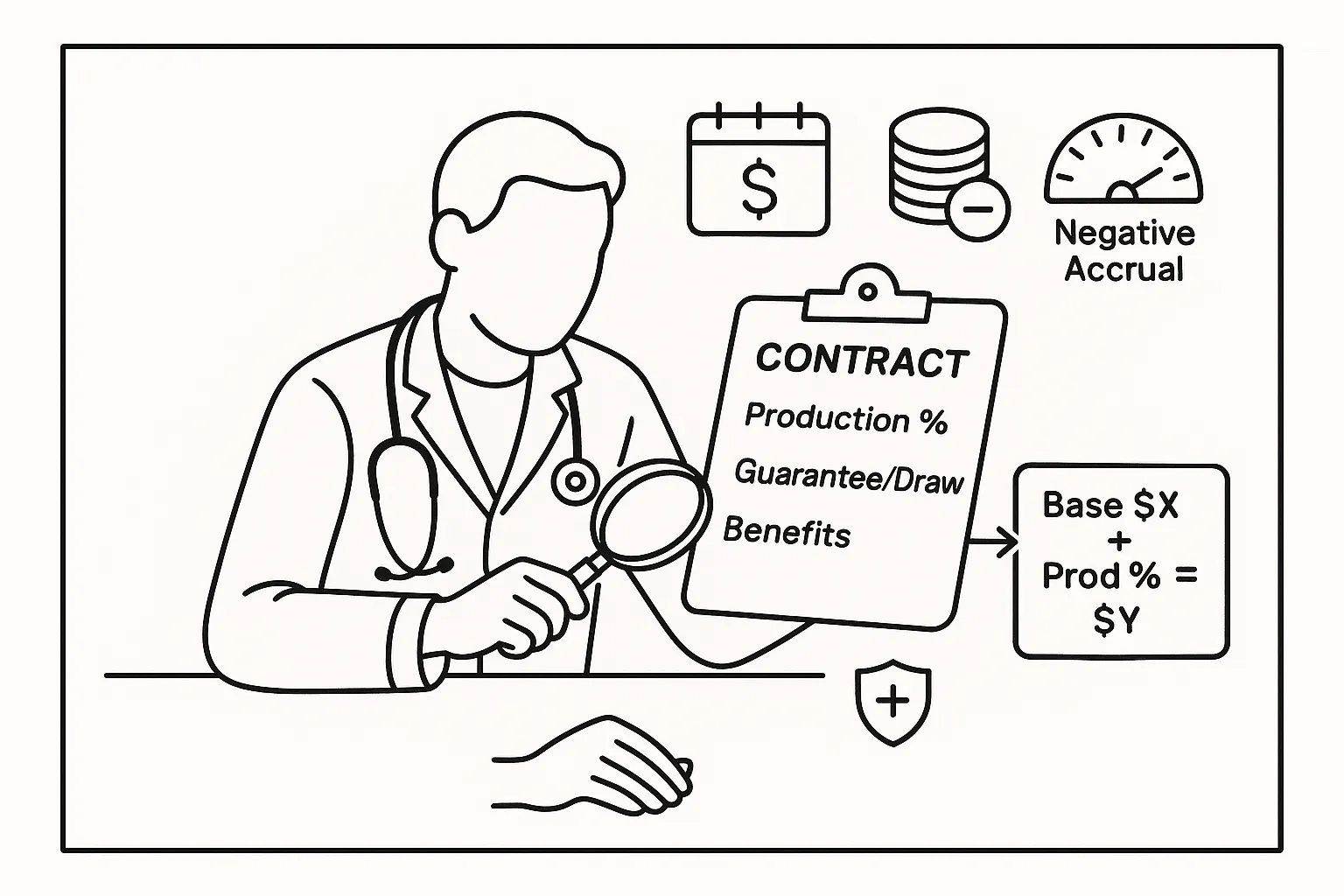
Compensation and benefits are areas where a small drafting error can cost an associate thousands of dollars each year. The offer should use measurable definitions and explain how compensation is calculated, when it is paid, and whether the employer may later recoup any amount. A detailed veterinary compensation and ProSal review can identify assumptions that are not apparent from the headline salary or production percentage.
ProSal, Production Pay, Draws, and Negative Accrual
ProSal and production-based models are common in corporate and private veterinary practices. An employer may offer a base salary plus a production percentage or compensation tied to collections. The offer should define whether production means gross revenue, adjusted production, net collections, billable procedures, or another figure. It should also identify which discounts, write-offs, refunds, laboratory charges, or other adjustments can reduce the amount credited to the veterinarian.
Timing matters because collections-based pay may lag behind the services performed. Confirm whether credit is assigned in the month services are provided or when the practice receives payment. Request a sample calculation showing a typical month, the applicable percentage, permitted deductions, the reconciliation schedule, and when any earned production compensation is paid. Our guide to veterinary production pay explains how these formulas affect actual earnings.
A stated base salary may be a true guarantee or an advance against future production, commonly described as a draw. If the amount is repayable, the contract should define when repayment occurs, whether interest applies, whether the employer may deduct it from wages or final compensation, and what happens at termination. Negative accrual provisions allow a production deficit to carry forward and reduce future compensation. Associates can request monthly repayment limits, an expiration period for old deficits, and language explaining whether negative accrual is forgiven when employment ends.
Bonuses, PTO, Insurance, and Other Benefits
Bonuses are frequently conditional, so the offer should state what each bonus rewards, the measurement period, the payment date, and whether it is prorated for a partial year. Signing and relocation bonuses often include repayment obligations if employment ends within a specified period. Review the triggering events carefully and seek a prorated schedule rather than automatic repayment of the full amount. A focused bonus and repayment clause review can clarify how resignation, termination, leave, or a delayed start date affects the obligation.
Benefits that sound generous may remain discretionary unless the documents provide specific terms. Confirm the start date and employee contribution for medical, dental, and vision coverage; the PTO accrual method and blackout dates; whether unused PTO is paid at termination; and the amount and scheduling rules for continuing education. The offer should also address payment of licensing, DEA or state fees when applicable, retirement-plan eligibility, employer-match vesting, and any student-loan assistance. If loan assistance depends on remaining employed for a set period, review the repayment consequences alongside the other bonus provisions.
Compensation and benefit expectations may also vary by market. A higher salary in a high-cost region may be accompanied by higher insurance premiums, commuting expenses, or living costs. Evaluate the complete economic package rather than comparing base salary alone.
Restrictive Covenants and Malpractice Coverage

Restrictive covenants and professional liability provisions may have consequences long after the initial offer is accepted. These terms should not be deferred as boilerplate for the final agreement. The offer and employment contract should clearly describe both the veterinarian’s post-employment restrictions and the insurance obligations that arise when the relationship ends.
Non-Compete, Non-Solicitation, and Confidentiality Terms
Non-compete enforceability varies significantly by state, and the language should be reviewed under the law that will govern the agreement. The restriction should identify the prohibited activities rather than broadly banning all veterinary work. An associate can request that the covenant apply only to direct clinical practice involving the same services or client base and exclude teaching, research, industry work, telemedicine, relief work, or other activities that do not compete with the employer when appropriate.
Duration and geography also matter. Veterinary agreements may propose restrictions lasting six to 24 months, but the appropriate limit depends on state law and the circumstances of the practice. The geographic area should be connected to the locations where the veterinarian actually works and realistic client travel patterns. Avoid language that applies a separate radius to every facility owned by a corporate group or creates an effective statewide or nationwide prohibition. A veterinary non-compete review can evaluate the scope and state-specific concerns before signing.
Non-solicitation clauses may restrict contact with clients, referral sources, or staff, but the duration and definitions should be precise. Confidentiality provisions should protect legitimate proprietary information without preventing lawful compensation discussions, communications with licensing authorities, or reporting of professional concerns. If the offer mentions ownership, a right of first refusal, or a future opportunity to buy in, confirm that the restrictive covenants do not become broader merely because ownership was discussed but never completed.
Professional Liability and Tail Insurance Obligations
Determine whether the employer provides occurrence or claims-made professional liability coverage. An occurrence policy generally responds to covered incidents occurring during the policy period even if a claim is made later. Claims-made coverage generally requires the policy to be active when the claim is made, which may create a need for tail coverage or prior-acts coverage after the veterinarian leaves.
The contract should state who pays premiums, applicable coverage limits, and whether defense costs reduce those limits. It should also address control of the defense and access to independent counsel when a conflict arises. If claims-made coverage is used, identify who purchases tail or run-off coverage under resignation, termination without cause, termination for cause, disability, retirement, or a practice sale. Chelle Law’s malpractice and tail insurance review examines these obligations before they become an unexpected exit expense.
Tail coverage can cost several times the annual premium, and employers sometimes agree to pay only under limited termination scenarios. If the employer will not assume the full obligation, the associate may seek a prorated contribution or severance that offsets the cost. State licensing requirements and local practice arrangements may also affect how coverage provisions should be evaluated.
Termination, Notice, and Repayment Risks
Termination provisions determine how either party can end the relationship and what financial obligations survive. “For cause” should be defined through objective events rather than broad statements allowing termination whenever the employer is dissatisfied. When an issue can reasonably be corrected, the agreement should provide written notice and a cure opportunity. Without clear language, a subjective termination decision may trigger repayment obligations, loss of a bonus, or forfeiture of earned but unpaid production compensation.
Without-cause termination allows a party to end employment without proving a breach, but the notice period must be workable. Review whether the employer can remove the veterinarian from the schedule during notice, reduce access to production opportunities, or require continued work without guaranteeing compensation. The agreement should also explain when the final production reconciliation occurs and whether collected revenue received after departure is still credited to the associate. A veterinary contract termination review can identify notice-period and final-payment provisions that place the associate at a disadvantage.
Any severance should specify the amount, payment method, timing, and required release. Repayment clauses for signing bonuses, relocation expenses, student-loan benefits, or training costs should identify the triggering events and use a clear prorated schedule where possible. Post-termination obligations may also include returning property, preserving records, cooperating with claims, complying with restrictive covenants, and completing patient or client transitions. These duties should be concrete and should not give the employer unlimited discretion to withhold final compensation.
Ownership and Veterinary Practice Buy-In Promises
An ownership opportunity can be a significant reason to accept a position, but language such as “may be offered,” “potential partnership,” or “subject to board approval” does not guarantee that a transaction will occur. A meaningful buy-in provision should address the expected timeline, eligibility milestones, valuation method, percentage available, approval process, and documents that will govern the ownership interest. Depending on the proposed arrangement, valuation may use an earnings multiple, EBITDA, an independent appraisal, or another agreed method.
Associates should also examine vesting, capital contributions, voting rights, profit distributions, additional capital calls, dilution, and exit rights. Forced buyout provisions or opaque accounting can substantially reduce the value of an ownership interest. Helpful protections may include transparent financial reporting, defined distribution schedules, preemptive rights for additional equity issuances, and a clear buy-sell valuation formula.
If ownership is central to the decision to join, essential buy-in terms should be settled in writing rather than left as a verbal expectation. The parties can make completion of agreed ownership documentation a condition that must occur before employment begins or before another defined milestone. Veterinarians considering equity can also review the firm’s guide to veterinary ownership pathways when comparing an employment offer with a future purchase opportunity.
Scheduling, Work Locations, and Professional Autonomy
Operational expectations often affect daily work more than the headline salary. The offer should address scheduled days, shift length, appointment expectations, emergency coverage, on-call rotation, weekend duties, and relief or locum shifts. If compensation depends on production, determine whether the employer controls the staffing, appointment volume, pricing, discounts, and support resources needed to meet the stated target. Performance metrics should be objective and connected to a reasonable review or corrective process.
Moonlighting restrictions should explain whether the associate may perform relief work, teach, consult, or work for another facility. Multi-location assignments should identify the regular work sites, maximum routine travel distance, scheduling notice, and mileage or travel reimbursement. Vague authority to transfer an associate among every facility owned by a corporate group can materially change commuting time and compensation. The veterinary schedule and call guide provides additional issues to examine when the offer includes flexible scheduling language.
Confirm who pays for veterinary licenses, controlled-substance registrations when applicable, specialty credentials, continuing education, and required renewals. If peer review or a performance improvement process is used, ask how concerns are documented, who evaluates them, and whether the veterinarian can respond. Clinical decision-making language should preserve professional autonomy and permit intervention for documented quality or compliance concerns rather than allowing productivity targets alone to control medical judgment.
State law can affect restrictive covenants, licensing obligations, wage deductions, and other contract provisions. A term that is common in one jurisdiction may operate differently in another. Before accepting an offer, review the complete package—including the offer letter, employment agreement, compensation plan, benefit documents, bonus addenda, and ownership materials—so that important promises do not disappear or conflict across documents.
Frequently Asked Questions
What compensation mistakes should I look for in a veterinarian offer letter?
Look for undefined production or collections formulas, unclear payment timing, undisclosed deductions, and negative accrual provisions that allow deficits to reduce future pay. Ask for the complete ProSal formula, sample calculations, reconciliation dates, and written limits on repayment or carry-forward balances.
Can an offer letter’s non-compete restrict where I work after leaving?
Potentially. The effect depends on the language, the governing state law, and the circumstances of the practice. Review the prohibited activities, duration, geographic area, covered locations, and whether the clause applies only to work that genuinely competes with the employer.
Why should malpractice and tail coverage be addressed before I accept an offer?
A claims-made policy may require tail or prior-acts coverage after employment ends, and that coverage can be expensive. The documents should identify the policy type, premium responsibility, defense-cost treatment, coverage limits, and who pays for tail under each termination scenario.
What should a signing bonus repayment clause say?
The clause should identify the events that trigger repayment, the amount due at each stage of employment, the payment deadline, and any permitted payroll deduction. Associates can request a prorated schedule rather than full repayment and should confirm how termination without cause, disability, or a delayed start date is treated.
How should I evaluate a promised veterinary practice buy-in?
Determine whether the promise is binding or merely discretionary. A meaningful ownership path should address timing, eligibility, valuation, the equity percentage available, capital requirements, voting and distribution rights, dilution, and the formula used if either party later buys out the interest.
When should an attorney review my veterinarian offer letter?
Seek review before signing the offer letter or employment agreement, particularly when the package includes ProSal, negative accrual, restrictive covenants, bonus repayment, claims-made insurance, multiple locations, or an ownership promise. An attorney can compare the documents, explain financial and exit risks, and help propose clearer language.
Review Your Veterinary Offer Before You Sign
Chelle Law provides attorney-led review of veterinarian offer letters and employment agreements, including compensation, restrictive covenants, malpractice coverage, termination terms, repayment obligations, and ownership provisions.
Contact Chelle Law