

Signing bonuses are common in veterinary hiring offers, especially for associates joining corporate groups, emergency practices, or clinics in high-cost markets. The payment may offset relocation expenses, replace income lost during a transition, or make a competitive offer more attractive. However, that up-front cash often comes with repayment clauses, clawbacks, and conditions that can require a veterinarian to repay thousands of dollars after leaving the position.
The financial risk depends on much more than the bonus amount. A contract may require repayment after a voluntary resignation, termination for cause, reduction in scheduled hours, rejected reassignment, or alleged breach of another employment obligation. Lump-sum repayment, payroll offsets, interest, restrictive covenants, and simultaneous tail insurance obligations can make an already difficult departure significantly more expensive.
Chelle Law has reviewed hundreds of veterinary associate contracts nationwide and represents veterinarians negotiating these provisions. This guide explains how common repayment structures work, which contract terms increase exposure, how state law and related employment provisions may affect collection, and what veterinarians can request before accepting an offer. A focused review of bonus and repayment terms can identify risks that are easy to overlook when attention is focused on the payment itself.
Key Takeaways
- Repayment risk often hinges on broad trigger events. Narrow, objective triggers, such as voluntary resignation within a defined period, create more predictable obligations.
- Pro rata or monthly vesting is generally less risky than a lump-sum clawback because the amount owed decreases as the veterinarian completes the required service period.
- State wage laws may restrict deductions from final pay. The contract should clearly address whether the employer may use payroll withholding or must pursue repayment separately.
- Repayment should be separated from noncompete, tail insurance, and other post-employment obligations where possible. Carveouts may also be appropriate for termination without cause, disability, or employer breach.
- The payment amount, vesting schedule, repayment formula, triggers, deadlines, and negotiated exceptions should all be documented before the veterinarian signs.
How Veterinary Signing Bonuses and Repayment Clauses Work
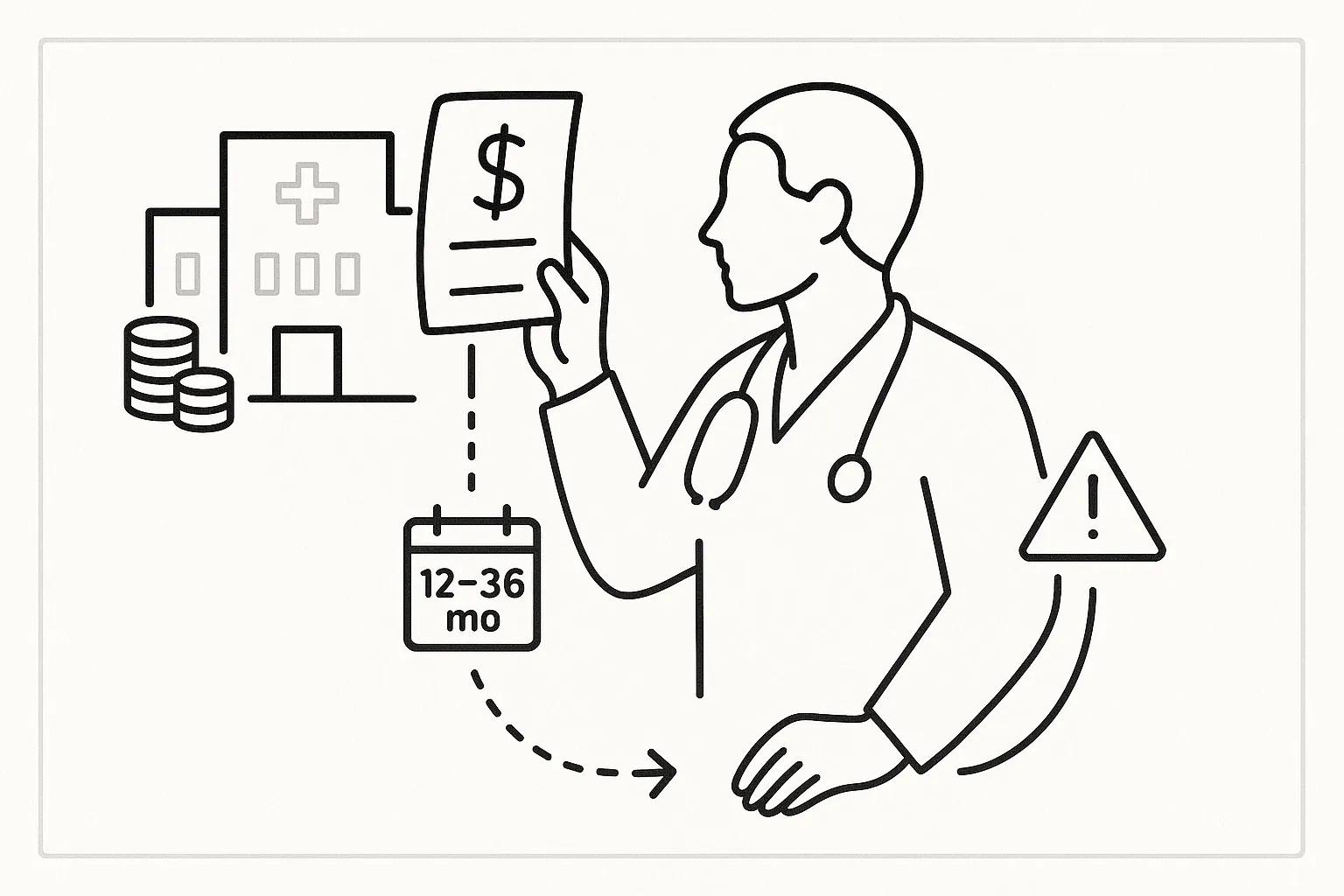
Signing bonuses in veterinary offers range from modest relocation reimbursements to substantial one-time cash payments intended to persuade an associate to join a practice or corporate network. Employers may describe the payment as a signing bonus, relocation stipend, retention payment, or advance against future earnings. That label matters because the agreement should explain whether the veterinarian earns the payment immediately, earns it gradually through continued service, or must satisfy production or other conditions.
- Purpose: The payment may offset relocation costs, compensate for lost earnings, or secure a commitment during recruitment.
- Payment timing: A bonus may be paid when the contract is signed, on the start date, after the first paycheck, or in installments across several pay periods.
- Repayment period: Many agreements tie repayment to a minimum employment period, commonly expressed as a defined number of months or years.
Employers use repayment provisions to protect their recruiting and training investment. Repayment is commonly triggered when an associate resigns before the required period or is terminated for cause. Some contracts go further by addressing reduced hours, productivity, reassignment, or restrictive covenant violations. Corporate veterinary groups may also pair signing bonuses with multi-location assignment clauses, negative accrual, or production requirements, so the veterinarian should understand exactly what conduct or event creates the debt.
Lump-Sum Repayment Versus Pro Rata Vesting
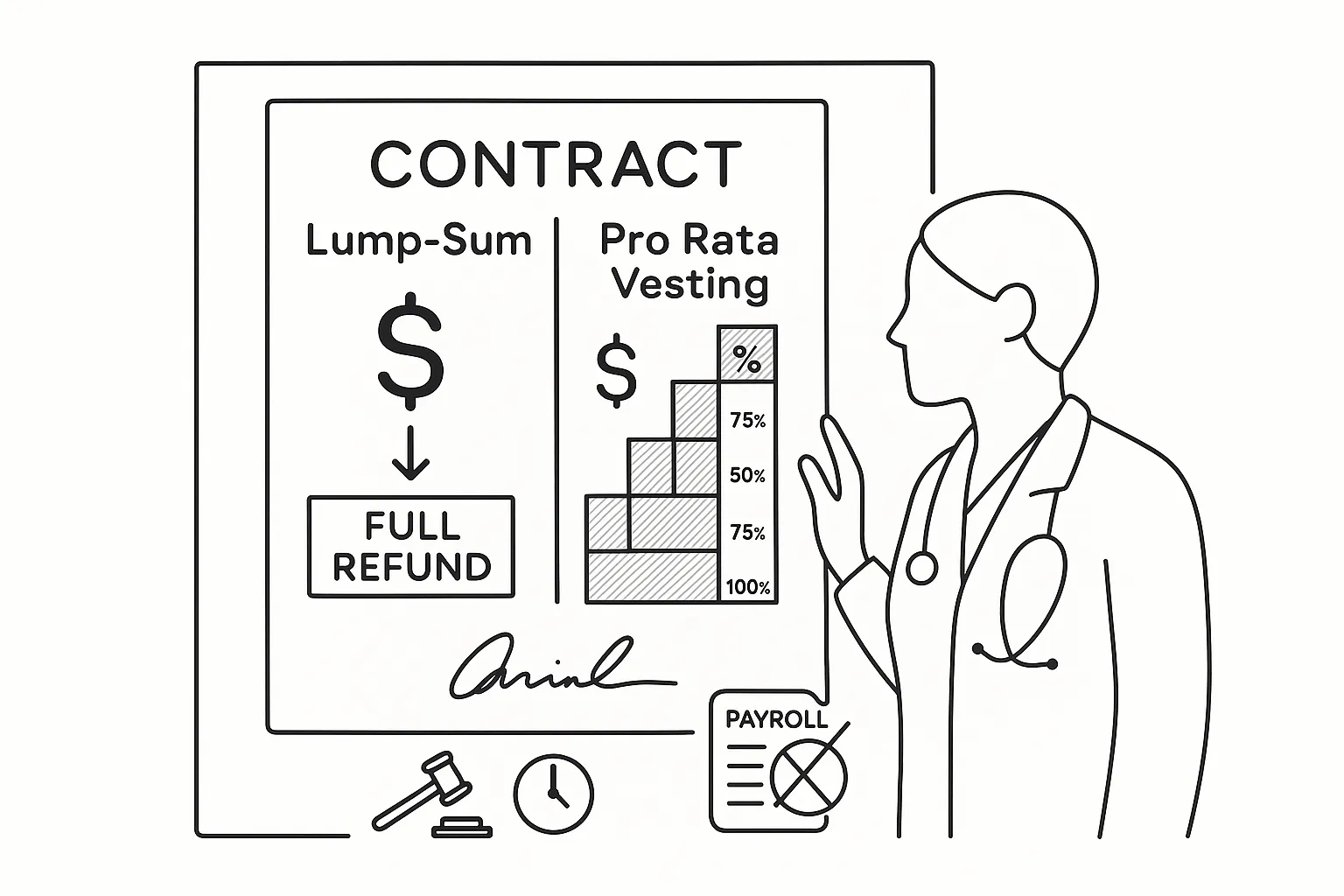
Under a lump-sum provision, the employer may demand the entire bonus if a trigger occurs at any point during the stated period. A veterinarian who leaves 11 months into a 24-month commitment could therefore owe the same amount as someone who leaves after only a few months. This all-or-nothing structure creates the greatest repayment exposure because the outstanding balance does not decline as the associate completes the service commitment.
Pro rata vesting reduces the balance over time. For example, a bonus might vest monthly, quarterly, or by a stated percentage after each six-month period. If the veterinarian leaves after completing part of the commitment, only the unvested balance is subject to repayment. A written schedule should identify the vesting start date, each reduction date, and the exact formula used to calculate the remaining balance. Monthly vesting generally provides greater fairness and predictability than a single cliff-vesting date.
Payroll Offsets, Interest, and Added Repayment Costs
Some employers attempt to recover a bonus by withholding final wages, offsetting production compensation, or applying commissions and other amounts allegedly owed to the veterinarian. Others use negative accrual language that carries a deficit forward when production targets are not met. State wage-deduction laws vary, and a contractual authorization does not necessarily resolve every wage-payment issue. The agreement should state whether repayment will be handled separately from payroll and whether additional written authorization or another collection process is required.
Interest, late fees, collection costs, attorney fees, or liquidated damages can substantially increase the balance. Although courts may scrutinize provisions that operate as unreasonable penalties, a veterinarian should not assume that an aggressive formula will simply be disregarded. Negotiating a fixed calculation, reasonable payment deadline, installment option, and no interest or penalties is often the most practical way to limit exposure.
Compensation provisions should be reviewed together because a signing bonus may interact with production calculations, negative accrual, or other payments characterized as advances. A broader veterinary compensation and ProSal review can clarify whether these terms create overlapping financial obligations.
Contract Language That Increases Repayment Risk
The most important issue is often not whether the contract contains a repayment clause, but how broadly that clause is written. A provision tied only to voluntary resignation during a defined period is more predictable than one triggered by any separation, schedule change, performance concern, or alleged breach. Veterinarians should review the repayment clause alongside the agreement’s definitions, termination provisions, compensation exhibits, and incorporated policies.
Broad Triggers, Clawbacks, and Ambiguous Definitions
Voluntary resignation before the end of a service period is a common trigger, but some contracts also include termination without cause, termination for not meeting productivity targets, reduction in full-time-equivalent status, refusal of reassignment, or failure to satisfy vaguely described conduct standards. The more events included, the more likely an ordinary workplace dispute will also become a repayment dispute. Narrow, objective triggers and reasonable carveouts reduce that uncertainty.
Clawback or forfeiture provisions may permit recoupment after undefined “losses,” policy violations, or conduct determined by the employer to be improper. Terms such as “cause,” “termination,” “breach,” and “employment relationship” should be defined rather than left to one party’s discretion. The provision should also specify when repayment becomes due, how notice must be delivered, whether there is an opportunity to cure an alleged breach, and how the amount is calculated.
Timing language deserves equal attention. Phrases such as “within a reasonable time” create avoidable uncertainty, while a fixed deadline and written repayment schedule make the obligation easier to evaluate. If the employer claims a right to deduct the balance from wages, the contract should identify the proposed process rather than relying on a broad authorization that may conflict with applicable state law.
How Bonus Repayment Interacts With Other Contract Terms
A signing bonus clause does not operate in isolation. It may overlap with restrictive covenants, termination rights, malpractice coverage, severance, ownership opportunities, or other repayment obligations. The combined effect can be far more expensive than any single clause suggests.
Restrictive Covenants, Termination, and Post-Employment Costs
Some employers link repayment to a noncompete or nonsolicitation provision. If the employer alleges a restrictive covenant violation, the veterinarian may face both enforcement of the restriction and a demand to repay the bonus. Even where a state limits certain noncompetes, the employer may still attempt to pursue a separately worded repayment obligation. A careful veterinary noncompete review should determine whether the provisions are connected and whether the financial remedy can be removed or narrowed.
Termination language creates another significant risk. If an employer may terminate the veterinarian without cause yet still demand full repayment, the veterinarian could lose the position and immediately owe a substantial debt. A stronger provision excludes termination without cause, disability, death, material employer breach, or another event outside the veterinarian’s reasonable control. If repayment remains possible, any severance and the unvested bonus balance should be coordinated rather than treated as unrelated obligations. The notice period and separation provisions should also be examined through a focused contract termination review.
Professional liability coverage can add another large expense at departure. An employer may require the veterinarian to repay the bonus and purchase tail coverage under a claims-made policy at the same time. The agreement should identify the policy type, who pays for tail insurance, when coverage must be purchased, and whether the obligation changes based on the reason for termination. Reviewing malpractice and tail insurance terms can help prevent simultaneous financial obligations that make leaving the practice impractical.
Bonus repayment can also affect buy-in paths and ownership transitions. An employer might require repayment if the associate leaves before completing an ownership earn-in period or attempt to offset the balance against buy-in credits. The contract should explain whether the bonus affects ownership valuation, capital contributions, or amounts already earned toward a purchase. These terms should be coordinated so that a veterinarian is not charged twice for the same departure.
State Law and Enforcement Considerations
State laws vary and can affect both the enforceability of a repayment clause and the methods an employer may use to collect. Wage-deduction rules are especially important when an employer wants to withhold the balance from a final paycheck. Some jurisdictions tightly restrict post-termination deductions, while others may permit certain deductions with a valid written authorization. A veterinarian should not assume that signing a broad contract clause automatically allows the employer to take wages that would otherwise be due.
Contract defenses may also matter. Depending on the facts and governing law, courts may examine whether a repayment provision is punitive, unconscionable, unsupported, or unrelated to a legitimate employer interest. Fraud, duress, waiver, modification, and statutes of limitation may affect a particular dispute. These issues are highly dependent on the contract, communications between the parties, and state law, so they should be evaluated rather than treated as automatic defenses.
State law may also affect connected noncompete provisions, final-pay requirements, and available remedies. Because the governing-law clause does not always answer every question, the veterinarian’s work location, employer location, and place of payment may all require attention. A state-specific veterinary contract review can account for local wage rules, restrictive covenant standards, and other regional contract considerations.
Negotiating Safer Repayment Terms
Veterinarians can reduce repayment exposure before signing by requesting targeted edits rather than simply rejecting the bonus. Pro rata monthly vesting, narrow triggers, and clear definitions are usually the most important changes. The provision should identify exactly when the service period begins, when each portion vests, what events create repayment, and how the outstanding amount will be calculated.
Carveouts should address termination without cause, disability, employer breach, material changes in duties, and other events that are not a voluntary decision to abandon the commitment. The agreement can also provide written notice and a cure period before an alleged breach creates repayment. Where the employer insists on a financial obligation, the veterinarian can request a cap, no interest, and an installment schedule that avoids an immediate lump-sum demand.
Alternative structures may also be available. The parties could place the payment in escrow and release it gradually, use a pre-agreed reduced buyout amount, divide the bonus into retention installments, or limit repayment to documented relocation expenses. These solutions still protect the employer’s recruiting investment while reducing the financial shock to the veterinarian.
Negotiation should address payroll collection directly. The veterinarian can request that repayment be handled through a separate written payment agreement rather than an automatic deduction from wages. Any authorization should be specific rather than open-ended, and the contract should not give the employer unilateral authority to determine the balance without an accounting.
Pre-Signing Checklist for Veterinary Associates
Before accepting a signing bonus, determine whether it is a true bonus, a retention payment, a relocation reimbursement, or an advance against future earnings. Review the complete employment agreement rather than relying on an offer letter or recruiter summary. The operative contract should answer the following questions:
- When is the bonus paid, and when does vesting begin?
- What exactly triggers repayment, and does termination without cause create an obligation?
- Does the amount decline monthly, quarterly, or only after a cliff-vesting date?
- Can the employer add interest, collection costs, attorney fees, or liquidated damages?
- May repayment be deducted from wages, production pay, unused leave, or other compensation?
- How does the clause interact with noncompete, tail insurance, severance, relocation, or buy-in terms?
- Are disability, employer breach, schedule changes, reassignment, and termination without cause addressed?
Keep the full repayment formula, vesting schedule, and every negotiated carveout in writing. Save the offer, compensation exhibits, emails, pay statements showing the payment, and documentation of changes to duties, schedule, location, or productivity expectations. If a recruiter or manager makes a verbal promise, request written confirmation and incorporation into the final agreement.
An attorney-led review is particularly important when the repayment amount is substantial, the triggers are broad or ambiguous, or the clause overlaps with restrictive covenants, tail coverage, production pay, or ownership terms. Chelle Law reviews veterinary agreements to identify enforceability concerns, propose practical revisions, and help veterinarians understand the combined financial consequences before they sign.
Frequently Asked Questions
What are the main veterinarian signing bonus repayment risks?
Common risks include broad repayment triggers, lump-sum clawbacks, payroll deductions, interest, collection costs, and connections to noncompete or tail insurance obligations. The risk increases when key terms such as cause, breach, repayment date, and outstanding balance are undefined or controlled solely by the employer.
How does pro rata vesting reduce signing bonus repayment exposure?
Pro rata vesting reduces the unearned balance as the veterinarian completes the required service period. If the bonus vests monthly or quarterly, a veterinarian who leaves early generally repays only the unvested portion rather than the entire original payment. The contract should contain a clear schedule and calculation formula.
Can an employer deduct signing bonus repayment from a final paycheck?
Whether a deduction is permitted depends on applicable wage law, the nature of the payment, and any valid authorization. Because state requirements differ, veterinarians should not assume that a broad contract clause permits an automatic deduction. The agreement should clearly state the proposed collection process.
What happens if the practice terminates me without cause?
The answer depends on the repayment clause. Some agreements demand repayment after any separation, while better-negotiated provisions exclude termination without cause and other events outside the veterinarian’s control. This carveout should be written into the signed agreement rather than left to an informal assurance.
How can bonus repayment interact with a noncompete or tail insurance obligation?
An employer may link repayment to compliance with restrictive covenants or require bonus repayment and tail insurance payment at the same time. These overlapping obligations can create substantial departure costs. The provisions should be reviewed together and separated, narrowed, or capped where possible.
When should a veterinarian obtain an attorney review of the repayment clause?
Attorney review is particularly useful when the bonus is substantial, repayment triggers are broad, the agreement permits payroll offsets, or the obligation overlaps with production compensation, termination, noncompete, malpractice, or ownership terms. Review before signing provides the best opportunity to clarify and negotiate the language.
Review Your Signing Bonus Before It Becomes a Debt
Chelle Law reviews veterinary employment agreements for repayment triggers, vesting terms, payroll offsets, restrictive covenants, and other provisions that can increase the cost of leaving a practice.
Contact Chelle Law