

A without-cause termination clause allows a veterinary employer to end an associate’s employment without alleging misconduct, breach, or another specific reason. Although these provisions are common in veterinary employment agreements, they can create an abrupt loss of salary, production compensation, benefits, and access to employer-provided malpractice coverage. The effect depends not only on the termination clause itself but also on how it interacts with the rest of the agreement.
For veterinarians paid under ProSal or another production-based model, termination can interrupt a compensation cycle before collections are reconciled. The agreement may also leave the associate responsible for negative accrual, signing-bonus repayment, malpractice tail coverage, or a restrictive covenant that limits the next job. These risks can be especially significant when the contract permits immediate termination without pay in lieu of notice or severance.
Chelle Law reviews veterinary contracts nationwide with attention to termination rights, final compensation, insurance obligations, restrictive covenants, and state-specific enforceability. A careful review should determine what happens before, during, and after a without-cause termination—not merely whether the employer has the right to end the relationship.
Key Takeaways
- A without-cause termination clause lets an employer end employment without alleging misconduct, making clear notice, pay-in-lieu, or severance important protections.
- The contract should explain how final salary, accrued production compensation, ProSal reconciliation, and negative accrual will be handled.
- Veterinarians covered by claims-made malpractice insurance should confirm who must purchase tail coverage after separation.
- Non-compete and non-solicitation provisions may continue after termination, even when the employer ends the relationship without cause.
- State law can affect final-pay timing, restrictive-covenant enforceability, and other post-termination rights, so contract review should account for the state where the veterinarian practices.
What Without-Cause Termination Means in a Veterinary Contract
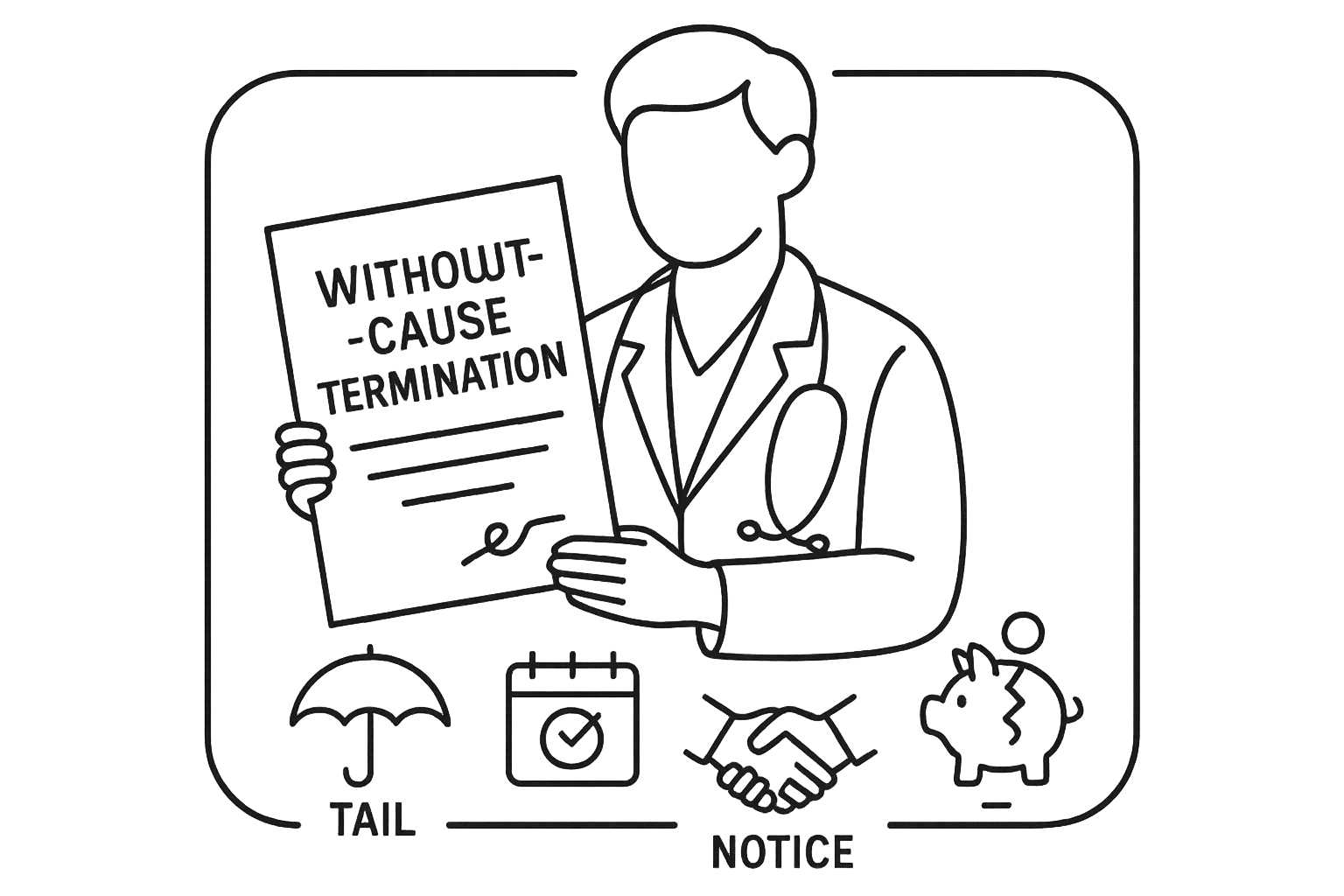
A without-cause termination provision allows an employer to end employment without proving misconduct or a contractual breach. It differs from “for-cause” termination, which ordinarily depends on stated grounds such as fraud, gross misconduct, loss of a required license, or another event defined by the agreement. The practical distinction matters because the notice, compensation, cure rights, and insurance obligations may differ depending on how the separation is classified.
Many veterinary employers, particularly corporate groups and multi-location practices, use at-will language or express without-cause termination rights to preserve operational flexibility. That flexibility benefits the employer but may transfer substantial risk to the associate unless the contract includes written notice, severance, continued benefits, or a clear payout formula for earned production. A focused review of veterinary termination terms can identify how these provisions work together before the agreement is signed.

Without-cause termination affects three core areas. First, a production-based veterinarian may lose expected income in the middle of a ProSal or collections cycle. Second, the end of employer-provided claims-made coverage may create a tail-insurance obligation. Third, a non-compete or non-solicitation clause may restrict where the veterinarian can work next. Because contract interpretation and enforcement vary by jurisdiction, the same language can have different practical consequences from one state to another.
Termination Language and Procedural Protections
Notice, At-Will Status, Fixed Terms, and Cause Definitions
A meaningful notice period can reduce the income shock caused by an unexpected separation. Common protections include 30 to 90 days’ written notice, pay in lieu of notice, or severance tied to tenure or average compensation. Immediate termination rights may be appropriate for serious safety, licensing, or regulatory events, but they should be drafted narrowly enough that they cannot be used to avoid the protections associated with an ordinary without-cause termination.
At-will employment generally permits either party to terminate the relationship at any time for a lawful reason. A fixed-term agreement may offer more predictability, but the stated one- or two-year term does not necessarily guarantee employment or compensation for that entire period. The contract must be read closely to determine whether either party can terminate early, what notice is required, and whether any damages or guaranteed payments follow an early employer termination.
The definition of “cause” is equally important. A stronger provision identifies specific grounds, such as loss of license, fraud, conviction of a defined offense, or gross negligence, and explains whether the veterinarian receives written notice and an opportunity to cure a remediable issue. Vague standards can allow an employer to classify an otherwise discretionary separation as a for-cause termination, potentially eliminating notice, severance, tail coverage, or other contractual benefits. Veterinarians should also review who makes the determination and whether the agreement requires arbitration, internal review, or another dispute process.
Compensation, Benefits, and Malpractice Exposure
Whether compensation consists of salary, shift rates, collections, or ProSal, the agreement should explain what the veterinarian receives after notice is given and after the final day worked. The analysis should include earned compensation, deductions, benefit continuation, repayment obligations, and professional liability coverage.
Final Pay, Production Bonuses, and Negative Accrual
The contract should identify how final salary is calculated, when it will be paid, and whether the veterinarian remains eligible for collections received after departure. State wage laws may impose separate final-pay requirements, so contractual language cannot be evaluated in isolation. A fair production provision defines the measurement period, collection window, formula, refunds, adjustments, and timing of the final reconciliation.
Accrued but unpaid production bonuses can become disputed when employment ends before the normal reconciliation date. The agreement should state whether the veterinarian receives credit for services performed before departure but collected afterward. A detailed ProSal and compensation review can also identify unilateral adjustment rights or accounting definitions that may reduce the final payment.
Negative accrual creates an additional risk if the veterinarian’s production does not meet the guaranteed base during a measurement period. The contract should explain whether a deficit carries forward, whether repayment can be demanded after termination, and whether any cap or lookback period applies. Transparent monthly statements and a clear reconciliation process help prevent an unexpected demand after separation.
Signing bonuses, relocation assistance, student-loan support, and other advances may also become repayable when employment ends. The repayment language should distinguish between a veterinarian who resigns and one whom the employer terminates without cause. Proration based on completed service can be more balanced than an all-or-nothing repayment obligation, and any repayment risk should be assessed together with the contract’s bonus and clawback provisions.
Benefits, Malpractice Coverage, and Tail Insurance
The agreement should clarify whether health coverage and other benefits continue during a notice or severance period. It should also address accrued PTO, continuing-education allowances, retirement-plan vesting, and any available post-termination health coverage. State law and the employer’s benefit plans may affect whether accrued PTO is paid and when coverage ends.
Malpractice insurance can create one of the largest post-termination exposures. An occurrence policy generally covers professional acts that occurred while the policy was active, even if the claim is reported later. A claims-made policy generally requires coverage to be active when the claim is reported, which can make extended reporting or tail coverage necessary after the veterinarian leaves.
If the employer provides claims-made coverage, the contract should expressly state who purchases tail coverage after each type of separation. Some agreements make the employer responsible only in limited circumstances, while others place the entire obligation on the associate. A malpractice and tail insurance review can determine whether the stated coverage and post-termination allocation adequately address ongoing liability.
Post-Termination Restrictions and Career Mobility
Non-Competes, Client Restrictions, and Case Transitions
Restrictive covenants often apply regardless of whether the veterinarian resigns, is terminated for cause, or is terminated without cause. A review should examine the non-compete duration, geographic radius, covered practice locations, prohibited services or species, and any restrictions on soliciting clients or employees. State law varies considerably, and statutory or case-law developments can change whether a restriction is enforceable.
When a broad restriction is present, possible revisions include a shorter duration, smaller geographic area, limits tied only to locations where the veterinarian actually worked, or client-based restrictions instead of a broad prohibition on practicing. Emergency work, relief shifts, specialty services, and preexisting professional relationships may also warrant express carve-outs. Chelle Law’s veterinary non-compete review considers the restriction alongside termination rights because the combined effect can determine whether the veterinarian can remain in the local market.
The agreement should also address ownership and access to animal-patient records, communications with clients, and the transition of active cases. A veterinarian may need a reasonable method for communicating continuity-of-care information without violating a non-solicitation clause. The contract should also avoid provisions that permit misleading statements about the veterinarian’s departure or unnecessarily damage the veterinarian’s professional reputation.
Negotiating Protection Before Signing
Veterinarians may have meaningful leverage, particularly in markets with strong demand. The best time to address termination risk is before signing, when notice, severance, compensation reconciliation, insurance, and restrictive covenants can be negotiated as one package rather than treated as unrelated provisions.
- Request a defined written notice period or pay in lieu of notice based on salary and, where appropriate, average production compensation.
- Seek severance when the employer terminates without cause, particularly if the veterinarian is relocating or giving up an established position.
- Require a cure period for remediable performance concerns before the employer can rely on a for-cause termination provision.
- Define collections, refunds, reconciliation timing, negative accrual, and post-departure production credit in writing.
- Address employer-paid tail coverage or another formula that accounts for the cost of extended reporting coverage.
- Limit repayment obligations and restrictive covenants when the employer initiates a without-cause termination.
Collections-based compensation should specify what counts as collections, when revenue is credited, how refunds and discounts are handled, and whether the employer can change the formula. Agreements involving buyouts, earnouts, partnership opportunities, referrals, relief shifts, or mobile practice work may require additional definitions and dispute procedures. Clear drafting reduces the employer’s ability to make unilateral post-termination adjustments.
Warning signs include a broad non-compete paired with no severance or tail commitment, vague ProSal language that permits unlimited negative accrual, or a significant relocation or signing-bonus obligation without protection if the employer ends the relationship. These provisions do not operate independently; their combined effect determines the veterinarian’s actual financial and professional exposure.
State Law and Attorney Contract Review
Non-compete enforceability, final-pay timing, and the treatment of accrued benefits can vary by state. Veterinary licensing boards generally do not decide ordinary employment-contract disputes, but a separation tied to professional discipline, recordkeeping, or patient-care allegations can create separate licensing concerns. The agreement should therefore be reviewed under the law governing the contract and the jurisdiction where the veterinarian will practice.
An attorney review should include a line-by-line analysis of termination mechanics, compensation, restrictive covenants, malpractice coverage, repayment obligations, and any ownership or buy-in terms. The goal is not simply to identify unfavorable language but to explain the practical consequences, propose revisions, and help the veterinarian prioritize negotiations. Veterinarians evaluating a new offer should seek review before signing, particularly when ProSal, negative accrual, broad restrictive covenants, or substantial repayment obligations are involved.
Frequently Asked Questions
What does without-cause termination mean for a veterinarian’s income?
The employer may end employment without alleging misconduct, potentially interrupting salary, ProSal, or another production formula in the middle of a measurement period. The contract should define notice or pay in lieu, final reconciliation, post-departure collections, and any negative-accrual obligation.
How much notice should a veterinary contract require for termination without cause?
There is no single notice period appropriate for every agreement. Veterinary contracts commonly use a defined written-notice period, and some provide pay in lieu of notice. The veterinarian should evaluate whether the period provides enough time to replace income, arrange insurance, transfer cases, and find work that complies with any restrictive covenant.
Who pays for tail coverage after a without-cause termination?
The contract should allocate that responsibility expressly. If the veterinarian has claims-made malpractice coverage and the agreement is silent or assigns tail to the associate, the veterinarian may have to purchase extended reporting coverage. Employer-paid tail or a severance arrangement that accounts for the premium can reduce this exposure.
Does a veterinary non-compete still apply when the employer terminates without cause?
It may, depending on the contract and applicable state law. Veterinarians should not assume that an employer-initiated termination automatically releases a non-compete. The agreement can instead be negotiated so the restriction is waived, narrowed, or shortened when the employer ends employment without cause.
What final-pay and ProSal terms should be confirmed before signing?
Confirm the final salary date, production measurement period, treatment of collections received after departure, reconciliation deadline, refund adjustments, and whether negative accrual carries forward. The employer should provide enough reporting for the veterinarian to verify the calculation.
When should a veterinarian have an attorney review the termination clause?
Review is particularly important before signing an agreement containing ProSal, negative accrual, claims-made insurance, a broad non-compete, substantial bonus repayment, relocation obligations, or an unclear fixed term. These provisions can magnify the consequences of a without-cause termination and should be evaluated together.
Review Your Veterinary Termination Terms Before You Sign
Chelle Law can evaluate how without-cause termination affects your compensation, malpractice coverage, repayment obligations, restrictive covenants, and next career move.
Contact Chelle Law