

Restrictive covenants, the noncompete, non‑solicit, confidentiality, and related clauses tucked into most veterinary associate agreements, can quietly shape the trajectory of your career. They affect where you can work, whether you can build your own book of clients, and even your ability to buy into a practice. We review these provisions for veterinarians nationwide, explain how they operate in real life, and show what to look for and negotiate so you protect your income and long‑term mobility.
This page focuses on the veterinary context: ProSal, production and collections formulas, negative accrual, malpractice (tail) issues, corporate‑group norms, and the state‑law differences that make one contract reasonable in New York but oppressive in California. We’re attorney‑led, experienced with DSG, NVA, VCA, Banfield, Thrive and independent practices, and we’ll explain what clauses mean for your daily work and future options.
Key Takeaways
- Veterinary Associate Restrictive Covenants can limit where you work, who you treat, and your ability to buy into or sell a practice, so review them with your career goals in mind.
- State law varies widely—what’s enforceable in one state may be invalid in another—so evaluate noncompete enforceability and local statutes before signing or resigning.
- Negotiate narrow, specific terms: short durations (commonly 6–12 months), client‑based carve‑outs (clients you personally treated in the prior 12–24 months), and explicit locum/emergency exceptions.
- Protect your income by insisting on compensation‑backed options (garden leave, clear buyout formulas, transparent ProSal/production audits) and caps on negative accrual or clawbacks.
- Get a lawyer to review offers and termination notices and bring your executed agreement, pay statements/ProSal records, malpractice insurance summary, and buy‑in communications to ensure restrictive covenants are reasonable and tailored.
What Restrictive Covenants Are And Why They Matter For Veterinary Associates
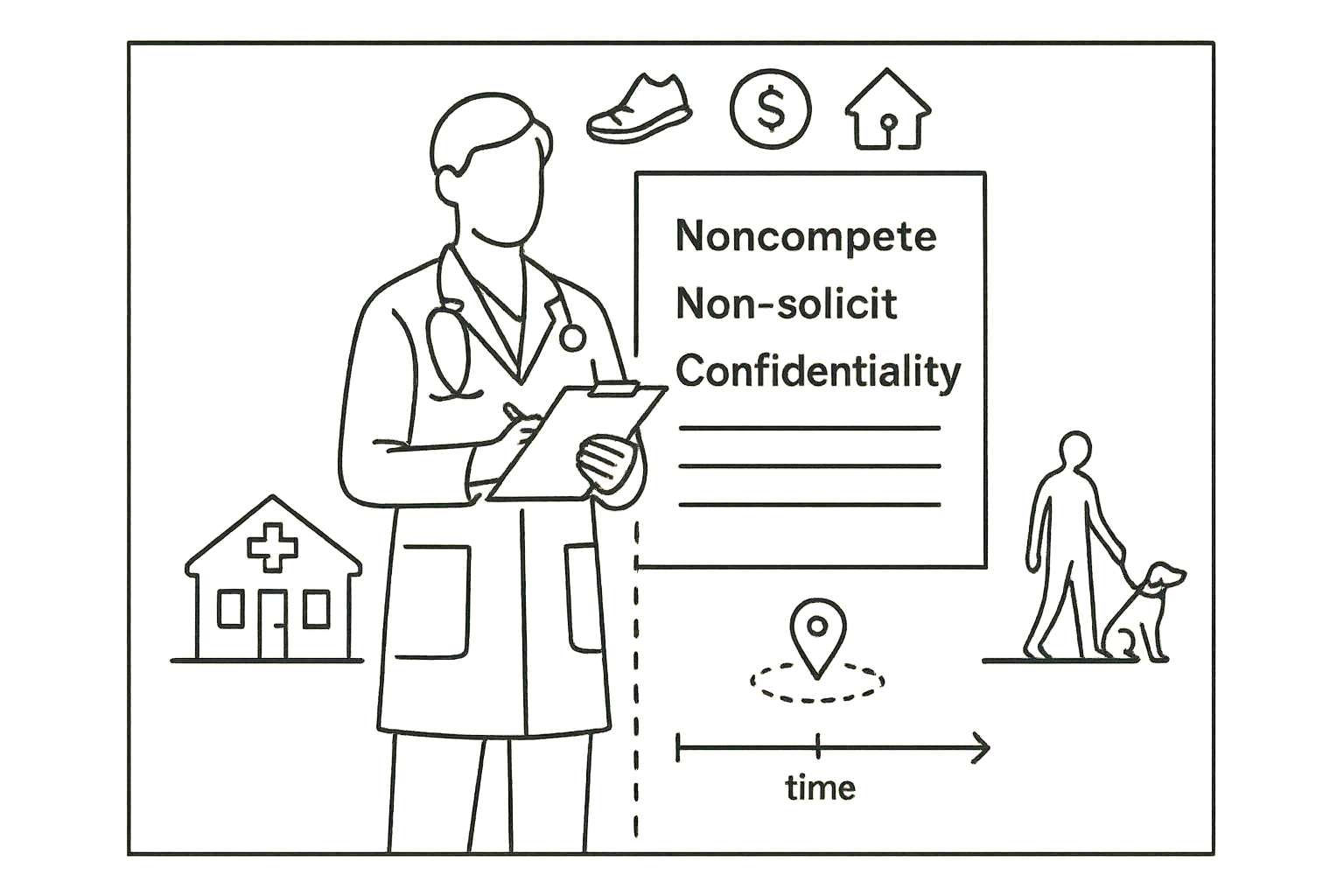
Restrictive covenants are contract provisions that limit what you can do during employment and after you leave. For veterinarians these typically include noncompetes, non‑solicit/referral restrictions, confidentiality rules, and assignment clauses. They matter because veterinary careers are mobile, associates change practices, move for family or cost‑of‑living reasons, and pursue buy‑in opportunities. A poorly drafted covenant can stop you from accepting a job in a neighboring town, prevent you from treating patients you’ve worked to build, or saddle you with expensive tail insurance obligations after termination.
Why we treat these clauses differently in veterinary contracts:
- Compensation ties matter. ProSal and production‑percentage systems create direct financial incentives: a restrictive covenant that limits where you can work after leaving affects the value of those earnings.
- Patient relationships are personal. Clients follow veterinarians: courts often look closely at how a covenant restricts patient access.
- Malpractice exposure and tail insurance can create post‑employment financial obligations that multiply the harm from a broad noncompete.
Our goal when reviewing these clauses is to protect three things: your mobility, your income, and your pathway to ownership. That means pushing for narrow geographic and temporal limits, clear definitions of ‘‘clients” and ‘‘production,” and explicit employer responsibilities for malpractice coverage during and after employment.
Common Types Of Restrictive Covenants In Veterinary Agreements
Noncompete Clauses
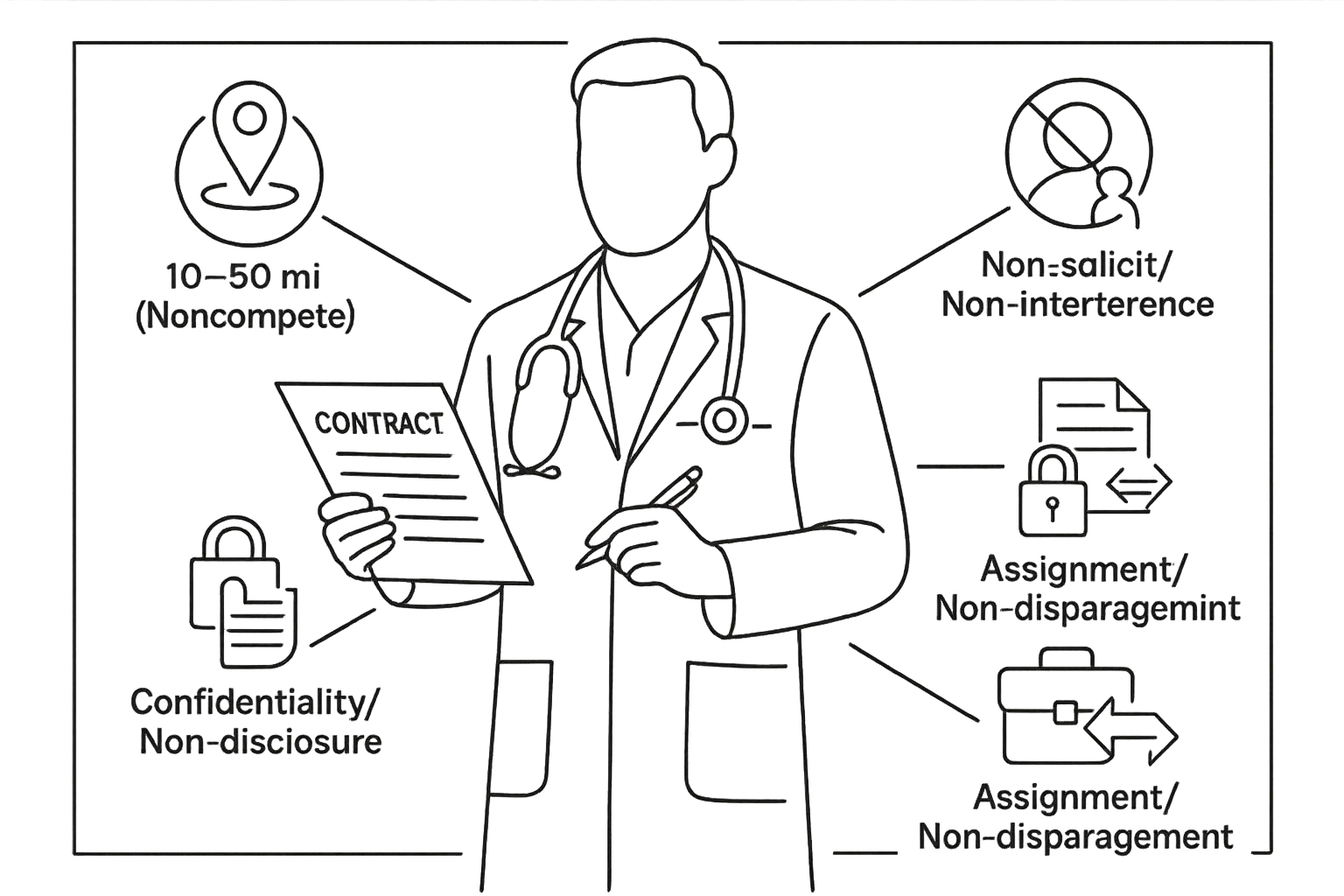
Noncompete clauses prohibit you from working within a defined area for a set period after leaving. In veterinary agreements you’ll see radii (e.g., 10–50 miles), town‑based restrictions, or market‑area definitions. Employers justify them by protecting goodwill and client lists: associates should insist on minimal duration (commonly 6–12 months in negotiated deals), narrow geography, and carve‑outs for emergency relief or locum work.
Non‑Solicitation And Non‑Interference Clauses
Non‑solicit provisions bar contacting former clients or recruiting staff. These are usually more enforceable than broad noncompetes, but still must be narrowly tailored, limited to clients seen in the last 12–24 months or employees with whom you had direct supervisory contact. Non‑interference language that prevents general advertising or passive intake is problematic and should be revised.
Confidentiality And Non‑Disclosure Provisions
Confidentiality provisions protect trade secrets, pricing, internal protocols, and client lists. These are standard and typically enforceable if they’re reasonable. We watch for overly broad definitions that sweep in publicly available information or hamper your ability to practice evidence‑based medicine.
Non‑Disparagement And Assignment Clauses
Non‑disparagement clauses limit public criticism after separation: they are common and acceptable when reciprocal. Assignment clauses allow the employer to transfer the agreement to another entity, important in M&A activity among corporate groups. We recommend limits on assignment that protect you from being suddenly bound to a different employer with worse terms.
How Enforceability Varies Across States
States That Frequently Enforce Noncompetes
Some states and courts continue to enforce reasonable noncompetes when employers show a legitimate business interest and the restriction is narrowly tailored. Texas, Florida, and several others will evaluate duration, geography, and whether the covenant protects trade secrets or client relationships.
States That Restrict Or Ban Noncompetes For Medical Professionals
A few jurisdictions significantly limit or bar noncompete clauses for health professionals. The most prominent example is California, where Business and Professions Code section 16600 makes most noncompetes unenforceable, and courts generally disfavor post‑employment restraints for medical providers. North Dakota and Oklahoma also limit post‑employment noncompetes for many workers. Several states have adopted statutes or case law that restrict enforcement for lower‑wage workers or impose notice and salary thresholds.
Key Legal Factors Courts Use To Evaluate Covenants
Courts look for (1) legitimate employer interest, protectable goodwill, trade secrets, or confidential information: (2) reasonable duration, shorter is better: (3) reasonable geographic scope, not broader than necessary: and (4) fair consideration, did you receive something of value in return (initial employment, a bonus, or a promotion). They also consider public policy: access to healthcare and patient continuity can weigh against broad restraints in veterinary and human medicine.
The nationwide trend is toward limiting noncompetes: legislatures and courts have tightened standards, particularly for low‑wage or essential services, and corporate consolidation in veterinary medicine is prompting closer judicial scrutiny.
How Restrictive Covenants Affect Your Career, Compensation, And Ownership Options
Impact On Mobility, Job Searches, And Relocation
A restrictive covenant limits where you can accept new work. For associates considering relocation or joining relief networks, even a modest radius can eliminate many nearby opportunities. That affects salary negotiation leverage, employers know a candidate with limited options may accept lower pay. We encourage carve‑outs for temporary locum work, emergency coverage, and moves prompted by a spouse’s relocation.
Consequences For Buy‑In, Partnership Pathways, And Practice Sales
Covenants can dictate who may purchase practice interests and whether you can compete post‑sale. A broad noncompete attached to a buy‑in can reduce the value of your equity or your exit options. When a practice is sold to a corporate group, assignment clauses and post‑sale covenant enforcement become central, clarify whether a sale triggers new restrictions or extinguishes old ones.
Interactions With Compensation Models (ProSal, Production, Collections)
Compensation model matters. Under ProSal (base + production %) or straight production/collections pay, your expected future revenue is tied to your client base. A post‑termination noncompete that excludes your former patients directly reduces the value of your production earnings and can make clawback or negative accrual provisions far more damaging. We examine whether compensation guarantees are offered, whether negative accrual can prevent you from taking a fair severance, and how signing‑bonus repayment interacts with any restrictive covenant when you leave early.
Negotiation Strategies And Contract Language To Protect Your Rights
Duration, Geographic Scope, And Patient/Client Carve‑Outs To Seek
Negotiate shorter durations (6–12 months is often reasonable), and replace broad radii with market‑based definitions (e.g., ‘‘clients you personally treated within the prior 18 months”). Ask for express carve‑outs for emergency relief, locum tenens assignments, and moves outside the metropolitan area for family reasons.
Compensation‑Backed Protections: Garden Leave, Compensation Guarantees, And Buyout Terms
Seek garden‑leave alternatives to noncompete enforcement: an employer can pay a portion of your compensation during the restricted period rather than completely restricting work. If a noncompete remains, request a clear buyout formula (e.g., X months’ average compensation) or a prorated compensation guarantee if the employer enforces the restraint. For ProSal doctors, insist that production calculations used to determine buyouts be transparent and auditable.
Language To Limit Ambiguity: Definitions, Assignment, And Successors
Define ‘‘clients,” ‘‘territory,” ‘‘confidential information,” and ‘‘gross production” precisely. Limit assignment to affiliates that will assume all employer obligations, and require employer notice if the agreement is assigned. Add successor‑in‑interest protections so you aren’t bound to a different employer without an opportunity to renegotiate.
Practical Red Flags To Spot In An Associate Agreement
Overbroad Or Undefined Patient/Client Restrictions
Vague client definitions that include ‘‘all clients of the practice” without temporal or personal‑contact limits can strip you of future work. Watch for provisions that count passive referrals or clients who never saw you personally.
Post‑Termination Payment Traps, Negative Accrual, And Tail Coverage Gaps
Clawbacks on signing bonuses, negative accrual rules that reduce future pay because of prior underperformance, or employer policies that shift tail insurance costs to you, these are common money traps. Confirm whether the employer provides an occurrence or claims‑made policy. If it’s claims‑made, insist the employer pays for tail coverage or provides a contractual indemnity on termination.
Automatic Assignment, Silent Ownership Pathways, And Vagueness About Termination
Automatic assignment to a corporate buyer without renegotiation can place you under stricter covenants. Vague termination language (for cause vs. without cause) can trigger repayment obligations or deny severance. Ask for clear notice periods and explicit definitions of ‘‘for cause” events.
When To Seek Legal Review And What To Bring To Your Attorney
Timing: Review Before Signing, Before Making Career Moves, And On Termination
Have us review offers before you sign. Also contact counsel before resigning if your agreement contains post‑employment restraints, and again on termination to confirm continuing obligations such as tail coverage, non‑solicit windows, and repayment triggers.
Documents And Questions To Bring To A Contract Review With Counsel
Bring the full executed agreement, any offer emails, the employer’s malpractice insurance summary, recent pay stubs or ProSal statements, and communications about buy‑in or partnership pathways. Be ready to discuss your career plans (relocation, relief work, buy‑in goals) so we can assess realistic carve‑outs.
What A Targeted Contract Review Can Achieve For Veterinary Associates
A focused attorney review will identify unenforceable or risky language, propose narrower covenant terms, draft garden‑leave or buyout formulas, clarify malpractice/tail responsibilities, and give you negotiation scripts to use with employers. We routinely convert vague provisions into measurable, limited terms that preserve mobility and reduce financial exposure.
Conclusion
Restrictive covenants are one of the highest‑impact provisions in a veterinary associate agreement. Read them with your career map in mind: Do they block moves, reduce the value of your production, or saddle you with tail costs you can’t afford? State law matters, what’s enforceable in one jurisdiction may be invalid in another, so tailored legal review is essential.
We review veterinary contracts nationwide, line‑by‑line, integrating state‑specific enforceability questions, malpractice coverage nuances, and compensation mechanics like ProSal, production, and negative accrual. If you’re evaluating an offer or facing post‑termination obligations, bring your agreement to us. We’ll protect your mobility, earnings, and pathway to ownership, so you can focus on patient care without losing future options.
Frequently Asked Questions about Veterinary Associate Restrictive Covenants
What are veterinary associate restrictive covenants and why do they matter?
Veterinary associate restrictive covenants are contract clauses—noncompete, non‑solicit, confidentiality, assignment—that limit post‑employment work and client access. They matter because they can reduce mobility, devalue production-based earnings like ProSal, and create costly tail insurance obligations that affect long‑term income and buy‑in opportunities.
How can a noncompete in an associate contract affect my ProSal or production compensation?
A broad noncompete can cut off access to patients that generate your production percentage, directly reducing future earnings and buyout value. Negotiate narrow geography, short duration (often 6–12 months), transparent production definitions, and clear buyout or garden‑leave compensation to protect ProSal income.
What key red flags should I watch for in restrictive covenants and related clauses?
Watch for vague client definitions, broad non‑solicit or passive intake bans, negative accrual/clawback terms, unaddressed tail insurance costs, and automatic assignment to corporate buyers. These provisions can limit mobility, trigger unexpected repayments, and shift malpractice exposure onto you.
When should I get an attorney review for veterinary restrictive covenants and what should I bring?
Get an attorney review before signing, before resigning, and on termination if post‑employment restraints apply. Bring the full executed agreement, offer emails, ProSal statements, malpractice insurance summary, and any buy‑in or relocation communications so counsel can tailor carve‑outs and negotiation strategies.
Are noncompete covenants enforceable everywhere in the U.S., for example in California?
Enforceability varies by state. Some states (Texas, Florida) may enforce reasonable noncompetes; others like California generally bar most post‑employment noncompetes for medical professionals under Business & Professions Code §16600. Always seek state‑specific legal review for accurate enforceability guidance.