

A veterinary employment agreement may allow the practice to end the relationship without alleging misconduct, a contractual breach, or another defined reason. This is commonly described as termination without cause. The clause can appear straightforward, but its consequences depend on much more than the employer’s right to terminate. Notice requirements, pay in lieu of notice, final production calculations, benefit termination, malpractice coverage, repayment obligations, and restrictive covenants can all affect what happens next.
The financial exposure can be particularly significant for veterinarians paid through ProSal, collections, or another production-based formula. Employment may end during a measurement period, before outstanding collections are credited or a bonus is reconciled. At the same time, the veterinarian may face negative accrual, repayment of a signing or relocation bonus, the cost of malpractice tail coverage, and a non-compete that limits nearby employment opportunities.
Chelle Law reviews veterinary employment contracts by examining how these provisions operate together. The analysis is not limited to whether either party can terminate the agreement. It also considers the mechanics of notice, the distinction between cause and without-cause termination, the financial closeout process, insurance obligations, and the restrictions that may follow the veterinarian into the next position.
Key Takeaways
- Termination without cause permits separation without proving one of the agreement’s defined grounds for misconduct or breach.
- The notice clause must be read with the provisions governing salary, ProSal, post-departure collections, negative accrual, benefits, and severance.
- Claims-made insurance may require tail or another extended-reporting arrangement, but the policy and endorsements—not only the employment contract—control the available coverage.
- A non-compete may continue after an employer-initiated separation. The FTC’s 2024 nationwide non-compete rule is not currently in effect, so applicable state law and the contract remain central.
- Repayment clauses can magnify the cost of termination when signing bonuses, relocation assistance, student-loan support, or other advances have not fully vested.
Why the Termination Clause Cannot Be Read Alone
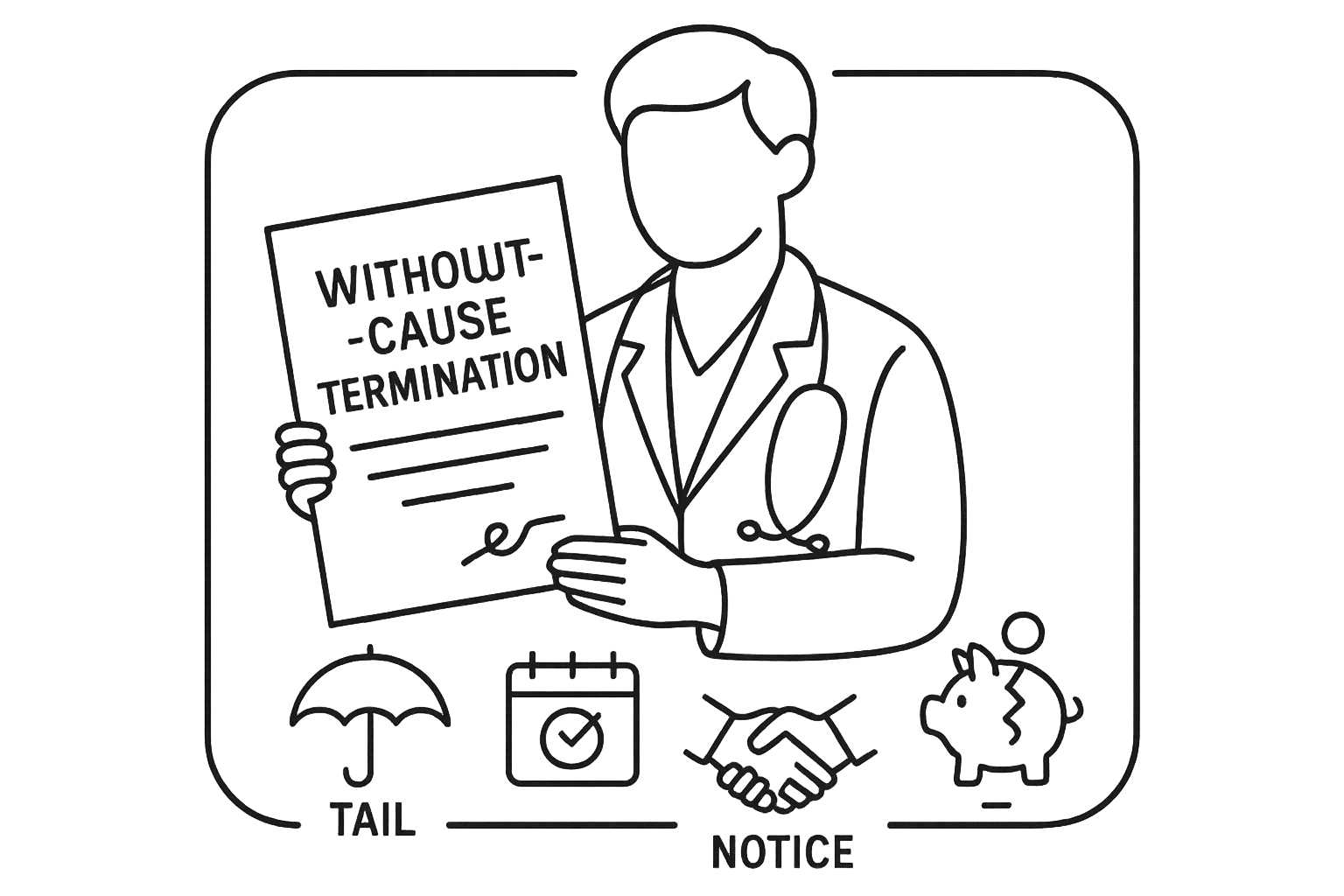
A termination provision establishes how the relationship can end, but other sections determine the practical result. A veterinarian may receive advance notice yet lose production credit immediately, remain responsible for a large bonus repayment, or become subject to a geographic restriction on the final employment date. Contract review therefore needs to trace each cross-reference, incorporated policy, and survival clause that applies after separation.
Without Cause, For Cause, At Will, and Fixed Terms
Termination without cause generally allows a party to end employment without establishing a specified breach. For-cause termination ordinarily depends on an event defined in the agreement, such as fraud, gross misconduct, loss of a required professional license, certain criminal conduct, or a serious violation of workplace obligations. Classification matters because immediate termination, severance, bonus repayment, insurance responsibility, and post-termination restrictions may change depending on the stated reason for separation.
The definition of cause deserves close attention. Objective grounds can make the provision easier to apply, while vague standards such as dissatisfaction or failure to meet unspecified expectations may give the employer substantial discretion. For issues that can be corrected, the agreement may provide written notice and a cure period. It may also identify who determines whether cause exists and whether arbitration, internal review, or another dispute procedure applies.
At-will language generally means either party can end the relationship at any time for a lawful reason, subject to applicable law and any contractual procedure. A stated one- or two-year term does not necessarily guarantee employment or compensation throughout that period. Many fixed-term agreements still contain an early without-cause termination right, so the term, renewal provision, and termination section must be reconciled rather than read separately.
Notice, Pay in Lieu, and Severance
A defined notice period can provide time to replace income, arrange insurance, transfer active cases, and search for work within any restrictive covenant. Veterinary agreements often use a written-notice period, but the appropriate duration depends on the position, local employment market, compensation model, and restrictions. The clause also needs to address whether the practice can remove the veterinarian from the schedule during notice and, if so, whether salary, expected production compensation, and benefits continue.
Pay in lieu of notice allows an employer to end active service immediately while making a contractually defined payment. The calculation may be based only on salary, or it may account for average production compensation and benefits. Severance is a separate contractual benefit and is not automatically available merely because the employer terminates without cause. If severance is offered, the agreement or separation documents may condition payment on a release of claims or compliance with continuing obligations.
Immediate termination may be appropriate for a narrow category of serious licensing, safety, or misconduct events. Overbroad cause language, however, can permit the employer to characterize a discretionary decision as cause and avoid notice, severance, tail coverage, or another benefit associated with ordinary termination. A focused review of veterinary termination provisions can identify those classification risks before the agreement is signed.
Closing Out Compensation and Benefits
The final-pay section needs to address more than the last regular paycheck. Salary, shift compensation, production credit, accrued bonuses, deductions, paid time off, retirement benefits, and repayment obligations may all follow different timelines. Federal law generally does not require an immediate final paycheck, discharge notice, or severance, according to the U.S. Department of Labor. State wage laws and the employment agreement may impose additional or stricter obligations.
ProSal, Collections, and Negative Accrual
Production compensation creates timing questions when employment ends before the normal reconciliation date. The agreement needs a workable method for crediting services performed before departure but paid or collected later. Important definitions include the measurement period, collection window, treatment of discounts and refunds, allocation of shared cases, charge adjustments, and the date on which the final calculation becomes binding.
ProSal arrangements commonly combine a guaranteed salary draw with periodic production reconciliation. Termination in the middle of a cycle can produce a dispute if the agreement does not explain whether the period is shortened, whether outstanding revenue remains attributable to the veterinarian, or whether the practice can modify its calculations after departure. A detailed veterinary compensation and ProSal review can flag definitions or unilateral adjustment rights that may reduce the final amount paid.
Negative accrual adds another layer of exposure. Contract analysis can determine whether a deficit carries into later periods, becomes immediately repayable at termination, or is forgiven when the employer ends employment without cause. The review can also evaluate any cap, lookback period, reconciliation deadline, and right to receive reports supporting the practice’s calculation. Without those details, a veterinarian may not be able to verify a post-employment demand.
Repayment Duties, PTO, and Other Benefits
Signing bonuses, relocation assistance, retention payments, student-loan support, and similar advances frequently include service-based repayment provisions. The wording may require full repayment if employment ends before a stated date, even when the employer initiates the separation. More tailored language can distinguish resignation or for-cause termination from an employer’s without-cause decision and can reduce the obligation as the veterinarian completes the required service period. Chelle Law’s bonus and repayment clause review examines those triggers and calculation methods.
Health insurance, accrued PTO, continuing-education funds, license and membership reimbursements, retirement-plan vesting, and other benefits may not all end on the same date. The governing plan documents and applicable state law can control issues that the employment agreement does not resolve. The contract can nevertheless clarify what remains available during a notice or severance period, whether approved expenses must be submitted by a deadline, and how unused allowances or PTO are treated.
Collections-based arrangements, buyout opportunities, partnership tracks, earnouts, referral compensation, relief work, and mobile-practice assignments may require additional definitions. If the agreement contains an ownership pathway, termination may affect vesting, valuation, repurchase rights, or eligibility to complete a future transaction. Those provisions need to be assessed with the termination section rather than treated as an unrelated future opportunity.
Malpractice Coverage After Employment Ends

Professional liability coverage can create a substantial post-termination expense. Occurrence coverage generally responds based on when the covered event occurred, even if a claim is reported after the policy period. Claims-made coverage generally depends on the claim being made and reported while the policy or an applicable extended-reporting period is active. Tail coverage is a common term for an extended-reporting mechanism associated with claims-made insurance.
The employment contract may assign responsibility for tail coverage, but the contract does not define the insurance protection by itself. The underlying policy, endorsements, reporting requirements, exclusions, retroactive date, consent provisions, and insurer-specific terms also need review. The National Association of Insurance Commissioners likewise distinguishes claims-made and occurrence coverage based on when the claim or covered event falls within the policy framework.
Some agreements make the veterinarian responsible for tail after every separation. Others allocate the cost according to who ends the relationship or how long the veterinarian worked for the practice. Employer-paid tail, prorated responsibility, or another arrangement may reduce the financial impact of an employer-initiated termination. A malpractice and tail insurance review can compare the contractual allocation with the policy documents that determine the actual coverage.
Restrictions That Can Affect the Veterinarian’s Next Job
A non-compete, non-solicitation clause, confidentiality provision, or restriction on outside work may survive termination regardless of which party ended the relationship. The review needs to consider duration, geographic scope, covered locations, prohibited services or species, and whether the restriction applies only where the veterinarian actually worked. Emergency care, relief shifts, specialty services, mobile work, and preexisting professional relationships may also require specific treatment.
The FTC’s 2024 nationwide non-compete rule is not currently in effect or enforceable. The agency’s current non-compete rule status page explains that a federal district court stopped enforcement and that the FTC later moved to dismiss its appeal. Veterinarians therefore should not assume that a federal rule automatically invalidates a restrictive covenant. Enforceability generally continues to depend on applicable state law, the contract’s language, and any other governing restrictions.
An employer-initiated termination does not necessarily release the veterinarian from a non-compete. The agreement can instead provide that the restriction is waived, shortened, or narrowed if the practice terminates without cause. Other possible revisions include tying the geographic area to locations where the veterinarian provided substantial services, limiting the restriction to a defined category of veterinary work, or using a client-based restriction instead of a broad prohibition on practice. A veterinary non-compete analysis can evaluate the covenant together with the termination clause and applicable jurisdiction.
Case transitions and client communications create separate concerns. The documents may address ownership and access to animal-patient records, continuity-of-care communications, return of practice property, and restrictions on contacting clients or staff. The language needs to permit lawful professional obligations without creating an unrestricted right to solicit the practice’s clients. Provisions governing public announcements, references, and statements about the departure may also affect the veterinarian’s professional reputation.
Contract Terms to Clarify Before Signing
The strongest time to address termination risk is ordinarily before the agreement is signed. Notice, compensation, insurance, repayment obligations, and restrictive covenants operate as a package, even when they appear in separate sections. A favorable notice period may offer little protection if the veterinarian loses production credit, must purchase expensive tail coverage, repays a large bonus, and cannot work nearby.
- Confirm how written notice must be delivered, when it becomes effective, and whether the employer can use pay in lieu of continued work.
- Define compensation during notice, including salary, scheduled shifts, average production pay, benefits, and approved time off.
- Identify specific for-cause events and provide a reasonable cure process for problems that can be corrected.
- Establish the final ProSal or collections measurement period, reporting rights, post-departure credit, refund treatment, and reconciliation deadline.
- Determine whether negative accrual or bonus repayment applies when the employer terminates without cause.
- Review the malpractice policy and allocate tail or extended-reporting costs for each type of separation.
- Evaluate whether non-compete and non-solicitation obligations change after an employer-initiated termination.
- Clarify case-transition duties, record access, client communications, expense submissions, and the return of practice property.
Warning signs include immediate without-cause termination without pay, vague production formulas, unlimited negative accrual, substantial repayment obligations that apply regardless of who terminates, claims-made insurance with no clear tail allocation, and a broad non-compete that remains fully effective after the practice ends employment. The presence of one provision may increase the significance of every other risk.
State law can affect final-pay timing, accrued benefits, deductions, repayment provisions, and restrictive-covenant enforceability. Veterinary licensing boards generally do not resolve ordinary private employment disputes, although allegations involving licensure, controlled substances, records, or patient care may create separate professional issues. Review therefore needs to account for the agreement’s governing law, the state where the veterinarian practices, and the actual circumstances described by the contract.
An attorney review can connect the termination mechanics to compensation, malpractice coverage, restrictive covenants, repayment exposure, and any ownership opportunity. The objective is to identify ambiguity, explain practical consequences, and determine which provisions may warrant clarification or revision before the veterinarian accepts the position.
Frequently Asked Questions
What does termination without cause mean for a veterinarian’s income?
The employer may end employment without alleging a defined breach, potentially interrupting salary, ProSal, or another production formula during a measurement period. The contract needs to explain notice or pay in lieu, compensation during notice, post-departure collections, final reconciliation, and any negative-accrual obligation.
Does a fixed contract term guarantee employment for the entire term?
Not necessarily. A one- or two-year agreement may still permit either party to terminate early without cause after giving the required notice. The term, renewal language, early termination rights, and any guaranteed compensation must be read together.
Can a veterinarian receive production credit after leaving the practice?
That depends on the compensation language and applicable law. The agreement can define whether services performed before departure remain eligible for credit when payment is collected later, how refunds and adjustments are handled, and when the practice must complete the final calculation.
Who pays for malpractice tail coverage after termination?
The contract may assign the cost to the employer, the veterinarian, or both, but the actual need for extended-reporting coverage depends on the policy. The claims-made policy, retroactive date, endorsements, reporting rules, and insurer terms must be reviewed along with the employment agreement.
Does an employer’s without-cause termination cancel a veterinary non-compete?
Not automatically. The covenant may continue unless the contract provides otherwise or applicable state law limits it. The FTC’s nationwide non-compete rule is not currently enforceable, so the agreement and jurisdiction-specific law remain important.
When is attorney review of a veterinary termination clause especially important?
Review is particularly useful when the agreement includes ProSal, negative accrual, claims-made insurance, a broad restrictive covenant, substantial bonus or relocation repayment, an unclear cause definition, or an ownership opportunity. These provisions can compound the financial and professional consequences of termination.
Have Your Veterinary Termination Terms Reviewed Before You Sign
Chelle Law can evaluate how termination without cause affects compensation, malpractice coverage, repayment obligations, restrictive covenants, and the transition to your next position.
Contact Chelle Law