

A veterinary offer letter often arrives as the welcome end to a long job search, but it is also the first document that may commit the parties to important employment terms. The letter may identify compensation, benefits, scheduling, bonuses, work locations, and a potential ownership path. It may also incorporate policies or anticipate a longer employment agreement that contains restrictions and obligations not mentioned in the initial offer.
The risk is not limited to an obviously unfavorable salary. Undefined production formulas can reduce expected earnings, bonus language can create substantial repayment liability, and a broad non-compete can affect where the veterinarian works after departure. Malpractice insurance, notice requirements, exclusivity, liquidated damages, multiple-location assignments, and ownership promises can create additional exposure when the documents are incomplete or inconsistent.
Chelle Law reviews veterinary offer letters together with the proposed employment agreement, compensation plan, benefit materials, bonus addenda, and other incorporated documents. That comparison helps identify missing definitions, conflicting promises, financial obligations, and provisions that may warrant clarification or revision before acceptance. The goal is to understand the complete employment package rather than relying on the headline salary or an informal recruiting conversation.
Key Terms to Check Before Accepting a Veterinary Offer
- Determine whether base compensation is guaranteed pay or a draw that can be reconciled against future production.
- Request complete definitions, sample calculations, payment dates, and negative-accrual rules for ProSal or other production compensation.
- Review non-compete, non-solicitation, confidentiality, exclusivity, and outside-work restrictions under the law governing the agreement.
- Identify the malpractice policy type, retroactive date, reporting requirements, coverage limits, defense terms, and responsibility for extended reporting coverage.
- Connect termination events to final compensation, bonus repayment, liquidated damages, insurance obligations, and post-employment restrictions.
- Reduce material ownership, scheduling, location, benefit, and professional-autonomy promises to clear written terms.
Why the Offer Letter and Employment Agreement Must Be Read Together
An offer letter may be brief, but brevity does not make it unimportant. Depending on its language and the governing law, the letter may create obligations, establish agreed terms, or become part of the final employment arrangement. Statements that the offer is contingent, subject to later documentation, or nonbinding require careful attention because they may leave important business terms open even after the veterinarian signs.
The longer employment agreement may change or qualify the initial offer. A letter might describe a “guaranteed salary,” while the compensation exhibit treats the same amount as a recoverable draw. It might promise a signing bonus without identifying repayment triggers, or mention partnership without committing the practice to an eligibility date, valuation method, or available equity percentage. An integration clause in the final agreement may also state that prior communications and promises no longer control.
Review should therefore cover every document referenced by the offer, not merely the signature page. Compensation plans, employee handbooks, benefit summaries, restrictive-covenant exhibits, professional liability policies, ownership materials, and incentive addenda can materially change the economic value of the position. If a document will govern compensation or create an obligation, it is better to obtain and evaluate it before accepting the offer than to rely on a promise that details will be supplied later.
Current veterinary contract education also identifies exclusivity and liquidated-damages provisions as issues that deserve separate attention. Exclusivity can prevent relief work, teaching, consulting, telemedicine, or other professional activity even when it does not compete with the practice. A liquidated-damages clause may impose a stated payment after a breach or early departure, so it must be evaluated alongside ordinary repayment provisions, termination rights, and restrictive covenants rather than treated as boilerplate.
Compensation, Benefits, and Repayment Terms
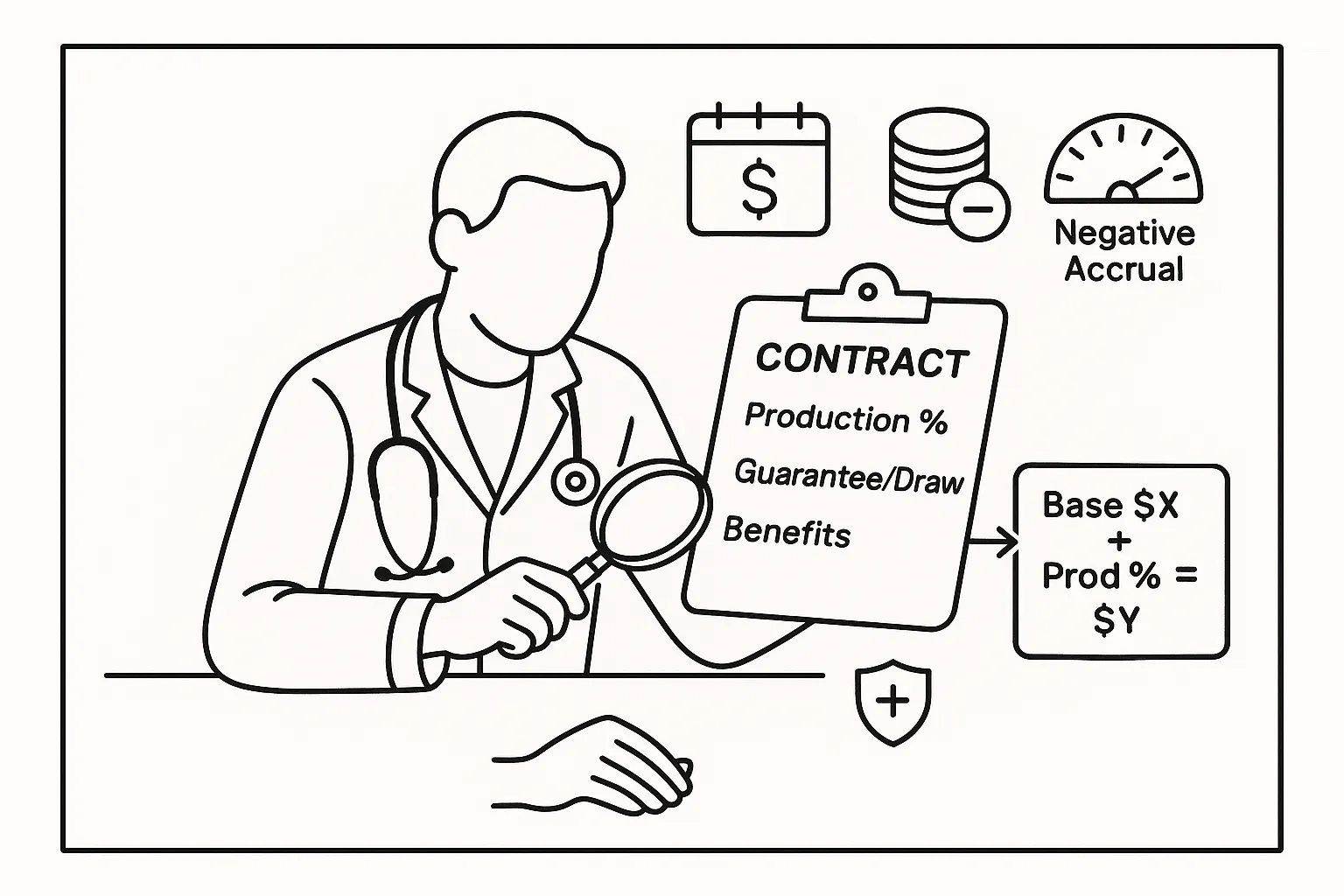
Compensation language must explain more than the annual salary or production percentage. A useful review follows the money from the services performed through the practice’s accounting system and into the veterinarian’s paycheck. It also identifies circumstances in which the employer can offset, recoup, delay, or withhold an amount. Chelle Law’s veterinary compensation and ProSal review focuses on these definitions and the way they interact with termination and repayment provisions.
ProSal, Production Credit, Draws, and Negative Accrual
A ProSal or production model may combine base pay with a percentage of production or collections, but the label alone does not explain how earnings are calculated. The documents need to define the revenue credited to the veterinarian and identify permitted reductions. Discounts, refunds, write-offs, laboratory expenses, medications, support costs, uncollected accounts, and shared procedures can all affect the result when the formula gives the practice discretion to make adjustments.
Payment timing is equally important. A collections-based formula may delay credit until the practice receives payment, while a production-based formula may assign credit when the service is performed or invoiced. The agreement can clarify how responsibility is allocated when multiple veterinarians participate in treatment, when an associate leaves before payment arrives, or when revenue is collected after the final day of employment. A written example showing the percentage, exclusions, reconciliation period, and payment date often exposes ambiguities that are easy to miss in a short formula. The firm’s guide to veterinary production compensation discusses these calculations in greater detail.
The stated base may be a true guarantee or an advance against future production. If it functions as a draw, important questions include whether deficits carry forward, how frequently reconciliation occurs, whether interest or administrative charges apply, and whether the employer may deduct a balance from wages or final compensation. Negative accrual can cause one low-production period to reduce later earnings. The documents can address whether deficits expire, whether carry-forward balances are capped, and what happens to any negative amount when employment ends.
Bonuses, PTO, Insurance Benefits, and Financial Clawbacks
Signing, relocation, retention, and student-loan payments commonly depend on continued employment for a stated period. The repayment provision needs to identify the triggering events, the amount due at each stage, the deadline for repayment, and any wage-deduction authorization. It should also distinguish resignation from termination without cause, disability, a delayed start date, a practice sale, or an employer breach. A prorated obligation may produce a substantially different result from a clause requiring full repayment until the final day of the commitment period. A focused review of veterinary bonus and repayment terms can identify those differences.
Performance bonuses also require measurable standards. The documents can specify what the bonus rewards, who calculates it, the measurement period, when the amount is paid, and whether the veterinarian must remain employed on the payment date. If management can modify targets during the year or exclude categories of revenue without objective limits, an attractive bonus may be difficult to earn or verify.
Benefit summaries deserve the same attention as cash compensation. Review the effective date and employee contribution for health coverage, PTO accrual and scheduling rules, treatment of unused leave at departure, continuing-education allowances, retirement eligibility, employer-match vesting, and payment of licensing or registration expenses. A benefit described as “available” may remain subject to a handbook or plan document, so the offer should not be evaluated without the controlling materials when the benefit materially affects the decision.
The complete economic package also includes commuting expenses, required travel, insurance contributions, continuing-education costs, unpaid call, and the local cost of living. A higher nominal salary may not produce a better financial result if the position imposes unreimbursed expenses or provides fewer benefits. Comparisons are most useful when they use the same assumptions for schedule, production opportunity, benefits, and repayment exposure.
Restrictions and Professional Liability Coverage

Restrictive covenants and malpractice provisions allocate risk beyond the first day of employment. They can limit future work, regulate communications with clients and staff, control outside professional activity, and create insurance costs after departure. These terms belong in the initial assessment of the offer rather than being deferred as standard language in the final contract.
Non-Competes, Non-Solicitation, Confidentiality, and Exclusivity
Non-compete enforceability depends heavily on the governing state’s statutes, regulations, and case law, as well as the wording and facts surrounding the agreement. The Federal Trade Commission confirms that its 2024 Noncompete Rule is not in effect and is not enforceable following the August 20, 2024 federal court order and later appellate developments. That means the rule is not an operative nationwide ban. State-law analysis remains essential, while separate federal enforcement may still address particular employers or restrictive practices.
A veterinary non-compete requires analysis of the prohibited activities, duration, geographic scope, covered facilities, and events that trigger the restriction. A provision tied to every location owned or later acquired by a corporate group can create a much larger exclusion area than a restriction based on the associate’s actual work sites. The language may also reach relief work, telemedicine, research, teaching, industry positions, or specialty services that do not compete directly with the former employer. A veterinary restrictive-covenant review can evaluate the practical reach of these terms under the applicable law.
Non-solicitation provisions may cover clients, employees, referral sources, or vendors, but the definitions and restricted conduct should be clear. Confidentiality language can protect legitimate proprietary information without being drafted so broadly that it obstructs lawful compensation discussions, regulatory reporting, or communications with professional advisers. Exclusivity and moonlighting clauses deserve separate review because they can prohibit outside work during employment even when no post-employment non-compete applies.
Claims-Made, Occurrence, and Extended Reporting Coverage
Professional liability coverage cannot be evaluated from the policy label alone. Occurrence coverage generally responds to covered events that take place during the policy period, even when the claim is reported later. Claims-made coverage generally depends on a claim being made and reported during the active policy period or an applicable extended reporting period, subject to the policy’s retroactive date and other terms. The National Association of Insurance Commissioners’ coverage overview provides additional context for these distinctions.
For claims-made coverage, the review should identify the retroactive date, reporting requirements, limits, exclusions, and availability of prior-acts or extended reporting coverage. The documents can also address whether defense expenses reduce the available limit, who controls defense and settlement decisions, and whether independent counsel is available when interests conflict. Tail coverage is not automatically required in every arrangement; the answer depends on the policy, reporting terms, replacement coverage, and circumstances of departure.
If an extended reporting endorsement may be necessary, the agreement needs to allocate responsibility for obtaining and paying for it. That allocation may differ depending on resignation, termination without cause, termination for cause, disability, retirement, a practice sale, or the employer’s decision to change insurers. The cost can vary by insurer and coverage terms, so unsupported estimates are less useful than obtaining the actual policy information. Chelle Law’s malpractice and tail insurance review examines these provisions together with the employment agreement.
Termination, Notice, and Post-Employment Financial Exposure
Termination language determines how the relationship ends and often activates other provisions throughout the contract. A for-cause clause may affect bonus repayment, tail responsibility, severance, restrictive covenants, and unpaid production. Objective definitions are easier to evaluate than language allowing immediate termination whenever the employer is dissatisfied. When a problem can reasonably be corrected, written notice and a defined cure period may provide a meaningful opportunity to address it.
Without-cause termination permits departure without proving a breach, but the notice period must be considered in practical terms. The agreement may allow the practice to remove the veterinarian from the schedule, restrict access to clients, reduce production opportunities, or continue base pay without incentive compensation. It may also require the associate to keep working while allowing the employer to accelerate the departure date. A veterinary termination review can trace how the notice clause affects compensation and other exit obligations.
Final-pay provisions need to address production or collections received after departure, unused PTO where applicable, approved expenses, bonuses already earned, and any asserted draw balance. Repayment provisions for signing incentives, relocation expenses, student-loan assistance, or training costs should be read together rather than in isolation. A liquidated-damages clause may create an additional stated payment, while a wage-deduction authorization may give the practice a mechanism to recover amounts directly from final compensation, subject to applicable law.
Post-employment duties may include returning property, transferring records, preserving confidentiality, cooperating with claims, and completing client transitions. These obligations need reasonable boundaries, particularly when cooperation is open-ended or unpaid. Severance language should identify the amount, payment schedule, conditions, and any release the veterinarian must sign. The exit provisions are most useful when they establish a predictable process rather than leaving material financial decisions to unilateral discretion after notice is given.
Scheduling, Locations, Outside Work, and Clinical Autonomy
Operational provisions can shape the veterinarian’s daily experience more than the annual compensation figure. The offer and agreement can define regular workdays, shift length, appointment expectations, emergency coverage, weekend rotations, on-call responsibilities, and relief assignments. When compensation depends on production, it is important to understand who controls staffing, appointment volume, pricing, discounts, equipment, and support resources. A production target may be unrealistic if the practice controls the conditions needed to reach it.
Multi-location language requires particular care. The documents can identify primary and secondary sites, maximum routine travel, scheduling notice, mileage reimbursement, and whether travel time affects compensation. Broad authority to assign the veterinarian to any present or future facility may substantially alter commuting time and expose the associate to additional non-compete radii. The veterinary schedule and call-duty guide outlines related questions for flexible or rotating assignments.
Outside-work restrictions may apply to relief shifts, teaching, consulting, volunteer activities, industry work, or a side business. The agreement should distinguish genuine conflicts from activities that do not compete with the employer or interfere with the schedule. Any approval requirement needs a workable process rather than unlimited discretion to reject outside activity for an unrelated reason.
Professional-autonomy provisions can explain how clinical decisions, quality concerns, productivity expectations, and performance reviews interact. The practice may use objective performance standards and documented corrective processes without allowing revenue goals alone to dictate medical judgment. The documents can also identify who pays for veterinary licenses, controlled-substance registrations when applicable, specialty credentials, required renewals, and continuing education.
Evaluating a Practice Buy-In or Ownership Promise
A future ownership opportunity may be a major reason to accept a position, but phrases such as “potential partnership,” “may be offered equity,” or “subject to approval” do not establish a binding transaction. If ownership is material to the decision, the documents should distinguish a genuine commitment from an aspirational recruiting statement. Important terms include the anticipated timeline, eligibility milestones, available ownership percentage, approval process, valuation method, and documents required to complete the purchase.
Valuation may rely on an earnings multiple, EBITDA, an independent appraisal, or another agreed method. The veterinarian also needs to understand required capital contributions, financing, voting rights, distributions, additional capital calls, dilution, financial reporting, and tax treatment. The value of an ownership interest can be reduced by mandatory buyout provisions, opaque accounting, or a repurchase formula that differs substantially from the original purchase method.
Exit rights are as important as the initial buy-in. The governing documents can address death, disability, termination of employment, voluntary sale, practice acquisition, and disputes among owners. They may also establish preemptive rights, transfer restrictions, valuation procedures, and payment terms for a repurchase. Veterinarians comparing employment with an equity opportunity can use Chelle Law’s overview of veterinary practice ownership pathways to identify issues that require further documentation.
A promised buy-in also needs to be reconciled with the restrictive covenants. The veterinarian should understand whether restrictions become broader after acquiring equity, whether the employer can delay the transaction indefinitely, and what happens if employment ends shortly before eligibility. When essential ownership terms remain unresolved, the offer should not assign the same value to the promise as it would to a completed or enforceable ownership arrangement.
A Practical Review Process Before Signing
Begin by collecting every document referenced in the offer. Compare the offer letter, employment agreement, compensation exhibit, bonus terms, benefit materials, handbook provisions, insurance information, and any ownership documents. Mark terms that differ across documents and identify subjects that were discussed during recruitment but do not appear in writing.
Next, test the agreement against realistic scenarios. Calculate compensation during a strong month and a slow month, then consider what happens during leave, a schedule reduction, or the notice period. Trace the financial outcome if the veterinarian resigns, is terminated without cause, cannot begin on time, or leaves before a bonus commitment ends. Map every non-compete radius to the facilities that could trigger it, and determine whether a work-location clause can expand that map after signing.
Finally, separate material issues from ordinary preferences. Compensation definitions, repayment exposure, insurance obligations, termination rights, restrictive covenants, exclusivity, liquidated damages, and ownership promises can have lasting financial or professional consequences. Clear drafting does not guarantee that every term will favor the associate, but it allows the veterinarian to make an informed decision and identify provisions that warrant discussion before accepting the position.
Frequently Asked Questions
Is a veterinary offer letter binding before the employment agreement is signed?
It depends on the letter’s language, the parties’ conduct, and the governing law. Provisions describing the offer as contingent or nonbinding may affect the analysis, while accepted terms can still carry practical or legal significance. Review the letter before signing and compare it with the final employment agreement.
What details are commonly missing from a veterinary production-pay offer?
Common omissions include the definition of credited production or collections, permitted deductions, allocation of shared services, reconciliation timing, payment dates, treatment of post-departure collections, and negative-accrual rules. A sample calculation can reveal how the stated percentage operates in practice.
Does the FTC rule prohibit veterinarian non-competes nationwide?
No. The FTC’s 2024 Noncompete Rule is not in effect and is not enforceable following a federal court order and subsequent appellate developments. Veterinary non-competes still require analysis under the governing state law, the agreement’s wording, and the specific employment circumstances.
When might a veterinarian need tail or extended reporting coverage?
Extended reporting coverage may be relevant when claims-made coverage ends and replacement coverage does not protect the same prior acts. The answer depends on the policy period, retroactive date, reporting requirements, prior-acts coverage, and departure circumstances. The agreement should identify who evaluates, obtains, and pays for any required coverage.
What is the difference between bonus repayment and liquidated damages?
Bonus repayment generally requires the veterinarian to return an identified incentive after a stated event, such as leaving before a commitment period ends. Liquidated damages impose a predetermined amount for a specified breach. Both provisions need to be evaluated with termination rights, wage-deduction language, and applicable law.
When should a veterinarian obtain attorney review of an offer?
Review is most useful before the offer letter or employment agreement is signed. It is particularly important when the package includes ProSal, negative accrual, repayment obligations, restrictive covenants, exclusivity, claims-made insurance, multiple locations, liquidated damages, or a practice-ownership promise.
Have Your Veterinary Offer Reviewed Before You Sign
Chelle Law reviews veterinary offer letters and employment agreements for compensation, repayment exposure, restrictive covenants, insurance obligations, termination terms, scheduling provisions, and ownership promises.
Contact Chelle Law