

Veterinary on-call work can involve several distinct obligations: remaining available outside regular hours, answering client or staff calls, reviewing records remotely, traveling to a hospital, treating an emergency case, and completing follow-up documentation. A compensation provision may pay for those obligations through a fixed availability stipend, hourly or premium call-back pay, production credit, or a blended formula. Unless the contract defines both the work and the payment method, the veterinarian may not know what a call shift is worth until after the schedule begins.
The financial issue is only one part of the analysis. Call coverage can affect personal time, response expectations, travel between hospitals, eligibility for production credit, professional liability exposure, and the ability to perform future emergency or relief work. Wage-and-hour rules may also distinguish relatively unrestricted off-premises availability from waiting time that is so restricted it becomes compensable. Employee classification, state law, and the practical limitations imposed during the shift all matter.
Chelle Law reviews on-call provisions as part of the complete veterinary agreement rather than treating the stipend or hourly rate as a stand-alone term. That analysis can identify undefined duties, discretionary compensation formulas, incomplete production attribution rules, multi-location obligations, insurance gaps, tail exposure, and separation provisions that change the value of the arrangement. The goal is to understand what the veterinarian must do, how each category of work is credited, and what happens when the schedule, compensation plan, or employment relationship changes.
Key Terms to Clarify Before Accepting Veterinary Call
- Separate standby availability from telephone triage, remote clinical work, call-back travel, in-clinic treatment, and required follow-up.
- State the stipend, hourly or premium rate, minimum call-back payment, production credit, and reconciliation process in writing.
- Define response times, call frequency, support staffing, covered locations, schedule changes, cancellations, travel reimbursement, and PTO coverage.
- Identify the insured parties, covered services and locations, policy form, defense obligations, exclusions, and responsibility for any tail coverage.
- Evaluate termination, repayment, noncompete, nonsolicitation, and no-hire provisions together with the call requirement.
Defining On-Call Work and Compensable Time
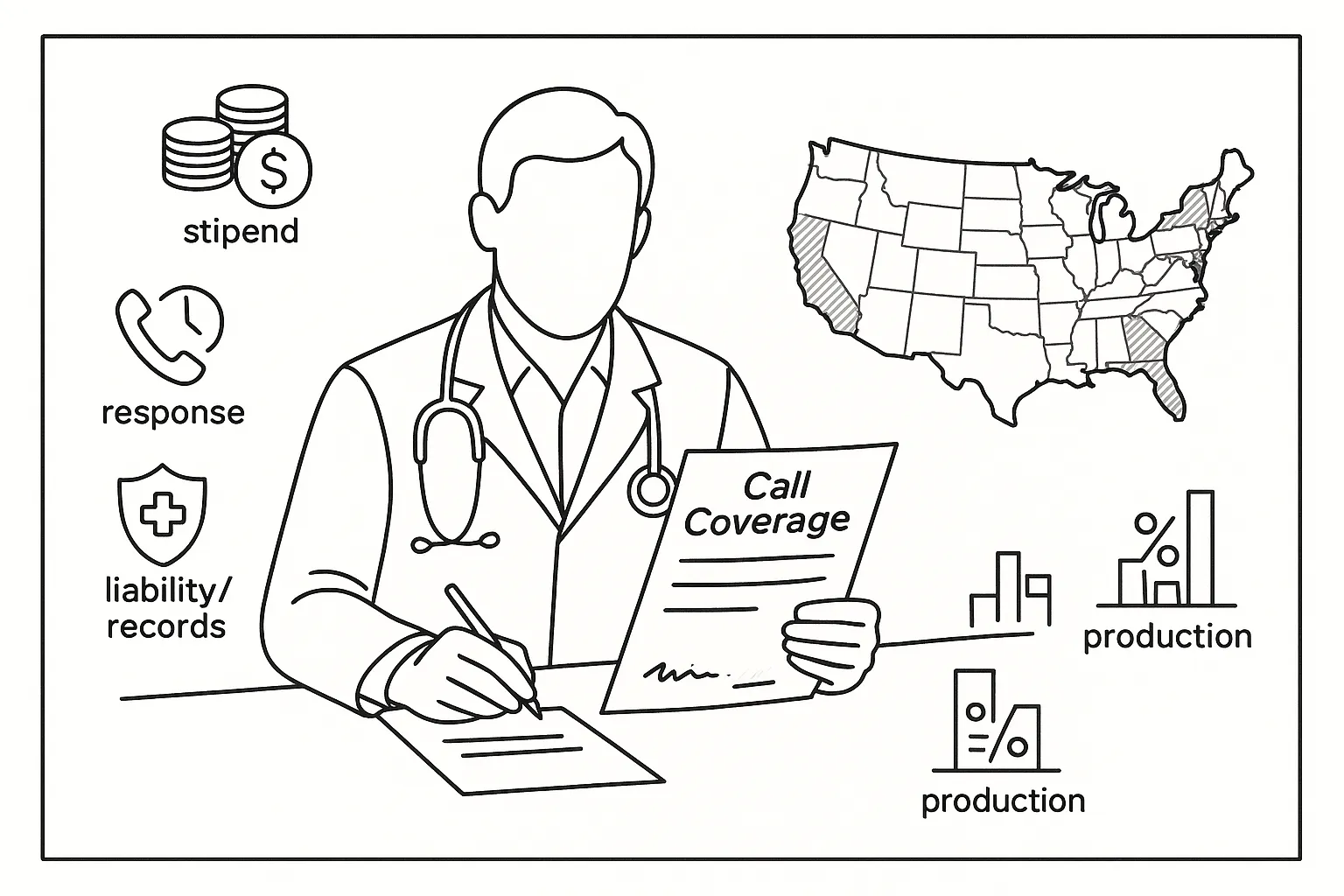
“On call” is not a complete description of the veterinarian’s responsibilities. One practice may use the term for carrying a phone while remaining free to pursue personal activities. Another may require the veterinarian to stay within a short radius, respond within minutes, monitor messages throughout the night, or report to one of several hospitals. The agreement can distinguish passive availability from actual work by identifying the call period, required response method, triage process, escalation procedure, support staff, and clinical or administrative tasks expected after a case is received.
Federal wage-and-hour guidance also makes that distinction important. Under the U.S. Department of Labor’s hours-worked guidance, off-premises availability is generally not work time when the employee can use the period effectively for personal purposes. Restrictions involving response time, geography, call frequency, required presence, or similar conditions can produce a different result. Time spent answering work calls, performing remote tasks, returning to the clinic, treating patients, and completing required records may constitute work time for a covered nonexempt employee.
A stipend does not, by itself, resolve minimum-wage or overtime questions. The analysis depends on the veterinarian’s employee classification, compensation structure, actual duties, applicable exemptions, and state law. A contract therefore benefits from a reliable time-recording process even when availability is paid through a flat amount. The language can explain when call-back time begins, whether remote work must be logged, how interrupted periods are recorded, and when the shift ends.
Operational details matter as much as legal labels. The provision can identify who initially screens a request, whether a technician or receptionist remains available, which communications may be handled remotely, and when an in-person examination is required. It can also address record completion, client updates, hospitalized-patient monitoring, next-day handoff, and follow-up treatment. Chelle Law’s guide to veterinary schedules and call duties provides additional context for how after-hours obligations interact with the veterinarian’s regular schedule.
How Veterinary Call Compensation Can Be Structured

Practices generally compensate call through an availability stipend, payment for actual time worked, production or collections credit, or some combination of those approaches. Each model allocates workload risk differently. A fixed stipend gives the veterinarian predictable pay but may become inadequate when call volume increases. An hourly model follows time more closely but requires clear timekeeping. Production compensation can reward clinical activity, although its value depends heavily on attribution, exclusions, collection delays, and reconciliation rules.
There is no reliable national call-pay figure that can be separated from the underlying job. The AVMA’s 2026 economic report notes that veterinary compensation and practice economics vary materially by geography and practice type, while recent compensation growth has slowed. A proposed call rate is more useful when compared with expected frequency, emergency intensity, response restrictions, staffing, travel, ordinary salary, production opportunity, and the complete benefits package.
Availability Stipends and Call-Back Pay
A flat stipend usually compensates the veterinarian for accepting a designated call period, whether or not a patient ultimately needs treatment. This approach is administratively simple and may be reasonable for low-volume coverage. Its weakness is that the same payment may apply to a quiet evening and a shift involving repeated calls, travel, procedures, client communications, and extensive records. The contract can avoid that ambiguity by stating whether the stipend buys availability only or also includes a defined amount of active work.
A blended structure may provide a stipend for remaining available plus hourly, premium, or minimum call-back pay when active work begins. Important terms include the applicable call period, payment timing, minimum increment, rate for remote services, and whether a return to the hospital triggers a guaranteed number of paid hours. If the veterinarian reports more than once, the language can explain whether each trip qualifies for a separate minimum.
Travel provisions require the same precision. The agreement can address mileage, drive time, parking, tolls, and trips between employer locations. It can also explain whether the veterinarian may be sent to a hospital outside the original assignment and what happens if multiple facilities request assistance simultaneously. References to overtime or premium pay must be evaluated under the veterinarian’s classification and applicable law rather than assumed to apply merely because the work occurs at night or on a weekend.
Production, Collections, and ProSal Credit
Production-based call compensation may credit the veterinarian for services rendered during an emergency case. The formula can use gross production, adjusted production, or collected revenue, and those terms are not interchangeable. The contract or incorporated compensation plan may need to identify which examinations, diagnostics, procedures, medications, hospitalization charges, and support-staff services count toward the veterinarian’s total. The distinction is explained further in the veterinary production pay resource.
Shared cases create a common attribution problem. An overnight veterinarian may stabilize a patient, while another associate performs a later procedure or receives the account’s production credit. The documents can establish how revenue is divided when several veterinarians participate, when a technician performs a service under supervision, or when a case transfers to the daytime team. Refunds, discounts, uncollectible accounts, prescription revenue, bundled charges, and client payment plans may also affect the calculation.
Transparent reporting is essential when call pay depends on production or collections. The veterinarian needs enough information to verify case attribution, excluded charges, adjustments, and reconciliation. Monthly and quarterly reconciliations can produce different cash-flow results, particularly when collections arrive after the service date. The agreement can also address access to reports after separation so the departing veterinarian can confirm a final payment.
Negative accrual can make call compensation especially difficult to evaluate. If the veterinarian misses a production threshold, the employer may carry the deficit into a later period and offset otherwise payable compensation. Contract analysis can determine whether deficits carry forward, whether there is a cap, when an account resets, and how a remaining deficit is handled at termination. A focused review of veterinary compensation and ProSal terms can identify whether call activity receives the credit the parties expect.
Scheduling, Cancellations, and Multi-Hospital Coverage
The value of call pay depends partly on how much control the veterinarian gives up. A relatively modest stipend can carry a significant personal cost if the veterinarian must remain close to the hospital, cannot consume alcohol, must arrange dependent care, or cannot accept other professional work. The contract can make that burden measurable by stating expected call frequency, maximum consecutive shifts, weekend and holiday rotation, response time, and the process for changing the schedule.
Advance notice and cancellation rules affect predictability. If the veterinarian reserves a weekend and the practice cancels coverage at the last minute, a minimum cancellation payment may protect some of the lost opportunity. Conversely, the employer may want a defined process for emergency substitutions. The agreement can describe who may approve a shift exchange, how much notice is required, whether approval may be withheld, and who remains responsible if the replacement does not report.
PTO provisions should be read alongside call language. Some agreements require associates to arrange their own call replacement before using already approved leave, while others allow the practice to manage the rotation. Questions include whether PTO days reduce call obligations, whether the veterinarian must cover extra shifts after returning, and whether scheduled call affects the amount of leave charged. These rules can materially alter the practical value of the stated PTO benefit.
Location Limits and Unilateral Schedule Changes
Multi-hospital groups may use broad assignment language that permits work at any current or future facility. For call coverage, that clause can expand travel distance, shorten the veterinarian’s effective response window, and create overlapping demands. More specific language may identify the regular facility, permitted additional locations, geographic limits, mileage or travel reimbursement, and the notice required before an assignment changes.
The documents may also reserve authority to alter schedules, call frequency, or compensation through a handbook or policy. Incorporated documents deserve the same attention as the signed agreement. The review can determine whether the employer may amend them unilaterally, whether notice is required, whether the veterinarian can terminate if a material change occurs, and which document controls if the provisions conflict.
State veterinary-practice and corporate-practice rules can affect which entity employs the veterinarian, controls clinical work, sets compensation, or provides management services. Those rules are state-specific and cannot be inferred from the name of a parent company or management organization. The contract parties, compensation source, scheduler, insurance provider, and entity directing medical decisions therefore need to be evaluated in the jurisdiction governing the relationship.
Professional Liability Protection for After-Hours Care
Emergency and after-hours work may involve incomplete histories, limited staffing, unfamiliar clients, and compressed decision-making. The employment agreement and insurance documents can identify whether the veterinarian, practice, or both are insured; which facilities and professional services are covered; and whether protection extends to remote advice, telephonic triage, off-site services, and work performed at an affiliated location. Coverage should not be assumed merely because the practice ordinarily provides liability insurance as an employee benefit.
Defense and indemnification language is also important. The agreement may address who selects counsel, controls the defense, pays deductibles, handles settlement decisions, and responds to a claim made after the veterinarian leaves. Exclusions for unauthorized services, conduct outside the scope of employment, or work at an unlisted location may affect call coverage. Cooperation duties can continue after separation and may require the veterinarian to assist with records, interviews, hearings, or litigation.
The policy form determines whether post-employment protection may be necessary. An occurrence policy generally responds according to when the incident occurred, even if the claim is reported later. A claims-made policy generally requires coverage to be active when the claim is made, potentially creating a need for an extended reporting endorsement, often called tail coverage. The claims-made versus occurrence guide explains the distinction and why the policy documents matter.
Tail coverage may be a substantial separation expense, depending on the policy and coverage history. The agreement can allocate that cost based on whether the veterinarian resigns, the employer terminates without cause, the contract expires, or the parties mutually end the relationship. It may also use a tenure-based formula or require the veterinarian to reimburse the employer. A veterinary malpractice and tail review can flag an obligation that might otherwise become apparent only after notice is given.
Termination, Future Work, and Restrictive Covenants
Call provisions continue to matter when employment ends. The contract may require a lengthy notice period while allowing the employer to remove scheduled call shifts, reduce production opportunities, or change assignments. That imbalance can reduce expected compensation during the final months of employment. The agreement can also address final production reconciliation, collections received after departure, incomplete records, pending cases, client handoffs, and payment for any transition work.
Post-employment obligations benefit from a defined endpoint. Open-ended requirements to answer client questions, remain available to the practice, or complete unpaid administrative work can create uncertainty after the veterinarian’s final day. If transition assistance is required, the provision can specify its duration, scope, scheduling process, compensation, and relationship to the final paycheck or bonus reconciliation.
Noncompete enforceability remains primarily dependent on applicable state law and the agreement’s wording. The FTC’s federal noncompete rule status page states that the nationwide rule is not in effect or enforceable following the relevant federal court order. Veterinary associates therefore should not assume that a federal rule automatically invalidates their restrictions. Governing law, venue, duration, geography, restricted activities, actual work locations, and available remedies all require separate analysis.
A restriction covering every hospital in a corporate network can be especially burdensome when the veterinarian worked at only one or two locations. Emergency, urgent-care, relief, and locum work may also fall within broad definitions of competition. Potential revisions can tie the restricted area to facilities where the veterinarian actually practiced, exclude locations opened after signing, narrow the duration or services covered, and create an appropriate exception for temporary or noncompetitive work. Chelle Law’s veterinary noncompete review evaluates those provisions in light of the contract and governing law.
Nonsolicitation, no-hire, confidentiality, liquidated-damages, and repayment provisions may restrict mobility even when a traditional noncompete is narrow or unavailable. Compensation coordination between competing practices presents a different issue. The 2025 federal worker-antitrust guidance addresses wage fixing, exchanges of compensation information, no-poach arrangements, and other worker-mobility restrictions. Competing veterinary businesses should independently determine call rates and hiring practices rather than coordinate pay or relief-work opportunities.
Contract Review Priorities and Common Red Flags
A useful review begins with the operational facts. The veterinarian can ask how often associates take call, how many calls typically require a clinic visit, which locations are included, how frequently the schedule changes, and what technical or administrative support remains available. Those answers allow the written rate to be evaluated against the actual burden rather than against the word “stipend” alone.
Important terms to examine include:
- A precise definition of availability, remote work, telephone triage, call-back travel, on-site treatment, documentation, and follow-up.
- Numeric compensation terms identifying the stipend, hourly or premium rate, minimum call-back payment, production percentage, and payment date.
- Timekeeping requirements and wage-and-hour treatment based on the veterinarian’s classification and applicable law.
- Production attribution for diagnostics, medications, procedures, shared cases, support-staff services, refunds, discounts, and collections.
- Call frequency, response times, schedule notice, cancellations, shift exchanges, PTO interaction, covered facilities, and travel reimbursement.
- Insurance coverage, defense and indemnification, policy form, exclusions, settlement control, and responsibility for tail coverage.
- Notice periods, final compensation, post-employment assistance, repayment terms, and restrictions affecting emergency or relief work.
Common red flags include language allowing unlimited call without additional compensation, a rate that can be changed later through policy, and production compensation without access to supporting reports. Other concerns include uncapped negative accrual, no minimum payment for active call-back work, mandatory coverage at unidentified facilities, uncompensated travel, and the ability to cancel or reassign shifts without notice. An insurance clause may also be incomplete if it promises “malpractice coverage” without identifying the policy form, covered parties, locations, exclusions, or tail responsibility.
The exit provisions can magnify those risks. A long notice period may become expensive if call shifts disappear, while bonus repayment or tail costs can make departure financially difficult. Broad restrictions may then limit the veterinarian’s ability to replace the lost income with emergency or relief work. A review of veterinary termination terms can show how notice, compensation, repayment, insurance, and restrictive covenants operate together.
Possible revisions need to fit the actual agreement and governing law. Depending on the arrangement, useful concepts may include separate pay for availability and active work, a minimum call-back amount, defined production categories, regular reporting, a limit on negative accrual, geographic boundaries for additional locations, and different tail allocations for resignation and termination without cause. Even a narrow clarification can prevent a larger dispute when call volume, ownership, staffing, or scheduling practices change.
Frequently Asked Questions
Is all veterinary on-call time compensable work time?
Not necessarily. Relatively unrestricted off-premises availability may not count as hours worked under federal law, while tight response times, geographic limits, frequent calls, or other substantial restrictions may support a different result. Active remote work, clinic work, and required call-back travel may be compensable, subject to classification and applicable federal and state law.
Can a veterinarian receive both a call stipend and additional call-back pay?
Yes. A contract may provide a fixed stipend for availability and separate hourly, premium, minimum, or production-based compensation when the veterinarian performs active work. The agreement should state what the stipend includes and identify the event that triggers additional payment.
How should ProSal credit for emergency call cases be calculated?
The formula should identify whether compensation uses production, adjusted production, or collections and which services and charges are credited to the veterinarian. It should also address shared cases, discounts, refunds, collection delays, reporting, reconciliation, and any negative accrual.
What should a contract say about call at multiple veterinary hospitals?
The contract can identify the covered facilities, geographic limits, response expectations, advance notice, mileage, drive-time treatment, and procedures for overlapping requests. Open-ended authority to assign call at any current or future location may materially increase the veterinarian’s workload and travel burden.
Who pays for veterinary malpractice tail coverage after employment ends?
Responsibility depends on the policy form and contract language. The agreement may assign the cost to the practice, veterinarian, or both and may use different rules for resignation, termination without cause, contract expiration, tenure, or another separation event.
Can a noncompete restrict emergency, relief, or locum veterinary work?
A broadly worded restriction may cover emergency, urgent-care, relief, or locum services, depending on its language and governing state law. The current federal FTC rule does not automatically invalidate veterinary noncompetes, so the restricted activities, locations, duration, remedies, and related nonsolicitation or no-hire clauses require individual review.
Have Your Veterinary Call Terms Reviewed Before You Commit
Chelle Law can analyze on-call duties, compensation formulas, scheduling, production credit, insurance, termination, and restrictions within the complete veterinary agreement.
Contact Chelle LawExplore Veterinary Contract Guidance
Review related legal services, practical resources, and state-focused veterinary contract information.