

Production compensation can reward veterinarians for generating revenue, managing a full caseload, and contributing to practice growth. Yet the percentage stated in an offer rarely tells the whole story. ProSal, straight production, collections-based pay, and salary-plus-bonus arrangements produce different results depending on how revenue is defined, when credit is assigned, which charges are excluded, and how the practice reconciles prior payments.
A formula that appears competitive may deliver substantially less income when it includes an aggressive production threshold, negative accrual, delayed reconciliation, retroactive chargebacks, or discretionary revenue allocation. Schedule control, staffing levels, appointment availability, discounts, paid leave, and multi-location assignments can also affect whether a veterinarian can realistically reach the stated target. The compensation provision must therefore be evaluated alongside termination, repayment, malpractice, restrictive covenant, and worker-classification terms.
Chelle Law reviews veterinary employment agreements to identify unclear calculations and contract provisions that may reduce, delay, or jeopardize expected earnings. That analysis can include testing the formula with sample numbers, examining reporting and audit rights, evaluating post-termination collections, and determining how related clauses affect the overall value of the offer. This article explains the principal risks and the questions veterinarians can raise before signing.
Key Takeaways
- A production percentage has limited meaning unless the contract defines credited revenue, thresholds, exclusions, attribution, and payment timing.
- Negative accrual and chargebacks can reduce future bonuses or create an asserted overpayment if the agreement permits deficits and adjustments to carry forward.
- Regular production statements, access to supporting data, worked examples, and a defined dispute process make the formula easier to verify.
- Final-pay language must address services performed before departure, amounts collected later, reconciliation timing, and permitted deductions.
- Production compensation must be reviewed with termination, noncompete, malpractice, benefits, repayment, and classification provisions.
Understanding the Production Formula
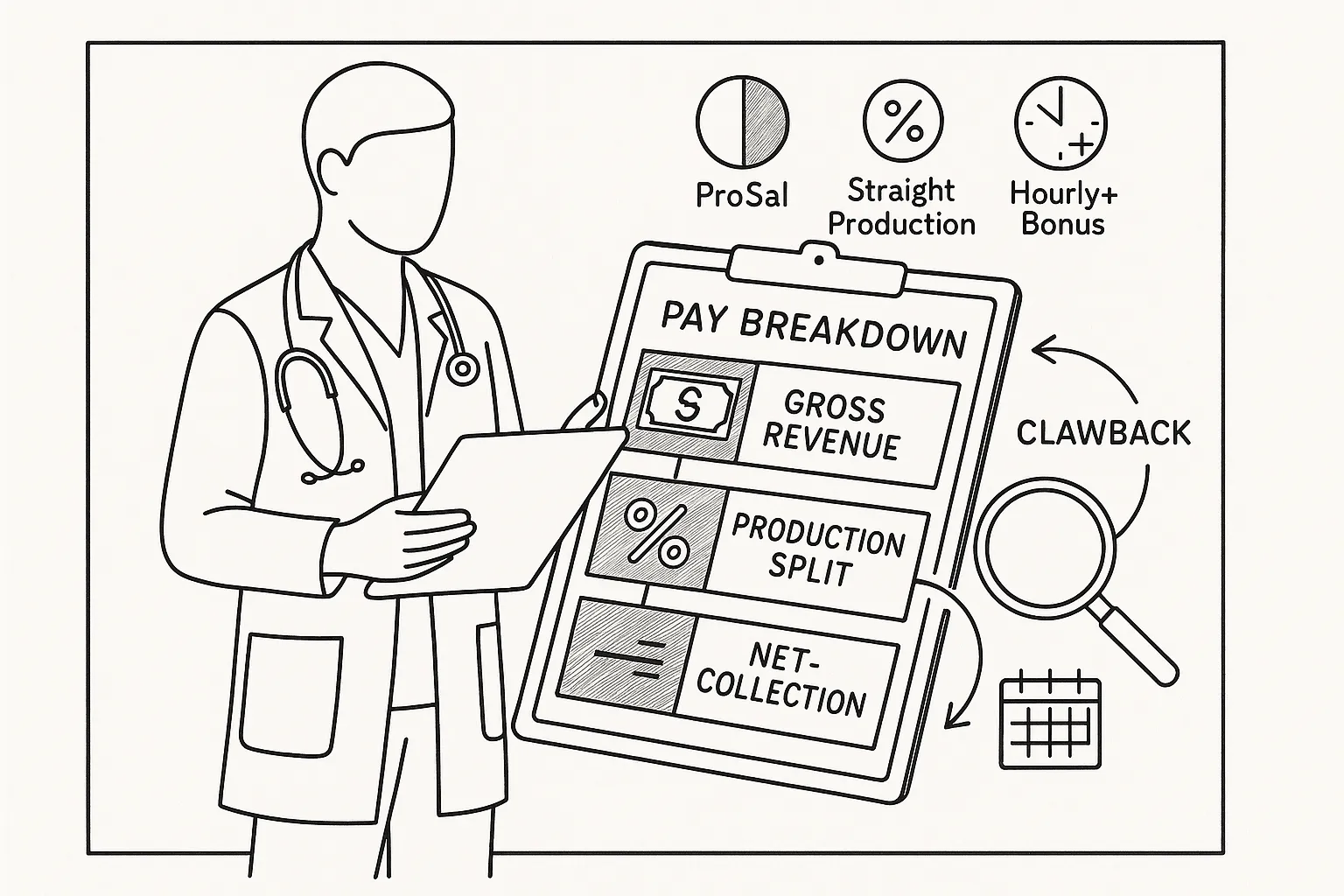
How ProSal, Production, and Collections Models Differ
Veterinary practices use several forms of incentive compensation. ProSal generally combines guaranteed compensation with additional pay when production exceeds a stated target. Straight production may base all compensation on a percentage of revenue, while a salary or hourly arrangement may include a periodic bonus tied to the veterinarian’s individual results or the practice’s overall performance. Relief and emergency roles may instead use daily or shift rates supplemented by after-hours, overtime, or production incentives.
No single model is best for every veterinarian. The financial result depends on practice volume, fee schedules, staffing, case mix, seasonality, appointment control, and the veterinarian’s tolerance for variable income. A veterinarian considering a hybrid arrangement can review Chelle Law’s explanation of ProSal compensation for veterinarians and compare the contract formula with realistic practice data.
- ProSal: Guaranteed compensation combined with a production percentage above a specified target.
- Production-based pay: Compensation calculated from services attributed to the veterinarian, sometimes before the practice receives payment.
- Collections-based pay: Compensation tied to money the practice actually receives, subject to the contract’s treatment of discounts, refunds, and write-offs.
- Negative accrual: A deficit that may reduce compensation in a later period when production falls below the target or earlier calculations are adjusted.
- Chargeback: A later reduction associated with a refund, discount, uncollected invoice, returned product, payment reversal, or similar adjustment.
- Reconciliation: The comparison of guaranteed compensation with earned production pay at the end of a stated measurement period.
The contract needs more than a percentage. It should identify the base salary or draw, production target, measurement period, payment date, reconciliation process, and consequences of a negative result. Because employers sometimes use production terminology inconsistently, the veterinarian must determine what each defined term means within that particular agreement.
What Counts as Credited Revenue
Many disputes begin with an undefined reference to “production” or “collections.” The formula might use gross charges, adjusted production, net collections, or cash received after discounts and write-offs. These alternatives are not interchangeable. The contract also may exclude laboratory charges, medications, boarding, technician services, prescription sales, or other revenue associated with the veterinarian’s cases.
Timing and attribution can be equally important. Revenue may be credited when the service occurs, when the client pays, or when cash posts to the practice-management system. The agreement needs a method for allocating multi-doctor cases, follow-up care, referrals, hospitalized patients, emergency transfers, technician-supported services, and work performed at different locations.
- Determine whether the percentage applies before or after discounts, refunds, processing fees, write-offs, and uncollectible accounts.
- Identify whether services are credited in the month performed or the month payment is received.
- Clarify how shared cases and services involving another veterinarian or support staff are allocated.
- Confirm which products, procedures, and ancillary services are excluded from credited revenue.
- Establish how later refunds or adjustments affect a bonus that has already been paid.
Worked examples can expose ambiguities that are difficult to see in a narrative formula. The examples should apply the percentage and threshold at several realistic revenue levels and show how the practice treats discounts, shared cases, delayed payments, paid leave, and refunds. If the calculation cannot be reproduced using the employer’s own records, the veterinarian may have no practical way to verify future pay.
Where Production Compensation Commonly Breaks Down
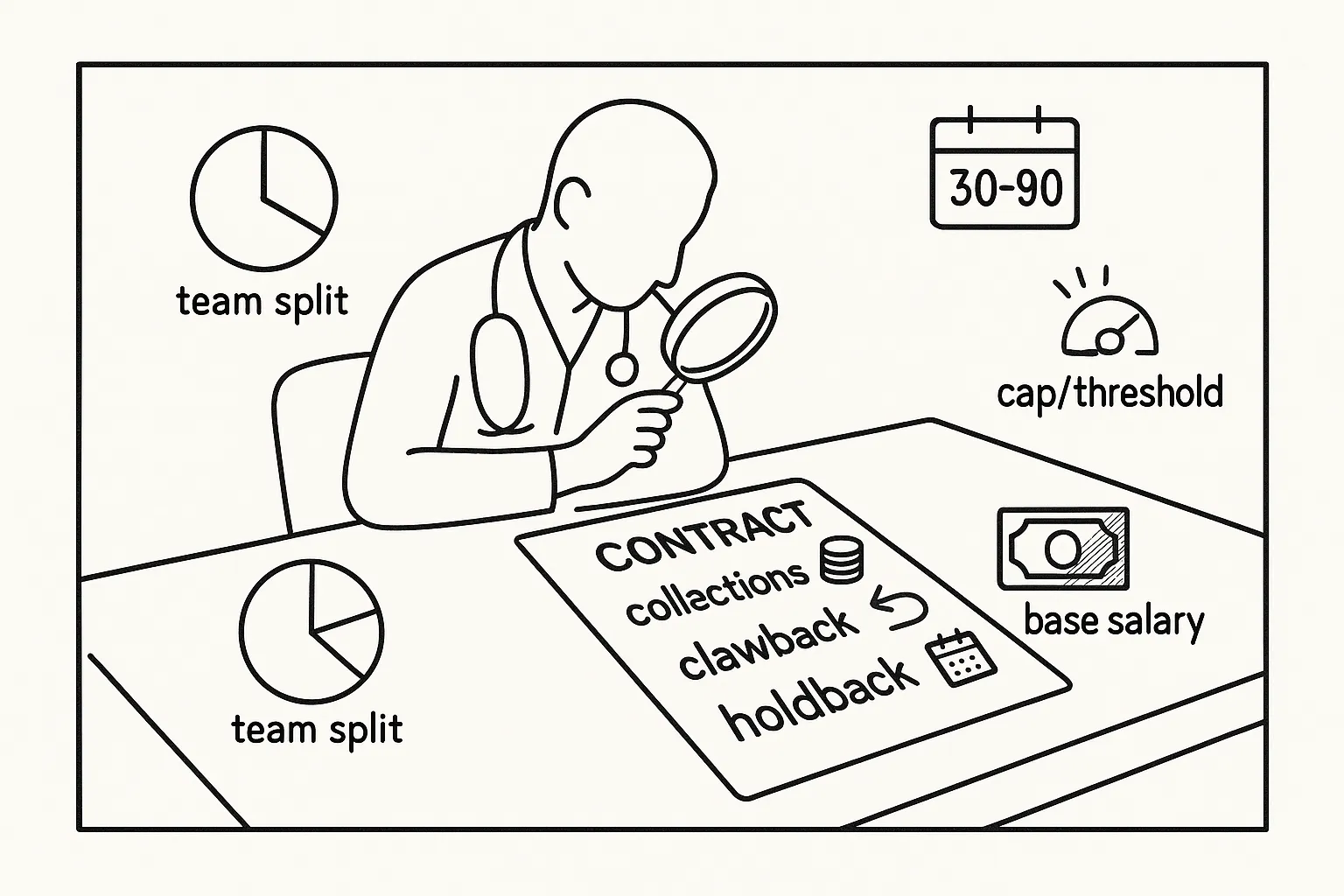
Negative Accrual, Chargebacks, and Delayed Reconciliation
Negative accrual can turn a guaranteed salary into a less predictable arrangement. If production falls below the target during one month or quarter, the deficit may carry forward and reduce later bonuses even after performance improves. The agreement needs to explain whether a negative balance carries into another period, when it resets, and whether the practice can characterize the balance as money owed by the veterinarian. Chelle Law’s discussion of veterinary negative accrual addresses these mechanics in greater detail.
Chargebacks create a related problem when the employer recalculates prior production after a client refund, discount, write-off, returned payment, or billing correction. An open-ended clause may permit adjustments months after the original bonus was paid. Important issues include the permitted lookback period, qualifying adjustments, deduction limits, required supporting records, and whether an asserted overpayment may reduce guaranteed compensation, final pay, or only future incentive payments.
Long reconciliation cycles make errors harder to detect and delay compensation that the veterinarian may already have earned under the formula. Annual reconciliation creates considerably less visibility than monthly reporting. The contract can specify when each statement is due, when incentive compensation is paid, and how quickly the practice must investigate a reported discrepancy.
Thresholds, Caps, and Employer-Controlled Inputs
A high production percentage can be offset by an unrealistic threshold, an undisclosed cap, or extensive revenue exclusions. Some formulas allocate revenue to a team pool or divide it among several doctors. Others allow the employer to change fees, discounts, staffing, appointment availability, location assignments, or operating hours without making a corresponding adjustment to the veterinarian’s target.
Those operational decisions matter because the practice often controls the inputs that determine whether the veterinarian can generate production. A compensation model should be tested using expected appointment volume, average transaction value, staffing constraints, scheduled leave, seasonal fluctuations, and the practice’s collection history. Modeling only an ideal high-volume month can make a difficult target appear attainable.
Paid time off deserves particular attention. A veterinarian may receive paid leave but lose the opportunity to meet an unchanged monthly target while away. Similar concerns arise when the practice closes for holidays, assigns administrative duties, limits appointments, or transfers the veterinarian to a lower-volume location. The documents can clarify whether targets are prorated for leave and employer-directed reductions in clinical time.
Federal and State Rules Still Matter
Production compensation is largely defined by the agreement, but contract language does not displace applicable wage law. The U.S. Department of Labor explains that federal law does not require commissions; when an employee receives commission or incentive compensation, however, minimum-wage and overtime requirements may still apply. Production payments can also affect the employee’s regular-rate calculation when overtime law covers the position.
State law may determine when production compensation becomes earned, whether a particular deduction is permissible, what written terms are required, and how quickly final wages must be paid. Federal law generally does not require an immediate final paycheck after termination, while some states impose earlier deadlines. A final-pay provision must therefore be assessed under the law governing the actual employment relationship rather than treated solely as a private accounting term.
There is no universal national contract rule standardizing ProSal calculations, negative accrual, chargebacks, reporting rights, or post-termination production. Those issues depend heavily on the written agreement and applicable state law. This makes precision especially important when a multistate employer uses the same compensation template in several jurisdictions.
Employee Classification and Noncompete Developments
Relief and associate veterinarians are sometimes classified as independent contractors even when the practice exercises substantial operational control. The IRS specifically recognizes that veterinarians may work as employees or independent contractors, but the classification depends on the actual relationship rather than the contract label, payment method, or issuance of a Form 1099. Practice control over schedules, fees, locations, procedures, equipment, records, and the ongoing integration of the veterinarian’s work can be relevant.
Classification tests are not identical across federal tax, wage-and-hour, unemployment, workers’ compensation, and state-law contexts. A veterinarian comparing arrangements can review the practical distinctions between W-2 employment and 1099 veterinary work, but the parties’ daily conduct remains more important than the heading placed on the agreement.
Restrictive covenants also require current, state-specific analysis. The FTC reports that its nationwide Noncompete Rule is not in effect or enforceable. That status does not make every veterinary noncompete valid; enforceability continues to depend principally on applicable state law, the wording of the restriction, and the circumstances of the relationship. The nationwide rule must also be distinguished from case-specific government enforcement involving particular employers.
Related Clauses That Change the Value of Production Pay
Termination language determines what happens to services performed before departure but collected afterward. A contract can address whether the veterinarian receives credit for those collections, the date of the final reconciliation, access to supporting reports, the payment deadline, and permissible post-termination deductions. A focused review of veterinary termination provisions can identify notice and final-payment terms that undermine an otherwise attractive compensation package.
A noncompete or nonsolicitation provision can limit the veterinarian’s ability to replace lost earnings after employment ends. Relevant terms include duration, geographic scope, restricted activities, covered practice locations, and the events that trigger the restriction. These provisions warrant a separate veterinary restrictive covenant review rather than being dismissed as standard language.
Malpractice provisions may shift significant costs to the veterinarian. The agreement can identify whether coverage is occurrence-based or claims-made, state the policy limits, and allocate responsibility for any required tail coverage. The reason employment ends may also change who pays. Chelle Law’s malpractice and tail insurance review evaluates these cost-allocation terms.
Total compensation includes more than production pay. Paid leave, health benefits, continuing education, licensing expenses, professional dues, retirement contributions, relocation assistance, and signing bonuses all affect the value of an offer. A higher production percentage may not compensate for limited benefits, difficult repayment obligations, or costs shifted to the veterinarian.
Partnership and ownership promises also require objective written terms. A meaningful pathway generally addresses eligibility, timing, valuation, financing, governance rights, distributions, and exit obligations. A vague statement that ownership may become available later does not establish the price, availability, or conditions of a future buy-in.
Contract Protections That Improve Pay Transparency
A workable production clause allows an independent reader to reproduce the calculation. The documents can define production or collections, list included and excluded revenue, state the percentage and target, explain attribution, and establish the reconciliation schedule. Sample calculations are especially useful when the formula contains multiple thresholds or changes after the veterinarian reaches a specified level.
- Require regular statements showing credited revenue, exclusions, discounts, refunds, chargebacks, thresholds, and the resulting payment.
- Identify the billing or practice-management reports available to verify the calculation.
- Establish a defined period for reporting and investigating discrepancies.
- State whether negative balances carry forward and when any balance resets.
- Limit unilateral changes to percentages, thresholds, fee schedules, and attribution methods.
- Explain how leave, staffing shortages, schedule changes, and multi-location assignments affect production expectations.
- Address final reconciliation and collections received after employment ends.
Audit and record-access provisions matter because the employer controls most of the underlying data. The agreement may require the practice to retain relevant records, provide read-only reports, and correct verified errors within a specified time. If a discrepancy is material, the documents can identify the process and deadline for issuing the corrected payment.
Warning signs include undefined terms, conflicting formulas, extensive employer discretion, lengthy reconciliation periods, unexplained revenue exclusions, and silence about final collections. Broad repayment provisions, mandatory arbitration, unclear tail obligations, and informal ownership promises can create additional financial exposure even when the production percentage itself appears favorable.
Preparing the Agreement for Legal Review
Contract review is most useful before the veterinarian signs an offer letter or employment agreement. The reviewer can compare the offer with the final contract, test the formula, identify language permitting later changes, and examine how production pay interacts with termination, restrictive covenants, malpractice coverage, bonuses, repayment obligations, and ownership terms.
- The compensation formula, percentage, target, measurement period, and sample calculations.
- Definitions of production, collections, adjustments, chargebacks, and negative accrual.
- Recent production reports or anonymized examples that illustrate how the practice applies the formula.
- Termination notice, final-pay terms, post-termination collections, and deduction provisions.
- Noncompete and nonsolicitation restrictions under the applicable state law.
- Malpractice coverage, policy type, limits, and any tail obligation.
- Signing bonuses, relocation assistance, benefit costs, and repayment triggers.
- Written ownership or partnership terms, including valuation and exit provisions.
An attorney-led review can provide a practical explanation of the risks, identify language that may warrant clarification, and suggest possible revisions for the veterinarian to discuss with the employer. If the employer issues a revised agreement, the new language must be compared with the original concerns because a change in one clause may affect the operation of another.
Frequently Asked Questions
What are the most common veterinary production-pay risks?
Common risks include undefined revenue terms, unrealistic thresholds, negative accrual, delayed reconciliation, retroactive chargebacks, discretionary attribution rules, and unclear final-pay provisions. Restrictive covenants, malpractice costs, and repayment obligations can further reduce the value of the compensation package.
What is the difference between production and collections?
Production usually refers to the value of services attributed to the veterinarian, while collections generally refers to money the practice receives. The contract must define the terms because discounts, refunds, write-offs, payment timing, and excluded revenue can cause the two figures to differ substantially.
Can negative accrual reduce a veterinarian’s future bonus?
It can if the agreement permits a deficit to carry into a later measurement period. The contract can clarify when negative balances arise, whether they carry forward, when they reset, and whether an alleged overpayment may affect future incentive compensation, guaranteed pay, or final wages.
Does a veterinarian receive production pay collected after leaving?
The answer depends on the contract and applicable wage-payment law. The agreement can specify whether services performed before departure remain eligible, how long later collections are tracked, when final reconciliation occurs, and which adjustments or deductions are permitted.
Does calling a relief veterinarian a contractor settle worker status?
No. Classification depends on the actual working relationship and the governing legal test, not only the agreement’s label or the issuance of a Form 1099. Control over schedules, fees, locations, equipment, procedures, and the ongoing integration of the work may be relevant.
What records help verify veterinary production compensation?
Useful records include regular production statements, credited revenue reports, exclusion and adjustment details, refund and chargeback records, threshold calculations, and final reconciliation data. Access to relevant billing reports and a defined discrepancy process makes the formula easier to audit.
Review Your Veterinary Production Compensation Before Signing
Chelle Law can analyze ProSal, collections, negative accrual, chargebacks, final-pay provisions, and related clauses that may affect your earnings and career mobility.
Contact Chelle LawExplore Veterinary Contract Guidance
Review legal services, practical resources, and state-focused information for veterinary employment agreements.