

A resignation notice clause determines how and when a veterinarian may end an employment relationship without breaching the agreement. The provision may specify a required number of days, an authorized recipient, an approved delivery method, and the event that starts the notice period. Although those details can appear administrative, uncertainty about when notice becomes effective may change the final employment date, delay a new position, or create a dispute over whether the veterinarian completed the required period.
The financial consequences can be more significant than the timing issue itself. Notice provisions often interact with ProSal or production compensation, final collections, negative accrual, signing-bonus repayment, malpractice coverage, restrictive covenants, and ownership opportunities. A veterinarian may continue treating patients during the notice period while facing a different compensation calculation, or may discover that employer-paid tail coverage depends on the manner of departure.
For that reason, a notice clause must be read with the entire termination section and every provision that survives employment. Chelle Law reviews these provisions to identify unclear resignation procedures, financial exposure, post-employment restrictions, and terms that may warrant clarification before signing or giving notice. No single nationwide rule controls veterinary notice periods, final compensation, tail allocation, or resignation penalties; the contract language and governing law remain central.
Key Takeaways
- Confirm the required notice period, delivery method, recipient, trigger date, and final employment date.
- Determine whether salary, ProSal, production pay, and collections-based compensation continue under the same formula during notice.
- Review bonus repayment, negative accrual, deductions, final reconciliation, and any stated damages for incomplete notice.
- Verify the actual malpractice policy type, reporting requirements, coverage end date, and responsibility for tail coverage.
- Analyze non-competes and other post-employment restrictions under current state law rather than assuming a nationwide rule applies.
Why a Veterinary Notice Clause Controls More Than a Departure Date

A notice period ordinarily states how far in advance an associate or employer must communicate an intended termination. Some agreements apply the same period to both parties, while others establish different requirements depending on who ends the relationship or why employment ends. The clause may also distinguish termination without cause from immediate termination for cause.
The practical question is not merely whether the agreement says 30, 60, or 90 days. A complete review asks when the clock starts, whether the notice must be written, who has authority to receive it, and whether email, personal delivery, or certified mail is effective. It also examines whether the employer can remove the veterinarian from the schedule, accelerate the departure date, change duties, or continue assigning call and multiple-location work after notice is delivered.
These procedural terms must be reconciled with the agreement’s broader veterinary contract termination requirements. The final workday may determine when benefits and liability coverage end, when a non-compete begins, whether a bonus is vested, and when the veterinarian may start another job. An apparently minor delivery mistake can therefore affect several independent obligations.
Compensation and Repayment Risks During the Notice Period
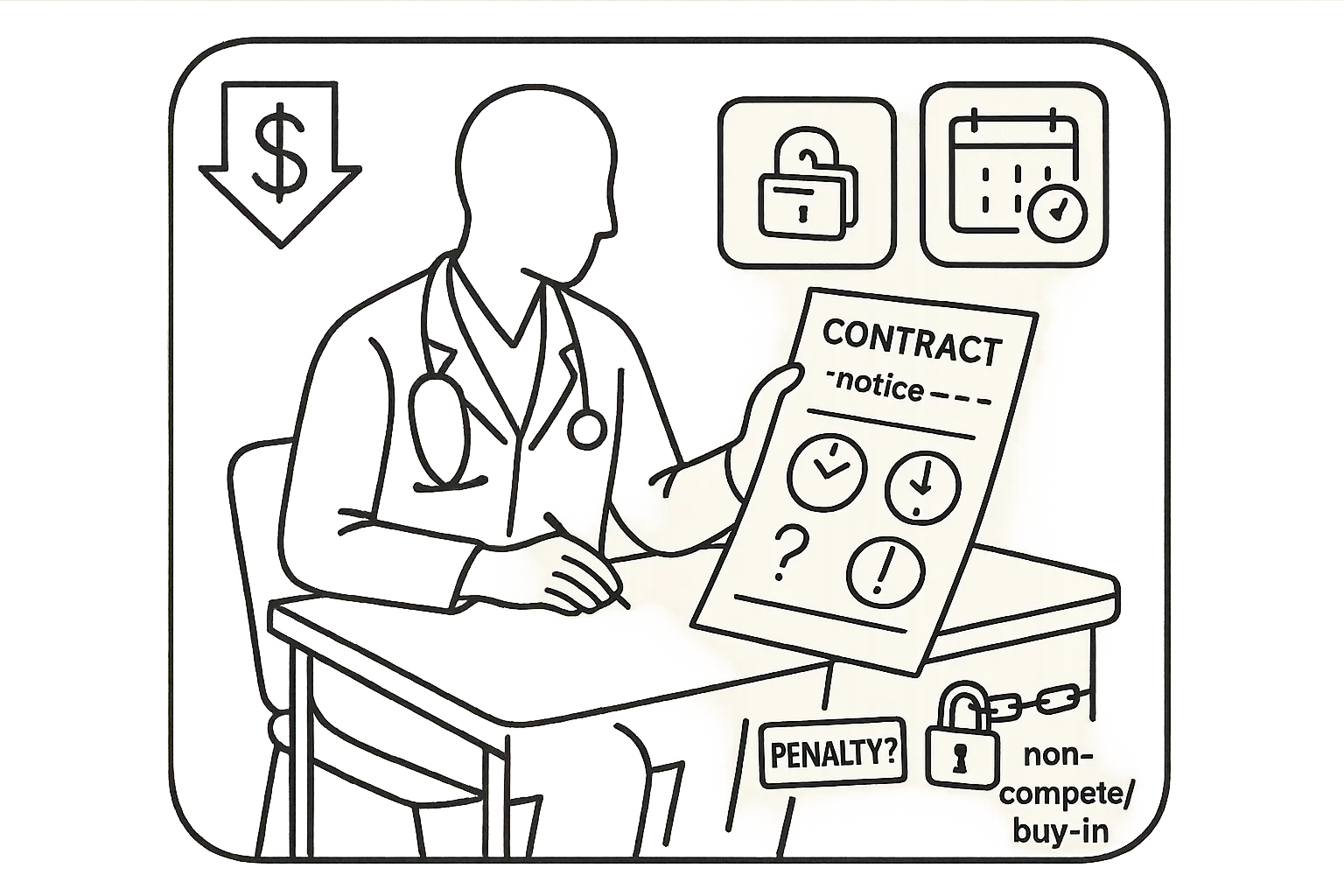
Veterinary compensation formulas can make the notice period financially complicated. Base salary may continue while production credit changes, or the employer may reserve the right to delay incentive compensation until accounts have been reconciled. The agreement may also connect resignation to repayment obligations that are separate from whether the veterinarian properly completed the notice period.
Notice Timing, Final Pay, and Contractual Penalties
Language stating that notice becomes effective when it is “received” can create uncertainty if the contract does not identify an authorized recipient or accepted delivery method. A conversation with a medical director, an email to a practice manager, and a letter to human resources may not have the same contractual effect. Written acknowledgment can also become important when the parties disagree about the last workday.
The termination section may impose fixed damages, permit deductions, or authorize the employer to hold compensation while completing a final accounting. The legal treatment of those provisions depends on the contract and applicable law. A label such as “penalty,” “liquidated damages,” or “reconciliation” does not, by itself, resolve whether the provision applies or may be enforced.
Important questions include whether the employer can waive part of the notice period, whether an accelerated departure changes compensation, and whether unused paid time off or other benefits are addressed. The agreement may also need to explain what happens if the practice stops scheduling the veterinarian before the stated termination date.
ProSal, Production Credit, Bonuses, and Negative Accrual
A veterinarian paid through ProSal, a production percentage, or collections may perform work before departure that is not billed or collected until later. The contract must be examined to determine whether credit arises when services are performed, invoiced, collected, or reconciled. Without a clear rule, the parties may disagree about production generated before termination but processed after employment ends.
- Do base salary and production compensation continue throughout the notice period?
- Can the employer modify the clinical schedule or production opportunity after receiving notice?
- Can a productivity shortfall be carried forward or deducted as negative accrual?
- When will the final production or collections report be provided?
- Will the veterinarian receive credit for services performed before departure but collected later?
A focused review of veterinary compensation and ProSal terms can identify whether the notice-period formula matches the compensation structure used during the rest of employment. It can also reveal whether the employer controls key variables, such as fee adjustments, refunds, discounts, staffing, appointment volume, and the timing of collections.
Signing, retention, and relocation bonuses require a separate analysis. A veterinarian may provide the full contractual notice and still owe repayment because employment ended before a service milestone. A bonus repayment clause review can evaluate whether repayment is prorated, which termination events trigger it, and whether the agreement permits the amount to be deducted from final compensation.
Malpractice Coverage When Veterinary Employment Ends
Professional liability coverage is commonly written on an occurrence or claims-made basis. Subject to the policy terms, an occurrence policy generally covers an incident that occurred while the policy was active even if the claim is reported later. Claims-made coverage generally depends on when the claim is made and reported, as well as the applicable retroactive date and other policy requirements.
If claims-made coverage ends with employment, an extended reporting endorsement—often called tail coverage—may be needed for later claims arising from prior work. The contract may assign that expense to the practice, the veterinarian, or one party depending on the reason employment ends. Some agreements condition employer-paid tail on completing the notice period, leaving under an approved termination provision, or complying with specified post-employment obligations.
- Confirm the policy type from the policy and endorsements, not merely from a contract label.
- Identify the retroactive date, reporting requirements, coverage limits, and date employer-sponsored coverage ends.
- Determine who must obtain tail coverage, who pays for it, and whether any conditions apply.
- Review whether the veterinarian must provide proof of replacement coverage or an extended reporting endorsement.
There is no identified nationwide veterinary rule requiring every employer to pay for tail coverage. Responsibility depends on the policy, the employment agreement, applicable law, and the circumstances of termination. The veterinary tail insurance guide explains the coverage structures in greater detail, but the actual policy documents remain essential.
Non-Competes and Other Post-Employment Restrictions
Notice provisions sometimes attempt to change the consequences of restrictive covenants. An agreement may state that incomplete notice extends a restriction, eliminates an exception, affects employer-paid tail, or causes the veterinarian to lose a potential buy-in. Those consequences must be analyzed independently rather than assuming that a notice breach automatically establishes the enforceability of every post-employment term.
Current State and Federal Non-Compete Developments
Veterinary non-compete law is not uniform. Maryland provides a notable profession-specific example: legislation effective June 1, 2024 makes non-compete and conflict-of-interest provisions involving licensed veterinary practitioners and veterinary technicians null and void under Maryland law. Veterinarians evaluating a Maryland agreement can review the state’s enacted veterinary non-compete legislation for the precise scope.
Washington currently regulates noncompetition covenants through requirements that include statutory conditions addressing matters such as disclosure, compensation, termination, and duration. Amendments enacted in 2026 are scheduled to make noncompetition covenants void and unenforceable beginning June 30, 2027, including covenants entered before that date. The amended Washington noncompetition statute treats categories such as nonsolicitation, confidentiality, and trade-secret protections differently, so each restriction must be classified correctly.
At the federal level, the Federal Trade Commission’s 2024 nationwide non-compete rule is not currently in effect or enforceable following federal-court litigation. The FTC’s rule-status page reports that the agency took steps in September 2025 to dismiss its Fifth Circuit appeal. That development does not create a nationwide conclusion that every veterinary non-compete is valid; state law, choice-of-law language, court decisions, and the facts still matter, and federal enforcement may continue through individual matters under other legal theories.
Non-competes also differ from client or employee nonsolicitation clauses, confidentiality provisions, trade-secret protections, record obligations, and ownership-related terms. A veterinarian considering another position should not assume that invalidity or inapplicability of one restriction eliminates the others. A jurisdiction-specific veterinary restrictive-covenant review can examine the duration, geographic area, restricted activities, triggering events, and relationship to the resignation clause.
Operational and Career Consequences of Giving Notice
A lengthy notice period can affect more than compensation. A prospective employer may be unwilling to hold a position open, while the existing practice may continue assigning call, weekend shifts, or work at several locations. The agreement may also limit outside employment or moonlighting, making it difficult to bridge the time between positions.
Veterinary employment terms also operate within professional obligations. For example, Washington veterinary regulations state that a veterinarian must not accept employment conditions that interfere with free professional judgment or infringe on the use of professional skills. Although that rule does not determine every notice dispute, it illustrates why scheduling, production pressure, employer control, and departure provisions cannot always be treated as ordinary administrative terms divorced from clinical responsibilities.
- Income disruption: Delayed reconciliation, production adjustments, bonus repayment, or negative accrual may reduce expected final compensation.
- Coverage expense: A tail obligation may arise while the veterinarian is also managing a transition between jobs.
- Start-date uncertainty: A dispute over the effective notice date can prevent the veterinarian from committing to a new start date.
- Mobility restrictions: A non-compete or nonsolicitation provision may affect available practices, clients, or geographic markets.
- Ownership consequences: Departure before a stated milestone may affect buy-in eligibility or rights under separate ownership documents.
The risk can be especially pronounced for a new graduate entering a first ProSal arrangement or an experienced associate leaving a practice with an anticipated ownership path. Addressing these interactions before signing is generally easier than attempting to interpret ambiguous terms after a resignation has already been delivered.
How to Clarify a Veterinary Resignation Clause
The goal of revising a notice provision is not always to obtain the shortest possible period. A workable clause establishes a predictable departure process while addressing compensation, coverage, scheduling, and surviving obligations. The appropriate language depends on the rest of the agreement and the law selected to govern it.
Drafting Points That May Warrant Revision
The following examples illustrate subjects that may be addressed in a redline. They are not universal clauses and must be adapted to the complete agreement:
- Delivery and receipt: Identify the recipient, permitted delivery methods, and date on which notice is deemed received.
- Compensation continuity: State whether base salary and production compensation remain subject to the ordinary formula throughout notice.
- Final production credit: Explain how the practice will credit services performed before departure but billed or collected afterward.
- Coverage responsibilities: Identify the policy type, coverage end date, and allocation of any tail expense.
- Limited financial consequences: Remove open-ended deductions or define the circumstances and calculation governing any stated damages.
- Separate post-employment terms: Avoid allowing a technical notice dispute to change the duration or scope of an otherwise independent restriction.
A practical review also asks whether the employer can waive work during notice without changing pay, require additional shifts, move the veterinarian among locations, or restrict paid time off. The agreement may need to specify whether benefits continue through the final day and when the employer will provide the last production statement and payment.
An attorney-led veterinary employment agreement review is particularly useful when resignation affects a complicated production formula, a multi-year bonus obligation, claims-made coverage, a buy-in opportunity, or a restrictive covenant. Reviewing those provisions together helps distinguish a procedural notice requirement from the separate financial and professional consequences attached to departure.
Frequently Asked Questions
What details make a veterinary resignation notice effective?
The agreement may require written notice, delivery through an approved method, receipt by a designated person, and completion of a stated number of days. The veterinarian should confirm the trigger date, final employment date, and whether written acknowledgment is required or useful.
Can production compensation change after a veterinarian gives notice?
That depends on the agreement and applicable law. The compensation and termination provisions must be read together to determine whether salary, ProSal, production percentages, collections credit, and reconciliation procedures continue unchanged during the notice period.
Does completing the notice period prevent bonus repayment?
Not necessarily. A bonus clause may require continued employment through a separate service date even when the veterinarian provides proper notice. The agreement may also address prorated repayment, exceptions based on the reason for termination, and deductions from final compensation.
Who pays for veterinary tail coverage after resignation?
No uniform nationwide rule assigns veterinary tail costs to every employer or veterinarian. Responsibility depends on the policy, endorsements, employment agreement, governing law, reason for termination, and any conditions tied to notice or post-employment obligations.
Does incomplete notice automatically make a non-compete enforceable?
No. The consequences of incomplete notice and the enforceability of a non-compete are separate questions. State law, the restriction’s wording, choice-of-law provisions, current court decisions, and the circumstances of the departure may all affect the analysis.
When is a legal review of a veterinary notice clause especially useful?
Review is particularly useful when notice affects production compensation, negative accrual, bonus repayment, claims-made coverage, liquidated damages, a restrictive covenant, ownership eligibility, multiple work locations, or the start date for a new position.
Review Your Veterinary Notice Terms Before a Career Move
Chelle Law can analyze how a resignation clause interacts with compensation, bonus repayment, malpractice coverage, restrictive covenants, and the timing of a veterinarian’s next position.
Contact Chelle LawExplore Veterinary Contract Guidance
Find attorney-led services, practical veterinary contract resources, and state-focused guidance for evaluating an agreement.