

A veterinary associate contract can appear competitive while shifting substantial financial and professional risk to the veterinarian. A few lines buried in the compensation, restrictive covenant, insurance, or termination sections may reduce earnings, create unexpected repayment obligations, or limit where the associate can work after leaving the practice. These risks are especially difficult to evaluate when an offer relies on undefined production formulas or promises that do not appear in the written agreement.
We review veterinary contracts for associates nationwide and repeatedly see the same costly problems: opaque ProSal calculations, open-ended negative accrual, broad noncompetes, unclear scheduling expectations, and surprising tail insurance obligations. State law can also affect the enforceability of post-employment restrictions, while the employer’s structure—such as a corporate group or private practice—may influence compensation flexibility, clinical autonomy, and ownership opportunities.
Identifying a bad agreement requires more than checking the stated salary. The compensation math, bonus reconciliation process, malpractice coverage, termination rights, repayment clauses, and future ownership terms must work together. Chelle Law examines these provisions, explains their practical consequences, and identifies language that may warrant clarification or negotiation before the veterinarian signs.
Key Veterinary Contract Red Flags
- Watch for opaque ProSal and production formulas. Confirm whether compensation is based on collections or charges, the exact percentage, payout timing, and how reconciliation works.
- Avoid unnecessarily broad restrictive covenants. Review the noncompete’s radius, duration, covered activities, and relationship to any client or employee non-solicitation provision.
- Clarify malpractice insurance by confirming whether the policy is occurrence-based or claims-made and who must purchase tail coverage when employment ends.
- Limit retroactive pay adjustments by defining chargebacks, setting a reasonable look-back period, and addressing open-ended negative accrual that can reduce future compensation.
- Treat vague buy-in, ownership, severance, and bonus repayment promises as red flags. Material terms should appear in the written agreement rather than depend on future discussions.
Compensation and Bonus Terms That Can Reduce Earnings
Unclear Production and ProSal Formulas
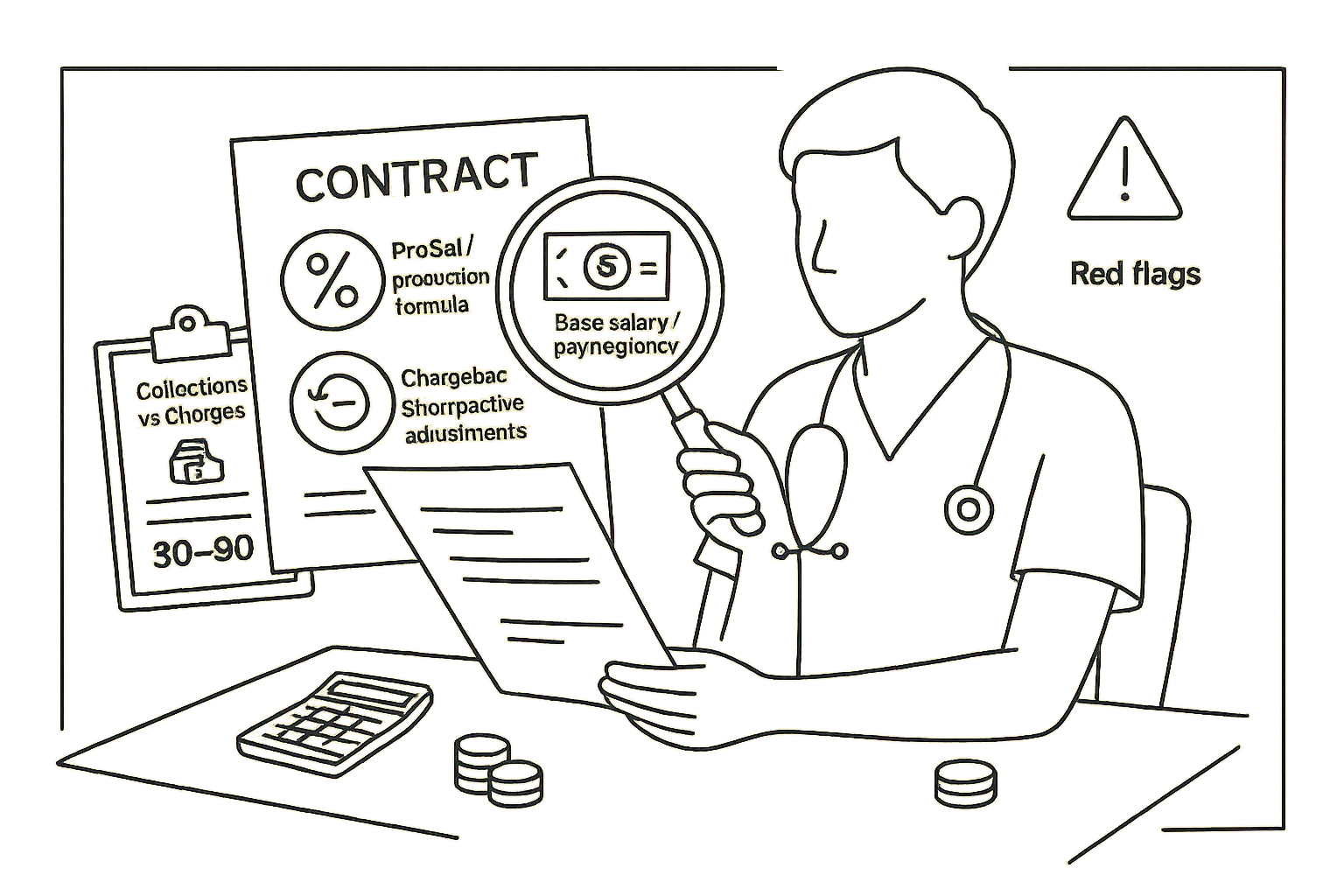
ProSal and production-based pay are standard in veterinary employment, but the details of the formula determine what the associate actually earns. Red flags include undefined “production,” reliance on gross charges rather than collections, or formulas that exclude particular services such as surgery, diagnostics, or hospice care. A thorough review of veterinary compensation terms should identify the base salary, exact production percentage, applicable revenue categories, calculation method, and payout schedule.
Collections-based compensation ties pay to money the practice receives, while charge-based formulas may credit billed services before payment is collected. The agreement should also explain whether production targets are measured monthly, quarterly, or annually and how underperformance affects any guarantee. Where appropriate, an associate may request a short guarantee period, such as three to six months, together with a written reconciliation schedule and example calculations.
The contract should state how often the veterinarian is paid and whether the base salary is a true guarantee, a draw against future production, or an advance subject to reconciliation. A guarantee that converts to production compensation without a clear calculation process can create unexpected reductions. Raises, overtime policies, bonus periods, and their relationship to the employer’s fiscal calendar should also be addressed.
Compensation expectations may vary by market and employer type. Associates in higher-cost regions may seek higher guarantees or blended ProSal models, while corporate groups may use more standardized terms than smaller private practices. Regardless of the setting, the written formula should define “collections,” explain who controls discounts and write-offs, and state whether the veterinarian receives credit for collections posted after a service is performed.
Negative Accrual, Chargebacks, and Retroactive Adjustments
Negative accrual clauses allow a production deficit to carry forward, while broad chargeback language may permit an employer to retroactively recalculate bonuses or guarantees. A clinic might apply chargebacks for refunds, client disputes, discounts, or write-offs months after the veterinarian provided the service. These provisions can make current and future pay difficult to predict.
Open-ended adjustment rights deserve careful attention. The agreement should identify permissible chargebacks, establish a defined look-back period, explain the reconciliation process, and address whether recoupment from future wages is limited. Veterinarians evaluating this issue should also understand how negative accrual affects production pay, particularly when a deficit can continue across bonus periods or survive termination.
If the employer controls billing practices, discounts, staffing, appointment volume, and collections, the veterinarian may have limited ability to influence the numbers used to calculate compensation. Requiring transparent reports and sample calculations can reduce disputes and provide both parties with a shared understanding of the formula.
Restrictive Covenants and Post-Employment Limits

Noncompete Scope, Duration, Geography, and State Law
Noncompete clauses are among the most career-limiting provisions in a veterinary associate agreement. Long durations, wide geographic radii, restrictions tied to every employer location, and sweeping activity prohibitions are significant red flags. Enforceability depends heavily on state law: some states largely prohibit employee noncompetes, while others may enforce restrictions they consider reasonable under the applicable legal framework.
A focused veterinary noncompete review examines the restricted activities, geographic area, duration, triggering events, and governing-law clause. Potential revisions may include narrowing the radius, reducing the restricted period, limiting the covenant to direct clinical practice in the same field, or excluding locations where the veterinarian did not work. When relocation is involved, the agreement’s choice-of-law provision also matters because it may affect how the restriction is evaluated.
Non-solicitation provisions can also restrict future opportunities. Language that treats every practice client as permanently off-limits may be broader than necessary, particularly when the associate never treated or contacted many of those clients. A more defined provision may identify the clients covered, the relevant look-back period, and the length of the restriction.
Non-poaching clauses may prevent an associate from recruiting staff after departure. In a multi-location corporate network, the provision should make clear whether it applies only to employees at the veterinarian’s location or to personnel throughout the organization. Geographic, temporal, and relationship-based limits can materially affect the practical reach of the restriction.
Malpractice Insurance, Tail Coverage, and Indemnification
Coverage Type and Responsibility for Tail Insurance
The agreement should state whether the employer provides professional liability coverage, whether the policy is occurrence-based or claims-made, and who pays for any required tail coverage. An occurrence policy generally addresses covered incidents that occurred during the policy period even if a claim is reported later. A claims-made policy generally requires coverage to remain in place when the claim is made, which may create a need for extended reporting or tail coverage after employment ends.
Corporate groups and private practices may allocate this responsibility differently. A departing associate who must purchase tail insurance can face a significant unplanned expense, so the contract should define who pays under each termination scenario. A malpractice and tail coverage review can also evaluate whether the obligation changes when the employer terminates without cause, the associate resigns, or the parties replace coverage.
Coverage limits, defense costs, exclusions, and reporting duties should be clear. If the employer requires the veterinarian to maintain an individual policy, the agreement should identify the required limits and address indemnification for work performed within the scope of employment. Indemnification language should not improperly shift responsibility for the employer’s conduct, staffing decisions, or operational policies to the associate.
Claims cooperation provisions are common, but the veterinarian should understand who controls the defense and settlement process. Language granting the employer unilateral control, limiting access to independent counsel, or permitting a denial of protection based on vague policy violations warrants careful review.
Termination, Notice, Repayment, and Severance Risks
Veterinary agreements may allow termination without cause, termination for defined cause, or both. The contract should distinguish these rights and explain the required notice. If the employer uses a fixed term, the veterinarian should still determine whether either party can end the relationship early and what financial obligations follow.
Termination-for-cause provisions should identify the conduct that permits immediate termination. Broad references to poor performance, policy violations, or conduct harmful to the employer may give the practice substantial discretion. For remediable issues, a written notice and reasonable cure process may provide a fair opportunity to correct the alleged problem before employment ends.
Short or absent notice periods can be particularly risky when compensation, scheduled shifts, health benefits, or tail obligations depend on the termination date. A review of termination and notice terms should also consider whether the employer can remove the associate from the schedule during the notice period, whether compensation continues, and when final production bonuses are calculated.
Signing bonuses, relocation payments, continuing education funds, and other incentives often include repayment provisions. The agreement should explain whether repayment is prorated, which termination events trigger it, and when payment is due. Severance is less common but may be negotiable in particular circumstances, especially when the veterinarian gives up an established position, relocates, or relies on a written ownership pathway.
Post-termination duties involving records, client communications, property return, patient transitions, and confidentiality should be specific and workable. Obligations that continue indefinitely or depend entirely on later employer instructions can create avoidable disputes.
Ownership and Partnership Promises That Need Written Terms
Promises of future ownership are attractive but may be ill-defined. Red flags include an unspecified valuation method, open-ended eligibility requirements, unclear payment schedules, and no deadline for presenting a formal offer. Meaningful buy-in terms should address the valuation process, payment structure, anticipated timeline, and what happens if the practice is sold before the transaction is completed.
Corporate groups may offer phantom equity or incentive compensation rather than ownership in the veterinary practice. The agreement should accurately describe the arrangement and explain vesting, valuation, forfeiture, and payment rights. A label such as “ownership opportunity” does not itself establish an enforceable right to equity.
Actual equity documents require review of transfer restrictions, voting rights, profit distributions, dilution, buy-sell provisions, rights of first refusal, and exit mechanics. Veterinarians considering a future buy-in can use a guide to veterinary partnership terms to identify issues that should be resolved before relying on an ownership promise.
Verbal assurances carry less protection than written commitments. If ownership is material to accepting the position, the parties should document milestones, valuation procedures, timing, and the consequences if the proposed opportunity does not proceed.
Schedule, Clinical Autonomy, and Performance Expectations
Undefined on-call duties, emergency rotations, weekend expectations, and moonlighting restrictions are common sources of conflict. The agreement should provide a schedule framework, describe after-hours responsibilities, explain whether additional call compensation is available, and state how schedule changes are communicated. If the practice can assign the veterinarian to multiple facilities, the contract should also address location limits, travel expectations, and reimbursement.
Moonlighting restrictions should be evaluated in relation to conflicts of interest, scheduling, confidentiality, and patient safety. A blanket prohibition may unnecessarily prevent reasonable supplemental work, while vague approval requirements can give the employer unrestricted discretion. Veterinarians should also compare the agreement with practical guidance on schedule and call obligations.
Contracts may attempt to shift medical decision-making authority to nonclinical managers or require strict compliance with corporate protocols. The veterinarian should understand how the agreement addresses professional judgment, applicable standards of care, treatment recommendations, referrals, and situations in which a protocol conflicts with patient needs.
Performance metrics should be transparent and measurable, particularly when they affect compensation, discipline, or termination. Subjective standards tied directly to immediate termination create uncertainty. Regular evaluations, objective goals, documented feedback, and reasonable improvement periods can provide a clearer process for addressing performance concerns.
Frequently Asked Questions
What compensation terms commonly make a veterinary associate contract risky?
Common warning signs include undefined production, unclear treatment of collections and charges, excluded services, vague production percentages, inconsistent bonus periods, and no written reconciliation process. The agreement should explain the base salary, production formula, payout schedule, write-offs, discounts, and provide enough detail to verify compensation.
How can negative accrual or chargebacks reduce a veterinarian’s pay?
Negative accrual may carry a production deficit into future compensation periods, while chargebacks may reverse previously credited revenue for refunds, disputes, or write-offs. Without defined limits, the employer may recalculate compensation months later. The contract should identify permissible adjustments, the look-back period, reporting requirements, and any limits on recoupment.
Which restrictive covenant terms should a veterinary associate examine?
The associate should examine the noncompete’s duration, geographic scope, covered activities, triggering events, and relationship to each practice location. Client non-solicitation, employee non-poaching, confidentiality, and choice-of-law provisions also matter. Enforceability varies by state, so the analysis should account for the law governing the agreement.
Who pays for veterinary malpractice tail coverage after termination?
The contract should answer that question. Responsibility may depend on the policy type and how employment ends. The veterinarian should confirm whether coverage is occurrence-based or claims-made, whether tail coverage is necessary, what it may cover, and whether the employer pays all or part of the cost under specified termination scenarios.
What should a veterinarian review in termination and repayment clauses?
Review without-cause notice, immediate termination triggers, cure rights, final bonus calculations, benefits, tail obligations, and post-employment duties. Repayment clauses should identify the covered bonus or expense, whether repayment is prorated, which termination events trigger it, and the deadline for payment.
When should a veterinarian obtain an attorney review of an associate agreement?
An attorney review is useful before signing when the agreement contains unclear production math, broad restrictive covenants, tail insurance obligations, repayment provisions, unusual termination rights, or vague ownership promises. Reviewing the complete written agreement before acceptance allows the veterinarian to understand the risks and request clarifications while the offer remains open.
Understand Your Veterinary Associate Contract Before You Sign
Chelle Law reviews compensation formulas, restrictive covenants, malpractice coverage, termination provisions, repayment obligations, and ownership language so you can evaluate the complete offer.
Contact Chelle LawExplore Veterinary Contract Guidance
Review related services, practical resources, and state-specific contract information for veterinarians.