
A signing bonus can make a nurse practitioner employment offer more attractive, especially when the payment helps cover relocation expenses, student loans, or the costs of changing jobs. The money may arrive near the beginning of employment, but it is not always unconditional compensation. Many agreements require repayment if the NP resigns, is terminated under specified circumstances, fails to complete credentialing, or otherwise leaves before a defined service period ends.
The financial risk depends on more than the stated bonus amount. The repayment formula may require a prorated balance or the entire gross payment, while separate language may authorize interest, collection expenses, or an attempted deduction from final wages. Termination provisions, restrictive covenants, malpractice obligations, and credentialing conditions can also affect when a repayment demand arises and whether leaving the position creates several expenses at once.
Chelle Law reviews these provisions as part of a complete nurse practitioner employment contract analysis. The review can identify repayment triggers, calculate potential exposure, explain how related clauses interact, and flag terms that may warrant clarification or revision before the agreement is signed. Because tax and wage-deduction rules are not controlled solely by the contract, the governing law and timing of any repayment also matter.
Signing Bonus Decisions to Make Before Accepting the Offer
- A signing bonus may become a contractual debt when a specified repayment event occurs.
- The service period, trigger definitions, proration formula, and exceptions determine the potential balance.
- A contractual right to demand repayment is different from a legal right to deduct the amount from wages or final pay.
- Same-year and later-year repayments can produce different payroll and federal tax consequences.
- Termination, non-compete, malpractice, credentialing, and repayment provisions need to be evaluated together.
How a Signing Bonus Becomes a Repayment Obligation
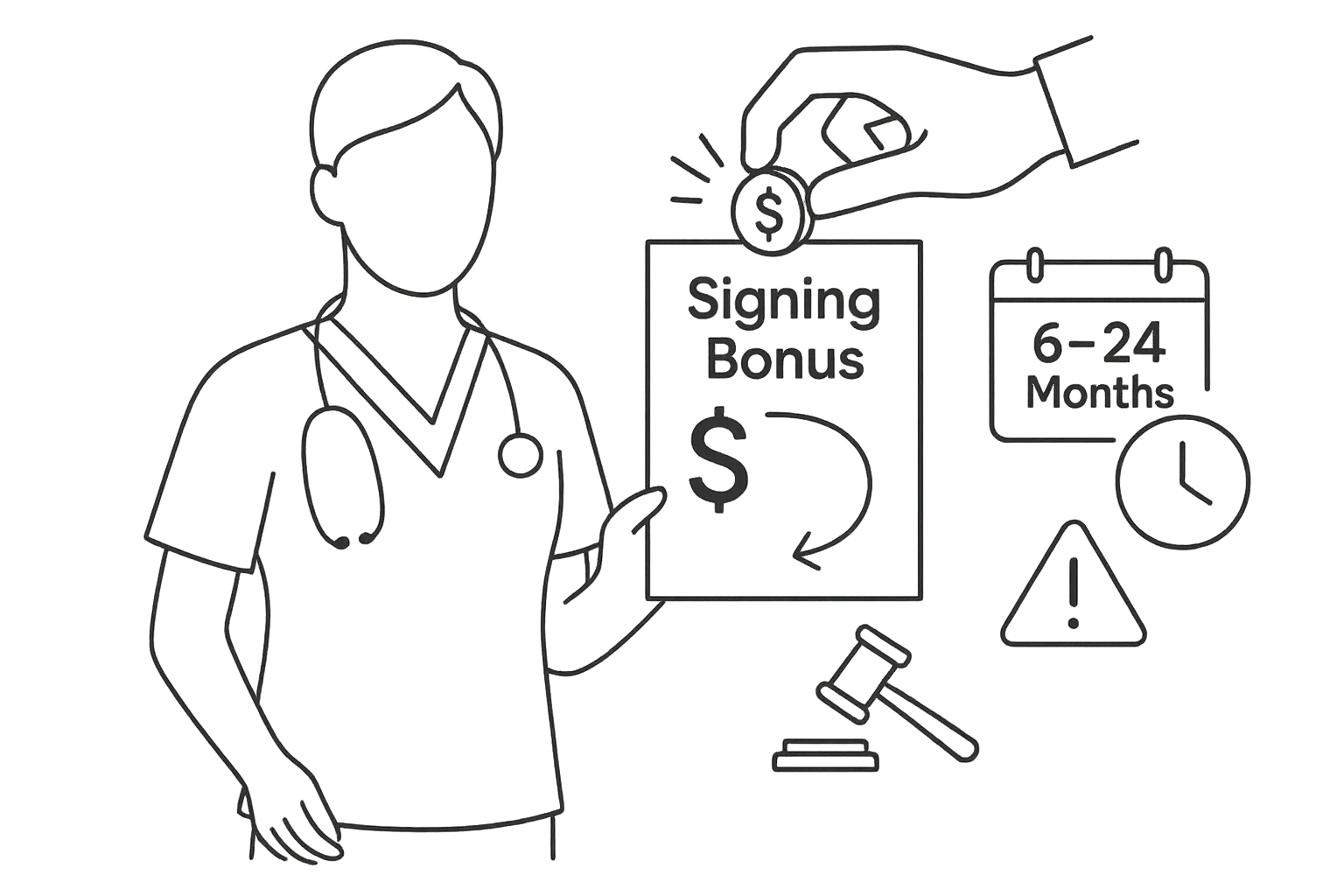
A repayment clause identifies a payment, establishes a required period of service, and defines the events that permit the employer to recover some or all of the money. Although the provision may be labeled a signing-bonus clause, the same section can cover relocation assistance, tuition reimbursement, loan payments, retention incentives, or other amounts conditioned on continued employment. The characterization of the payment may affect the contractual, tax, and wage-deduction analysis.
The agreement may provide for one lump-sum payment, installments tied to a start date, or staged payments after specific milestones. It may also incorporate a separate offer letter, repayment agreement, compensation plan, or employer policy. Reviewing only the employment agreement can therefore miss a second document containing the actual clawback formula. A broader explanation of these structures is available in Chelle Law’s guide to NP signing bonus repayment provisions.
Payments and service commitments covered by the clause
The first question is which payments are subject to recovery. A clause may apply only to a stated signing bonus, or it may combine that payment with relocation funds, training expenses, licensing fees, tuition assistance, or student-loan benefits. Broad language such as “all recruitment expenses” can create uncertainty if the agreement does not list the covered amounts or establish a maximum obligation.
The service commitment also requires careful attention. It may begin on the signing date, the employment start date, the credentialing date, or the date the bonus is paid. Those dates can be months apart. The agreement should make it possible to determine when the repayment period begins, when it ends, and whether delays outside the NP’s control extend the obligation.
Resignation, termination, and credentialing triggers
Voluntary resignation during the service period is a common repayment trigger, but many clauses go further. They may require repayment after termination for cause, a claimed material breach, loss of a required license, failure to complete credentialing, or inability to satisfy a supervision or collaboration condition. The practical effect depends on how those events are defined elsewhere in the contract.
Termination without cause deserves separate treatment. Some agreements expressly excuse repayment when the employer ends the relationship without cause, while others include every separation from employment or remain silent. Disability, death, organizational restructuring, a practice sale, delayed payer enrollment, and an employer’s inability to provide the promised position may also warrant specific treatment rather than being left to a broad default clause.
A review of the termination provisions can clarify how notice periods, cause definitions, cure rights, and credentialing conditions affect repayment. These are drafting and interpretation issues rather than uniform rules; the result depends on the agreement and applicable law.
Calculating the NP’s Maximum Financial Exposure
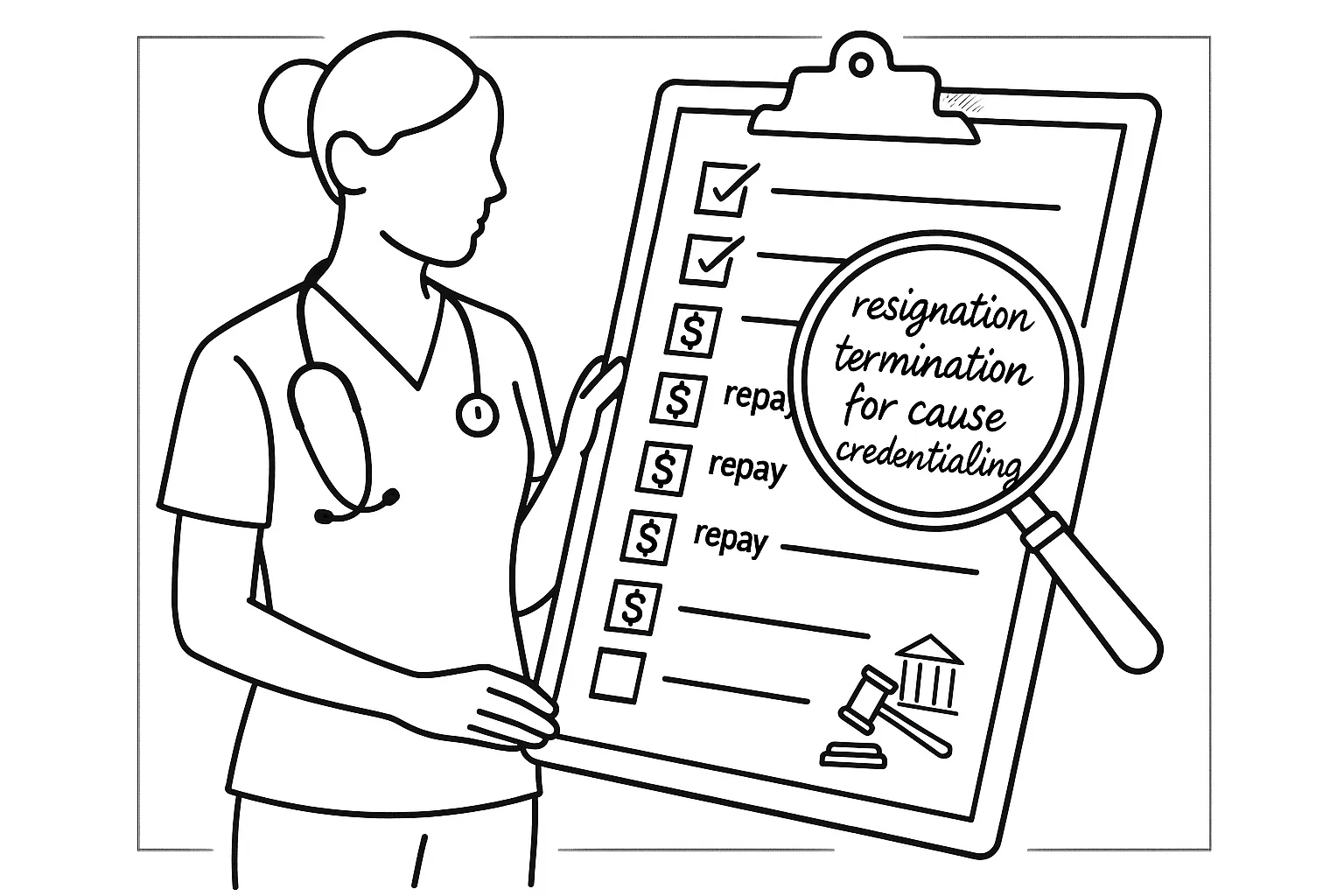
The trigger determines whether a repayment obligation arises, but the formula determines its size. Two offers with the same bonus can create very different risks if one reduces the balance monthly and the other requires full repayment until the final day of a two-year commitment. The analysis also needs to account for related payments, tax withholding, interest, attorney fees, and the deadline for returning the money.
Proration, staged reductions, and full acceleration
Monthly proration generally makes the declining obligation easier to measure. For example, a $12,000 bonus prorated evenly over 12 completed months would ordinarily decrease by $1,000 for each qualifying month, assuming that is how the written formula operates. A staged provision may instead forgive a fixed percentage after six months, one year, or another milestone.
A full-repayment clause creates greater exposure because the entire amount remains due until the commitment is completed. Some agreements also accelerate relocation assistance or other benefits after the same trigger. Important questions include whether partial months count, whether an approved leave pauses the schedule, and whether the repayment obligation is capped at the amount actually paid.
- Prorated repayment: The balance declines according to completed service.
- Staged forgiveness: The obligation falls at specified milestones rather than each month.
- Full acceleration: The entire covered payment becomes due after a listed trigger.
- Added collection costs: Interest, attorney fees, or administrative charges may increase the demand.
- Combined repayment: The clause may aggregate the bonus with relocation, education, or recruitment expenses.
Gross repayment, tax withholding, and repayment timing
A demand for the gross bonus can exceed the cash the NP originally received because payroll taxes were withheld from the payment. The contract may identify a gross or net amount, but that language does not by itself resolve federal tax treatment. Timing matters, particularly when repayment occurs in a later tax year rather than the year in which the bonus was included in income.
IRS Publication 525 addresses repayments of income previously reported under a claim of right. Depending on the facts and amount, a later-year repayment may involve a deduction or credit, including special treatment when the repayment exceeds $3,000. Social Security and Medicare taxes, employer refund procedures, and Additional Medicare Tax can involve separate rules. An NP facing an actual repayment may therefore need advice from a qualified tax professional in addition to contract review.
Collection Rights Are Not the Same as Payroll Deduction Rights
An employer may assert that the contract creates a debt without necessarily having the right to remove the entire balance from a paycheck. A repayment request, civil collection claim, payroll deduction, and setoff against other compensation are distinct collection methods. The agreement may authorize one or more of them, but applicable federal and state wage laws can limit how wages are withheld.
Federal wage law generally does not decide whether the underlying contract permits recovery of the bonus. However, the U.S. Department of Labor’s wage-deduction guidance explains that deductions can implicate minimum-wage and overtime requirements. The treatment of a principal advance may also differ from interest, administrative charges, or costs added to the balance.
State rules can be more restrictive and vary considerably. California generally limits deductions and the recovery of previously paid wages in ways that can make an end-of-employment balloon deduction problematic even when an authorization exists. Texas generally requires a court order, legal authorization, or written employee authorization for a lawful deduction. These examples illustrate why contractual setoff language should not be treated as universally effective.
Before assuming that a bonus can be taken from final wages, the analysis needs to address the governing state’s authorization requirements, the specificity of the deduction language, the nature of the payment, and the wages or compensation the employer proposes to withhold. A clause allowing deduction “to the fullest extent permitted by law” still requires a separate legal analysis of what the law permits.
How Repayment Terms Affect an NP’s Exit From Employment
A bonus clawback can create immediate cash pressure after the funds have been used for moving expenses, debt reduction, or ordinary living costs. That pressure may discourage an NP from leaving a position with unfavorable scheduling, workload, compensation, or practice conditions. The obligation can also arise when the NP is already facing lost income between jobs or delays in credentialing with a new employer.
The repayment provision may overlap with a non-compete, non-solicitation clause, notice requirement, or liquidated-damages provision. A repayment clause is not automatically a non-compete, but a substantial financial obligation can function as an exit deterrent. The analysis should determine whether repayment follows resignation alone, a breach of a restrictive covenant, or failure to complete an independently defined service commitment.
The Federal Trade Commission’s nationwide noncompete rule is not currently in effect or enforceable. After a federal court blocked enforcement in 2024, the FTC withdrew its appeal in September 2025. Restrictive-covenant enforceability therefore continues to depend principally on applicable state law and existing case law rather than the vacated federal rule. An NP non-compete review can evaluate those restrictions separately from the bonus obligation.
Exit costs can also accumulate. An NP covered under a claims-made malpractice policy may be responsible for tail coverage at the same time a bonus becomes repayable. Relocation repayment, unpaid productivity compensation, and a gap before the next position begins can further increase the financial impact. Reviewing malpractice and tail insurance terms helps identify whether those obligations could arise together.
Terms That Can Make Repayment More Predictable
The appropriate revisions depend on the offer, the size and purpose of the bonus, and the rest of the employment agreement. The objective is not necessarily to eliminate every repayment obligation. It is to define the risk so the NP can understand the maximum amount, the events that create liability, and the process the employer may use to seek payment.
- Regular proration: Reduce the balance monthly or according to another clear service-based schedule.
- A defined repayment cap: Identify the maximum amount and exclude vague categories of unlisted recruitment expenses.
- Specific exceptions: Address termination without cause, disability, death, employer breach, position elimination, or other circumstances outside the NP’s control.
- A precise cause definition: Coordinate repayment with any notice and cure rights in the termination section.
- Clear collection procedures: State the payment deadline, permitted collection methods, and whether interest or costs may be added.
- Tax-related clarity: Specify whether the contractual demand uses the gross or net amount without suggesting that the contract determines tax treatment.
- Document consistency: Reconcile the offer letter, bonus agreement, employment contract, compensation plan, and incorporated policies.
The agreement also needs to distinguish an employment condition from events controlled by the employer. For example, a credentialing delay may arise from incomplete NP documentation, employer processing, payer enrollment, or a regulatory issue. A clause that treats every delay as an NP default can allocate risk without regard to who caused the problem. Similar care is appropriate when repayment is tied to collaboration, supervision, productivity, or continued eligibility for a particular role.
Bonus terms are only one part of the economic package. A complete compensation and productivity review can compare the upfront payment with base compensation, incentive formulas, benefits, repayment exposure, and other provisions that determine the offer’s actual value.
When to Request an Attorney Review
Review is most useful before the offer is signed, when unclear or unfavorable language can still be identified. Attorney analysis is particularly important when the bonus is substantial, the service period is lengthy, the balance does not decline over time, or repayment can follow termination without cause. Broad payroll-deduction authority, interest, collection costs, vague credentialing triggers, and overlapping restrictive covenants also increase the need for careful review.
The complete document package matters. Relevant materials may include the offer letter, employment agreement, bonus or relocation agreement, exhibits, compensation plan, employer policies incorporated by reference, malpractice provisions, termination terms, restrictive covenants, payment records, and related written communications. Reviewing the documents together allows the NP to estimate the potential loss and understand how the obligation may affect a later job transition.
Frequently Asked Questions
Do nurse practitioners always have to repay a signing bonus after resigning?
No. Repayment depends on the contract’s trigger language, the resignation date, the service period, any proration formula, and applicable exceptions. The agreement must be analyzed to determine whether a balance remains and how it is calculated.
What happens if the employer terminates the NP without cause?
The result depends on the contract. Some agreements excuse repayment after termination without cause, while others include it as a trigger or fail to address it. Silence or broad separation language can create a dispute over whether repayment is due.
Can the employer demand the gross bonus instead of the amount received after taxes?
Some contracts calculate repayment from the gross stated bonus, while others address the net payment or a tax adjustment. The contractual formula and actual tax treatment are separate issues, particularly when repayment occurs in a later tax year.
Can a signing bonus be deducted from the NP’s final paycheck?
Not automatically. Contract language may authorize a deduction or setoff, but federal wage requirements and state-specific deduction laws can limit that remedy. A contractual repayment claim does not necessarily permit unilateral withholding from final wages.
Is a prorated repayment clause better than full repayment?
Proration usually makes the obligation decline as the NP completes the required service, which can produce a more proportionate and predictable result. The clause still needs to define the start date, calculation method, partial months, leaves, and applicable triggers.
What documents are needed to review a signing bonus obligation?
Provide the complete offer letter, employment agreement, exhibits, bonus and relocation documents, compensation plans, termination provisions, restrictive covenants, incorporated policies, payment records, and relevant written communications.
Understand the Repayment Risk Before Accepting the Bonus
Chelle Law reviews nurse practitioner agreements to identify signing-bonus triggers, repayment formulas, collection language, termination risks, and related provisions that may affect your income and career mobility.
Contact Chelle LawExplore Nurse Practitioner Contract Guidance
Find contract review services, practical resources, and state-focused information for nurse practitioners.