
A without-cause termination clause allows a nurse practitioner or employer to end a contractual relationship without proving misconduct, breach, or another defined ground for termination. The clause can appear straightforward, but it rarely operates alone. Its practical effect depends on the required notice, whether the NP continues working during that period, how final compensation is calculated, and which obligations survive the separation.
Those details can determine whether an NP receives several additional weeks of income or faces an immediate gap between positions. They may also affect productivity bonuses, signing-bonus repayment, malpractice tail coverage, restrictive covenants, payer enrollment, and the time required to begin practicing elsewhere. State law can further influence final wages, deductions, leave payout, non-compete enforcement, and other separation issues.
Chelle Law reviews termination language together with the compensation plan, insurance provisions, restrictive covenants, incorporated policies, and repayment terms. A comprehensive nurse practitioner contract review can identify provisions that shift unexpected financial or professional risk to the NP before the agreement is signed.
Key Takeaways
- A without-cause termination clause generally allows an employer to end employment without proving misconduct, subject to the contract and applicable law.
- The agreement should clearly address notice, pay in lieu of notice, severance, accrued compensation, and benefit termination.
- Termination may affect RVU or collections reconciliations, bonus eligibility, malpractice tail coverage, repayment obligations, and restrictive covenants.
- Clear post-termination payment formulas and deadlines can reduce uncertainty and disputes.
- The entire agreement must be reviewed together because protections in the termination clause can be limited by language elsewhere in the contract.
How a Without-Cause Termination Clause Operates
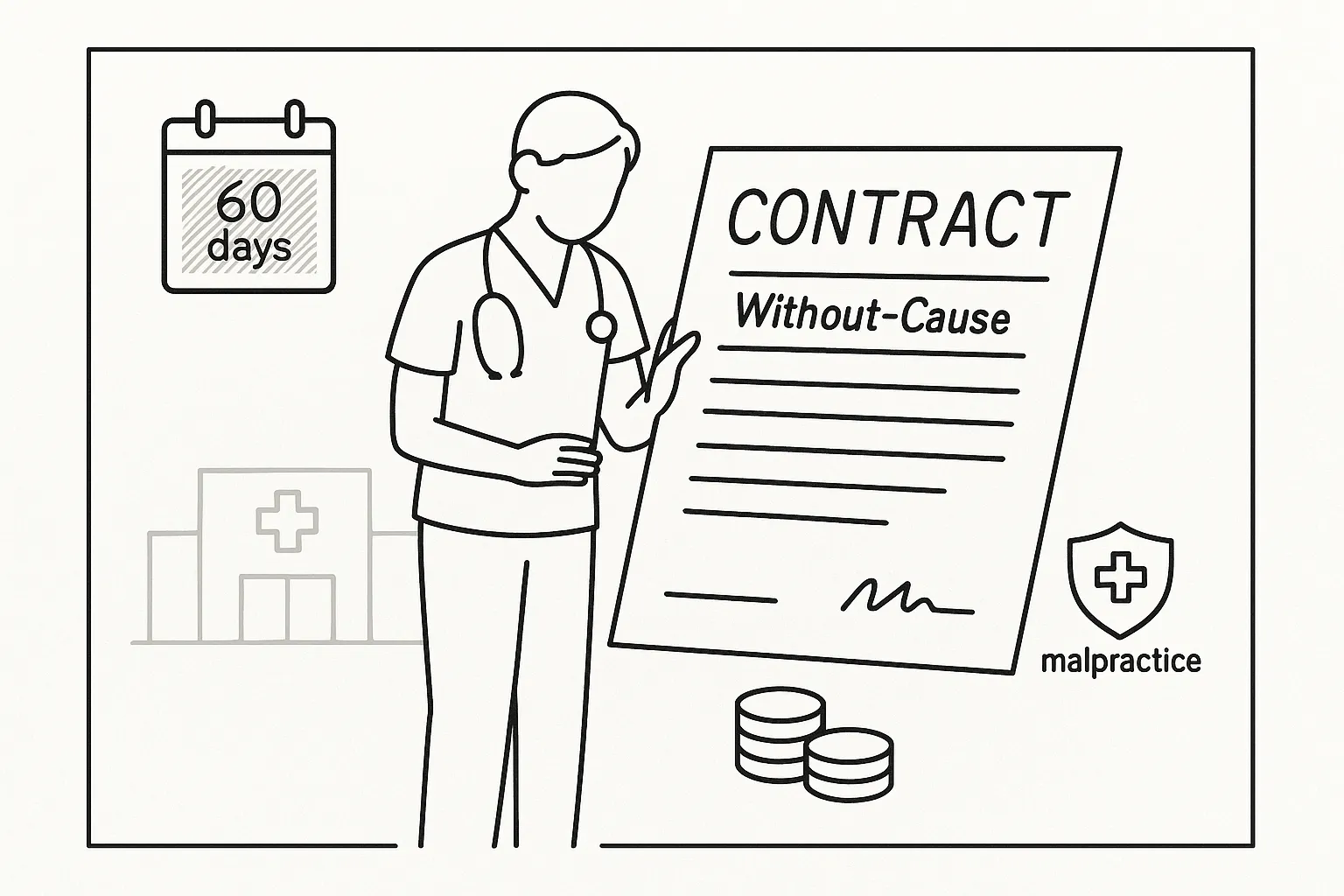
A contractual term—such as one year or two years—does not necessarily guarantee employment for that entire period. When the agreement includes a without-cause termination right, either party may be able to end the relationship early by following the stated procedure. The contract may make that right mutual, give the parties different notice periods, or reserve broader termination flexibility for the employer.
Without Cause Versus Termination for Cause
Termination for cause ordinarily depends on an event identified in the agreement, such as loss of licensure, exclusion from a government program, fraud, material breach, or specified misconduct. Some agreements provide a cure period for certain breaches but permit immediate termination for others. The definition of cause matters because it may affect notice, severance, bonus eligibility, repayment obligations, tail insurance, and restrictive covenants.
Without-cause termination generally does not require the terminating party to establish one of those events. It is therefore important not to assume that a separation labeled “without cause” carries the same financial consequences as a for-cause termination. The agreement may provide different rights for each category, and related provisions may use inconsistent definitions that require reconciliation.
Notice, Continued Duties, and Pay in Lieu
The notice provision controls more than the number of days before employment ends. It may prescribe written delivery by hand, certified mail, overnight service, or a designated electronic method. It may also state when notice becomes effective, whether the notice period can be shortened, and whether the employer may remove the NP from clinical duties before the formal termination date.
For example, a contract may require 60 days’ notice but allow the employer to discontinue patient care duties immediately. The financial result depends on whether salary and benefits continue, whether the employer may make a payment in lieu of notice, and what that payment includes. A base-salary payment may not replace lost productivity compensation, benefits, paid leave, or other amounts unless the agreement addresses them.
- Mutuality: Determine whether both parties have the same right and notice period.
- Delivery: Identify the required recipient, delivery method, and effective date.
- Clinical responsibilities: Clarify whether the NP remains scheduled, takes call, completes charts, or assists with patient handoffs.
- Early removal: Evaluate whether compensation and benefits continue if access or duties end before the termination date.
- Pay in lieu: Determine whether the payment includes only salary or also benefits and incentive compensation.
The Financial Consequences of Separation
Termination economics extend beyond the NP’s final regular paycheck. Salary, bonuses, productivity compensation, expense reimbursements, paid leave, severance, insurance costs, and repayment duties may all be governed by different sections of the contract. Applicable state law and benefit-plan documents may also affect the result, so no single national rule determines every payment due after separation.
Final Salary, Bonuses, and Productivity Compensation
Severance is not automatic merely because an employer invokes a without-cause clause. A right to severance generally must arise from the agreement, an applicable plan, or another enforceable obligation. When severance is offered, the contract may condition payment on signing a release, returning property, complying with restrictive covenants, or meeting another post-employment requirement.
Productivity compensation can be harder to calculate than salary. RVU, collections-based, quality, and hybrid formulas may rely on delayed reporting, quarterly measurement periods, collection windows, thresholds, chargebacks, or negative accrual. The agreement may also require active employment on the payment date even when the NP performed the underlying work before termination. An NP compensation review can evaluate whether the formula explains the final measurement period, reconciliation date, deductions, data access, and payment deadline.
Bonus language deserves the same attention. A formulaic earned bonus may be treated differently from a discretionary award, and signing or retention bonuses may carry separate repayment conditions. The documents should be reviewed for active-employment requirements, forfeiture language, prorated calculations, and provisions authorizing deductions from final pay. The enforceability of a deduction or forfeiture may depend on the governing law and specific facts.
Tail Coverage and Repayment Exposure
Professional liability coverage can create a substantial post-employment cost. Occurrence coverage generally protects covered incidents that occurred during the policy period even when a claim is filed later. Claims-made coverage may require extended reporting endorsement coverage, commonly called tail insurance, after the policy or the NP’s coverage under it ends.
The contract can allocate tail responsibility differently depending on how employment ends. An employer may pay after an employer-initiated termination without cause but require the NP to pay after resignation or termination for cause. Other agreements divide the cost, forgive the NP’s obligation over time, or provide no distinction at all. A focused malpractice and tail insurance review can clarify the policy type, triggering event, payment responsibility, and any conditions attached to employer-funded coverage.
Signing bonuses, relocation allowances, training expenses, and student-loan benefits can produce a second financial obligation. Repayment clauses may use full, prorated, or gradually forgiven amounts. The most protective language distinguishes voluntary resignation and termination for cause from an employer’s decision to terminate without cause. The contract also needs to be read for setoff or deduction rights rather than assuming the repayment balance will be handled separately.
Non-Competes and Other Continuing Restrictions
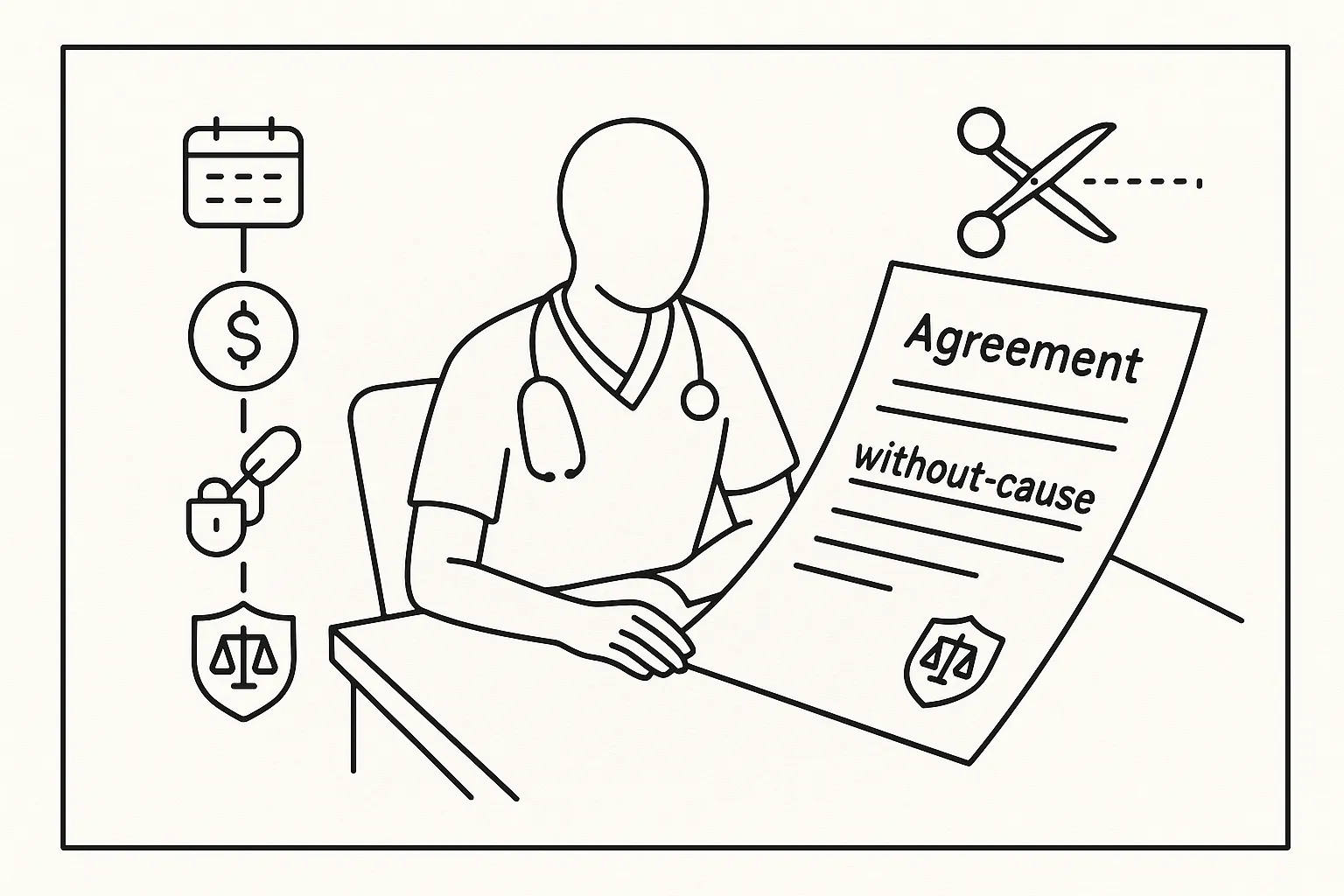
An employer’s decision to end the relationship does not necessarily release the NP from a non-compete, patient non-solicitation clause, employee non-solicitation restriction, confidentiality provision, or prohibition on using proprietary information. Some agreements apply restrictive covenants after every form of separation. Others waive or narrow the restrictions when the employer terminates without cause.
The federal landscape also requires current analysis. The Federal Trade Commission’s 2024 nationwide non-compete rule was set aside and is not currently enforceable. That development does not mean every non-compete is valid. Enforceability remains heavily dependent on state law, the contract language, the NP’s duties, and the surrounding facts. The FTC also continues case-specific scrutiny of certain non-compete and no-hire practices, including activity involving healthcare markets.
A careful review of NP restrictive covenants examines the restricted period, geographic area, prohibited services, patient and employee restrictions, available remedies, and any employer power to waive or modify the clause. The analysis should specifically address whether restrictions change after employer-initiated termination and whether an injunction, fee-shifting provision, or liquidated-damages clause could increase the cost of a dispute.
Legal Limits and Contract Classification
The phrase “without cause” describes a contractual termination mechanism; it does not authorize an otherwise unlawful reason for ending employment. Depending on the applicable statute, employer coverage, worker status, protected characteristic, protected activity, and facts, federal or state law may prohibit discrimination or retaliation. The Equal Employment Opportunity Commission explains that federal protections can apply to firing and other employment decisions, but the availability of a particular claim requires an individualized legal analysis.
The contract’s classification of the NP also matters. A worker labeled an independent contractor may have different contractual rights, tax treatment, benefit eligibility, wage protections, and potential remedies than an employee. The label itself does not necessarily control legal classification. In February 2026, the U.S. Department of Labor proposed replacing its 2024 independent-contractor rule with a different economic-reality analysis, but that proposal is pending rather than binding law. NPs working under contractor language can obtain an independent contractor agreement review to assess how classification and termination provisions interact.
State-specific review remains essential. Rules governing final wages, leave payout, deductions, restrictive covenants, repayment provisions, and other separation issues are not uniform. A contract may also select governing law, venue, arbitration, fee shifting, or a shortened dispute deadline, each of which can affect the practical options available after a disagreement.
Credentialing, Billing, and the Move to a New Position
An NP may experience a gap in clinical income even after securing another position. Facility privileges, payer enrollment, prescribing access, required supervision or collaboration arrangements, and employer onboarding can delay the start of billable work. The termination clause therefore needs to be evaluated alongside the likely transition time rather than only against the stated notice period.
Medicare enrollment deserves specific attention. Nurse practitioners may reassign Medicare benefits to an employer or contractor, and CMS permits practitioners to change or end a reassignment through its enrollment systems. During separation, the parties may need to address the effective date of a reassignment change, the NP’s NPI use, outstanding billing, access to supporting records, and responsibility for claims submitted before or after departure. CMS provides current guidance for practitioners who need to manage their Medicare enrollment.
The agreement may also cover patient notices, record custody, incomplete charts, prescription refills, continuity-of-care responsibilities, return of equipment, and access to the electronic health record. These provisions should distinguish routine transition duties from professional misconduct. If employment is already ending, a focused contract termination review can help identify deadlines and continuing obligations before the NP signs a release, repayment acknowledgment, or final compensation statement.
Questions to Resolve Before Accepting the Clause
A notice period has limited protective value if other provisions allow the employer to stop incentive payments, enforce a broad non-compete, require bonus repayment, or shift tail costs to the NP. Review the entire agreement and every incorporated compensation plan, handbook provision, insurance exhibit, and policy referenced by the contract. Important questions include:
- Can both parties terminate without cause, and does each have the same notice period?
- How must notice be delivered, and when does the notice period begin?
- Can the employer immediately remove the NP from clinical duties or system access?
- What salary, benefits, bonuses, RVUs, collections, and quality incentives continue during the notice period?
- Does pay in lieu of notice include anything beyond base salary?
- Is severance available, and does receiving it require a release or continued compliance with restrictions?
- Who pays for tail coverage after each type of separation?
- Does employer-initiated termination trigger or excuse repayment of bonuses, relocation funds, or other benefits?
- Do non-compete and non-solicitation provisions remain effective after termination without cause?
- How will payer enrollment, Medicare reassignment, patient records, billing, privileges, and transition duties be handled?
- What governing law, forum, arbitration clause, fee provision, or dispute deadline applies?
It is useful to model the financial effect of an unexpected separation before signing. Estimate income during the notice period, potential unpaid incentive compensation, repayment balances, tail expense, and the time required to become credentialed at another organization. Keep copies of the final agreement, amendments, compensation plans, insurance documents, policies, and relevant employment communications so the governing terms can be evaluated if termination occurs.
Frequently Asked Questions
Can an employer terminate a nurse practitioner without stating a reason?
A without-cause clause may allow an employer to end the relationship without proving a contractual breach or misconduct. The employer still must comply with applicable notice and payment terms, and the clause does not authorize discrimination, retaliation, or another unlawful basis for termination.
Does without-cause termination entitle an NP to severance?
Not automatically. Severance generally depends on the employment agreement, an applicable severance plan, or another enforceable obligation. It may also be conditioned on signing a release or complying with continuing contractual duties.
What happens to an NP’s bonus or productivity pay after termination?
The compensation provisions determine how pending incentives are calculated. Relevant terms include measurement periods, active-employment conditions, collection windows, reconciliation dates, deductions, negative accrual, data access, and the deadline for final payment.
Who pays for malpractice tail coverage when the employer ends the contract?
Responsibility depends on the policy type and contract language. Claims-made coverage may require tail insurance, while occurrence coverage generally does not require tail for covered incidents during the policy period. The agreement may allocate the cost differently based on who initiates termination and why.
Can an NP non-compete apply after termination without cause?
It may. Some contracts apply restrictions after every separation, while others waive or narrow them after employer-initiated termination without cause. The FTC’s nationwide rule is not currently enforceable, so the contract, applicable state law, and specific circumstances remain central to the analysis.
What records should an NP keep if employment ends?
Keep the signed agreement, amendments, compensation plans, bonus calculations, insurance documents, applicable policies, notice correspondence, pay records, and separation documents. Those materials may be necessary to evaluate final compensation, repayment demands, tail responsibility, restrictive covenants, and transition obligations.
Understand Your NP Termination Terms Before You Sign
Chelle Law reviews notice requirements, final compensation, repayment duties, restrictive covenants, malpractice coverage, and transition provisions so you can understand the risks created by the agreement.
Contact Chelle Law