
Severance can provide important financial protection when a nurse practitioner’s employment ends, but the stated dollar amount rarely tells the entire story. Eligibility may depend on who initiates the termination, how the agreement defines cause, whether the NP completes a notice period, and whether a release is signed on time. Offsets, repayment rights, malpractice obligations, and post-employment restrictions can further reduce the package’s practical value.
Federal law generally does not require an employer to provide severance merely because employment ends. Instead, an NP’s right to severance usually arises from an employment agreement, severance plan, employer policy, separation agreement, or applicable state law. That distinction matters because severance is not necessarily a substitute for earned wages, accrued benefits, bonus compensation, or other amounts that may be governed by separate documents and legal standards.
A useful contract review therefore examines more than the payment formula. It considers the events that trigger payment, the conditions that can eliminate eligibility, the timing and tax treatment of the benefit, and the obligations that survive separation. Chelle Law reviews these provisions together with termination rights, compensation plans, restrictive covenants, malpractice coverage, and repayment clauses so nurse practitioners can understand the economic and professional consequences before signing or responding to a proposed separation agreement.
Key Takeaways
- Severance is generally a contractual or policy-based benefit rather than an automatic federal entitlement.
- The termination trigger, definition of cause, release requirement, payment deadline, and offset language can be more important than the headline amount.
- Bonuses, productivity compensation, PTO, benefits, tail insurance, and repayment obligations may be treated separately from severance.
- Severance is generally taxable compensation, so the gross package will differ from the immediate cash received after withholding.
- A release may affect legal claims, agency participation, confidentiality obligations, and post-employment restrictions and requires careful review before acceptance.
Where an NP’s Right to Severance Comes From

The U.S. Department of Labor explains that the Fair Labor Standards Act does not require severance pay. An employer may nevertheless create an enforceable obligation through an employment contract, written severance policy, benefits plan, or separation agreement. Applicable state law may also affect payment rights, wage treatment, and the handling of accrued leave or other compensation.
The source of the benefit affects how the provision is interpreted and which documents need to be reviewed. A contract may promise a defined payment after an employer-initiated termination without cause, while a handbook may reserve discretion to change a general policy. A formal severance plan may also raise issues under the Employee Retirement Income Security Act, depending on its structure and administration. The employment agreement cannot be evaluated accurately without identifying every document incorporated by reference.
Severance must also be distinguished from money already earned. Final salary, vested incentives, commissions, PTO, expense reimbursements, retirement benefits, and productivity compensation may be controlled by different contract provisions, compensation plans, benefit documents, and state laws. A separation payment described as “all amounts due” deserves particular attention because broad language can create uncertainty about whether the payment supplements or replaces other compensation.
Large-scale layoffs can introduce a separate federal issue. When the Worker Adjustment and Retraining Notification Act applies, qualifying employers may face notice obligations and potential back-pay and benefit liability. Contractual severance does not automatically replace WARN obligations, and an offset may be available only in limited circumstances. Nurse practitioners employed by hospitals, health systems, and other large organizations may need to distinguish ordinary contractual severance from payments connected to a covered mass layoff or facility closing.
How to Measure the Real Value of a Severance Package
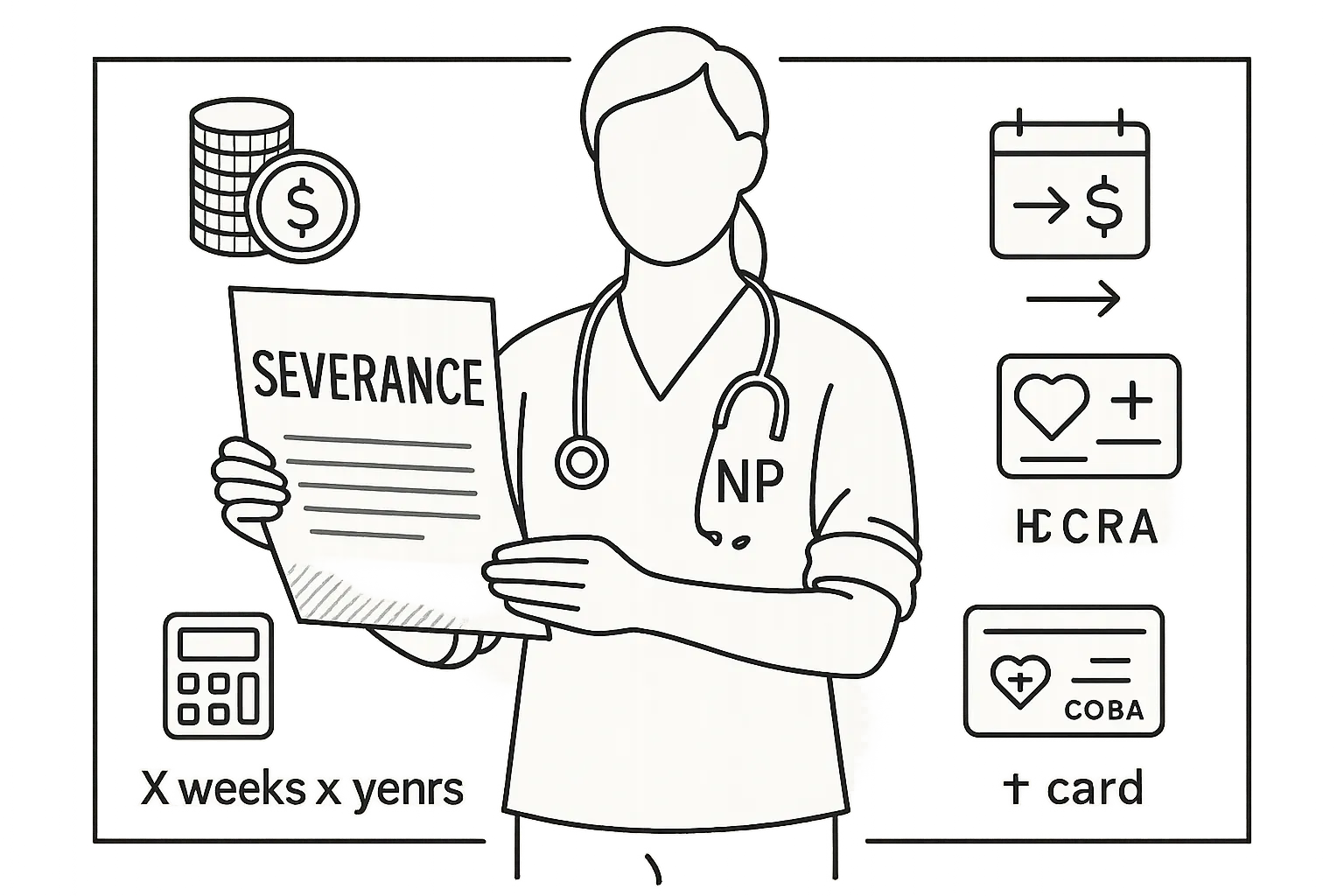
Severance can bridge the gap between positions, particularly when credentialing, payer enrollment, licensing, or onboarding delays postpone the start of a new job. Its actual value depends on the payment method, included compensation, benefit treatment, tax withholding, insurance obligations, and conditions attached to receipt. A large gross figure may offer limited protection if it is subject to broad offsets or accompanied by significant post-employment costs.
Lump Sums, Salary Continuation, and Tenure Formulas
A fixed lump sum provides a defined payment after a qualifying separation. The agreement needs to identify the payment date, any release or revocation period that delays payment, and whether the employer may deduct alleged debts. A lump sum can provide certainty, but health benefits and other payroll-based coverage may end independently of the cash payment.
Salary continuation spreads payments across a stated period. This structure may preserve ordinary payroll treatment, but the documents may stop payments when the NP accepts another job or require regular certification of employment status. The clause should explain whether outside income reduces the benefit and what happens if the employer disputes the information provided.
Some agreements calculate severance by multiplying weeks or months of pay by completed years of service. The definition of “pay” is critical. Base salary alone can produce a substantially different result from a formula that includes average bonuses, collections, or productivity compensation. A focused NP compensation and productivity review can identify how the severance formula interacts with RVUs, collections, reconciliations, and negative accrual.
Benefits, Taxes, and Malpractice Coverage
Benefits assistance can be valuable, but the language must distinguish employer-paid premiums from the right to continue coverage at the NP’s own expense. The package may address medical coverage, a premium stipend, retirement-plan treatment, or vesting. Plan documents can control issues that the employment contract does not fully explain.
Severance and dismissal pay are generally taxable wages subject to applicable withholding and employment taxes. The net payment will therefore be lower than the stated gross benefit. Withholding is a payroll calculation rather than a definitive statement of the NP’s final income-tax liability, so payment timing and tax treatment may warrant discussion with a qualified tax professional.
Malpractice coverage can create a separate and potentially significant expense. No uniform federal rule assigns claims-made tail responsibility to either the NP or the employer. The answer may depend on the employment agreement, insurance policy, reporting endorsement, insurer requirements, termination circumstances, applicable state law, and related practice documents. A malpractice and tail insurance review can determine whether a severance payment is likely to be reduced in practical terms by an obligation to purchase post-employment coverage.
Eligibility Conditions That Can Limit or Eliminate Payment
The headline benefit has little value if the employer retains broad discretion to deny eligibility. The agreement should be read as a sequence: what event qualifies, what conditions the NP must satisfy, when payment becomes due, what deductions are permitted, and what later conduct could trigger repayment.
Termination Triggers, Cause Definitions, and Offsets
Severance is commonly tied to an employer-initiated termination without cause, but the definition of cause may be broad enough to undermine that protection. Clauses based on failure to meet expectations, dissatisfaction with performance, policy violations, or damage to reputation may give the employer considerable classification discretion. Objective definitions, notice of an alleged breach, and an opportunity to cure certain conduct can materially affect eligibility.
Other provisions may require minimum tenure, completion of a contractual notice period, continued work through a specified date, or timely return of employer property. These conditions need to be compared with the agreement’s broader termination and notice provisions. An NP who resigns, leaves before completing notice, or is terminated during the notice period may receive a different result depending on the precise wording.
Mitigation and offset language can reduce future payments based on earnings from a new job. Important questions include whether the offset applies to gross or net earnings, whether self-employment counts, how frequently income must be reported, and whether the employer may suspend payments during a review. A clawback goes further by allowing the employer to recover severance already paid. The trigger, repayment period, dispute process, and materiality of the alleged breach all warrant careful analysis.
Releases and Post-Separation Promises
Employers frequently condition severance on a release of claims, confidentiality terms, non-disparagement language, cooperation duties, or confirmation of restrictive covenant compliance. The release should identify the claims covered, the effective date, any excluded rights, and the consequences of an alleged breach. Consideration for the release generally needs to be something beyond compensation the employee is already entitled to receive.
Special federal requirements apply when an agreement asks an employee to waive claims under the Age Discrimination in Employment Act. A knowing and voluntary waiver generally must be clearly written, specifically address ADEA rights, advise the employee in writing to consult an attorney, and provide additional consideration. An individual agreement generally allows at least 21 days for consideration, while certain group programs require 45 days, followed by a seven-day revocation period. Future claims cannot be waived.
A release also cannot lawfully prevent an employee from filing a charge with the Equal Employment Opportunity Commission or participating in an agency investigation or proceeding. The EEOC’s waiver guidance explains the distinction between releasing private claims and restricting protected agency participation. Separation documents should be evaluated for both the rights being released and any new obligations imposed after employment ends.
Other Contract Terms That Can Reduce Severance Value
A severance clause cannot be valued in isolation. Several provisions elsewhere in the employment agreement may create costs, deductions, or professional restrictions that become effective at the same time as the payment.
- Bonuses and productivity compensation: The agreement may exclude bonuses, RVUs, collections, or quality incentives from severance while separately requiring a final reconciliation. Negative accrual or disputed attribution can reduce compensation owed at departure.
- Signing and relocation benefits: A termination may activate repayment obligations even when the NP qualifies for severance. The net economic result depends on whether the employer can deduct those amounts directly and whether repayment is prorated. Similar issues arise under signing bonus repayment provisions.
- Restrictive covenants: A non-compete, non-solicitation clause, or patient restriction may delay the NP’s ability to earn replacement income. Severance may also be forfeited or recovered after an alleged violation.
- Accrued leave and benefits: PTO, retirement benefits, deferred compensation, and health coverage may be controlled by policies or plan documents rather than the severance clause.
- Professional liability coverage: Tail premiums, reporting duties, cooperation requirements, and access to claim information can survive termination regardless of whether severance is paid.
Restrictive covenant law remains especially dependent on jurisdiction and contract language. The Federal Trade Commission reports that its nationwide noncompete rule is not currently enforceable following federal-court action and subsequent procedural developments. An NP should not assume that federal rule invalidates an existing or proposed restriction. State law, the provision’s wording, and current legal developments remain central to a meaningful non-compete analysis.
Reviewing and Clarifying an NP Severance Clause
Clear severance drafting identifies the qualifying event, calculation method, payment date, included compensation, permitted deductions, benefit treatment, and any release requirement. It also explains whether new employment affects continued payments and whether severance remains payable if the employer terminates the NP during a notice period. Objective language is generally easier to evaluate than provisions that depend entirely on the employer’s subjective satisfaction.
The most valuable revision is not always a larger cash payment. Depending on the agreement, an NP may place greater value on employer-paid tail coverage, continued benefits, a narrower cause definition, reduced bonus repayment, a limited release, or relief from a restrictive covenant. Those trade-offs need to be evaluated against base compensation, incentive opportunities, job stability, and the likely time required to begin another position.
A complete review should include the employment agreement, offer letter, compensation and bonus plans, incorporated handbook provisions, severance policy, benefits documents, malpractice policy information, and any proposed separation agreement. Existing employees may also need payroll records, productivity statements, performance communications, and termination notices. A comprehensive nurse practitioner contract review can identify inconsistencies among these documents and clarify which provisions may warrant revision before the parties rely on the severance promise.
Frequently Asked Questions
Is an employer legally required to give a nurse practitioner severance pay?
Federal wage law generally does not require severance merely because employment ends. A right to payment may instead arise from an employment agreement, severance plan, employer policy, separation agreement, or applicable state law.
What events commonly make an NP eligible for severance?
Eligibility often follows an employer-initiated termination without cause or another event expressly identified in the agreement. Minimum service requirements, completion of a notice period, timely execution of a release, and compliance with continuing obligations may also affect payment.
Is a lump-sum payment better than salary continuation?
Neither structure is automatically better. A lump sum offers a defined payment, while salary continuation spreads income over time and may interact differently with benefits or later employment. The comparison depends on offsets, payment timing, tax withholding, benefit eligibility, and the conditions attached to continued payments.
Are bonuses, RVUs, and accrued PTO included in NP severance?
Only if the controlling contract, compensation plan, policy, or applicable law provides for their inclusion. Base salary, bonuses, productivity pay, PTO, commissions, and benefit rights may receive different treatment, so each governing document needs to be reviewed separately.
Can a severance agreement stop an NP from filing an EEOC charge?
A severance agreement generally cannot prohibit an employee from filing an EEOC charge or participating in an EEOC investigation or proceeding. The agreement may release certain private claims if the waiver satisfies applicable legal requirements, but it cannot eliminate protected agency participation.
How can tail insurance change the value of an NP severance package?
If the NP must purchase claims-made tail coverage after termination, the premium can substantially reduce the package’s net economic value. Responsibility depends on the contract, insurance policy, insurer requirements, termination circumstances, and applicable state law rather than a uniform federal rule.
Have Your Nurse Practitioner Severance Terms Reviewed
Chelle Law can review severance eligibility, payment formulas, releases, repayment provisions, malpractice obligations, and post-employment restrictions in the context of your complete agreement.
Contact Chelle LawExplore Nurse Practitioner Contract Guidance
Review legal services, practical contract resources, and state-focused guidance for nurse practitioners.